

The Psychology of Climbing MMR: Mindset Secrets from Professional Dota 2 Players

Here’s a truth that most Dota 2 players don’t want to hear: the biggest obstacle to climbing MMR isn’t your mechanics, your game knowledge, or your hero pool — it’s your mindset. Professional players and high-MMR grinders all say the same thing: the mental game is at least 50% of what determines your rank. You can have 7K-level knowledge and 3K-level emotional control, and you’ll end up at 4K.
Think about it. How many games have you lost not because you were outplayed, but because you tilted after a bad team fight How many losing streaks happened not because you suddenly forgot how to play Dota, but because frustration from one game carried into the next How many times did you queue “one more game” at 2 AM, exhausted and angry, and lose predictably
The psychology of MMR climbing is a discipline unto itself, and the best players in the world treat it with the same seriousness as mechanical skill or game knowledge. This guide draws on insights from professional players, sports psychologists, and the lived experience of thousands of games to give you a comprehensive mental framework for consistent climbing. We’ll cover tilt management, growth mindset vs. fixed mindset, queue discipline, the 40-40-20 rule, mental preparation routines, dealing with toxicity, and burnout prevention.
If you implement even half of what’s in this guide, you will climb. Not because you’ll suddenly play better mechanically, but because you’ll stop sabotaging yourself.
Table of Contents
- The 40-40-20 Rule: Understanding What You Control
- Tilt Management: The #1 MMR Killer
- Growth Mindset vs. Fixed Mindset
- Queue Discipline: When to Play and When to Stop
- Mental Preparation Routines
- Dealing with Toxicity
- Burnout Prevention
- Self-Review and Improvement Cycles
- Mindset Insights from Pro Players
- Frequently Asked Questions
The 40-40-20 Rule: Understanding What You Control
The 40-40-20 rule is one of the most important concepts in competitive gaming psychology. It states that in any given game of Dota 2:
- 40% of games are unwinnable. No matter how well you play, some games are lost before they begin. Your team picks poorly, your allies disconnect, someone intentionally feeds, or the enemy team simply outclasses yours. These games are out of your control.
- 40% of games are unlosable. The inverse is also true. Sometimes your team dominates, the enemy team has the problem players, and you win regardless of your personal performance.
- 20% of games are decided by YOUR performance. These are the swing games — the ones where your individual play determines the outcome. These are the games that matter for your MMR.
Why This Rule Changes Everything
Understanding the 40-40-20 rule fundamentally changes how you approach Dota 2:
You stop blaming yourself for unwinnable games. When your mid goes 0-8 by minute 10, that’s a 40% game. No amount of perfect play from you would have changed the outcome. Let it go. Don’t analyze it, don’t rage about it, don’t carry the frustration into the next game.
You stop congratulating yourself for free wins. When you go 15-2 because the enemy team had an intentional feeder, that’s a 40% game going the other way. You didn’t earn that win through skill — it was handed to you. Stay humble.
You focus on the 20% where you matter. These swing games are where your practice, knowledge, and — critically — mental state determine your climb. If you win 70% of your swing games (through good play, good decisions, and good mental state), your overall win rate is: 40% (free wins) + 14% (swing game wins) = 54% win rate. That’s enough to climb steadily over hundreds of games.
The Math of Climbing
Let’s do the math to see how the 40-40-20 rule translates to MMR gains:
| Swing Game Win Rate | Overall Win Rate | MMR Change per 100 Games | Time to Gain 500 MMR |
|---|---|---|---|
| 50% (average) | 50% | 0 MMR | Never |
| 55% | 51% | +60 MMR | ~830 games |
| 60% | 52% | +120 MMR | ~420 games |
| 70% | 54% | +240 MMR | ~210 games |
| 80% | 56% | +360 MMR | ~140 games |
| 90% | 58% | +480 MMR | ~105 games |
The key insight: even a small improvement in your swing game win rate produces meaningful MMR gains over time. Going from 50% to 60% in swing games (a modest improvement from good mental habits) translates to 120 MMR per 100 games. Play 500 games in a season and that’s 600 MMR — enough to move up an entire bracket.
And here’s the kicker: improving your mental game might be the easiest way to increase your swing game win rate. Mechanical improvements take hundreds of hours of practice. Learning new heroes takes weeks. But not queuing while tilted That’s a decision you can make right now, in this moment, that will immediately improve your results.
Tilt Management: The #1 MMR Killer
Tilt is the emotional state where frustration, anger, or negativity impairs your decision-making and performance. Every Dota 2 player has experienced tilt. The question isn’t whether you tilt — it’s how you manage it.
What Tilt Does to Your Gameplay
When you’re tilted, your brain shifts from analytical thinking to emotional reaction. This manifests in specific gameplay deteriorations:
- Tunnel vision: You focus on what went wrong instead of what’s happening now. You’re thinking about the carry who stole your rune 5 minutes ago instead of watching the minimap.
- Aggressive overextension: Tilted players play aggressively to “force” wins. This leads to diving too deep, fighting when behind, and taking unnecessary risks.
- Reduced map awareness: Emotional preoccupation reduces your ability to track enemy positions, ward placements, and cooldown timers.
- Blame externalization: Instead of evaluating your own play, you blame teammates. This prevents learning and creates a negative feedback loop.
- Communication breakdown: Tilted players type angry messages in chat instead of making productive calls. Every second spent typing is a second not spent playing.
- Momentum loss: One tilted mistake leads to another. A tilted death leads to an aggressive buyback, which leads to a second death, which leads to a game-losing spiral.
Types of Tilt
Tilt manifests differently in different players. Identifying your tilt pattern helps you manage it:
| Tilt Type | Symptoms | Root Cause | Management Strategy |
|---|---|---|---|
| Angry Tilt | Flaming teammates, aggressive all-chat, rage buying/selling items | Feeling powerless, ego threat | Mute all, deep breathing, take a break |
| Quiet Tilt | Giving up mentally, playing passively, “running it down” | Learned helplessness, hopelessness | Focus on micro-goals (next CS, next ward placement) |
| Revenge Tilt | Queuing immediately after a loss to “win it back” | Loss aversion, gambling mentality | Enforce stop-loss rules (see Queue Discipline) |
| Perfectionist Tilt | Harsh self-criticism after any mistake, declining confidence | Unrealistic self-expectations | Accept mistakes as learning, focus on progress not perfection |
| Teammate Tilt | Fixating on teammate mistakes, refusing to cooperate | Need for control, inflexibility | Focus only on own play, mute problematic players |
The 5-Minute Rule for Tilt Management
When you notice yourself tilting during a game, apply the 5-minute rule:
- Recognize: “I am tilting right now.” Simply naming the emotion reduces its power. This is a psychological technique called “affect labeling.”
- Mute: Mute any player who’s contributing to your tilt. Don’t argue, don’t defend yourself, just mute.
- Breathe: Take 3 deep breaths. Physiologically, deep breathing activates your parasympathetic nervous system and reduces cortisol (the stress hormone).
- Refocus: Pick one thing to focus on for the next 5 minutes. “I’m going to get every last hit in this wave.” “I’m going to ward these two spots.” Give your brain a specific task to replace the emotional spiral.
- Reassess after 5 minutes: If you’re still tilting, accept that this game may not go well and commit to not queuing another game until you’ve reset mentally.
Between-Game Tilt Management
The most dangerous tilt is between games — the frustration from a loss that carries into the next game. Between-game tilt management:
- Take a break: After a frustrating game, get up. Walk around. Get water. The physical break interrupts the mental loop.
- Don’t immediately requeue: The instinct after a bad game is to queue immediately to “fix” the loss. This is the gambling mentality. Resist it.
- Review the game briefly: What went wrong Was it a 40% unwinnable game Or did you make mistakes Brief, honest assessment prevents lingering frustration.
- Reset your mindset: Before queuing again, consciously decide to treat the next game as a fresh start. The previous game’s result has zero impact on the next game.
Growth Mindset vs. Fixed Mindset
The concept of growth mindset vs. fixed mindset, developed by psychologist Carol Dweck, is profoundly applicable to Dota 2 MMR climbing.
Fixed Mindset in Dota 2
A player with a fixed mindset believes that their skill level is largely innate and static. Fixed mindset thoughts include:
- “I’m a 3K player and that’s my ceiling”
- “I don’t have the talent to reach Immortal”
- “Some people are just naturally better at this game”
- “My teammates are always bad — the matchmaking is rigged against me”
- “I’ve been playing for 5 years and I’m still the same rank, so I can’t improve”
Fixed mindset players avoid challenges (they stick to heroes they already know), give up easily when things get hard (they tilt and blame others), see effort as pointless (“why try, I’ll always be this rank”), ignore constructive criticism (“that’s just your opinion”), and feel threatened by others’ success (“they must be smurfs or cheaters”).
Growth Mindset in Dota 2
A player with a growth mindset believes that their skill is developed through effort, practice, and learning. Growth mindset thoughts include:
- “I’m 3K right now, and I’m working on getting to 4K”
- “I can learn anything if I put in the time”
- “Every loss is a learning opportunity”
- “My mistakes are specific and fixable — I need to improve my map awareness and positioning”
- “That player is better than me at laning — what are they doing differently”
Growth mindset players embrace challenges (they try new heroes and strategies), persist through setbacks (they review losses and identify improvements), see effort as the path to mastery, learn from criticism and feedback, and are inspired by others’ success.
How to Develop a Growth Mindset
- Reframe failures as data: Instead of “I’m terrible at Dota,” think “I lost that lane because I didn’t respect their kill potential at level 3. Next time I’ll play more cautiously until level 4.”
- Focus on process over results: Don’t measure sessions by MMR gained/lost. Measure them by lessons learned, mechanics practiced, and habits built.
- Set specific, achievable goals: Instead of “I want to reach 5K,” set process goals like “I want to improve my last hitting to 70+ CS by 10 minutes” or “I want to die fewer than 5 times per game this week.”
- Track your improvement: Keep a simple log of your games. Note what you learned from each loss. Over weeks and months, you’ll see patterns of improvement that the raw MMR number might obscure.
- Learn from better players: Watch replays of higher-MMR players and ask “why did they do that” Watch your own replays and ask “what could I have done better” Our coaching service accelerates this process by pairing you with Immortal-rank players who provide structured feedback and identify blind spots you can’t see yourself.
The “Yet” Technique
A simple but powerful growth mindset technique: add “yet” to any fixed mindset statement.
- “I can’t play Earth Spirit” → “I can’t play Earth Spirit yet“
- “I don’t understand power spikes” → “I don’t understand power spikes yet“
- “I can’t reach Immortal” → “I can’t reach Immortal yet“
This simple linguistic shift transforms a statement of limitation into a statement of potential. It acknowledges your current state while affirming that improvement is possible.
Queue Discipline: When to Play and When to Stop
Queue discipline is the set of rules you follow regarding when to queue for games and when to stop. It’s one of the most practical and immediately implementable strategies for climbing MMR.
The Stop-Loss Rule
Borrow a concept from stock trading: set a stop-loss limit for your gaming sessions. Common stop-loss rules:
- 2-loss stop: After 2 consecutive losses, stop playing ranked. Take a break or switch to unranked.
- 3-loss stop: After 3 losses total in a session (not necessarily consecutive), stop for the day.
- Tilt stop: If you feel tilted at any point — regardless of win/loss — stop immediately.
The 2-loss stop is the most popular among high-MMR players because it prevents the devastating 5-10 game losing streaks that can erase weeks of progress. Two losses in a row usually indicate that something is off — your focus, the time of day, or just variance — and continuing to queue is more likely to extend the streak than reverse it.
Optimal Queue Times
When you play matters more than you think. Research and anecdotal evidence from high-MMR players suggest:
| Time of Day | Queue Quality | Reason |
|---|---|---|
| Morning (8AM-12PM) | Good | Fewer players, but those playing are generally focused. Lower queue times in some regions. |
| Afternoon (12PM-5PM) | Best | Peak player count, best matchmaking quality. Players are awake and alert. |
| Evening (5PM-10PM) | Good | High player count. Some after-work/school players may be tired or stressed. |
| Late Night (10PM-2AM) | Declining | Players getting tired. More likely to encounter tilted, drunk, or unfocused players. |
| Very Late (2AM-8AM) | Poor | Low player count means wider MMR spread in matches. Players are exhausted. You’re exhausted. |
Your own alertness matters most. If you’re a night owl who performs best at midnight, play at midnight. If you’re a morning person, play in the morning. The key is to queue when YOU are at your best, not when the general population is.
Pre-Game Readiness Check
Before clicking “Find Match,” run through this checklist:
- Am I in a good mental state (Not tilted, not angry, not distracted)
- Am I physically ready (Not exhausted, not hungry, not dehydrated)
- Do I have time for a full game (Don’t queue if you might need to leave in 30 minutes)
- Am I focused (Close distracting tabs, put phone on silent)
- Am I playing to improve (Not playing to “grind” mindlessly or escape boredom)
If any answer is “no,” don’t queue for ranked. Play unranked, watch replays, practice last hitting, or do something else entirely. Queuing ranked while unfocused or tilted is the fastest way to lose MMR.
Session Length Management
Mental fatigue degrades performance over time. Most players perform best during their first 2-3 games and gradually decline afterward. Consider limiting ranked sessions to 3-4 games maximum, with breaks between each game.
A 3-game session structure might look like:
- Game 1 → 5-minute break (water, stretch, bathroom)
- Game 2 → 10-minute break (walk around, clear your head)
- Game 3 → Session over. Review the session briefly, then stop.
Mental Preparation Routines
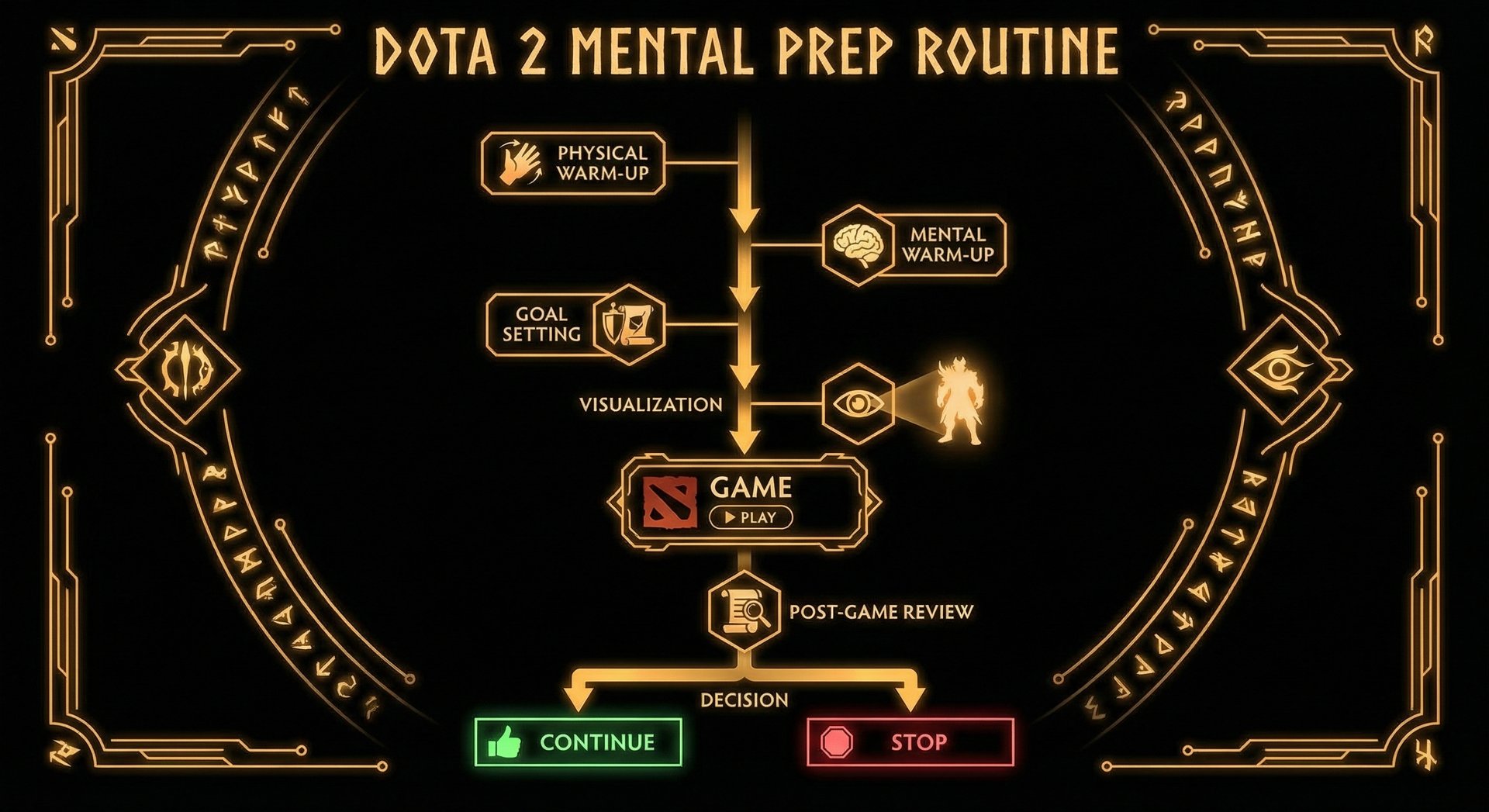
Professional athletes don’t compete without warming up. Dota 2 should be no different. A pre-game mental preparation routine primes your brain for peak performance.
The 10-Minute Pre-Session Routine
- Physical warm-up (2 minutes): Stretch your wrists, fingers, neck, and shoulders. Hand exercises reduce strain and improve reaction time. A simple wrist rotation and finger spread routine prevents fatigue and potential RSI.
- Mental warm-up (3 minutes): Play one round of the last-hit trainer or a custom practice lobby. This warms up your clicking accuracy and gets your brain into “Dota mode.”
- Goal setting (2 minutes): Set 1-2 specific goals for the session. Not “win games” — specific, process-oriented goals like “I will check the minimap every 5 seconds” or “I will buy all my components before dying.”
- Visualization (3 minutes): Close your eyes and briefly imagine yourself playing well. Visualize a successful gank, a clutch team fight, a well-executed farm pattern. Visualization is a proven sports psychology technique that improves performance by priming neural pathways.
During-Game Mental Cues
Use mental cues during the game to maintain focus:
- “Map check” — Remind yourself to scan the minimap every 3-5 seconds
- “What’s my next play” — After every engagement, ask what objective comes next
- “Breathe” — Take a deep breath during downtime (walking between camps, dead timer)
- “Focus on me” — When teammates make mistakes, redirect your attention to your own play
- “It’s a 40% game” — If the game is clearly unwinnable, acknowledge it and focus on practicing something specific rather than tilting
Post-Game Ritual
After each game, spend 2-3 minutes on a brief review:
- What went well Identify one thing you did right. Positive reinforcement builds confidence.
- What could improve Identify one specific mistake. Not “I played bad” — a specific, actionable mistake like “I was out of position at 22 minutes when they smoked.”
- Am I ready for another game Honest self-assessment. If the answer is “no,” stop.
Dealing with Toxicity
Toxicity is endemic to Dota 2. Flame, griefing, intentional feeding, and verbal abuse are unfortunately common. Your ability to handle toxicity without letting it affect your performance is a crucial climbing skill.
The Case for Muting
Muting toxic teammates is the single most effective anti-toxicity tool. Many players resist muting because they feel they’ll “miss important calls.” The reality: a toxic player’s rare useful call is vastly outweighed by the tilt-inducing negativity they produce. Mute without hesitation.
When to mute:
- At the first sign of blame or flame directed at you or others
- When a player types in all caps or uses excessive pings
- When chat arguments begin (mute all participants)
- Preventatively — some high-MMR players mute all allies at the start of every game and communicate exclusively through pings and chat wheel
Why Engaging with Toxicity Always Loses
Arguing with a toxic teammate never improves the situation. There are only two possible outcomes:
- They get more toxic (most likely), making the game environment worse
- They apologize and reform (virtually never happens mid-game)
Every second you spend typing in response to toxicity is a second you’re not watching the minimap, not last hitting, not making plays. The opportunity cost of engaging with toxic players is enormous. Mute, focus, play.
Preventing Toxicity Through Leadership
You can reduce toxicity in your games through positive communication:
- Use positive calls: “Nice kill,” “good ward,” “let’s push top” — positive communication sets a constructive tone
- Make strategic calls: Players with a plan tilt less. Call objectives, suggest smoke ganks, ping timing windows
- Don’t blame: When something goes wrong, make a forward-looking call instead of a backward-looking blame. “Let’s play safer” instead of “why did you dive”
- Acknowledge good play: When a teammate makes a good play, say so. Positive reinforcement improves team morale
The Behavior Score Factor
Dota 2’s behavior score system matches players with similar behavior scores. Higher behavior scores (8000-10000) result in teammates who communicate better, tilt less, and cooperate more. Lower behavior scores result in the opposite.
Maintaining a high behavior score is one of the most underrated climbing strategies. Steps to improve behavior score:
- Don’t abandon games
- Don’t get reported (avoid flaming, don’t grief, play your role)
- Commend allies who play well
- Be positive in communication
- Play your role properly (don’t steal farm from carry, don’t refuse to support)
If your behavior score has dropped into the low range, you may find yourself in low priority queue — a separate matchmaking pool with longer queue times and lower-quality games. Getting out of low priority requires winning a set number of games, which can be challenging when you’re matched with other low-behavior-score players. Our LP removal service can help you escape this cycle quickly.
Burnout Prevention
Burnout is the state of physical and emotional exhaustion that comes from prolonged stress and overwork. In Dota 2, burnout manifests as loss of motivation, decreased enjoyment, declining performance, and apathy toward outcomes. Even professional players experience burnout — it’s one of the leading causes of retirement from competitive gaming.
Signs of Dota 2 Burnout
- You queue out of habit, not because you want to play
- Games feel like a chore rather than fun
- You don’t care whether you win or lose
- Your performance has gradually declined over weeks/months
- You feel physically tired or emotionally drained after playing
- You’re playing more but enjoying less
- You find yourself browsing your phone during games
- The prospect of a 40-minute game fills you with dread
Causes of Burnout
Overplaying: Playing too many games per day or per week without rest. The human brain needs variety and recovery time.
Results obsession: Focusing exclusively on MMR number rather than enjoyment or improvement. When every game feels like a test that determines your worth, the pressure becomes exhausting.
Lack of variety: Playing the same heroes, the same role, the same strategies every game. Monotony kills motivation.
Toxic environments: Consistently negative teammates erode your enjoyment of the game over time. Toxicity is emotionally draining even when you’re not the target.
External pressure: Feeling like you “should” be a certain rank, or that your friends/community expect you to perform at a certain level.
Burnout Prevention Strategies
- Limit daily game count: Set a hard cap of 3-5 ranked games per day. More than this and diminishing returns set in.
- Take rest days: At least 1-2 days per week with no Dota 2. Use these days for other activities, other games, or just rest.
- Vary your experience: Play different roles, try new heroes in unranked, play Turbo mode for fun, watch pro games, or engage with the Dota community through content rather than games.
- Remember why you play: Dota 2 is a game. Games are supposed to be fun. If you’re not having fun, something needs to change — your approach, your schedule, or your goals.
- Take extended breaks: If you feel burned out, take a week off. Come back with fresh eyes. Your skills won’t disappear in a week, and your motivation will regenerate.
- Celebrate progress: Track your improvement and celebrate milestones. Reached a new medal Hit a personal best CS record Won a game through excellent decision-making These are worth celebrating.
- Maintain physical health: Exercise, sleep, and nutrition directly impact your gaming performance and mental resilience. A 30-minute daily walk or workout session improves focus, reduces tilt, and prevents the physical deterioration that comes from hours of sedentary gaming.
The Sustainable Climbing Approach
The most successful long-term climbers treat Dota 2 like a marathon, not a sprint. They play consistently but not excessively — 2-3 games per day, 5-6 days per week, with periodic breaks. They focus on improvement rather than results, trusting that the MMR will follow. And they maintain interests and activities outside of Dota 2, ensuring that their identity and self-worth aren’t entirely tied to their rank.
This sustainable approach won’t produce dramatic overnight MMR gains, but it produces consistent, reliable climbing over months and years. A player who gains 200 MMR per month through sustainable practice will eventually reach any goal — without burning out along the way.
Self-Review and Improvement Cycles
The fastest way to improve at Dota 2 is structured self-review. Yet most players never watch their own replays, never analyze their mistakes, and never set specific improvement goals. They rely solely on “playing more games” and hope that improvement happens through osmosis. It doesn’t.
How to Review Your Own Replays
- Watch one replay per session: Pick a game you lost that wasn’t a 40% unwinnable game — a game where your performance mattered.
- Focus on your hero only: Don’t watch teammate perspectives. You can’t control their play. Watch only your own hero.
- Identify 3 mistakes: Find three specific moments where you made a mistake. Missed a kill, bad positioning, wasted an ability, poor item timing — specific, identifiable errors.
- Categorize the mistakes: Are they mechanical (misclicked ability), decision-making (wrong target), positioning (too far forward), or awareness (didn’t see enemy rotation)
- Plan a fix: For each mistake, plan a specific fix for next game. “I will check the minimap before using my ultimate” or “I will farm the triangle instead of pushing the dangerous lane.”
The Improvement Journal
Keep a simple text file or notebook with your game reviews. Each entry should include:
- Date and game ID
- Hero played and result
- 1-3 key mistakes identified
- 1 improvement goal for next session
Over time, this journal reveals your recurring mistakes — the patterns that you can’t see in the moment but become obvious in aggregate. Maybe you consistently die to smoke ganks between 15-20 minutes. Maybe you always miss your power spike timing. Maybe you buy the wrong items against magic damage lineups. The journal exposes these patterns.
Coaching as Accelerated Review
Self-review is valuable but limited by your own perspective. You can’t see mistakes you don’t know are mistakes. This is where external review — through coaching — provides exponential improvement. A professional coach can identify mistakes, inefficiencies, and opportunities in your play that you would never notice on your own. Our coaching service provides Immortal-rank coaches who analyze your replays, identify your specific improvement areas, and provide actionable feedback tailored to your skill level and goals.
Mindset Insights from Professional Dota 2 Players
Professional players who have reached the pinnacle of Dota 2 competition consistently emphasize the mental game. Here are insights drawn from interviews, streams, and guides published by top players.
“Focus on Your Own Play”
This is the single most repeated piece of advice from pro players. You cannot control your teammates. You cannot control the matchmaking system. You cannot control whether the enemy mid gets a lucky Haste rune. The only thing you can control is your own play — your last hitting, your positioning, your item choices, your communication, and your mental state. Focus there.
“Every Game Is a New Game”
Pro players treat each game as completely independent of the last. A 0-10 loss followed by a 15-0 stomp are equally possible. Carrying momentum (positive or negative) from one game to the next is an emotional trap. Reset completely between games.
“Winning Is a Byproduct of Improvement”
Counterintuitively, the players who climb fastest are often the ones who care least about their MMR number. They focus on improving specific skills, and the MMR follows naturally. Players who obsess over MMR tend to tilt, force plays, and make emotional decisions — all of which sabotage their climb.
“Physical Health = Mental Health = Game Performance”
Many pro players have spoken about the importance of physical fitness, proper sleep, and nutrition. Puppey, Kuroky, and other veteran pros maintain workout routines. N0tail has spoken about the mental health challenges of competitive gaming. The message is clear: your body affects your brain, and your brain affects your gameplay.
“Play to Learn, Not to Win”
When you play to win, every loss feels like failure. When you play to learn, every game — win or loss — is a success as long as you learned something. This reframe reduces pressure, reduces tilt, and paradoxically leads to more wins because you’re making decisions based on learning rather than desperation.
“Take Breaks Before You Need Them”
Don’t wait until you’re burned out to take a break. Schedule regular rest days, and take breaks within sessions before fatigue sets in. Prevention is always easier than recovery.
Practical Mental Exercises for Climbing
Exercise 1: The Accountability Review
After each game (win or loss), write down:
- Three things YOU did well
- Three things YOU could improve
- Zero mentions of teammate performance
This exercise forces you to take responsibility for your own performance and eliminates blame as a coping mechanism.
Exercise 2: The Deliberate Practice Session
Dedicate one gaming session per week to deliberate practice — not playing to win, but playing to improve a specific skill. Examples:
- “This session, I’m focusing only on map awareness. I will check the minimap every 3 seconds.”
- “This session, I’m focusing on CS efficiency. I want 70+ CS by 10 minutes.”
- “This session, I’m focusing on communication. I will make at least 5 productive calls per game.”
Exercise 3: The Emotional Log
Rate your emotional state from 1-10 before, during, and after each game. Over time, patterns emerge: maybe your performance drops when your pre-game mood is below 6, or maybe you consistently tilt after the 25-minute mark. These insights help you optimize when and how you play.
Exercise 4: The “What Would a Pro Do” Exercise
During games, when facing a difficult decision, ask: “What would a 9K player do here” This shifts you from emotional reaction to analytical thinking. You may not always know the answer, but the question itself forces a more thoughtful approach.
Frequently Asked Questions
Conclusion: Your Mindset Is Your MMR
The psychology of climbing MMR isn’t a soft skill — it’s the foundation that determines whether your mechanical skill and game knowledge actually translate into rank. You can have 6K knowledge and 3K mental discipline, and you’ll plateau at 4K. Conversely, a player with 4K knowledge and Immortal-level mental discipline will outclimb their “smarter” peers every time.
The strategies in this guide — the 40-40-20 framework, tilt management, growth mindset, queue discipline, mental preparation routines, toxicity management, and burnout prevention — are all immediately implementable. You don’t need to practice them for 100 hours. You can start using them in your very next game. Set a 2-loss stop limit. Mute the first toxic player. Take a deep breath after a bad team fight. Watch one replay per day. These small changes compound into dramatic results over hundreds of games.
The MMR you want is achievable. The question isn’t whether you have the talent — it’s whether you have the mental discipline to play consistently, learn from every game, and maintain your focus through the inevitable ups and downs of competitive Dota 2. The players who reach Immortal aren’t superhuman — they’re disciplined, patient, and self-aware.
Start today. Not tomorrow. Not “after one more game.” Right now, commit to one mental habit from this guide and apply it in your next session. Track the results over a week, a month, a season. You’ll be amazed at how much your rank changes when your mindset does.
Ready to Climb Start Your Boost Today
Team Smurf is the #1 rated Dota 2 boosting service. Immortal-rank boosters, maximum safety, competitive pricing, 24/7 support.
Written by Team Smurf’s Immortal-rank analysts — Last verified February 2026



