How to Master Oracle in Dota 2: The Ultimate Guide for Every Rank (2026)

Oracle is the most mechanically demanding support in Dota 2, and that is not an exaggeration. With a kit that can heal allies for massive amounts, save them from certain death, purge debuffs on command, or accidentally nuke your own carry to death if you press the wrong button at the wrong time — Oracle separates the truly skilled support players from everyone else.
Sitting at a roughly 48% winrate in pub games but consistently picked in professional Dota, Oracle is the textbook example of a hero whose power scales directly with player skill. In the right hands, False Promise turns losing fights into won ones. Purifying Flames becomes one of the strongest heals in the game. Fortune’s End strips critical buffs off enemies at the worst possible moment. In the wrong hands, you will feed your lane partner kills and wonder why your team is flaming you.
This guide covers everything you need to go from “I accidentally killed my carry with Purifying Flames” to “I just saved our Immortal mid player through three ultimates.” We will break down every ability interaction, the optimal item builds at every rank bracket, laning strategies, team fight positioning, and the specific mechanical tricks that separate a 3K Oracle from a 7K one.
Table of Contents
Why Oracle Is Dota’s Hardest Support
Oracle is a ranged intelligence support who plays primarily as a position 5 hard support, though he occasionally shows up as a position 4 soft support in specific lineups. His identity revolves around one core concept: every single one of his abilities is a double-edged sword. Fortune’s End purges allies AND enemies. Fate’s Edict grants magic immunity but also disarms. Purifying Flames deals burst magic damage THEN heals over time. False Promise delays all damage and doubles all healing — but that delayed damage hits all at once when it ends.
This is what makes Oracle unique in the entire Dota 2 hero pool. No other support demands this level of real-time decision-making. You need to know when Purifying Flames is a nuke versus when it is a heal. You need to understand which buffs and debuffs Fortune’s End will purge. You need to decide in a split second whether Fate’s Edict saves your carry or gets them killed by physical damage.
According to Dotabuff, Oracle maintains around a 48% winrate across all brackets but jumps to over 52% in Immortal and Divine games. His pick rate is relatively low in pubs (around 5-7%) but significantly higher in professional matches, where coordinated teams can fully exploit his save potential. In the current patch, Oracle remains a strong pick into burst-heavy lineups and pairs exceptionally well with aggressive cores who want to dive deep into fights.
Pros
- Strongest single-target save in the game with False Promise
- Built-in purge on a basic ability (Fortune’s End)
- Massive healing output with Purifying Flames spam
- Strong laning with high base damage and nuke potential
- Scales well into late game without items
Cons
- Extremely high skill floor — one of the hardest heroes to play correctly
- Can accidentally kill allies with Purifying Flames
- Very squishy with no escape mechanism
- Highly dependent on positioning and reaction time
- Abilities can backfire catastrophically if misused

Abilities Deep Dive
Fortune’s End (Q)
Fortune’s End is a channeled projectile that purges and roots enemies in an area around the target on impact. The channel time ranges from 0.5 to 2.5 seconds, and the root duration equals the channel time. At max channel, you get a 2.5-second root that also purges all purgeable buffs from enemies hit.
Hidden mechanics most players miss:
- It purges allies too. If you target Fortune’s End on an allied hero, it will purge debuffs from them on impact without dealing damage or rooting. This is one of Oracle’s most underused abilities — you can remove slows, silences, and other purgeable debuffs from your carry.
- The purge happens before the root. This means if an enemy has Haste rune or any movement speed buff, Fortune’s End strips it first, then roots them.
- It cancels Purifying Flames heal. If you cast Fortune’s End on an enemy you just hit with Purifying Flames, the projectile purges the heal-over-time component, leaving only the burst damage. This is the core of Oracle’s damage combo.
- AoE radius is 350. It hits in a small area around the primary target, meaning you can purge and root multiple enemies if they are grouped.
Skill Build Note
You always take at least one point in Fortune’s End by level 2. The channel time scales with level (minimum channel stays 0.5s), but the key value is the purge. In aggressive lanes, a quick-tap Q into E combo is your bread and butter for harass.
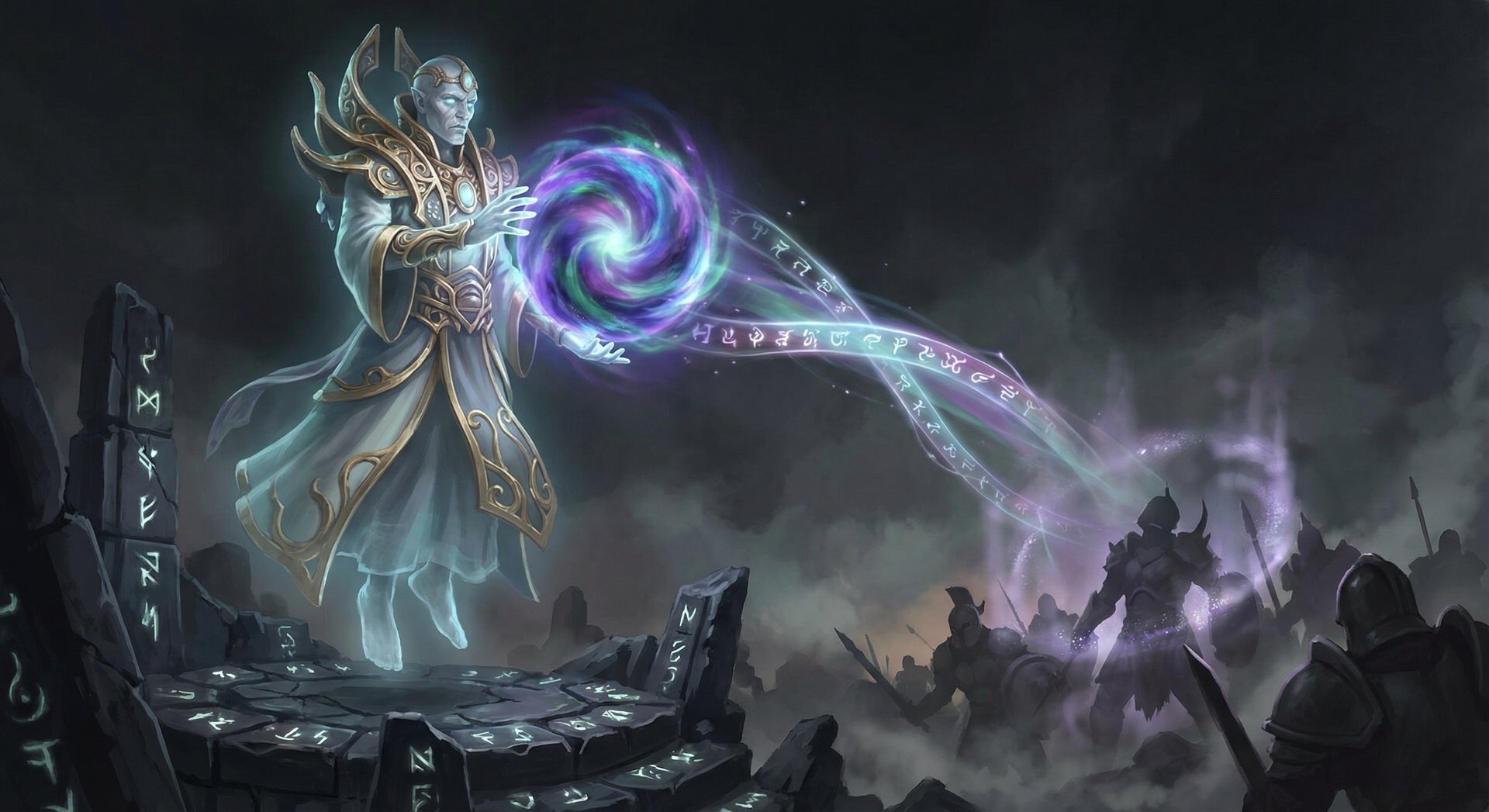
Fate’s Edict (W)
Fate’s Edict is perhaps the most misunderstood ability in Dota 2. It grants the target 100% magic damage resistance and disarms them for 3.5/4/4.5/5 seconds. It can be cast on allies or enemies.
Why this ability is broken in the right hands:
- On allies: Complete magic immunity. Your carry is about to eat a Lina Laguna Blade Fate’s Edict negates 100% of it. The disarm does not matter if they were going to die anyway.
- On enemies: Disarms them, preventing right-click damage. Cast this on the enemy carry in a fight and they literally cannot attack for up to 5 seconds. The magic resistance they gain is usually irrelevant if your team deals physical damage.
- Combo with Purifying Flames: Cast Fate’s Edict on an ally, then spam Purifying Flames on them. The magic resistance blocks the initial burst damage from Purifying Flames, but the heal-over-time still applies fully. This turns Purifying Flames into a pure heal with zero drawback.
- It is purgeable. Strong dispels and certain abilities can remove Fate’s Edict early. Keep this in mind when deciding your cast timing.
Purifying Flames (E)
Purifying Flames deals 90/150/210/270 magic damage instantly, then heals the target for 11/22/33/44 HP per second over 9 seconds (totaling 99/198/297/396 healing). The net effect on an enemy without magic resistance: they take burst damage but then slowly heal it back (and more). On an ally: they take burst damage first, then get healed for more than they lost.
Critical interactions:
- Damage combo (enemy): E then immediately Q (quick tap). Fortune’s End purges the heal, leaving only the 270 burst damage. At level 7 with 4 points in E and 1 in Q, this combo deals 270 + 120 = 390 magic damage before reductions. You can also double-tap E before the Q projectile lands for even more burst.
- Heal combo (ally): W then spam E. Fate’s Edict blocks the burst damage from Purifying Flames but the heal still ticks. With a 2.5-second cooldown on Purifying Flames at max level, you can stack multiple heal instances.
- False Promise interaction: During False Promise, all healing is doubled. Purifying Flames heals become insanely powerful — each cast heals 792 HP total (396 x 2) while the damage is delayed and potentially negated by the massive healing.
- 2.5-second cooldown. This is absurdly short. You can cast this ability 3-4 times during a single False Promise, resulting in thousands of HP healed.
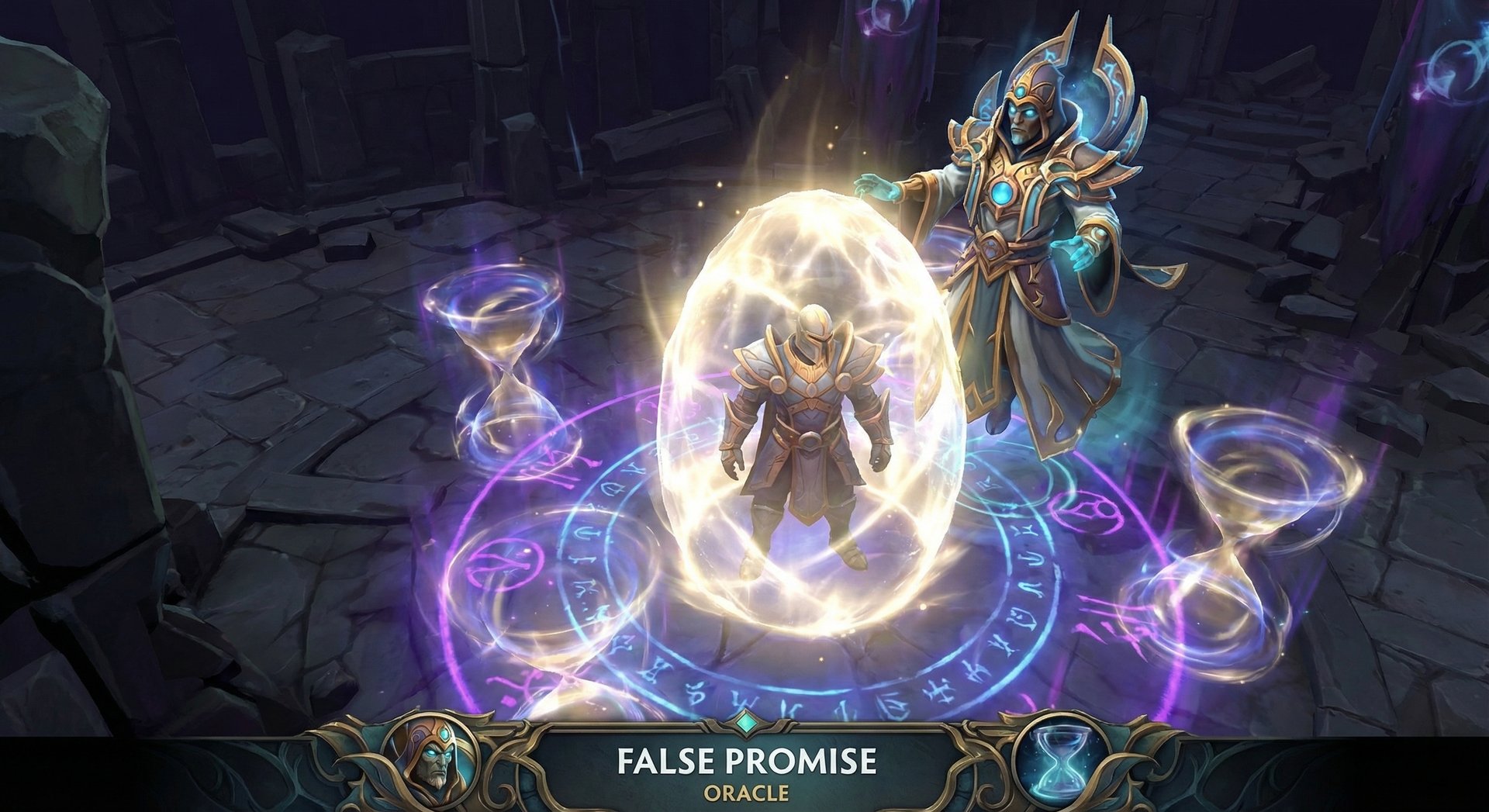
False Promise (R) — Ultimate
The reason Oracle exists. False Promise makes an allied hero invisible to the effects of damage and healing for 7/8.5/10 seconds. During the duration, the target’s HP bar does not change — all damage taken and healing received are tracked separately. When False Promise ends, the target receives double the total healing minus total damage. If the net result is positive, they live. If not, they die.
What makes this ability insane:
- Strong dispel on cast. False Promise applies a strong dispel when first cast, removing stuns, silences, roots, and most debuffs instantly. This alone makes it a fight-changing ability.
- Healing is doubled. ALL healing received during False Promise is doubled — not just from Oracle’s abilities. Mekansm, salves, lifesteal, regeneration, allied heals — everything gets doubled.
- The target can still act normally. Unlike some save abilities, False Promise does not banish or disable the target. Your carry can keep fighting, dealing damage while being effectively immortal (if you heal them enough).
- Does not prevent disables. The target can still be stunned, silenced, and disabled during False Promise. They just will not take HP damage from those abilities until it ends.
- Damage type matters at the end. The final damage from False Promise is HP Removal, meaning it cannot be reduced by any means. If the math says they die, they die.
Item Builds by Rank Bracket
Oracle’s item build is less about raw stats and more about amplifying his ability to save allies and survive long enough to cast spells. The hero functions well with minimal farm, which is perfect for a position 5 support. However, the right items at the right time can make the difference between a mediocre Oracle and a game-winning one.

| Rank | Starting | Early Game | Core Items | Late Game |
|---|---|---|---|---|
| Herald-Crusader | Tango, Healing Salve, Blood Grenade, Clarity x2, Observer Ward | Magic Stick, Boots, Wind Lace | Arcane Boots, Magic Wand, Glimmer Cape | Aether Lens, Force Staff |
| Archon-Legend | Tango, Healing Salve, Blood Grenade, Clarity x2, Sentry Ward | Magic Stick, Tranquil Boots, Wind Lace | Aether Lens, Glimmer Cape, Holy Locket | Force Staff, Aghanim’s Scepter |
| Ancient-Divine | Tango, Blood Grenade, Clarity x2, Sentry Ward, Smoke | Magic Stick, Tranquil Boots, Urn of Shadows | Aether Lens, Holy Locket, Force Staff | Glimmer Cape, Aghanim’s Shard |
| Immortal | Tango, Blood Grenade, Clarity x2, Sentry Ward, Smoke | Magic Wand, Tranquil Boots, Urn of Shadows | Aether Lens, Holy Locket, Glimmer Cape | Aghanim’s Shard, Aghanim’s Scepter, Refresher Orb |
Why Items Differ by Rank
Herald-Crusader: At lower ranks, fights are chaotic and positioning is poor. Arcane Boots help with Oracle’s mana-hungry kit, and Glimmer Cape is the single best save item because low-rank players rarely buy detection. The extra layer of invisibility on top of False Promise often means your target lives every time.
Archon-Legend: Players start to understand Oracle’s kit better here. Tranquil Boots become viable because Oracle rarely needs to be in the middle of fights — he operates from the backline. Holy Locket starts to shine because players can coordinate healing during False Promise.
Ancient-Divine: Urn of Shadows becomes a priority because the charges generate extra healing during False Promise (doubled, remember), and it also provides a strong offensive tool for ganking. Force Staff takes priority over Glimmer Cape because higher-ranked players buy more detection.
Immortal: The full luxury build includes Aghanim’s Scepter, which makes False Promise apply a continuous invisibility to the target during the duration. This fundamentally changes how the enemy team has to approach fights. Refresher Orb in ultra-late games lets you cast False Promise twice in a single fight — on two different cores.
Key Item Explanations
Aether Lens: Non-negotiable on Oracle. The extra 225 cast range means you can False Promise your carry from a safe distance. Getting picked off before you can cast your ultimate is the number one way Oracle loses games. Aether Lens solves this.
Holy Locket: Amplifies all healing and regeneration by 30%. Combined with False Promise’s double healing, your Purifying Flames heals become absurd. A single E during False Promise heals for 396 x 2 x 1.3 = 1,029 HP. Spam it three times and you are healing for over 3,000 HP.
Glimmer Cape: Layering Glimmer Cape invisibility with False Promise makes your target nearly impossible to kill without detection AND high burst damage. The magic resistance from Glimmer also helps reduce the magic damage your target takes during False Promise.
Laning Phase Masterclass
Oracle is a surprisingly strong laner despite being a full save support. His base damage is solid for a ranged hero, and Purifying Flames gives him one of the highest single-target burst nukes available at early levels. The key to laning with Oracle is understanding when to play aggressively and when to sit back.

Level 1-3 Strategy
Starting skill: Take Purifying Flames (E) at level 1. The 90 magic damage burst is strong for trading and securing ranged creeps. At level 2, take Fortune’s End (Q) to unlock your kill combo.
The E-Q combo at level 2 deals approximately 140 magic damage after reductions (90 from E, plus Q damage, minus the purged heal). This is enough to chunk most offlaners down to half HP if they have been taking some right-click harass. Coordinate with your carry to go for a kill at level 2 — most offlaners do not expect Oracle to have this kind of burst that early.
Level 3: Take another point in Purifying Flames. At level 2 E, you deal 150 burst damage on the nuke, which makes your E-Q combo significantly stronger. If the offlaner is a melee hero, you can zone them completely by threatening this combo every time they approach creeps.
Lane Partner Synergies
Oracle works best with aggressive carries who want to fight early:
- Huskar: The dream lane. Fate’s Edict blocks magic damage while Huskar burns at low HP. False Promise later lets Huskar dive without fear. One of the most oppressive lane combos in Dota.
- Ursa: Oracle’s nuke and root set up Ursa’s Overpower perfectly. Fortune’s End roots for up to 2.5 seconds, which is plenty of time for Ursa to unload.
- Juggernaut: Fortune’s End root into Blade Fury is a guaranteed kill at level 2. The root holds the target in Blade Fury’s AoE for maximum damage.
- Troll Warlord: Troll benefits enormously from False Promise later in the game, and the lane combo of root into Troll’s bash potential is very strong.
Matchup-Specific Tips
Against Axe: Do NOT Purifying Flames your carry if Axe is nearby. The burst damage can trigger Counter Helix procs and may even dip your carry below the Culling Blade threshold. Focus Purifying Flames on Axe himself for harass.
Against Undying: Fortune’s End can purge Decay stacks from your carry. This is huge in the laning phase. Make sure to prioritize dispelling Decay stacks over offensive uses of Q.
Against Silencer: Fate’s Edict provides complete magic immunity, which blocks Last Word and Arcane Curse damage. You can protect your carry from Silencer’s harass almost entirely.
Positioning in Lane
Oracle should stand behind or beside the carry, not in front. You are 620 range, which lets you harass offlaners without overextending. Your job is to trade efficiently using Purifying Flames and right-clicks while pulling creep aggro minimally. When the enemy support tries to contest pulls, that is when you go aggressive with E-Q combo — most position 4 supports cannot trade with Oracle’s burst damage at levels 2-3.
Mid and Late Game Transitions
Oracle’s transition from laning to mid game is where most players struggle. Unlike supports who roam and gank, Oracle’s power comes from being near his cores during fights. Your job is not to make plays happen — it is to ensure your team’s play-makers survive when they go in.

Timing Windows
10-15 minutes: Oracle’s first power spike. By this point you should have level 6 and ideally basic boots plus a component of Aether Lens. Your first False Promise usage sets the tone for the mid game. Identify which core on your team is most likely to dive into fights and stay near them.
20-25 minutes: With Aether Lens and Tranquil Boots completed, Oracle hits his stride. You can cast from 1,100+ range, meaning you are extremely hard to pick off in fights. This is also when team fights become more frequent, and working with a coach can dramatically improve your False Promise timing.
30+ minutes: Late game Oracle with Holy Locket, Glimmer Cape, and possibly Aghanim’s Shard becomes one of the strongest supports in the game. The healing output during False Promise reaches absurd levels, and the strong dispel on cast can single-handedly save fights by removing key disables.
Team Fight Positioning
Stay at maximum cast range at all times. Oracle is squishy, has no escape, and once you die, your team loses its best save. Position yourself 1,000-1,200 units behind your front line. Aether Lens is mandatory for this playstyle.
During team fights, your priority order is:
- False Promise the core who is about to die (not proactively — wait until they actually take damage)
- Purifying Flames spam on the False Promise target to stack healing
- Fate’s Edict on the enemy carry to disarm them OR on your ally to block a big magic nuke
- Fortune’s End to purge enemy buffs or root fleeing targets
- Glimmer Cape the False Promise target for extra survivability
The biggest mistake Oracle players make is using False Promise too early. If your carry is at 80% HP and the fight just started, do not cast False Promise yet. Wait until they are actually in danger. Using it too early means the healing accumulated over the duration may not outweigh the damage they take over a long fight, and the ult will be on cooldown when they actually need it.
When Oracle Peaks
Oracle does not have a traditional “peak” like most heroes. Instead, his effectiveness scales with how much burst damage exists in the game. Against lineups that deal damage in short bursts (Lina, Lion, Morphling Shotgun), Oracle thrives because False Promise absorbs those bursts and his healing easily outweighs them. Against sustained DPS lineups (Medusa, Troll Warlord, Faceless Void Chronosphere), Oracle struggles because the sheer volume of damage over False Promise’s duration can overwhelm his healing.
Counters: Heroes That Destroy Oracle
Understanding Oracle’s counters is critical for both playing him and playing against him. These five heroes make Oracle’s life miserable and should heavily factor into your decision to pick him.
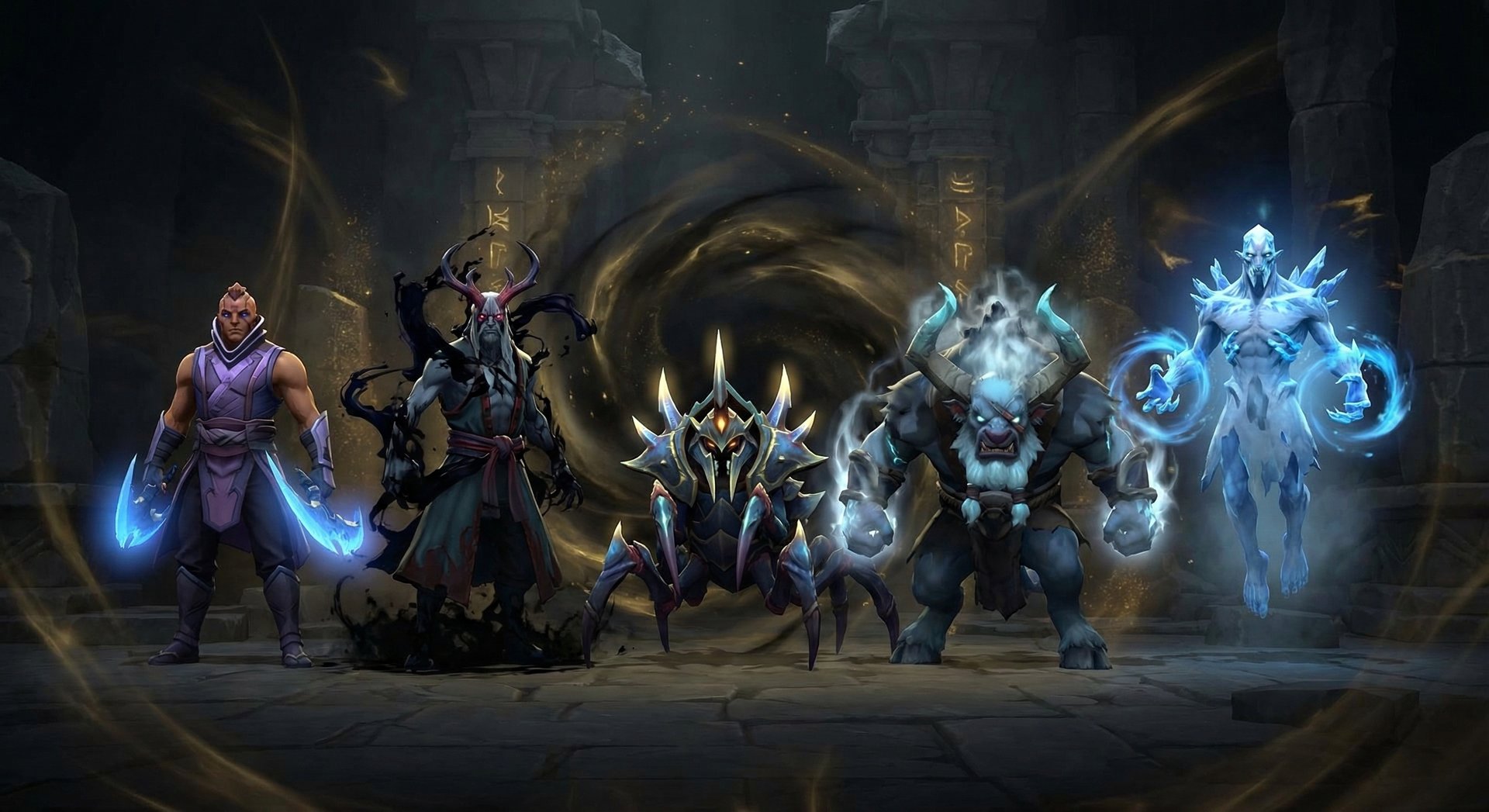
1. Ancient Apparition
The hardest counter in the game. Ice Blast prevents all healing — including the doubled healing during False Promise. If Ice Blast debuff is on your target during False Promise, they gain zero healing, meaning all the accumulated damage hits them at once and they die. There is no counterplay to this interaction. If the enemy team has AA, strongly consider not picking Oracle.
2. Anti-Mage
Mana Burn shreds Oracle’s mana pool. Oracle is one of the most mana-hungry heroes in the game, and AM’s Mana Break combined with Mana Void can delete Oracle in seconds. Additionally, Oracle’s relatively low mana pool means Mana Void deals significant AoE damage to nearby allies when Oracle dies.
3. Nyx Assassin
Spiked Carapace reflects Oracle’s Purifying Flames damage back, and since Oracle frequently casts spells, Nyx gets value from Mana Burn. More importantly, Vendetta allows Nyx to sneak up on Oracle’s backline position and one-shot him before he can cast False Promise.
4. Grimstroke
Soulbind targets two heroes and forces them to share single-target spells. If Oracle is Soulbound with his carry, his own Purifying Flames will hit both of them — dealing damage to both. Grimstroke’s silence from Phantom’s Embrace also prevents Oracle from casting spells for a long duration if not dispelled.
5. Spirit Breaker
Charge of Darkness provides long-range initiation directly onto Oracle’s backline position. The bash through magic immunity means Fate’s Edict does not protect against the stun. Spirit Breaker forces Oracle to constantly watch his positioning, and one successful charge usually means a dead Oracle before he can react with False Promise on himself.
Playing Around Counters
Against AA: Ban him. Seriously. If he gets through, your only option is to use False Promise early enough that it expires before AA has time to ult, or pray he misses.
Against gap-closers (Nyx, SB): Buy Force Staff as a second item after Aether Lens. Position even further back than usual. Ward aggressively to spot incoming ganks.
Against mana burn (AM, Nyx): Prioritize mana sustain items. Clarity usage off cooldown. Consider Lotus Orb in late game to reflect Mana Break damage.
Heroes Oracle Destroys
Just as some heroes counter Oracle, there are matchups where Oracle completely takes over the game.
1. Lina
Laguna Blade is Lina’s main kill threat, and Fate’s Edict completely nullifies it. A well-timed W on your ally turns Lina’s 1,000+ damage nuke into zero. Additionally, False Promise absorbs Lina’s entire combo and the healing easily outweighs her burst.
2. Lion
Same logic as Lina. Finger of Death deals massive magic burst, and Fate’s Edict blocks 100% of it. Fortune’s End also purges Hex if timed correctly (by targeting the hexed ally).
3. Huskar
As a lane partner, Oracle and Huskar are disgusting. But even against enemy Huskar, Fate’s Edict blocks his Burning Spears magic damage and Life Break damage, and Fortune’s End purges Burning Spears stacks.
4. Skywrath Mage
Skywrath’s entire kit is magic damage. Fate’s Edict makes your ally completely immune to Mystic Flare, Arcane Bolt, and Concussive Shot. Oracle is the single hardest counter to Skywrath Mage in the entire game.
5. Necrophos
Reaper’s Scythe deals more damage the lower the target’s HP. False Promise prevents HP from changing during its duration, meaning Necro cannot tell how low your ally actually is. Combined with the massive healing you pump in, your ally often emerges from False Promise at full HP despite taking Scythe damage.
How Pros Play Oracle in Current Patch
Oracle has been a recurring pick in professional Dota throughout 2025 and into 2026. His presence in drafts often signals a team that wants to enable an aggressive core — typically a Huskar, Slark, or any hero that benefits from diving deep into enemy formations.
Notable professional trends:
- Position 5 priority: Pro teams almost exclusively play Oracle as position 5, ensuring he is always near the hard carry. The hero needs minimal items to function, making him ideal for hard support.
- Early Aether Lens rush: Professional Oracle players rush Aether Lens as their first major item, often completing it by 12-15 minutes even on a position 5 budget. The cast range is considered non-negotiable.
- Aggressive laning: Pro players maximize Oracle’s laning potential with constant E-Q combos on the enemy offlaner. In pro games, Oracle frequently has the highest hero damage in the first 10 minutes despite being a support.
- False Promise timing: Top Oracle players wait until the absolute last possible moment to cast False Promise. In tournaments, you will see Immortal-level Oracle players hold R until their carry is below 20% HP, maximizing the value of the healing during the duration and the strong dispel.
Teams like Team Spirit, Gaimin Gladiators, and Tundra Esports have historically used Oracle in combination with aggressive mids and carries. The hero’s ability to turn a fight from a 3-for-0 loss into a 0-for-3 win with a single well-timed False Promise makes him a perennial competitive pick. For more insights on pro-level play, check out Liquipedia’s Oracle page for recent match histories and build variations.
Rank-Specific Climbing Guide
Oracle’s winrate varies dramatically across rank brackets, and the strategies that work at 2K MMR will not work at 6K. Here is how to adapt your Oracle play to your specific bracket.

Herald to Guardian (0-1,500 MMR)
At this bracket, do not play Oracle. Genuinely. This is not gatekeeping — Oracle requires a fundamental understanding of Dota 2 mechanics that Herald players are still developing. If you insist on playing him, focus on one thing: use Purifying Flames only as a nuke on enemies, never on allies. Healing allies with E requires understanding the W-E combo, and misusing it will kill your own carry.
Build simple: Arcane Boots into Glimmer Cape. In every fight, save False Promise for the carry. That is your entire job. Do not try to be fancy. One good False Promise wins fights at this bracket because enemies do not know how to deal with it — they will keep attacking your invincible carry.
Crusader to Archon (1,500-3,000 MMR)
This is where you can start learning the W-E heal combo. Practice in demo mode first: cast Fate’s Edict on an ally, then immediately Purifying Flames. The magic immunity blocks the damage, and only the heal applies. Once you can do this consistently, your sustain in lane and in fights improves dramatically.
Key focus: Start purging debuffs with Fortune’s End on allies. Most Archon players forget this entirely. If your carry gets slowed, silenced, or has a purgeable debuff, target them with Q to cleanse it. This alone will improve your win rate significantly.
If you are struggling to climb through this bracket, consider MMR boosting to reach a bracket where your Oracle play can be fully utilized.
Legend to Ancient (3,000-5,000 MMR)
The macro leap. At this level, Oracle players need to master False Promise timing and team fight positioning. Stop using False Promise reactively at the last second (you are not good enough yet) — instead, use it slightly earlier to give yourself time to spam Purifying Flames 3-4 times during the duration.
Itemization focus: Always build Aether Lens first. Learn to carry Smoke of Deceit and coordinate ganks with your mid player. Oracle’s E-Q burst can solo kill most mid heroes at levels 5-7 when combined with your mid’s damage.
Start learning to Fate’s Edict the enemy carry instead of always using it defensively. Disarming the enemy carry for 5 seconds in a team fight is often more valuable than blocking one magic nuke on your ally.
Divine to Immortal (5,000+ MMR)
At this level, Oracle is played to his full potential. Every ability is used both offensively and defensively depending on the situation. False Promise timing becomes precise — you wait until the carry takes the initial burst, then ult to strong dispel whatever disabled them, then immediately spam E while layering Glimmer Cape.
What separates top 1% Oracle players:
- Double Purifying Flames before Fortune’s End lands. Cast E twice on the enemy, then Q. The projectile travel time gives you enough time to land two E nukes before Q purges the heal, dealing 540+ magic damage in one combo.
- Preemptive Fate’s Edict. Using W on allies before the big spell lands requires reading the enemy’s patterns. Top Oracle players W their carry the instant they see Lina start her Laguna Blade animation.
- False Promise with Glimmer Cape layering. Cast R, then Glimmer during the duration, then spam E. The target is invisible, magic resistant, being healed for thousands of HP, and the enemy team needs detection + enough damage to outdamage the doubled healing. This is the holy grail of Oracle play.
- Offensive Fortune’s End on Roshan. Fortune’s End purges Roshan’s Linken’s-like spell block, enabling your team’s single-target disables to land on Roshan during contests.
Tips and Tricks
These are the mechanical details and hidden interactions that elevate your Oracle play from “competent” to “terrifying.”

Animation Cancels and Cast Optimization
- Quick-cast Fortune’s End. Tap Q and immediately move-command. The minimum channel time is 0.5 seconds, but with quick-cast, you can release the projectile almost instantly. Use this when you need a fast purge or root rather than a long one.
- Shift-queue E-Q combo. Cast Purifying Flames, then shift-queue Fortune’s End on the same target. This ensures the Q projectile leaves immediately after E lands, giving minimal time for the heal to tick.
- Triple E during False Promise. With max level Purifying Flames (2.5s cooldown) and False Promise lasting 10 seconds, you can cast E up to 4 times during a single False Promise. That is 396 x 4 x 2 = 3,168 healing at minimum (more with Holy Locket).
Hidden Interactions
- False Promise removes Slardar’s Corrosive Haze and Bounty Hunter’s Track on cast (strong dispel). This has huge implications for vision-based plays.
- Fortune’s End can be cast while channeling TP. Wait… no it cannot. But a common misconception is that Oracle can purge while TPing — he cannot. However, the projectile continues traveling after you start channeling TP if you cast Q first, then TP immediately.
- Fate’s Edict blocks Ethereal Blade damage. If an enemy Ghost Scepters or gets hit by Ethereal Blade, you can cast Fate’s Edict on them to give them 100% magic resistance while they are ethereal — making them immune to both physical AND magical damage for the overlap duration.
- Purifying Flames can deny allies. If your ally is at very low HP and is about to die to an enemy, casting E on them denies the kill. This is a legitimate strategy in pro games to deny kill gold and experience.
Common Mistakes to Avoid
- Healing allies without Fate’s Edict. If you cast E on a low-HP ally without W first, you might kill them. Always W first, then E, unless you are certain the burst damage will not kill them.
- Using False Promise too early. The healing during False Promise needs to outweigh the damage. If you ult when your carry is still at 70% HP, the enemy team has 10 full seconds to pour damage in, and your healing may not keep up.
- Forgetting to purge allies. Fortune’s End on allies removes slows, silences, and other purgeable debuffs. Many Oracle players only use Q offensively and forget about the defensive purge.
- Standing too close to fights. Oracle has no escape. If you die before casting False Promise, your team loses its most important save. Stay at maximum cast range always.
- Not buying Aether Lens. There is no excuse for skipping this item. Cast range is Oracle’s survival mechanism.
Frequently Asked Questions
No. Oracle is consistently rated as one of the hardest heroes in Dota 2 to play effectively. His abilities can harm allies if used incorrectly, and his skill ceiling is extremely high. We recommend learning support fundamentals with easier heroes like Crystal Maiden or Lion before attempting Oracle. If you want to fast-track your support skills, professional coaching can help you learn Oracle’s mechanics properly.
Max Purifying Flames (E) first in almost every game. Take one point in Fortune’s End (Q) at level 2 and one point in Fate’s Edict (W) at level 3 or 4. Ultimate at 6, 12, and 18. The standard build is E-Q-E-W-E-R-E, then max Q second. Only deviate from this if you face a heavy magic damage lane where early W levels are critical.
Badly. Ice Blast prevents all healing, including the doubled healing during False Promise. If your target has Ice Blast debuff during False Promise, they will receive zero healing and all accumulated damage hits when False Promise ends, almost certainly killing them. Always ban AA when picking Oracle.
Yes, but only with Fate’s Edict (W) active first, or during False Promise. Without W or R, the initial burst damage from E can kill low-HP allies. The combo is: W on ally (blocks magic damage), then spam E (pure healing with no downside). During False Promise, the burst damage is delayed and doubled healing usually outweighs it.
Situationally. Oracle can play position 4 in aggressive trilanes or with specific lane combos (Oracle + Huskar, Oracle + Ursa). However, he generally performs better as position 5 because he needs to stay near the carry during fights and does not benefit much from extra farm. Position 4 Oracle can work in Ancient+ brackets where players understand how to play around him.
Talent choices are game-dependent, but the general preference is: Level 10 — Purifying Flames heal increase for sustained fights, or cast range for safety. Level 15 — Fortune’s End AoE radius for team fight impact. Level 20 — False Promise duration for late-game insurance. Level 25 — typically the False Promise cooldown reduction talent, as it lets you cast R twice in extended fights.
Pick Ancient Apparition (prevents all healing during False Promise). Buy Spirit Vessel (reduces healing by 45%). Focus Oracle first in fights — he is squishy with no escape. Buy detection to counter Glimmer Cape saves. Draft sustained DPS over burst damage to overwhelm False Promise healing over time.
Master Oracle With Immortal-Rank Coaching
Oracle is one of the hardest supports to master on your own. Our Immortal-rank coaches have thousands of Oracle games and can teach you the exact timing, combos, and positioning that turn this hero into a game-winner. Or skip the grind entirely with our boosting service.