

Nature’s Prophet Guide 7.41f: Build, Treants and Matchups

Nature’s Prophet is the strangest hero in the 7.41f meta. Valve has buffed him in three separate patches since the 7.41 rework, and the public still cannot win with him. On October 20, 2026, OpenDota’s public-match stats show him at 43.7% across 373,721 picks in the last seven days. That is the second-lowest win rate of all 127 heroes, ahead of only Shadow Fiend at 43.6%, while the median hero sits at 49.4%. Yet he is also the 9th most banned hero in OpenDota’s pro tally, with 108 bans. This Nature’s Prophet guide for 7.41f explains why those two facts coexist and how to actually play him.
The short version: 7.41f did not touch him. His last changes came in 7.41d on June 4, 2026, and the numbers below are what is live today. The data says the problem is not damage or tools. It is the clock. His win rate is strongest in short games and fades steadily the longer the match runs, in both public and pro samples. The most common public builds are late-game carry templates, and that is exactly the plan the numbers punish.
Below you will find every Nature’s Prophet change since patch 7.39, the current ability and talent numbers from Valve’s data feed, win rates by rank and by game length, what the public builds, a look at his recent pro games, matchups, and a plain verdict on when to pick him. For the evergreen basics, start with our complete Nature’s Prophet guide. This page is the 7.41f update. For the wider patch context, see the 7.41f patch notes guide.
Table of Contents
- What Changed for Nature’s Prophet Since 7.39
- Is Nature’s Prophet Good Right Now?
- His Kit With Current Numbers
- Talents
- Skill Order
- Item Build: What the Public Buys
- Win Rate by Game Length
- What the Pros Are Doing With Him
- Game Plan: Early, Mid and Late
- Matchups
- How to Play Against Nature’s Prophet
- When to Pick Him in Ranked
- The Bottom Line
- FAQ
What Changed for Nature’s Prophet Since 7.39
Nature’s Prophet received no changes in 7.41e or 7.41f. His most recent change was a Level 20 talent buff in 7.41d on June 4, 2026. Valve’s patch list shows 7.41f as the latest numbered gameplay patch, released September 15, 2026. You can read the full text in Valve’s official 7.41f patch notes. He does not appear in the hero sections of either patch (7.41e shipped July 30).
The history matters because the 7.41 rework of March 24, 2026 changed what the hero is. Here is every Nature’s Prophet change in Valve’s notes from 7.39 to today, taken from the official patch-note feed.
| Patch | Date | Change |
|---|---|---|
| 7.39 | May 22, 2025 | Attack range 620 to 600. Ironwood Treant facet removed. Soothing Saplings facet reworked and Nature’s Profit facet added. |
| 7.39b | May 29, 2025 | Wrath of Nature base damage 100/140/180 to 90/130/170. |
| 7.39c | Jun 24, 2025 | Curse of the Oldgrowth damage per tree 20 to 15. |
| 7.39d | Aug 5, 2025 | Agility gain 3.2 to 3.0. Sprout damage 70/135/200/265 to 70/130/190/250. |
| 7.40 | Dec 15, 2025 | Agility gain 3.0 to 2.6. Damage gain per level 4.1 to 3.9. Spirit of the Forest bonus per tree 3% to 2%. Nature’s Call mana cost 120 to 100, Treant range 100 to 125. Curse radius 1200 to 900. |
| 7.40c | Jan 21, 2026 | Treant damage 16/24/32/40 to 16/25/34/43. |
| 7.41 | Mar 24, 2026 | The rework. Level 1 damage 40-50 to 44-50. Spirit of the Forest no longer levels with Wrath, multiplier per Treant 1x to 2x, and Treants now have it too. Treant health 550 to 450, 25% magic resistance, bonus hero damage, free pathing through trees. Level 15 talent became a flat +100 Teleportation Barrier. |
| 7.41b | Apr 7, 2026 | Wrath of Nature base damage 90/130/170 back to 100/140/180. |
| 7.41c | May 6, 2026 | Nature’s Call mana cost 100 to 85/90/95/100. Treant bonus hero damage 4/8/12/16 to 6/10/14/18. Level 20 Sprout damage talent +170 to +220 and Wrath cooldown talent 15s to 20s. |
| 7.41d | Jun 4, 2026 | Level 20 Sprout damage talent +220 to +240. Living Treants now always count for Spirit of the Forest, even out of range. |
Read the pattern. From 7.41b onward, almost every change has been a buff: Wrath damage restored, Nature’s Call cheaper, Treants hitting harder, talents bigger. Valve has been trying to lift this hero for six months. The next section shows how that has gone.
Is Nature’s Prophet Good Right Now?
By public win rate, no. Nature’s Prophet is at 43.7% over 373,721 picks in the last seven days, 126th of 127 heroes by win rate and 43rd by pick count. The data comes from OpenDota’s hero stats endpoint, pulled October 20, 2026. Shadow Fiend is the only hero lower at 43.6%, and we covered him in our Shadow Fiend 7.41f guide. The median hero is at 49.4%.
The gap is not one bad bracket. It shows up everywhere. OpenDota’s rank-bracket fields (1 = Herald through 7 = Divine) give the following picture against the median hero in that same bracket.
| Bracket | NP picks | NP win rate | Median hero | Gap |
|---|---|---|---|---|
| Herald | 8,817 | 46.8% | 48.8% | -2.0 |
| Guardian | 29,546 | 44.4% | 49.4% | -5.0 |
| Crusader | 54,119 | 43.1% | 49.2% | -6.1 |
| Archon | 78,473 | 42.1% | 49.4% | -7.3 |
| Legend | 84,214 | 42.8% | 49.5% | -6.7 |
| Ancient | 47,146 | 43.3% | 49.8% | -6.5 |
| Divine | 33,766 | 45.5% | 49.8% | -4.3 |
Three things stand out. First, the gap is negative in every bracket. Second, it is widest in Archon and Legend, where most of his games are played. Third, it narrows at both ends of the ladder, and the data does not tell us why. Immortal-bracket data is empty in this feed, so we cannot say more about the top.
Turbo tells the same story. OpenDota logs 176,855 Turbo picks in the same window at 43.6%, so it is not a ranked-queue quirk.
His Kit With Current Numbers
Every number below comes from Valve’s own data feed for the current patch (hero_id 53), not from memory or old wiki pages. Valve lists him as a Universal hero: 19 base Strength with 2.6 gain, 14 base Agility with 2.6 gain, and 22 base Intelligence with 3.5 gain. He is ranged with 600 attack range, 295 movement speed, and 25% base magic resistance. Valve’s role ratings tag him highest as a Pusher, with Carry, Nuker and Escape each at 1.
| Ability | Cooldown | Mana | Key numbers |
|---|---|---|---|
| Sprout | 14/12/10/8 | 70/80/90/100 | Damage 70/130/190/250. Trap duration 2.5/3/3.5/4s. Cast range 625/700/775/850. Damage radius 275. Vision radius 400. |
| Teleportation | 65/50/35/20 | 50/60/70/80 | 3 second cast, anywhere on the map. Barrier on arrival 70/130/190/250, lasting 15s. |
| Nature’s Call | 45/40/35/30 | 85/90/95/100 | Up to 2/3/4/5 Treants, limited by trees in the area. Area radius 150/225/300/375. Treants live 50s with 450 HP, 25% magic resistance, 16/25/34/43 damage plus 6/10/14/18 against heroes, 300/315/330/345 movement speed. |
| Curse of the Oldgrowth | 18 | 80 | All enemy heroes within 900 range for 7s: 15 damage per second per tree and 7% slow per tree, counting trees within 250 radius. Treants count as trees. Reveals the target in fog. |
| Spirit of the Forest | Passive | None | 2% bonus damage per nearby tree within 300 radius (radius grows by 10 per hero level per the 7.41 notes). Treants provide a multiplier of 2 and count from any distance. |
| Wrath of Nature | 85 | 130/160/190 | Global bounce through enemies in vision, nearest first. Base damage 100/140/180, each extra target adds damage, up to 16 targets. |
A few details Immortal players know and most pubs forget.
- Sprout is a kill spell, not just a trap. At max level it deals 250 damage, and at level 20 the talent adds 240 more for 490. While the ring lasts, its trees also count as trees for Curse of the Oldgrowth and Spirit of the Forest.
- Treants walk through trees. The 7.41 notes gave them free pathing, and the feed marks their tree-walking as active. Treants follow a target through a forest, so tree juking does not shake them.
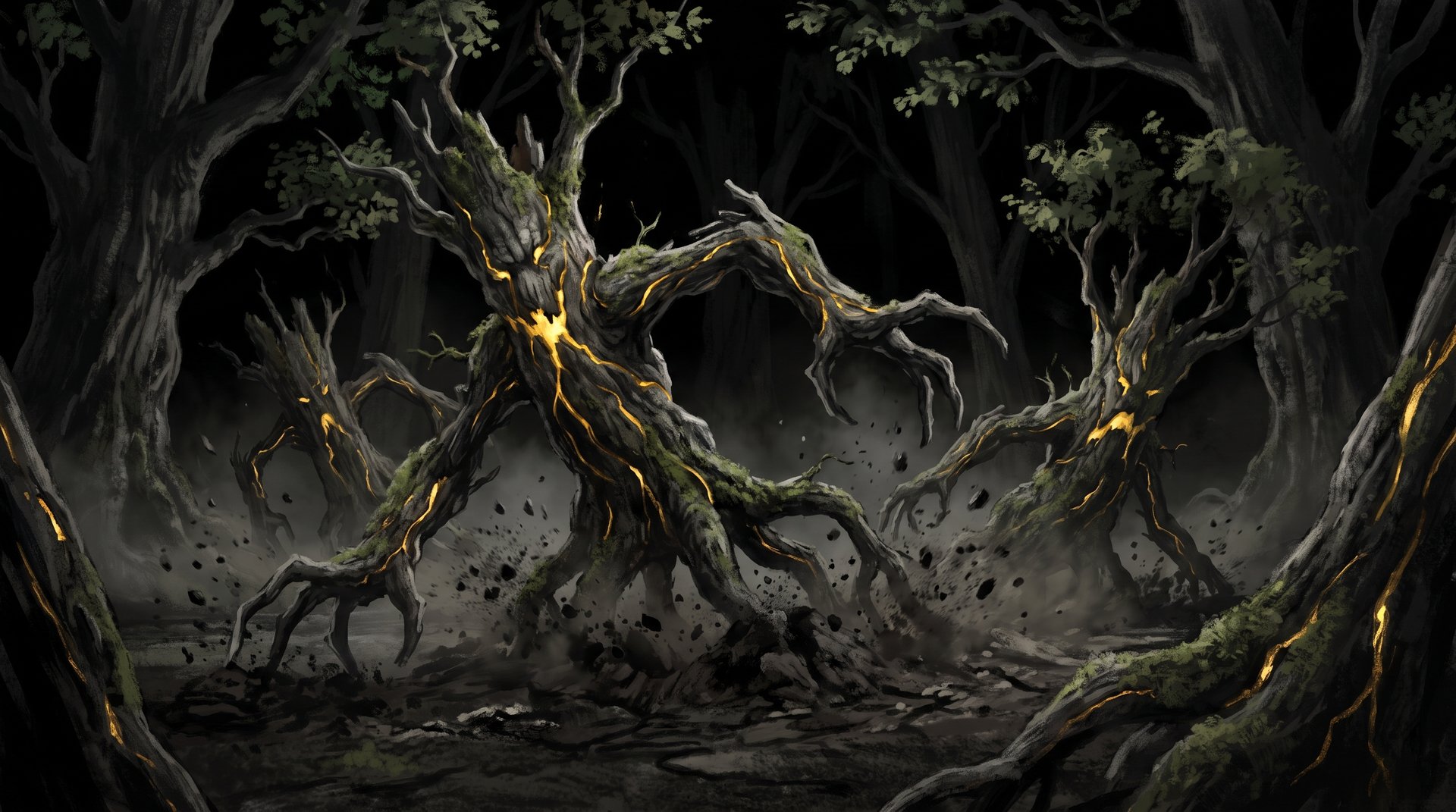
- Treants carry Spirit of the Forest themselves. The 7.41 notes say they gain bonus damage for each nearby tree and Treant. More trees in the area also means more Treants.
- The cap is trees, not level. The feed note reads “Nature’s Call can only create as many treants as there are trees in the target area.” A bare lane means fewer Treants than the tooltip promises.
- Wrath is long-range and map-wide. It “will not hit units out of vision” and can be cast through the minimap. Your team’s vision decides how much of it lands.
If you want to understand how trees regrow and get cut, which matters constantly on this hero, read our guide to Dota 2 trees, regrowth timers and juke spots.
Talents
The values below come from Valve’s feed. Levels 15, 20 and 25 are confirmed by patch-note text for the talents Valve has changed. The Level 10 pair, the Level 15 Treant movement speed talent and the Level 25 Teleportation cooldown talent are placed from the order of the feed’s talent list, not from a patch note, so treat them as our best reading.
| Level | Left | Right |
|---|---|---|
| 25 | Teleportation cooldown removed | 3x Treant HP and damage |
| 20 | Wrath of Nature cooldown -20s | +240 Sprout damage |
| 15 | +50 Treant movement speed | +100 Teleportation barrier |
| 10 | Nature’s Call cooldown -10s | +25 Wrath of Nature base damage |
Left and right sides in this table follow the feed’s list order and are not a claim about the in-game talent tree layout. What matters is the content of each pair.
- Level 25 is the real decision. Removing the Teleportation cooldown makes him a permanent presence on the map. Tripling Treant stats turns 450 HP into 1,350 and the hero-damage portion from 18 to 54 at max level, per the feed’s multiply operation. The 7.41 notes confirm this talent no longer boosts the Spirit of the Forest multiplier.
- Level 20 gives you a choice between burst and tempo. The Sprout talent turns a 14-second spell into a roughly 490-damage nuke at max level. The Wrath talent drops its cooldown from 85 to 65 seconds.
- Level 15 is a quiet pick. The +100 barrier lifts a max-level Teleportation barrier from 250 to 350 for 15 seconds, which is meaningful when you teleport into a fight alone.
Skill Order
This is our editorial recommendation, built from the mechanics above, not a statistic. Valve’s feed lists Curse of the Oldgrowth with one set of numbers and no per-level scaling, so we treat it as a fixed utility spell and plan the order around the other three basics and the ultimate.
- Sprout first. It is your only reliable early kill setup and your tree-spawning tool. It also scales hardest per point: 70 to 250 damage, 2.5 to 4 seconds of trap, and the cooldown falls from 14 to 8.
- Nature’s Call second. It is how you farm, push and trade. The cooldown drops 5 seconds per level and the extra Treants per level change how a wave dies.
- One point in Teleportation when you need map presence. The mana is low (50 at level 1), but the cooldown is long at 65 seconds. Add points when your lane is pushed and you want to move.
- Wrath at levels 6, 12 and 18. Hold it as a finisher and a rotation tool, not an opener.
At level 1, take Sprout if you intend to trade or set up kills. Nature’s Call needs trees in range to create Treants, so it only works well where the lane has forest nearby.
Item Build: What the Public Buys
OpenDota’s item popularity endpoint for Nature’s Prophet reports counts in the low hundreds per item, so treat this as a description of what players buy, not proof of what wins. The sample leans toward one idea: a physical farming carry.
| Phase | Most common purchases (count) |
|---|---|
| Starting | Branches (195), Circlet (171), Faerie Fire (103), Tango (81) |
| Early | Boots (100), Power Treads (98), Javelin (69), Mithril Hammer (27) |
| Mid | Mithril Hammer (142), Blade of Alacrity (101), Dragon Lance (93), Hyperstone (88), Mjollnir (87), Maelstrom (81), Ogre Axe (72), Black King Bar (66) |
| Late | Demon Edge (69), Daedalus (45), Reaver (43), Eaglesong (42), Satanic (41), Butterfly (39), Crystalys (36) |
The pattern is clear: Mithril Hammer into Maelstrom or Mjollnir, Dragon Lance for range, then Daedalus, Satanic or Butterfly. It is a standard hard-carry template. The question the win rate raises is whether Nature’s Prophet is a good home for it.
Our read is that it is not the best one. His damage bonus depends on trees rather than items, which makes a six-slot right-clicker build a questionable fit, and every minute spent farming is a minute his Treants and Teleportation are not creating pressure. A build that keeps the tempo tools in front is the logical alternative:
- Early: Magic Wand and Boots (Power Treads or another boot suited to your lane). Mana is your constraint with Sprout and Nature’s Call both costing 70 or more.
- Mid: A mobility or initiation item such as Force Staff (39 in the mid sample), Black King Bar (66) before you commit to fights, and a single damage item rather than three.
- Late: Spend gold on survivability and cooldown, not a fourth attack-damage item. Your damage already comes from Wrath, Curse and Treants.
That is an opinion based on kit logic, not a tested win-rate claim. If you want the item meta around it, see our 7.41f item tier list.
Win Rate by Game Length
This is the most useful chart for Nature’s Prophet. OpenDota’s duration endpoint returns his win rate by 5-minute game-length buckets. The sample is not perfectly clean: it holds 28,190 games with a 52.2% overall win rate, which does not match the 43.7% headline, so read the shape and not the absolute numbers.
| OpenDota bucket | Games | Win rate |
|---|---|---|
| 10 min | 353 | 72.0% |
| 15 min | 1,495 | 63.9% |
| 20 min | 3,602 | 58.1% |
| 25 min | 5,647 | 54.4% |
| 30 min | 5,824 | 51.5% |
| 35 min | 4,176 | 47.4% |
| 40 min | 3,048 | 47.5% |
| 45 min | 1,794 | 47.0% |
| 50 min | 1,132 | 44.9% |
Win rate falls steadily from 72% in 10-minute games to under 45% at 50 minutes. That is the profile of a hero who wins by tempo and loses by waiting. It also frames the item data above: the most common public build is a late-game template.
The lesson is blunt. Every pick of Nature’s Prophet should have a plan to take towers and fights before minute 30. If your team cannot do that, the pick is wrong.
What the Pros Are Doing With Him
OpenDota’s hero stats show a pro tally of 49 picks, 27 wins and 108 bans. That makes him 15th by pro picks and 9th by pro bans of 127 heroes, ahead of Necrophos at 101 bans. A hero banned that often is respected, even if he is not always won with.
The more detailed picture comes from OpenDota’s recent hero matches list, which returned his last 100 league games between October 8 and October 19, 2026. That list includes qualifiers and lower-tier events, so it is broader than the tier-one tally above.
| Event | Games | Wins |
|---|---|---|
| DreamLeague Season 30 Qualifiers | 71 | 37 |
| EPL Masters 2026 | 16 | 3 |
| BLAST SLAM VIII | 6 | 3 |
| NEXUS SERIES II | 3 | 2 |
| 1win Streamers League #3 | 3 | 1 |
| PARI Universe closed qualifiers | 1 | 1 |
| Total | 100 | 47 |
So the pro record is 47-53 overall. The two tallies disagree (27-22 versus 47-53), most likely because they cover different sets of matches, and neither sample is large. The fair conclusion is that he is not winning at a rate that justifies the ban count, and not collapsing either. The 3-13 record at EPL Masters is a reminder that one event can distort a small sample.
The match-length pattern is the same as in public games. Median length across the 100 games was 37.1 minutes, and the win rate slides as games run longer.
| Game length | Games | Wins | Win rate |
|---|---|---|---|
| Under 30 min | 24 | 13 | 54% |
| 30 to 40 min | 33 | 16 | 48% |
| 40 to 50 min | 25 | 11 | 44% |
| 50 min and over | 18 | 7 | 39% |
The average line across the 100 games was 9.0 kills, 4.0 deaths and 12.2 assists. That is a hero in the thick of fights, not one farming on the side. We cannot tell from this data which position each player used him in, so do not read it as a role claim.
The BLAST SLAM VIII games
The six BLAST SLAM VIII games are the best indicator of how top teams use him. Teams below are as listed in OpenDota’s pro-player directory, which can reflect a player’s current team rather than the exact lineup on the day.
| Date | Match ID | Team | K/D/A | Length | Result |
|---|---|---|---|---|---|
| Oct 8 | 9035434210 | Team Yandex | 5/7/20 | 51 min | Loss |
| Oct 9 | 9036774670 | PARIVISION | 24/1/14 | 51 min | Win |
| Oct 9 | 9037061385 | Aurora Gaming | 12/5/24 | 51 min | Win |
| Oct 10 | 9038344101 | PARIVISION | 16/4/16 | 43 min | Loss |
| Oct 11 | 9040268873 | Team Spirit | 7/9/16 | 52 min | Win |
| Oct 11 | 9040460429 | Team Yandex | 14/0/14 | 48 min | Loss |
Every one of those six games went 43 minutes or longer, and the split was 3-3. The 24/1/14 line on October 9 and the 14/0/14 line on October 11 show the hero can dominate a game and still lose it. For context on how the event played out, see our BLAST SLAM VIII final recap.
Game Plan: Early, Mid and Late
Early game
Your strength is Sprout. At level 1 it costs 70 mana and trades 70 damage for a 2.5 second trap inside a ring of trees. Use it to force the enemy off the experience range and to set up kills with a lane partner. Keep your mana: Nature’s Call at 85 mana is the other half of your power, and you cannot afford to be empty when a creep camp or an enemy wave is in range.
Do not hide behind the tower and wait. Every minute you are not pressing, the win-rate curve is working against you.
Mid game
This is the window the numbers say you win in. Use Teleportation to arrive on a lane and break a tower while the enemy is elsewhere. The 70 to 250 barrier (plus 100 with the talent) keeps you alive through the first burst on arrival. Nature’s Call inside a dense treeline turns into a push that most heroes cannot clear fast.
Cast Curse of the Oldgrowth when enemies are standing in forest. At 15 damage per second and 7% slow per tree, ten trees would mean 150 damage per second and a 70% slow on paper, if the effect stacks linearly (the feed does not state a cap). That is a real fight-winning tool when it lands in a thick area, and it counts your Treants as trees too.
Late game
If the game reaches 45 minutes, your edge is mostly gone in both public and pro samples. Wrath of Nature still does real damage through vision, and the Level 25 talents are strong, but you are now fighting against enemy carries with full builds. Use Wrath as a finisher or a way to clear a retreating team, and avoid deep fights where you are the only target.
Matchups
These numbers come from OpenDota’s matchup endpoint for Nature’s Prophet. Sample sizes are small, roughly 100 to 200 games each, so treat them as tendencies, not rules. The list is limited to heroes with at least 100 games in the sample.
| NP does best against | Games | NP win rate |
|---|---|---|
| Pangolier | 130 | 60.0% |
| Dark Willow | 137 | 59.1% |
| Tiny | 123 | 56.9% |
| Templar Assassin | 108 | 54.6% |
| Queen of Pain | 118 | 52.5% |
| Storm Spirit | 132 | 52.3% |
| NP does worst against | Games | NP win rate |
|---|---|---|
| Pudge | 124 | 42.7% |
| Timbersaw | 123 | 43.1% |
| Ember Spirit | 134 | 44.0% |
| Skywrath Mage | 112 | 46.4% |
| Spirit Breaker | 112 | 47.3% |
| Snapfire | 200 | 47.5% |
The data does not say why. A reasonable reading is that heroes who punish a tree-dependent hero in a mobile fight, or who cut through the forest, are the ones to worry about. Timbersaw makes a living cutting trees, and Pudge pulls you out of your treeline. Treat those as our interpretation of the pattern, not as something the sample proves.
How to Play Against Nature’s Prophet
If you are on the other side, the data gives you a clear plan. His win rate collapses in long games, and his pro ban count shows teams respect him. So the best answer is patience.
- Do not let him teleport freely. A global presence is only dangerous if you ignore the map. Ward the approaches to your towers.
- Respect trees, not just the hero. His Curse and his damage bonus both scale with them. Fight in open ground.
- Kill the Treants early in the fight. They have 450 HP and 25% magic resistance, which is not much against focused physical damage.
- Extend the game. Both public and pro samples show his win rate sliding after the 30-minute mark.
For the full counter-play article, read How to Counter Nature’s Prophet: Defending the Split Push.
When to Pick Him in Ranked
Our honest advice, based on the data in this guide:
- Pick him when your team has a plan to end the game before minute 35, when the enemy has little tree-cutting or global pressure, and when you have a lane partner who can use a Sprout.
- Pick him when the enemy draft is made of heroes he does best against, such as Pangolier, Dark Willow or Tiny, but remember those samples are small.
- Skip him when you plan to farm for 25 minutes and fight at 40. That is the exact game plan his win-rate curve punishes.
- Skip him into Pudge, Timbersaw or Ember Spirit, and when your team cannot follow up on a Teleportation.
If you are stuck in a bracket where hero choice is costing you games, our Dota 2 coaching can audit your replays and show you where the clock is beating you.
The Bottom Line
Nature’s Prophet in 7.41f is a high-ceiling tempo hero that the public plays as a slow carry. Valve has buffed him in three patches since the rework and left him alone in 7.41e and 7.41f. The result is a 43.7% win rate, 126th of 127 heroes, and a 9th-place ban count among pros.
The numbers point to a fix that costs nothing: shorten your game plan. His win rate runs from 72% in 10-minute games to under 45% at 50 minutes in the public sample, and from 54% under 30 minutes to 39% beyond 50 in the pro sample. Use Sprout early, Teleportation and Nature’s Call to take towers in the middle of the game, and treat any match past 45 minutes as a bonus, not the plan. If a 7.42 patch lands, we will refresh this guide against Valve’s new notes.
If you would rather skip the hero-by-hero grind altogether, see our comparison of the best Dota 2 boosting services, our MMR boosting guide, and the honest answer to whether Dota 2 boosting is safe.
Frequently Asked Questions
By public win rate, no. OpenDota shows 43.7% over 373,721 picks in the last seven days, 126th of 127 heroes. He is still banned often in pro games, so teams respect the hero even when the win rate is poor.
No. Valve’s notes for 7.41e and 7.41f do not list him. His last change was the Level 20 Sprout damage talent buff in 7.41d on June 4, 2026.
The data points to game length. His win rate falls from 72% in 10-minute games to under 45% at 50 minutes in OpenDota’s sample. Most players build him as a late-game carry, which is the plan his numbers punish.
It turns trees in the target area into Treants, up to 2/3/4/5 by level, limited by how many trees are there. Treants last 50 seconds, have 450 HP and 25% magic resistance, and can walk through trees. They also carry Spirit of the Forest themselves.
It depends on your game plan. Removing the Teleportation cooldown gives you constant map presence, while 3x Treant HP and damage makes a Nature’s Call push far harder to clear. Given his strength in the mid game, the Teleportation option fits the tempo plan better.
In OpenDota’s matchup sample he does worst against Pudge at 42.7%, Timbersaw at 43.1% and Ember Spirit at 44.0%. Sample sizes are around 100 to 200 games each, so use these as tendencies and not rules.
Valve rates him highest as a Pusher, with Carry, Nuker and Escape at 1. The public mostly builds him as a farming carry, but the data suggests he wins more as a tempo hero who pushes and teleports.
Stuck in a bracket where drafts decide your games?
Our Immortal-rank coaches review your replays and show you what to change. Or skip the grind with a rank service built by Dota 2 specialists.
Get Dota 2 Coaching Boost My MMR Instead


