

Dota 2 Trees: Regrowth, Cutting, Vision and Juke Spots

Trees in Dota 2 are more than scenery. They block vision, create escape routes, reset wards, and decide team fights at every rank. Yet most players treat trees as static background noise — until a high-MMR hero vanishes into the treeline and kills them from a direction they never expected.
This guide covers every tree mechanic you need to know: how long it takes for cut trees to regrow, every method to destroy them (items and spells), the exact rules for how trees block vision, and five juke spots that consistently confuse chasers at every skill bracket. All mechanics in this post are verified for patch 7.41f.
If you have never thought systematically about trees before, you are giving up real advantages every game. If you already use jukes and cut paths occasionally, this guide will sharpen the details. Either way, understanding trees is one of the highest-return mechanical upgrades available to players below Immortal — and it costs zero gold. If you want to see how map control and vision decisions translate directly into MMR gains, read on.
Table of Contents
What Are Trees in Dota 2?
Trees are solid, impassable terrain objects that cover large portions of both jungles, the riverbanks, and areas surrounding lane towers. Unlike most map geometry, trees can be temporarily removed by items, hero spells, and other mechanics — which is what makes them interactive rather than just obstacles.
Every tree on the map is an individual object with its own state: either standing or destroyed. When destroyed, a tree leaves a brief visual indicator (a cleared space) and then begins its regrowth countdown. Once the timer expires, the tree respawns fully and is again impassable.
Key tree properties that many players overlook:
- Trees block ground-level vision. You cannot see units behind a tree from ground level even if the distance is short.
- Trees are fully impassable to ground units. Heroes must go around trees unless they have a specific ability that destroys or bypasses them.
- Trees do not block flying vision. A unit with flying movement can pass through and see over trees freely.
- Trees are individual objects. Destroying one tree opens one gap. Destroy multiple adjacent trees to create a passable corridor.
- Trees reset by timer only. There is no way to accelerate a tree's regrowth in a normal game. Cut trees stay cut for the full regrowth window.
The vast majority of Dota 2's strategic depth around trees — juking, ward placement, escape pathing — comes directly from the combination of “trees block vision” and “trees can be temporarily removed.” Master both rules and you gain control of a spatial dimension that many opponents never think about consciously.
It is also worth noting what trees do NOT do. Trees do not make heroes invisible by themselves. Standing behind a tree breaks line of sight from enemies on the other side, but if an enemy has a unit positioned so they can see around the tree, they see you. True invisibility requires Shadow Blade, Shadow Walk, or a similar ability. Trees are a vision blocker, not an invisibility source.
Tree Regrowth Timer: How and When Trees Come Back
Every destroyed tree in Dota 2 follows a regrowth cycle. Once cut or destroyed by any standard method, a tree remains absent for 5 minutes (300 seconds) before automatically respawning in its original position. This timer applies regardless of which ability or item destroyed the tree. Cutting the same tree repeatedly resets the 5-minute countdown from zero each time it is destroyed, so a frequently-used corridor can remain open for the entire game if you keep refreshing the cut before each 5-minute window closes.
Understanding the 5-minute regrowth window is critical for escape planning. A Quelling Blade cut made at the start of the game opens your escape path for 5 minutes. At the 5-minute mark, that tree respawns and the path closes. If you are playing a hero who relies on a specific escape route — a carry whose safelane exit you pre-cut, for example — you need to either cut again before minute 5 or accept that the path closes until you cut it again.
What the Regrowth Timer Applies To
The 5-minute regrowth timer applies to trees destroyed by:
- Tango (item) — the consumed tree respawns 5 minutes after it was eaten
- Quelling Blade (item) — the chopped tree respawns after 5 minutes
- Hero abilities that cut trees (Timber Chain, Dragon Slave, Acid Spray, and all others) — destroyed trees regrow after 5 minutes
- Creep attacks: creeps do not normally cut trees, but if a mechanic creates a tree-cutting effect, those trees follow the same timer
Trees That Do NOT Follow the Standard Regrowth Timer
Not all trees on the map are permanent map geometry. Some are created by abilities and have entirely different lifecycles:
- Nature's Prophet's Sprout: Creates a ring of trees around a target unit for the duration of the ability. These trees are ability-created and despawn when the Sprout duration ends — they do not follow the standard 5-minute regrowth mechanic. Once the Sprout duration expires, the trees disappear instantly regardless of whether they were cut during that time.
The practical distinction matters in fights. If you use Sprout to trap an enemy, they can cut through the ring with a Quelling Blade or an ability. When Sprout ends, the entire ring vanishes regardless of whether trees were cut. Standard map trees, by contrast, stay open for 5 minutes after being cut. A Tango escape cut gives you a lasting corridor; a Sprout cut is temporary by design.
Does Anything Permanently Remove Trees?
Under standard game conditions in a normal Dota 2 ranked or unranked match, no ability permanently removes map trees. Every cut tree will respawn after the 5-minute timer. This means no permanent terrain modification is possible. Plan your cut-path escapes with this in mind: the corridor you opened at the start of the laning phase will close before the midgame unless you actively maintain it.
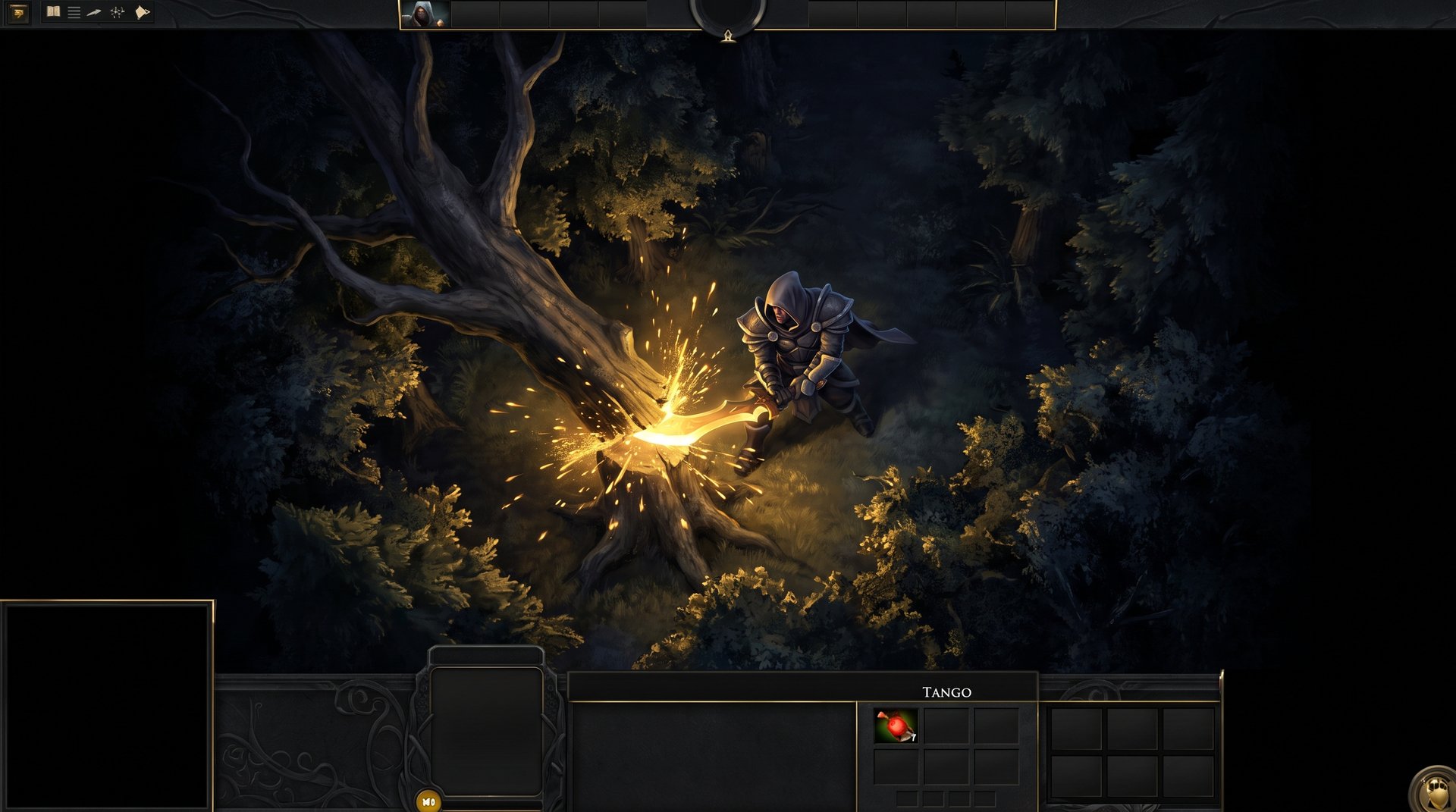
Every Way to Cut Trees in Dota 2
Tree-cutting in Dota 2 is a category unto itself. From basic items to hero ultimates, the number of abilities that interact with trees is larger than most players realize. Knowing the full list matters for two reasons: offensively, knowing what tools you have to open paths and sight lines; defensively, knowing what the enemy can use to follow you into a treeline.
Items That Cut Trees
Two items provide dedicated tree cutting in Dota 2. Both are purchasable early, both are frequently slotted by multiple heroes per game, and both are among the most gold-efficient items in the game for what they provide.
| Item | Cost | How It Cuts | Key Notes |
|---|---|---|---|
| Tango | 90 gold (2 charges) | Targets a single tree in cast range; destroys it and grants 115 HP regen over 8 seconds | Also works on enemy Observer Wards (see below); shareable with allies at the cost of one bonus charge |
| Quelling Blade | 200 gold | Active ability chops one nearby tree in melee range | Passive grants +6 attack damage to melee heroes on creeps; doubles as a farming tool |
The Tango on Observer Ward Mechanic
Tango can target and destroy enemy Observer Wards. The ward counts as a tree target — destroying it and granting the Tango user full HP regen as if they consumed a real tree. This is an intentional mechanic, not a bug, and it is criminally underused below Divine rank.
Why it matters: a single Tango charge at roughly 45 gold (half the item cost) dewarding an observer that cost the enemy 0 gold but 135 seconds of stock time is enormous value. The limiting factor is knowledge: you need to know approximately where the ward is. Behavioral tells (enemy support walking toward a specific tree cluster then immediately leaving), predictive dewarding, and smoke-warded scouting can all give you that knowledge. Once you have it, Tango is a free deward.
Hero Abilities That Cut Trees
Dozens of hero abilities destroy trees in their area of effect. The following table covers the most commonly encountered ones — heroes whose tree-cutting is a core part of how they are played or played against.
| Hero | Ability | Tree Interaction |
|---|---|---|
| Timbersaw | Timber Chain | Destroys all trees along the chain hook path; central to his mobility and gap-closing |
| Timbersaw | Whirling Death | Destroys trees in a circle around Timbersaw on activation |
| Timbersaw | Chakram | Destroys trees in the outbound and return path of the thrown Chakram |
| Nature's Prophet | Sprout | Creates a temporary ring of trees around a target; trees vanish at ability end regardless of cuts |
| Magnus | Shockwave | Destroys trees along the shockwave line |
| Magnus | Skewer | Destroys trees as Magnus charges forward with his target |
| Lina | Dragon Slave | Destroys trees along the fire line; useful for opening sight lines while harassing |
| Jakiro | Dual Breath | Destroys trees along both breath paths |
| Pugna | Nether Blast | Destroys trees in the ground-blast area of effect |
| Clockwerk | Hookshot | Destroys trees in the hookshot path; allows Clockwerk to target heroes hiding in treelines |
| Alchemist | Acid Spray | Destroys trees in the acid spray area |
| Sand King | Epicenter | Destroys trees in the Epicenter pulsing area around Sand King |
| Storm Spirit | Ball Lightning | Destroys trees as Storm Spirit travels through them during Ball Lightning |
| Phoenix | Sun Ray | Destroys trees along the Sun Ray beam path |
This list covers the most frequently encountered tree-cutting abilities but is not exhaustive. Dota 2 has over 120 heroes and many more spells with terrain interaction. The practical rule: any ability with a directional line effect, a wide area of effect, or a dash/charge component has a reasonable chance of cutting trees in its path. Check the in-game tooltip or test in demo mode when you encounter a new hero whose tree interaction you are unsure about.
Timbersaw: The Tree-Cutting Specialist
Timbersaw deserves separate attention because his entire kit is built around tree interaction. Every damage ability he has either requires trees to function or actively cuts trees as a side effect. Timber Chain latches to trees to pull Timbersaw across the map — the more trees, the more mobility. Whirling Death clears trees around him on activation. Chakram cuts trees in both directions of its travel arc.
What this means for playing against Timbersaw: he is significantly weaker in open terrain. Fights near the river, in front of towers, and in other low-tree areas cut his effective mobility to a fraction of what it is in jungle. Forcing Timbersaw into open terrain by avoiding the jungle during team fights is a legitimate counter-strategy that works at every rank.
What this means for playing Timbersaw: pre-cut the jungle you plan to fight through. A Timber Chain works best when there are trees to hook to. If a Quelling Blade clears have already opened large gaps in your jungle, enemy heroes have more predictable paths to intercept you. Maintain the tree density in your own jungle when possible by not over-cutting before fights.
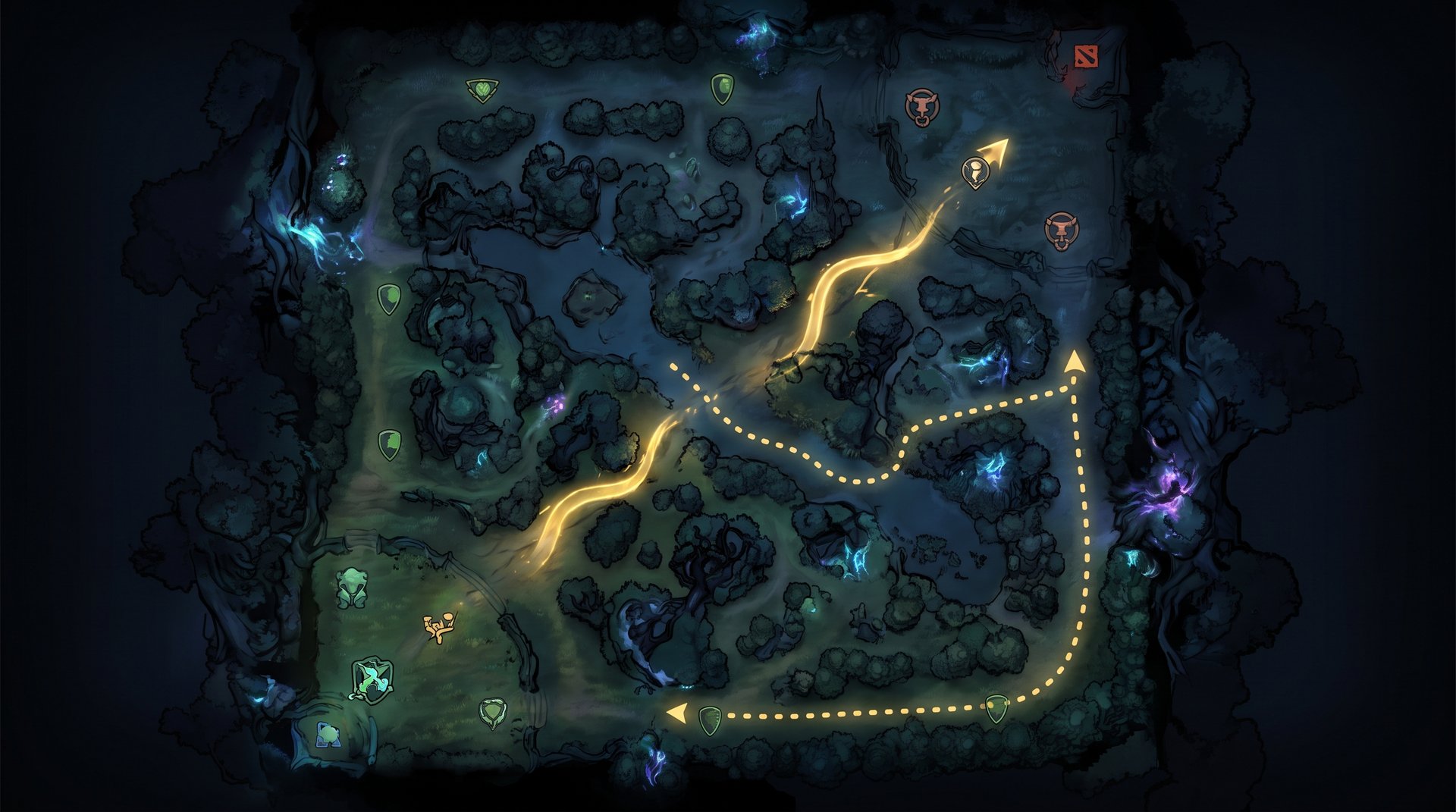
Tree Vision: How Trees Block Sight in Dota 2
Trees block vision — but the exact rules of how they block it, and what bypasses tree vision blocking, determine where wards should go, how jukes work, and why certain angles feel like they should give vision but do not. For a full deep-dive into ward placement by map zone and deward timing, read our Dota 2 Warding Guide. This section focuses on the tree-specific rules that vision strategy is built on top of.
The Core Rule: Trees as Vision Walls
Ground-level units — heroes, creeps, and most observer wards — cannot see through trees. A unit's vision cone is blocked at the tree boundary. If a tree stands between your hero and an enemy unit, that enemy is invisible to you even if the map distance between you is only a few units.
This creates natural “fog of war walls.” A hero hidden immediately behind a dense treeline is invisible to any unit on the other side of that treeline, regardless of proximity. Two heroes can be 50 units apart in map distance with a single tree between them, and neither can see the other from ground level.
This is distinct from how vision works in other games. There is no “partial vision” that lets you see vague shapes through trees. Trees are binary: they either block the sight line or they do not. There is no “half-tree” effect.
Flying Vision and Trees
Units with flying movement bypass tree vision restrictions entirely. They both move over trees without being stopped and see through (or rather, over) them. In Dota 2, flying vision sources include:
- Beastmaster's Hawk: The Hawk ability creates a scouting unit that flies freely over trees and provides vision of any position on the map it travels to. This makes Beastmaster one of the most picked heroes in professional play: the ability to place vision deep in the enemy jungle or over the Roshan pit without committing a ward or a hero is extremely powerful. The Hawk's vision ignores tree blocking entirely.
- Courier in flight: The courier can fly, bypassing trees and providing a limited moving vision source as it travels across the map.
- Aerial heroes and abilities: Heroes whose movement type is “flying” (Batrider, Gyrocopter, and a handful of others) can move over trees and see over them. The same applies to flying-movement-granting abilities.
- Phoenix during Supernova: Phoenix in its Supernova (egg) form has aerial movement.
If a unit can move over trees without being blocked, it sees over them. If trees stop a unit's movement, they also stop that unit's vision.
Wards, Trees, and Vision Coverage
Observer wards placed inside tree clusters see very little. Trees cut off the vision cone in all directions from the ward's placement point. A ward dropped in the middle of a dense forest segment provides almost no vision value — it can barely see beyond its immediate surroundings.
However, wards placed inside tree clusters are also very difficult to find and deward. Sentry wards need vision of the observer to reveal it, and the surrounding trees block sentry vision the same way they block observer vision. This creates a tradeoff: wards at the edge of a cliff or treeline give maximum vision but are easy to sentry; wards placed deeper in the forest give minimal vision but are harder to find.
This is why the best ward spots in Dota 2 are typically at the boundary between tree clusters and open ground — places where the ward looks into open terrain and sees well, while sitting just inside the tree edge where it is harder to spot. Our Warding Guide covers the specific spots by map area in full detail.
Trees, Vision and Smoke Ganks
Smoke of Deceit interacts with trees in an important way. A smoked hero in a treeline is invisible to enemy heroes and wards by default (since smoke provides invisibility from non-adjacent vision sources). But a hero or ward that is physically in the trees near your smoke route can break the smoke — not from the smoke mechanic itself, but because some heroes have proximity detection abilities. Always plan smoke routes to avoid the obvious ward spots along the path, especially in the treeline adjacent to lanes.
5 Key Juke Spots in Dota 2 (Patch 7.41f)
A juke spot is a treeline location where you can make an unpredictable direction change that causes a chaser to lose visual on you. The effect can come from: a bend in the tree corridor that you round faster than the chaser follows; a dense cluster that you enter and exit from an unexpected angle; or simply the fact that the chaser cannot tell which of three exits you used after you disappeared from their screen.
Juke spots work best when you already know the layout and your chaser does not. This is why practicing five specific spots — knowing the exit angles, knowing which trees to cut to create gaps, knowing the width of each corridor — pays recurring dividends. Every time someone chases you into one of these spots without knowing it, your knowledge advantage converts directly into a save.
Note: this post is about tree mechanics and juke fundamentals. Positioning principles that determine WHEN to run into a juke spot versus when to fight or use an escape item are covered in our Map Awareness Guide.
Juke Spot 1: Radiant Safelane Tree Corridor (Bottom Escape)
Between the Radiant T1 bottom tower and the main Radiant jungle lies a tree corridor running diagonally toward the hard camp area. This is the default escape route for Radiant carries being ganked in the bottom lane.
Why it works: Chasers who rotate into the bottom lane — whether by TP or by running from mid — approach from the river side. Entering the tree corridor immediately behind the T1 angles you directly away from their line of approach and puts the tree wall between you and them instantly. With even a half-second head start, the chaser loses direct line of sight the moment you enter the first tree cluster.
How to use it: Pre-cut the first tree in this corridor early — as early as the 2-minute mark on anticipated gank timings. Open the gap and leave it. The regrowth timer means you have 5 minutes of easy access. If the tree regrows before you need it again, the Quelling Blade active reopens it in one click.
Common mistake: Running along the edge of the corridor instead of into it. Edge-running keeps you in partial sight of chasers who are faster than you. Cut a tree and go INTO the forest — depth is what breaks vision, not proximity to the tree line.
Juke Spot 2: Dire Safelane Tree Cluster (Top Escape)
The Dire side mirrors the Radiant setup. Trees between the Dire top lane and the main Dire jungle form a cluster just past the T1 tower. When Dire carries are ganked top, cutting into these trees angles toward the Dire hard camp and the safety of the upper jungle.
Depth advantage: The Dire top tree cluster is deeper than it appears from the lane. Players new to this spot often stop at the first tree gap and are still visible from the lane. The correct move is to push further into the cluster — three to four tree lengths deep — before pausing. At that depth, no ground-level unit in the lane has line of sight on you.
Exit reads: This cluster has two primary exits: toward the Dire hardcamp (looping around to safety) and toward the river side of the T1 (looping back into the lane). Chasers who follow you into the trees will typically commit to one of these exits to cut you off. If they go toward the hardcamp side, exit toward the river. If they commit to the river side, loop deeper toward camp. Reading which way the chaser commits takes experience, but knowing the exits exists is the prerequisite.
Juke Spot 3: Mid Lane Treeline Bends
Both sides of the mid lane have tree corridors that midlaners use constantly. Because midlane is the highest-rotation target in the game, these corridors get the most use of any juke location.
Radiant mid side: The trees south of the mid river crossing create a bent corridor. Entering when a Dire hero is rotating from the Dire jungle gives you a brief gap before they can see which direction you turned at the bend. Midlaners who keep Quelling Blade active can open a second exit at the bend, making the choice even harder for the chaser.
Dire mid side: Symmetric setup. Trees north of the mid crossing toward the Dire jungle and top side. Pre-cutting a gap here at the standard 3-minute gank timing — just before the first rune spawn when rotations are most likely — is a habit that saves midlane carries repeatedly across a game.
Hero-specific note: Storm Spirit's Ball Lightning cuts trees as he travels, making him one of the most corridor-independent midlaners. He creates his own paths. If you are chasing a Storm Spirit who entered a treeline, do not assume the corridors he used are the standard ones — he may have cut new angles that do not exist for any other hero.
Juke Spot 4: Roshan Pit Approach Trees (Center Map)
Post-New Frontiers (patch 7.33+), Roshan sits in the center of the map in a pit with trees on multiple flanks. Fights near Roshan are among the most intense in the game, and the trees immediately around the pit's approach corridors are used as both ambush positions and escape routes by both teams.
Defensive use: If your team just won a Roshan fight but an enemy survived, that enemy almost always tries to use these trees rather than running back to base — base is slower and more exposed. Knowing the rough tree layout here lets you predict their position and decide whether to chase or secure the objective first.
Offensive use: If you are the survivor retreating from a bad Rosh fight, the tree clusters on the far side of the pit (away from the enemy team) buy critical seconds for a TP channel to complete. Even 2 to 3 seconds of visual block from the trees is often enough for the TP animation to finish.
AOE awareness: The Roshan area is a constant site of Epicenter (Sand King), Sprout (Nature's Prophet), Chakram (Timbersaw), and other tree-cutting abilities during fights. Always glance at the state of nearby trees before committing to a juke into this area mid-fight — the corridor you planned may have been cut open by fight AOEs, removing the vision block you were counting on.
Juke Spot 5: Lotus Pool Corridors (New Frontiers)
The Lotus Pool is the defining new feature of the New Frontiers map (added in patch 7.33), sitting in the center of the map and surrounded by tree corridors that many players still do not know well. This makes it the highest-variance juke location in the current game — the unfamiliarity factor is enormous.
Experienced players who know the Lotus Pool tree layout can disappear into the adjacent corridors cleanly, with multiple exit angles that are hard to predict if you have never studied them. Less-experienced chasers — which describes most players outside the top thousand MMR — have poor mental models of this area and often over-commit to one exit while you escape through another.
How to learn it: Open a custom lobby, walk to the Lotus Pool area, and spend five minutes following every tree corridor by foot. Identify the entry and exit points. Cut a tree to see where it opens. This is a 5-minute investment that pays back every game you play for the foreseeable future, because most of your opponents at any bracket below Immortal have not done it.
AOE caveat: The Lotus Pool is a contested objective and gets a lot of fight AOE traffic. After any significant fight in the center of the map, check whether key corridors around the pool have been cut open before relying on them for a juke.
Advanced Tree Mechanics Worth Knowing
Beyond the fundamentals, a few tree mechanics separate players who “know about trees” from players who actively gain value from them in every game.
Pre-Cutting for Safety
The best tree usage is proactive, not reactive. If you are playing a carry in the safelane against a Pudge mid or a roaming support, spend 30 seconds in the early laning phase to cut the first tree in your nearest escape corridor. This costs you one Tango charge. What it buys is a gap that is already open when you need to run — removing one step from the escape sequence under pressure. Reacting to a gank and then cutting the tree is two actions under duress. Having the gap pre-cut is one action: run.
Cutting for Vision Control
Trees can be cut offensively to open vision angles that observer wards cannot provide. A Quelling Blade active that removes one tree on the edge of the enemy jungle gives you a sight line into that camp from the river — sight you would otherwise need a ward for. This is especially useful for supports who have run out of ward stock but still need information on enemy jungling patterns. A single Quelling Blade active, costing 200 gold and already in your inventory, provides real-time vision at zero additional cost.
Tree-Blocking Abilities
Several abilities create terrain or movement effects around trees in ways that matter for positioning:
- Treant Protector's Nature's Guise: Treant can become invisible while near trees. His proximity to trees is what activates the fade. This means keeping Treant pushed away from the treeline — fighting him in open ground — removes one of his key defensive mechanics.
- Nature's Prophet's Teleportation: Nature's Prophet can TP to any location on the map, including into tree clusters. This makes him one of the most tree-aware heroes in the game by necessity — he teleports to the exact location he clicks, so he must know which tree-interior spots are safe to arrive at without walking into solid tree geometry.
Using This Knowledge to Climb
Tree mechanics, vision control, and map awareness are tightly interconnected. Players who understand trees deeply make better real-time decisions because they always know which corridors are available as escape options and which vision gaps exist near objectives. This is the kind of knowledge that high-MMR players accumulate naturally through experience, but it can be accelerated intentionally.
If you are trying to climb from a lower bracket, mastering one tree corridor per hero role — one for your typical safelane position, one for mid, one for support — is more immediately useful than learning ten in the abstract. Apply each one in live games before adding more. Check our best Dota 2 boosting services comparison if you are interested in external MMR support, or see our Dota 2 boosting safety guide for the facts on how these services work. For solo improvement, our MMR Boosting Guide covers the fastest organic paths to climb.
Want to Accelerate Your Climb?
Tree mechanics and vision control are exactly the areas that Immortal-rank coaches address in early sessions — they are the clearest skill gaps between Herald/Archon and Ancient/Divine players. A single coaching session often identifies the five specific habits holding your rank in place. Tree awareness is almost always one of them.


