


How Much MMR Do You Gain or Lose per Game in 2026? (Ranked, Calibration, Uncertainty)

In standard ranked Dota 2 (patch 7.41f), most players gain or lose +25 or -25 MMR per game. That number is flat — Valve does not publish its exact formula, but the community consistently reports +/-25 as the baseline once a player has low uncertainty. New accounts and players returning after a long break see larger swings, and calibration games follow entirely different rules.
| Scenario | MMR per Win | MMR per Loss | Notes |
|---|---|---|---|
| Standard ranked (low uncertainty) | +25 | -25 | Community-observed baseline, most active accounts |
| Returning player (3+ months away) | +28 to +34 | -28 to -34 | Uncertainty rises after inactivity; settles after ~20-30 games |
| New account (fresh ranked unlock) | +30 to +35 | -30 to -35 | High uncertainty phase; swings decrease each game |
| Calibration game (first-time placement) | +60 to +120 | -60 to -120 | Community reports; wide range based on starting position |
| Win streak (4+ in a row) | +25 | -25 | Win streak bonus was removed in patch 7.07 (2017) |
All figures above are community-observed and compiled from thousands of game reports on Dotabuff, OpenDota, and Dota 2 community forums. Valve has never officially published exact MMR deltas.
Table of Contents
How Standard Ranked MMR Works in 2026
Dota 2 uses a variant of the Elo rating system for ranked matchmaking, but with Valve’s own modifications that have never been fully documented. What the community has measured across years of tracking is a mostly flat +/-25 MMR system for established accounts with low uncertainty.
After enough ranked games — roughly 100 or more across an account’s history — most players find that every win gives exactly +25 MMR and every loss takes exactly -25. The system does not care how well you performed personally. KDA, last hits, tower damage, and ward count have no effect on this number. Only the win or loss outcome matters for understanding how MMR is calculated.
This flatness is intentional. Valve wants the system to reward winning as a team rather than individual performance. A support who buys wards, rotates correctly, and saves their carry gets the same +25 as the carry who went 15-2 with 700 GPM. Both contributed to the win, and both get the same credit.
What Determines If You Get Exactly +25
The +/-25 number is not literally hardcoded into every account. It is the result of the uncertainty component of Valve’s algorithm reaching its lowest practical value. When uncertainty is low, MMR changes stabilize at +/-25. When uncertainty is elevated, the number rises.
Factors that keep uncertainty low:
- Playing ranked consistently — at least a few games per week
- Having a long match history (200+ ranked games on the account)
- Not taking extended breaks from the game
- Playing at a consistent time of day on the same servers
Factors that push uncertainty up and raise your MMR swing:
- Long break (3+ months of no ranked games)
- First ranked games on a fresh account
- Playing on servers far from your usual region
- Account calibration or recalibration periods
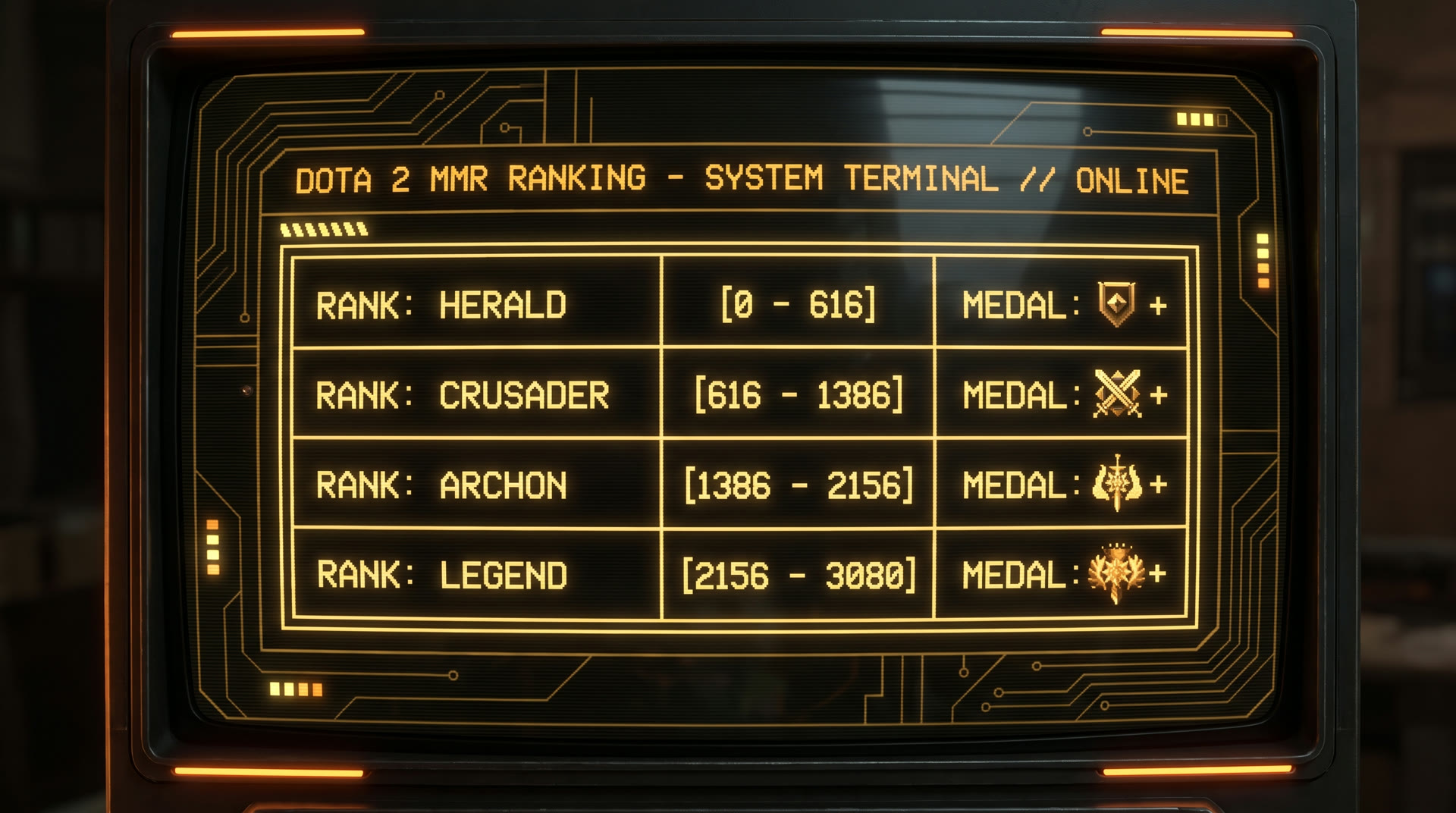
The +/-25 System in Numbers
To illustrate: if you win 6 and lose 4 of your next 10 games, you will be +20 MMR net (+60 from 6 wins, -40 from 4 losses). To break even, you need a 50% winrate. To climb meaningfully — say, 500 MMR over a season — you need roughly 10 more wins than losses per 100 games played, which is a 55% winrate maintained consistently.
That math is why players who want faster MMR progress either need to find a significant skill gap in their bracket, improve their hero pool, or bring in external help. At exactly 50%, you are treading water forever.
What Uncertainty Does to Your MMR Swings
Uncertainty is Valve’s internal measure of how confident the system is in your current MMR number. It is never shown to you directly, but its effects are visible: if you gain more than 25 MMR from a single win, your uncertainty is elevated. If you gain exactly 25, it has settled.
Think of uncertainty as a confidence interval. A player with 4 ranked games has very wide uncertainty — maybe they belong at 1000 MMR, maybe at 3000. As they play more, the system narrows that range. After 100+ games, uncertainty reaches a floor and changes stabilize.
Returning Player Uncertainty
If you come back to ranked after 3 or more months away, your uncertainty automatically increases. The longer the break, the higher it rises. Community tracking suggests that returning players commonly see +/-28 to +/-34 per game for the first 15-30 games before settling back to +/-25.
This is intentional. Valve knows that players’ actual skill can change significantly over months — you might have played a lot of other games, watched professional Dota, or conversely let your mechanics rust. The system briefly widens to recalibrate quickly. For a detailed breakdown of how this affects matchmaking, the post why you get matched against higher ranks during uncertainty explains the pairing logic.
How Many Games to Reach Low Uncertainty
There is no universal answer, but community reports consistently point to:
- Fresh account: 30 to 50 ranked games to approach +/-25
- Returning player (3-6 month break): 15 to 25 games
- Returning player (1+ year break): up to 40 games
These are community-observed estimates. The actual number depends on the consistency of your results. If you win 10 games in a row during high uncertainty, the system updates rapidly. If results are mixed, uncertainty takes longer to resolve.
MMR Per Game During Calibration
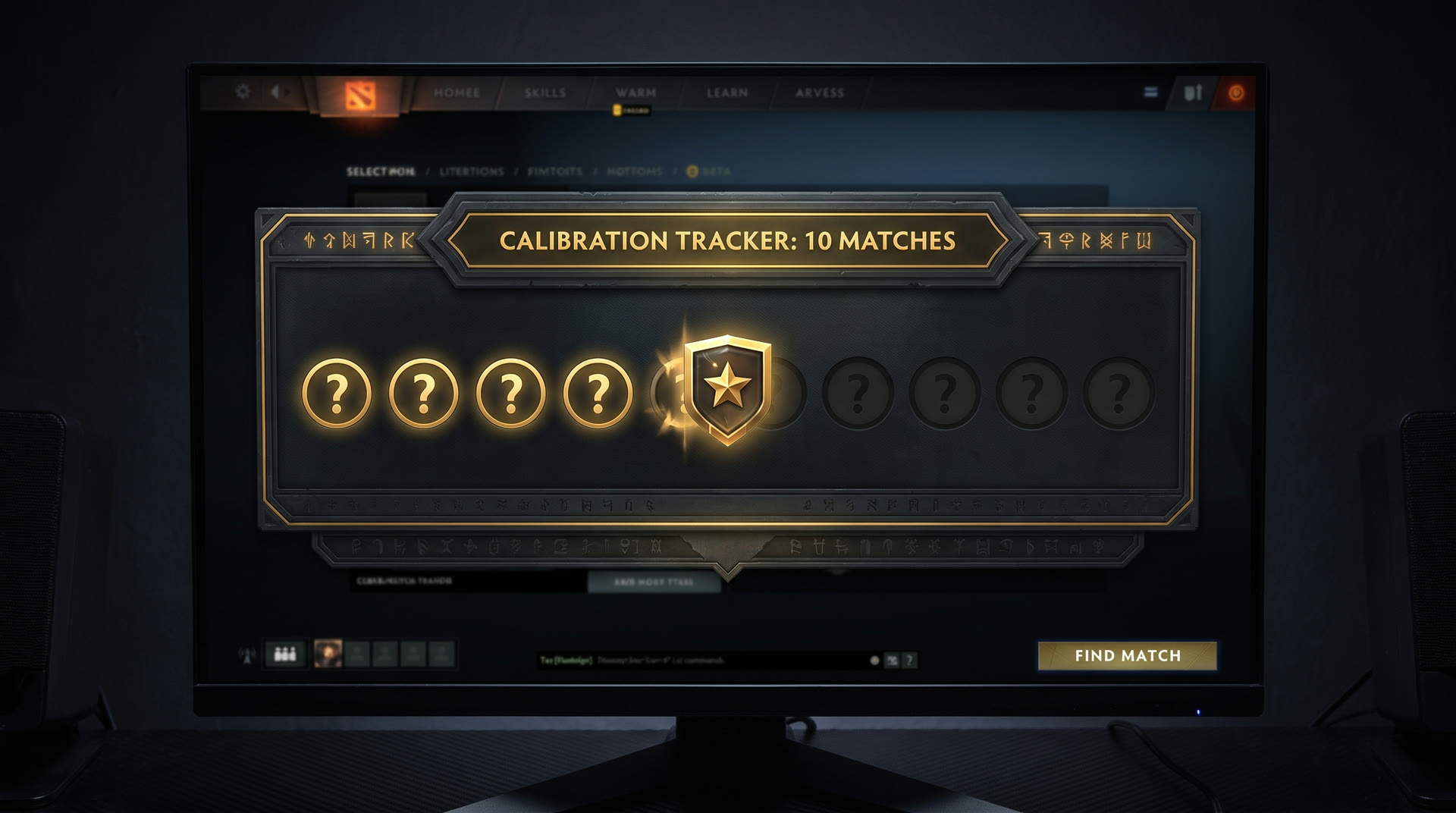
Calibration is different from standard ranked. When you first unlock ranked (or in seasons where Valve resets the calibration), you play a set of placement games. Each win or loss during this phase moves your MMR by a much larger amount than the standard +/-25.
Community data compiled from player reports over multiple seasons suggests calibration MMR swings range from approximately +60 to +120 per win and -60 to -120 per loss. The exact amount depends on:
- Your performance level relative to the bracket you are being placed into
- Whether you won or lost the previous placement game
- Your account’s underlying uncertainty at calibration start
For the full breakdown of what happens across all 10 calibration games — including what winning all 10 realistically gets you — the post what happens if you win all 10 calibration games covers the expected endpoints by starting rank.
Why Calibration Swings Are Larger
The mathematics behind this are simple: the system needs to move you from an uncertain starting position to an accurate MMR estimate in as few games as possible. If it only moved +/-25 per game, it would take 100+ games to place a 5000 MMR player who starts at 1000. Large calibration swings solve this — they get your MMR close to reality in 10 games rather than 100.
The downside is that a player who goes 5-5 in calibration will end up lower than a player who goes 8-2, even if both have the same underlying skill level. This is why your calibration record matters more per game than any other phase of ranked play. If you want help ensuring a strong calibration result, the Dota 2 MMR calibration service lets experienced boosters play through the placement phase at your skill ceiling.
Win Streaks — What Changed in 2017
Many players still believe that winning 4 or more games in a row gives bonus MMR. This was true — but the win streak bonus was officially removed in patch 7.07 in November 2017.
Before 7.07, players on a hot streak could earn more than +25 per win, which created a system where players tried to engineer streaks. After 7.07, Valve flattened this out. Today, whether you are on a 10-game win streak or just coming off a 10-game losing streak, each new game is worth exactly +/-25 (assuming low uncertainty).
The details are covered fully in do win streaks give bonus MMR in Dota 2, including testing methodology and what the current 7.41f system actually rewards instead.
What Still Changes During Streaks
While the MMR delta stays the same, there are secondary effects of being on a winning or losing streak:
- Matchmaking confidence: if you have been winning consistently, the system may match you against slightly stronger opponents faster than usual to confirm your rating — this is uncertainty adjusting, not a streak system
- Rank star progress: stars at each medal tier require a fixed number of wins, so consistent winning fills stars faster regardless of MMR amount
- Behavior score: extended positive interactions improve your behavior score, which affects matchmaking pool quality but not MMR delta
Why Your MMR Feels Inconsistent
If MMR is just +/-25 per game, why does it feel inconsistent? Several factors create the illusion of unfairness:
Smurfs and Account Buyers
A smurf (experienced player on a fresh account) has high uncertainty. When they win against your team, they gain +30-35 per game. When you lose to them, you lose the standard -25. This creates a slight asymmetry that feels like the system is penalizing you for losing to someone who was not meant to be in your bracket.
Party vs. Solo MMR History
Playing in a party can affect matchmaking bracket placement. If your party has much higher average MMR than yours, the system adjusts expected outcomes, which can alter how wins and losses translate to MMR changes. Community tracking shows solo MMR tends to be more stable and predictable than party MMR movements.
Behavior Score and Match Quality
Behavior score does not change your MMR delta directly. But a low behavior score places you in lower-quality lobbies with more disconnects, trolls, and intentional feeders. In these lobbies, wins become harder to secure — you might be playing 5v4 or 4v3 regularly without knowing it. This feels like the game is “rigged” but is actually a consequence of accumulated poor behavior score.
The Variance Is You
This is uncomfortable, but the data supports it: at a large enough sample (50+ games), MMR movement is almost entirely explained by your winrate, which is almost entirely explained by your relative skill level in that bracket. If you are 300 MMR below your ceiling, you will hover. If you are 300 MMR below your floor, you will grind out a climb over time. The system is accurate — it just takes more games than most players want to believe.
For players who want the hard math on how many wins per star it takes to visibly climb, how many games per medal star breaks down the exact game counts needed at each bracket.
How to Maximize MMR Gain Per Game
You cannot change the +/-25 per game. But you can control how consistently you win. Here is what the data and player experience say about climbing more efficiently:
Play High-Impact Roles in Your Bracket
In lower brackets (Herald through Crusader), position 1 carry and position 3 offlane tend to have the highest individual impact per game because these roles can snowball the game independently. In mid brackets (Archon through Legend), mid lane adds a massive carry potential. In higher brackets (Ancient+), support execution becomes the key differentiator.
Lock a Small Hero Pool
Playing 2-3 heroes at very high mastery consistently outperforms playing 10 heroes at moderate mastery. When you know your hero’s timings, power spikes, and counterplay inside-out, you eliminate mechanical mistakes that would otherwise cost games. Community tracking on Dotabuff shows that players who track 20+ games on one hero average 3-5% higher winrate than those who spread across 10+.
Maintain Behavior Score
If your behavior score falls below roughly 9000, you will notice a quality drop in your lobbies. Concede-votes get used aggressively, players disconnect early, and tilted teammates become common. Keeping your score high is free MMR in the sense that it prevents unnecessary losses to lobby quality issues.
Consider Coaching for Mechanical Ceilings
If you have been stuck in the same 200 MMR range for 50+ games, the issue is usually a pattern in your decision-making that you cannot see from inside a game. A session with an experienced coach who has played at your target MMR identifies these patterns faster than solo review. The Dota 2 coaching service is designed specifically for this — one session focusing on your recent replays often unlocks a climbing pattern that raw game volume would take months to find.
For players who want to accelerate the climb directly, you can also review the options at Dota 2 MMR boost to see what targeted rank-pushing looks like with professional help. A full breakdown of what to look for in any boosting service is covered in is Dota 2 boosting safe.
Frequently Asked Questions
Want to Climb Faster Without the Grind?
At +25 per win, climbing 1000 MMR takes hundreds of games at a 55% winrate. TeamSmurf’s boosters have been through every bracket and know exactly what separates climbing accounts from stuck ones. Whether you need a coached session to fix a specific pattern or a direct rank boost to hit your target, we deliver guaranteed results.



