Why Am I Matched Against Higher Ranks? Uncertainty Explained

You load into a ranked game and hover over the enemy mid. Their profile shows a Divine badge — you are Archon. Your stomach drops. You start the game convinced it is already lost. But here is the thing: the matchmaker put that player in your lobby for a specific reason, and once you understand it, that knot in your stomach will start to loosen.
Dota 2 matchmaking is built around a concept called uncertainty. The system does not always know exactly how good you are, and it does not always know exactly how good your opponents are either. When uncertainty is high, the range of possible opponents widens. This article breaks down exactly why that happens, what you can do about it, and when the smarter play is to stop grinding and get professional help moving the needle with our Dota 2 boosting services.
What You Will Learn
- How Dota 2 Uses Glicko-Style Ratings
- What Rating Deviation (Uncertainty) Actually Means
- New and Returning Accounts: The High-Uncertainty Window
- How Uncertainty Widens Your Match Pool
- Party Queue and the Skill Gap Problem
- Role Queue MMR and Why Ranks Look Mismatched
- Smurfs and Sandbagging
- Queue Time vs Match Quality Trade-Off
- What You Can Actually Do About It
- FAQ
How Dota 2 Uses Glicko-Style Ratings
Valve has never published a full technical specification of the matchmaking algorithm. What is publicly known — from official blog posts, GDC talks, and the work of community researchers — is that Dota 2 uses a system broadly similar to Glicko-2, a rating model originally designed for chess that was later adapted for online games.
In a Glicko-2 system, every player carries three values instead of one:
- Rating (R) — your estimated skill, expressed as MMR in Dota 2
- Rating Deviation (RD) — how confident the system is in that estimate (lower RD = higher confidence)
- Rating Volatility (sigma) — how much your rating is expected to fluctuate based on recent performance
The MMR number you see in your profile reflects R. What you do not see publicly is your RD, and that hidden number is the core reason you sometimes end up in games with players who look far more skilled than you.
What Rating Deviation (Uncertainty) Actually Means
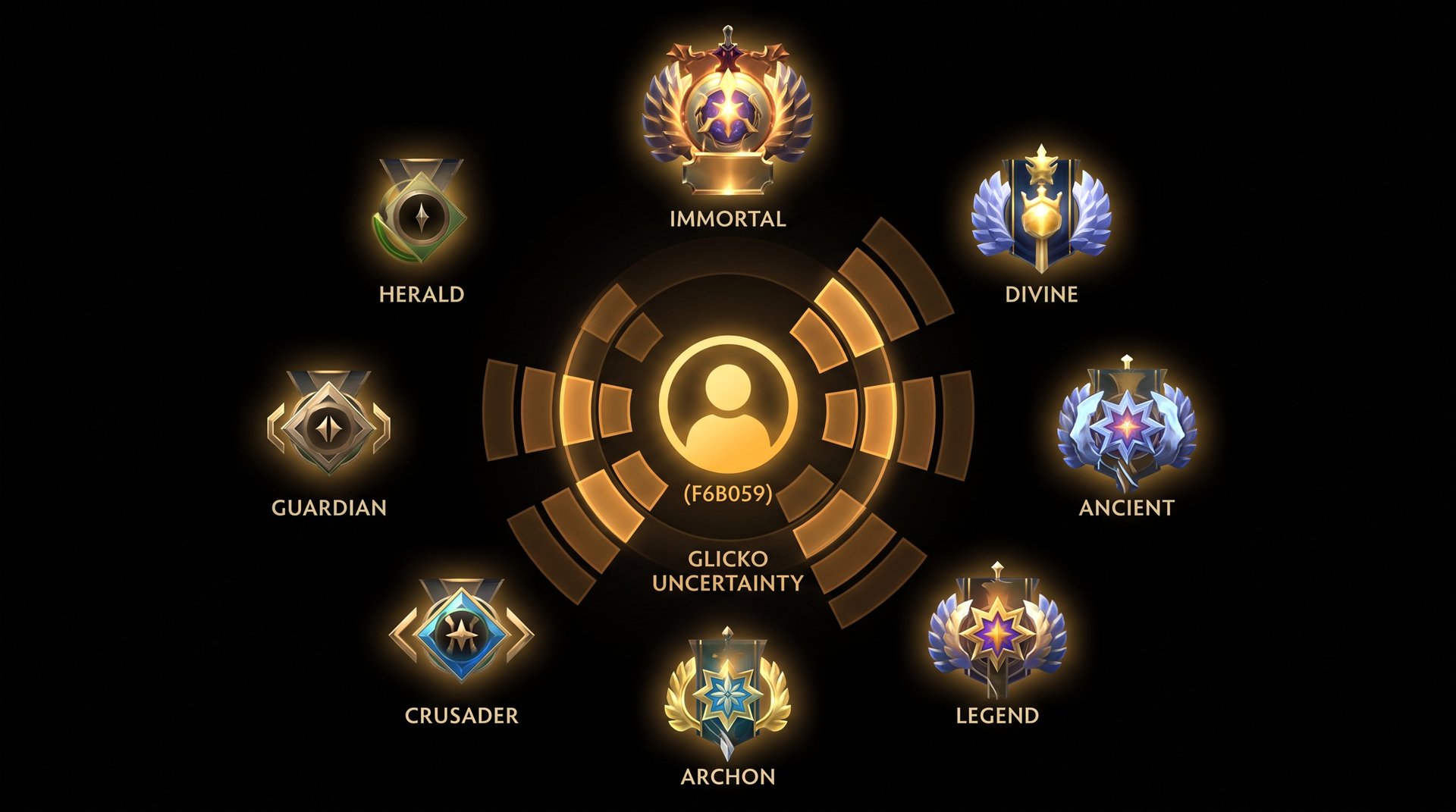
Think of your MMR not as a single fixed number but as a range. If your RD is high, the system is essentially saying: “This player is probably around 3,000 MMR, but could realistically be anywhere between 2,400 and 3,600.” If your RD is low — meaning the system has watched you play many games and has high confidence — that range tightens to something like 2,900 to 3,100.
The matchmaker uses this range when searching for opponents. It is not looking for players at exactly your MMR. It is looking for players whose ranges overlap with yours. When your RD is high, your range is wide, and you will regularly land in games with players whose median MMR is notably different from yours.
Why RD Changes Over Time
Your RD naturally increases (uncertainty grows) when you have not played ranked matches recently. Valve applies a decay to confidence: the system knows its estimate of a player who has not played in three months is less reliable than its estimate of someone who completed matches yesterday. When you come back from a break, your first few games will have a wider impact on your MMR in both directions — and you will face a wider range of opponents.
Conversely, RD decreases (uncertainty shrinks) as you play more ranked games. Community research suggests that a typical account reaches a “settled” confidence level after roughly 30 to 50 ranked games following calibration, though accounts that exhibit high volatility — big swings in performance — may take longer.
New and Returning Accounts: The High-Uncertainty Window
New accounts present the biggest uncertainty problem. Every new account goes through 10 calibration matches before receiving an initial medal. During those 10 games, and for a period afterward, the system has very limited data. It is essentially asking: “Who is this player?”
The answer it arrives at could be wrong — sometimes significantly. A player who rushed through 100 Turbo games before playing ranked will have a behavior score, a playtime, and hero pool data that the matchmaker uses as signals, but calibration MMR is still highly uncertain. Community estimates suggest new-account uncertainty windows can be equivalent to several hundred MMR in either direction.
Returning players face a similar problem. An account that was Divine 2 twelve months ago and just queued for the first time since a long break will have its RD inflated. The system knows this player was good but is not sure whether they are still good, and it will test that uncertainty by placing them in games where the actual skill level of the lobby is broader than usual.
How Uncertainty Widens Your Match Pool
The matchmaker has two competing goals that are always in tension:
- Match quality: Put equally skilled players together
- Queue time: Find a match quickly
These goals conflict. Especially at non-peak hours, the pool of available players at your exact MMR range may be very small. To find a full 10-player lobby quickly, the system widens the skill window it is willing to accept.
When that widening happens, you or someone on your team or the enemy team may be an outlier — their RD is high (uncertain placement) or the queue time has stretched long enough that the system is accepting a broader range to fill the lobby. Both situations produce the “why am I playing a Divine?” feeling.
| Account Status | Estimated Uncertainty Level | Typical Match Range | Games to Settle |
|---|---|---|---|
| Brand new account (calibrating) | Very high | +/- 400-600 MMR (community est.) | 10-30 games |
| Returning after 6+ months | High | +/- 200-400 MMR (community est.) | 20-40 games |
| Active player, 30+ recent games | Medium | +/- 100-200 MMR (community est.) | Already settling |
| Veteran with 500+ ranked games | Low | +/- 50-100 MMR (community est.) | Stable |
| Low-population server off-peak | Variable | Can expand significantly | N/A (queue dependent) |
All MMR range figures in the table are community estimates. Valve has not published exact numbers for uncertainty windows or match range expansion rates.
The Queue Time Expansion Problem
Most regional servers have peak hours — usually evening local time — and off-peak hours in the early morning. During off-peak, there are simply fewer players in the pool at any given MMR range. The matchmaker must either wait longer (increasing queue time) or accept a wider skill gap (decreasing match quality). In practice, it does both: it waits a limited amount of time and then expands the acceptable window incrementally.
This is why high-MMR players (above 6,000 MMR) and very low-MMR players (below 1,000 MMR) often report the worst match quality in terms of visible skill spread. Both tails of the distribution have fewer players, so the pool expansion kicks in sooner and more aggressively.
Party Queue and the Skill Gap Problem
Playing in a party introduces another source of apparent rank mismatches. When a party queues, the matchmaker must balance the skill level of the entire party against the skill level of the opposing side. A party containing two players — one at 2,000 MMR and one at 5,000 MMR — creates a combined average that may land somewhere in the 3,500 range. The matchmaker will then try to build the opposing team from solo players in that range.
The result is that solo queue players in the 3,500 range end up in a lobby where one enemy is a 5,000 MMR player. From their perspective, they are facing someone wildly higher than their bracket. From the matchmaker’s perspective, the average balance is acceptable.
Valve has applied penalties to large MMR gaps within parties — community research suggests parties with members more than 1,500 MMR apart experience longer queue times and reduced match quality scores. The exact penalty thresholds are not published by Valve.
This is one reason MMR boosting via duo coaching is appealing to players stuck in a bracket: a professional player handles the high-skill slot in the party and shapes the lobby in a more predictable direction rather than contributing to random skill-gap lobbies.
Role Queue MMR and Why Ranks Look Mismatched
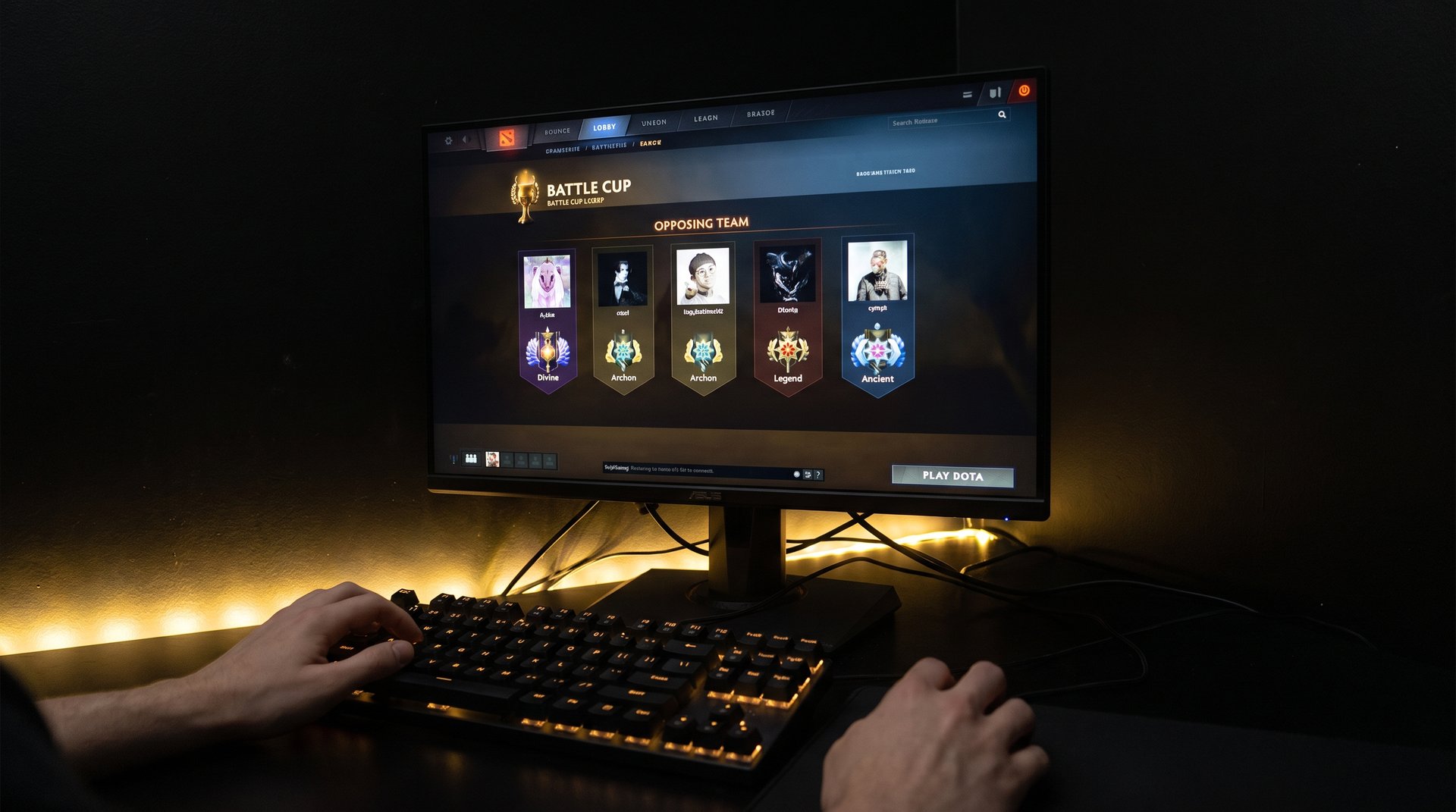
Dota 2’s role queue system gives players separate MMR values for their core role and their support role. A player might be 4,500 MMR as a core and 3,800 MMR as a support. When you hover over an enemy player in a ranked role-queue game, the badge you see reflects their highest MMR across roles (or sometimes their current role MMR, depending on client display settings — this can vary).
This creates a specific mismatch scenario: the player you are looking at shows a 4,500 MMR badge, but they queued for support in this particular game. Their support MMR is 3,800, which is closer to your own core MMR of 3,600. The matchmaker matched you against them in the support role, not the core role, and the skill gap is much smaller than the badge implies.
Conversely, a player might queue core at their 4,500 MMR and end up in a lobby that would normally be below their core rank because the system accepted a wider window during calibration or off-peak. Understanding which role a player queued for — and at what role MMR — removes a lot of the apparent “mismatch” confusion.
Smurfs and Sandbagging
Not every “higher-ranked” player in your lobby got there through the uncertainty system. Some are there because they are sandbagging — intentionally playing poorly to suppress their MMR — or because they are smurfing on alternate accounts that are still in calibration.
Valve has invested in smurf detection since 2020 and continues to iterate on it. When a new account performs at a level significantly above its current MMR, the system applies accelerated calibration adjustments, moving the account up the ladder faster than normal. Community estimates suggest that a highly skilled player on a fresh account may be matched in games 500 to 1,500 MMR above the account’s current badge within the first 20 to 30 ranked games — which means you are sometimes facing them during that adjustment period.
Sandbagging is a different issue. A player who deliberately throws games to lower their MMR below their natural skill level will produce games where their opponents (you) face someone significantly better than the lobby’s median MMR suggests. This is a known problem in Dota 2 and one Valve’s behavior score system attempts to address indirectly, though it is an imperfect solution.
If you are consistently losing to players who seem far above your bracket, it is worth honestly evaluating whether the gap is partly the uncertainty system at work and partly your own skill ceiling. Many players who feel they are “trapped” in a bracket by unfair matchmaking are actually at or near their true MMR. A professional boosting service can help you determine your true ceiling by watching how you perform after being placed higher.
Queue Time vs Match Quality Trade-Off
The matchmaker does not have a universal solution to the quality-vs-speed problem. It uses a scoring function that weighs multiple factors — MMR balance, party composition, role fill, server ping — and finds the best available combination from the current pool of queuing players. “Best available” is the key phrase.
If there are only 50 players in your MMR range queued on your server right now, the best available lobby may still have a wider skill spread than either you or the algorithm would prefer. The system is making a local optimum decision given the players in the pool, not a global perfect match.
This is not a bug or a conspiracy. It is a fundamental constraint of any live-service online game with a limited player pool. Games with 100,000 simultaneous players will always have better match quality at any given MMR than games with 10,000, because the pool to sample from is 10 times larger.
What Valve Has Said About Match Quality
Valve has published occasional matchmaking updates acknowledging the quality-vs-speed trade-off. In a 2021 developer blog, they stated that improvements to the system prioritized “finding fair matches over finding fast matches” — but also acknowledged that queue time targets (the hidden timer at which the system begins expanding its acceptable MMR window) are calibrated based on regional player counts. Regions with fewer players have a shorter timer before expansion kicks in.
What You Can Actually Do About It
Understanding why the mismatch happens is useful, but what can you actually do about it?
1. Play During Peak Hours
The larger the pool of available players at your MMR, the better your match quality. Queue during regional peak hours — typically 7:00 PM to 11:00 PM local time — to maximize the chance the matchmaker has enough players in your range to form a balanced lobby without expanding the window.
2. Accept Calibration Games for What They Are
If you are on a new account, recently returned from a break, or just finished a seasonal recalibration, give yourself 20 to 30 games before drawing conclusions about match quality. Your RD is still high, the system is still learning where you belong, and the lobbies will reflect that uncertainty. Do not tilt, do not force, do not switch roles mid-calibration.
3. Play Ranked Roles and Fill Your Correct Role
The role queue system is designed to reduce the mismatch caused by role-MMR gaps. Use it. Queue for the role you intend to play, at the MMR that reflects your skill in that role. Trying to queue support when you are a 5K core player — hoping for easier games — will backfire because the lobby quality will reflect your inflated core MMR badge, not your lower support MMR.
4. Avoid Large-Gap Party Queues
If you are 2,500 MMR and your friend is 4,500 MMR, queuing together will consistently produce lobbies where someone on your team or the enemy team seems out of place. The matchmaker is doing its best, but the math is difficult. If climbing is the goal, both players may need to work on their individual MMR before productive party queue is possible.
5. Get Professional Help if Calibration is Broken
Some players find themselves stuck in a bracket that genuinely does not reflect their skill — often because of a bad calibration run (a streak of losses during the 10 initial calibration games) or because they improved significantly since their last calibration. A professional duo boost or coaching session can help reset the trajectory. Our full MMR boosting guide walks through how the process works safely and what to expect.
If you have concerns about account safety, read our detailed breakdown of whether Dota 2 boosting is safe before making any decisions.
6. Track Pattern, Not Individual Games
One game against a higher-ranked opponent is noise. Twenty games in a row against higher-ranked opponents is a signal — either your RD is still high (and will normalize), or there is a systemic issue with your region’s pool size. Track your last 20 games. If the skill spread is consistently wide, check your regional server population data (tools like Dotabuff or Stratz can surface this) and consider switching to a more populated server during off-peak.
Stop Guessing, Start Climbing
If uncertainty has you stuck — if calibration went wrong, if you are returning after a break, or if you simply want to know what your real ceiling looks like — our boosters work alongside you, not instead of you.
Every TeamSmurf booster has been vetted at the Immortal level. We do not use bots, scripts, or account-sharing without explicit client approval. Our boosting service is the fastest way to cut through bad calibration and start playing games that reflect your actual skill.