

Low-Stakes and No-Stakes Games Explained: When a Loss Costs Less

You queue ranked, the game fills, and just before the horn sounds you see a banner: “This is a low-stakes game.” Your first thought is probably “does this mean I don’t have to try?” Your second thought is probably “wait — what does this actually cost me?”
Low-stakes and no-stakes games are Dota 2’s way of telling you that matchmaking made a compromise. The lobby is unbalanced enough that Valve has decided to reduce — or remove entirely — the MMR on the line. This page explains when that happens, how much MMR you actually gain or lose, and why it matters for how you play.
One thing this page does NOT cover: abandonment penalties. If you left a game and want to know what you lost, that is a separate system entirely — read our full breakdown at Do You Lose MMR for Abandoning? Every Penalty Explained.
What You Will Find Here
- What Are Low-Stakes Games?
- What Are No-Stakes Games?
- Low vs. No vs. Normal: Full Comparison
- When Does the System Apply This?
- The Party MMR Gap Problem
- How Much MMR Do You Actually Gain or Lose?
- Does This Affect Your Behavior Score?
- Should You Still Try in These Games?
- Not the Same as Abandonment Penalties
- Frequently Asked Questions
What Are Low-Stakes Games in Dota 2?
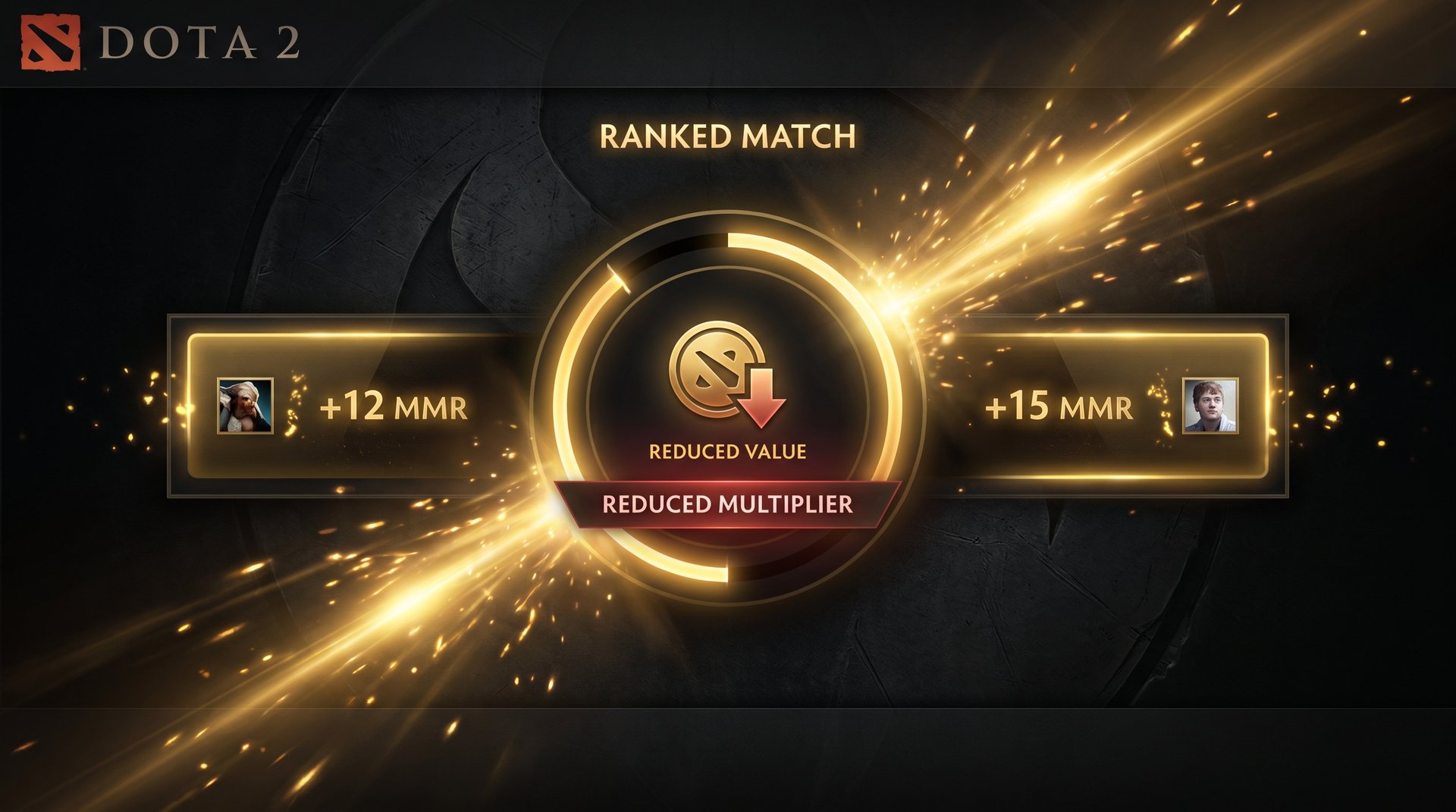
A low-stakes game is a ranked match where Valve’s matchmaking system has determined that the lobby does not meet its normal quality threshold. Instead of cancelling the search or making one team wait longer, it creates the game anyway — but reduces the MMR multiplier on both sides.
In practical terms: the wins and losses still count, the game still goes on your record, and your behavior score is still affected. The only thing that changes is how many MMR points move. You earn less for a win and you lose less for a loss.
Valve introduced the low-stakes designation as part of its ongoing effort to make ranked matchmaking feel more fair. Rather than forcing players into obviously skewed lobbies at full MMR cost, the system signals the imbalance upfront and softens the penalty for whoever ends up on the weaker side.
The notification is displayed during the pre-game loading sequence — you will see a banner or indicator on the match accept screen or the loading screen itself noting the reduced stakes. Once you see it, you cannot back out without taking an abandon penalty (which is a separate system — more on that below).
What Triggers the Low-Stakes Label?
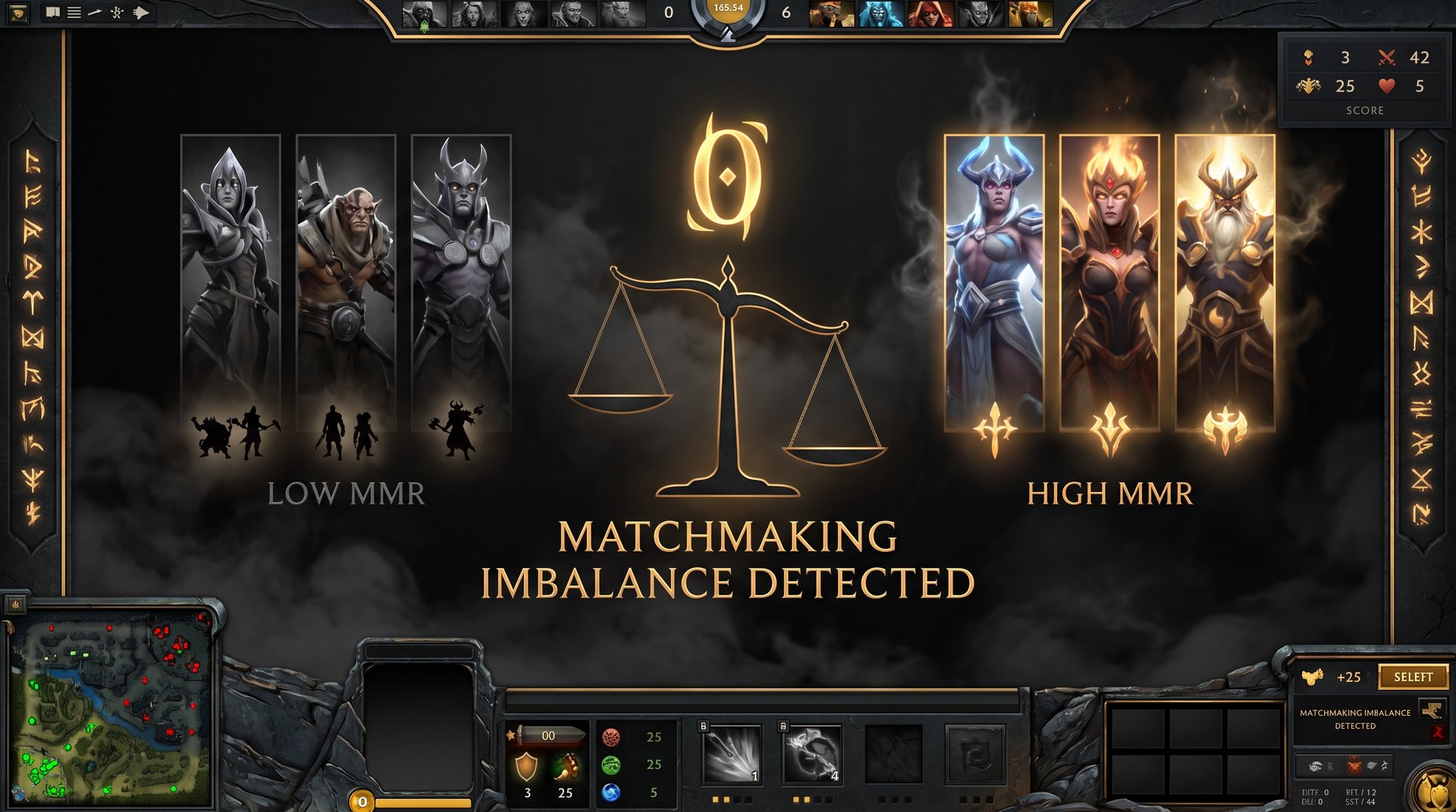
The most common trigger is a party where the MMR spread between players is too large for matchmaking to absorb cleanly. When a high-MMR player parties with a lower-MMR friend, the system has to find an opposing team that satisfies both MMR averages simultaneously — which is genuinely hard. If it cannot after a reasonable search time, it may match the lobby anyway but reduce the stakes to reflect the imperfect balance.
Other causes include:
- Solo queue with extremely poor match quality — the system waited too long and accepted a suboptimal lobby
- Role queue imbalances — if the available player pool at a given MMR is thin for a required role
- Off-peak hours — smaller player pools in certain regions or time windows force compromises more often
- Behavior score edge cases — some low behavior score scenarios can intersect with reduced-stakes matching
What Are No-Stakes Games in Dota 2?
No-stakes games are the more extreme version. In a no-stakes game, the MMR multiplier drops to zero — meaning neither side gains or loses any ranked points regardless of outcome. You can win a 60-minute comeback and your MMR will not move. You can lose in 20 minutes and your MMR will not move either.
These games appear when the matchmaking imbalance is severe enough that Valve determines assigning any MMR weight would be unfair. The most common scenario is a party that includes a player whose MMR is dramatically higher or lower than the rest of the lobby — enough that the expected win probability for one team is so lopsided that ranking stakes would be meaningless.
Like low-stakes games, no-stakes games still count toward:
- Your behavior score (good and bad behavior both register)
- Your game history and match records
- Your reported stats on tools like Dotabuff and Stratz
- Potential low priority queue if you abandon
The ONLY thing that does not happen in a no-stakes game is MMR movement. Everything else is live.
Low-Stakes vs. No-Stakes vs. Normal: Side-by-Side
Here is exactly what changes — and what does not — across the three game types.
| Feature | Normal Ranked | Low-Stakes Ranked | No-Stakes Ranked |
|---|---|---|---|
| MMR change on win | Full amount (typically +25-30) | Reduced (multiplier applied) | Zero |
| MMR change on loss | Full amount (typically -25-30) | Reduced (multiplier applied) | Zero |
| Game appears in match history | Yes | Yes | Yes |
| Behavior score affected | Yes | Yes | Yes |
| Abandon = low priority risk | Yes | Yes | Yes |
| Counts toward seasonal games | Yes | Yes | Yes |
| Pre-game notification shown | No | Yes | Yes |
| Typical cause | Normal match quality | Party MMR gap or queue compromise | Extreme MMR disparity in lobby |
When Does Valve Apply the Low-Stakes or No-Stakes Label?
Valve has not published the exact algorithm that triggers these labels, but based on how the system behaves in practice, the key condition is match quality falling below a threshold that would normally justify creating the lobby at all.
Matchmaking in ranked Dota 2 is trying to satisfy several constraints at once:
- Both teams should have similar average MMR
- Each player should be getting a lobby within their expected skill range
- Roles should be filled according to player queue preferences
- No team should have a dramatically higher win probability than the other
When a lobby cannot meet all of these constraints cleanly — usually because of party composition or thin player pools — the system makes a trade-off. It creates the lobby but marks it as reduced-stakes to signal that the match was a compromise.
The closer the lobby gets to complete balance on all four dimensions, the more likely it is to be a full-stakes game. The further it deviates, the more likely it lands in low-stakes territory. If it deviates far enough, it becomes no-stakes.
The Party MMR Gap Problem
The most reliable way to end up in a low-stakes or no-stakes game is to queue as a party with a large MMR gap between party members. This is also the scenario where players most often notice and complain about the label.
Consider a 5,000 MMR Archon player partying with a 1,200 MMR Herald player. Their combined average might be around 3,100 MMR — but the matchmaking system cannot simply find two teams of “3,100 MMR average” players and call it a fair game. The high-MMR player will be carrying, the low-MMR player will be struggling, and both opposing team members will be playing in a lobby that does not match their individual skill levels.
Valve responds to this kind of disparity in a few ways depending on severity:
- Moderate gap (500-1,500 MMR between party members): Game is usually still full-stakes but matchmaking takes longer to find a lobby
- Large gap (1,500-3,000 MMR): Low-stakes is likely, especially in off-peak hours or less populated regions
- Extreme gap (3,000+ MMR): No-stakes becomes probable; the system may also warn you before the queue fills
Solo Queue and Low-Stakes Games
Solo queue can still produce low-stakes games, though it is less common. In solo queue, the main triggers are:
- Queue times that have extended significantly, causing the matchmaker to relax its quality requirements
- Very high MMR ranges (Immortal bracket) where the pool is smaller and some imbalance is tolerated
- Role queue situations where a specific role combination cannot be matched well
- Behavior score-related matchmaking adjustments
If you are seeing low-stakes games in solo queue regularly, it is worth checking two things: your region settings (are you inadvertently queuing into a low-population region?) and your behavior score (low scores change how the matchmaker handles your games).
How Much MMR Do You Actually Gain or Lose?
Valve does not publicly specify the exact multiplier used for low-stakes games. The community understanding, based on aggregate experience across many accounts, is that the multiplier is approximately 0.5x — meaning you gain and lose roughly half the MMR you would in a normal game.
For a player normally earning +25 per win:
- Low-stakes win: Approximately +12 to +15 (Valve’s exact figure varies by lobby imbalance severity)
- Low-stakes loss: Approximately -12 to -15
- No-stakes win: Zero
- No-stakes loss: Zero
The upside for low-stakes games is symmetrical: you also lose less if you lose. Players often feel these games are “free” but that is not quite accurate — you are still playing for real MMR, just at a discount. A string of low-stakes losses at half the normal rate still adds up to a real rank drop if you lose enough of them.
For players focused on climbing, the optimum outcome in a low-stakes game is the same as in any game: win. The climb will be slower game-for-game, but it is not zero.
Does This Affect Your Behavior Score?
Yes. Your behavior score is fully active in both low-stakes and no-stakes games. This is one of the most common misconceptions about these game types — players assume that if MMR is not on the line, nothing is on the line. That is wrong.
Specifically:
- Commends: Still counted and impact your behavior score positively
- Reports: Still counted; multiple valid reports in these games can lower your score
- Abandoning: Still triggers the abandon detection system and can land you in low priority queue — exactly the same as abandoning a full-stakes game. See our abandonment guide for the full penalty breakdown.
- Communication abuse: Still detectable and reportable
Behavior score matters for matchmaking quality — lower scores can push you into lower-quality lobbies, which ironically can increase the frequency of low-stakes games. It creates a feedback loop: low behavior score triggers more low-stakes games, which some players then play poorly or abandon because “it doesn’t count,” which further damages behavior score.
Play these games the same way you would play full-stakes games from a behavior standpoint. The MMR multiplier is reduced; the social rules are not.
Low Priority Queue Is a Separate System
Low priority queue (LP) is not the same as a low-stakes or no-stakes game. LP is a punishment queue that uses Single Draft mode and requires you to win — not just play — a set number of games to exit. You enter LP for abandoning games, receiving too many reports in a short period, or other behavior violations.
A game being labeled “low-stakes” does not mean you are in LP. You can be in LP and have the games there be full-stakes (LP has its own MMR reduction rules but they operate differently). For everything you need to know about LP, see our guide on Dota 2 low priority explained.
Should You Still Try Hard in Low-Stakes and No-Stakes Games?
This is the question every player actually wants answered. The short version: yes, you should still play seriously — but for different reasons depending on the game type.
In Low-Stakes Games: Absolutely Try
The MMR is real, just reduced. A low-stakes win still moves your rank forward. If you are in a session where you are playing low-stakes games more often, playing well in them is still the path to climbing — just at a slower rate. Treating them as throwaway games turns a small MMR disadvantage into a behavioral pattern that actively hurts your score.
There is also the practice argument. Low-stakes lobbies often feature the kind of chaotic, uneven games where decision-making under pressure gets tested. Positioning against a higher-MMR opponent, managing a lead against an outmatched enemy, or carrying through a game that lacks coordination — these are real skills that transfer to full-stakes play.
In No-Stakes Games: Try for the Practice
With zero MMR on the line, the pure gameplay benefits are all you have. These games can still be genuinely useful:
- Practice new heroes you have not played in ranked
- Test draft combinations with your party
- Work on specific mechanical aspects of your game without the anxiety of full stakes
- Play positions outside your main role in a low-risk environment
What you should not do is grief, troll, or abandon. Even with no MMR at stake, behavior score still counts, your teammates are real people, and the habits you build in these games carry over into full-stakes ones.
Not the Same as Abandonment Penalties
This distinction matters enough to state explicitly. Low-stakes and no-stakes games are about the MMR multiplier on a match where you are PRESENT and PLAYING. Abandonment penalties are what happens when you LEAVE a game before it ends.
These are completely different systems that operate independently:
- Low-stakes/no-stakes: Applied before the game starts, based on matchmaking quality. Affects MMR gain/loss only.
- Abandonment penalties: Applied when you leave a game in progress. Affects behavior score, can lead to low priority queue, and in some cases removes MMR even from a win that you did not finish. Has nothing to do with whether the game was low-stakes or not.
Critically: if you abandon a low-stakes or no-stakes game, you still get the full abandon penalty. The reduced MMR stakes do not reduce the abandon punishment. You could abandon a no-stakes game and receive the same behavior score hit and LP queue risk as abandoning a full-stakes game.
For the complete breakdown of every penalty Dota 2 applies for leaving games — including the safe-to-leave timer, what counts as an abandon, and how to recover — read our dedicated guide: Do You Lose MMR for Abandoning? Every Penalty Explained.
Strategy Tips for Getting More Full-Stakes Games
If low-stakes games are appearing too often in your ranked queue and you want to minimize them, the following adjustments are effective:
1. Queue Solo or With a Close MMR Party
The single biggest determinant of full-stakes game frequency is your party’s MMR spread. Keep party members within 1,000 MMR of each other when possible. The closer the spread, the easier matchmaking can create a balanced lobby at full stakes.
2. Queue During Peak Hours in Your Primary Region
Larger active player pools mean the matchmaker has more options for a balanced lobby. Off-peak hours — late at night or early morning in your region — mean smaller pools and more compromises. Peak evening hours in your local time zone will almost always produce better quality matches.
3. Check Your Behavior Score
The behavior score system affects which pool of players you match with. Players with lower behavior scores are placed in lower-quality lobbies by design, which increases the chance of a low-stakes label. Keeping your score above 9,000 — through commends, avoiding reports, and not abandoning — gives you access to the highest quality matchmaking pools.
4. Use the Role Queue Correctly
Role queue is meant to speed up matchmaking for roles that have consistent demand. Queuing for roles you can actually play well, rather than gaming the system for faster queues, helps the matchmaker build cleaner lobbies that stay at full stakes.
5. Accept That Some Will Always Happen
Especially in Immortal bracket or in less-populated regions, a certain number of low-stakes games is unavoidable. The best players at those levels understand this and play the game anyway rather than going through mental gymnastics about whether each game “counts.” Your MMR average across hundreds of games reflects your true level regardless of individual game stakes.
Want to Climb Faster Without the Compromised Lobbies?
TeamSmurf’s professional boosters play only in full-stakes solo ranked games — no low-stakes, no party exploits. We are a Dota 2-only service, and we handle every boost with the same standards we hold for our own accounts.
Frequently Asked Questions
Does a win in a no-stakes game give any MMR at all?
Can I back out of a low-stakes or no-stakes game after I see the label?
Do low-stakes games count toward my calibration games?
How can I tell if my past games were low-stakes?
Does playing with a booster or coach on my account cause low-stakes games?
Is it possible to get stuck in low-stakes games permanently?
Does the low-stakes multiplier apply equally to both wins and losses?
Why doesn’t Valve just not create the lobby if the match quality is too low?



