

Is There an MMR Cap in Dota 2? The Ceiling Above 13,000

In This Article
No. Dota 2 does not have a hard MMR cap. The ranked matchmaking number is technically unbounded — the system places no upper limit on how high a player’s rating can climb. What players often mistake for a “cap” is actually a leaderboard visibility threshold, a regional population effect, or the practical ceiling imposed by the quality and availability of opponents.
This article explains exactly what the ceiling above 13,000 MMR looks like, why the confusion between a “cap” and a “threshold” persists, how the ceiling differs by region, and what the highest MMR ever recorded tells us about where the system actually tops out in practice.
Is There a Hard MMR Cap in Dota 2?
Valve has never introduced a numeric ceiling on MMR. The matchmaking rating system is a continuous scale — win games, gain points, lose games, lose points. There is no line of code that says “stop at 15,000” or “freeze at 12,000.” If you win enough games against opponents at your level, your MMR keeps climbing.
This is different from games that hard-cap their ranking system at a specific number (some games cap at 9,999 or 10,000 to prevent the number from growing indefinitely). Dota 2 never adopted that design. The Immortal rank system that replaced the old star-tier model removed the fixed bracket boundaries entirely for the top rank — instead of a star count that maxes out, you get a raw MMR number and a leaderboard position that reflects exactly where you sit relative to other Immortal players.
The question “is there a cap?” usually comes from one of three observations:
- Players seem to “plateau” around certain numbers. This is real, but it reflects the player’s skill level settling into a true rating, not an artificial ceiling. MMR is a measure of relative performance, not a score to grind indefinitely — at some point, your win rate stabilizes around 50%.
- The official leaderboard seems to cut off at a point. The leaderboard shows only the top-ranked players in a region, and below a certain threshold you drop off the visible list. That threshold is not a cap — it is a visibility filter.
- Very few players ever get above 12,000, 13,000, or higher. True — but the rarity is caused by the extreme skill required, not by a programmed limit. If a player consistently wins at 14,000 MMR, they gain MMR exactly the same way any player does.
The ceiling is real, but it is a practical ceiling — one imposed by physics, population, and human skill limits — not a technical one imposed by Valve. Understanding the difference matters if you are trying to set realistic goals for your own ranked climb.
The Leaderboard Threshold Is Not a Cap
The most common source of the “cap” misconception is the Immortal leaderboard. When players talk about the “top of the leaderboard” or the “leaderboard cutoff,” they are describing a visibility system — who gets a public rank number displayed next to their name — not a ceiling on MMR itself.
Here is how the system actually works. Once you reach the Immortal rank (the threshold varies slightly by region and season, but sits roughly around 5,600 to 5,800+ MMR in recent seasons), your progress no longer shows as medal stars. Instead, you receive a leaderboard position that reflects how high your MMR is relative to other Immortal players in your region. The official leaderboard displays ranked players with a visible position number.
Two critical points about this system:
Being off the leaderboard does not mean your MMR stopped
Players below the leaderboard cutoff are still Immortal, still have a specific MMR number, and still gain and lose MMR normally from every ranked game they play. Their MMR keeps changing. They simply do not receive a public position number. The leaderboard is a display layer on top of the MMR system, not a replacement for it. Your MMR exists and moves whether or not it is publicly visible.
The leaderboard position is a rank, not a cap
If you are ranked position 250 in EU Immortal, and you win your next game, your MMR goes up. If enough other players’ MMR is lower than yours after that win, you might move to position 200. The number that is “capped” is not your MMR — it is the count of players shown on the leaderboard. The MMR underneath that can always increase.
The visible leaderboard reflects current ratings, updated hourly. The gap between the rank-1 player on a given server and the freshest Immortal can be enormous — thousands of MMR points. In EU, for instance, the difference between leaderboard rank 1 and a fresh Immortal player represents more rating than the entire range from Herald 1 to Ancient 5. The leaderboard entry point sits well above Immortal threshold itself.
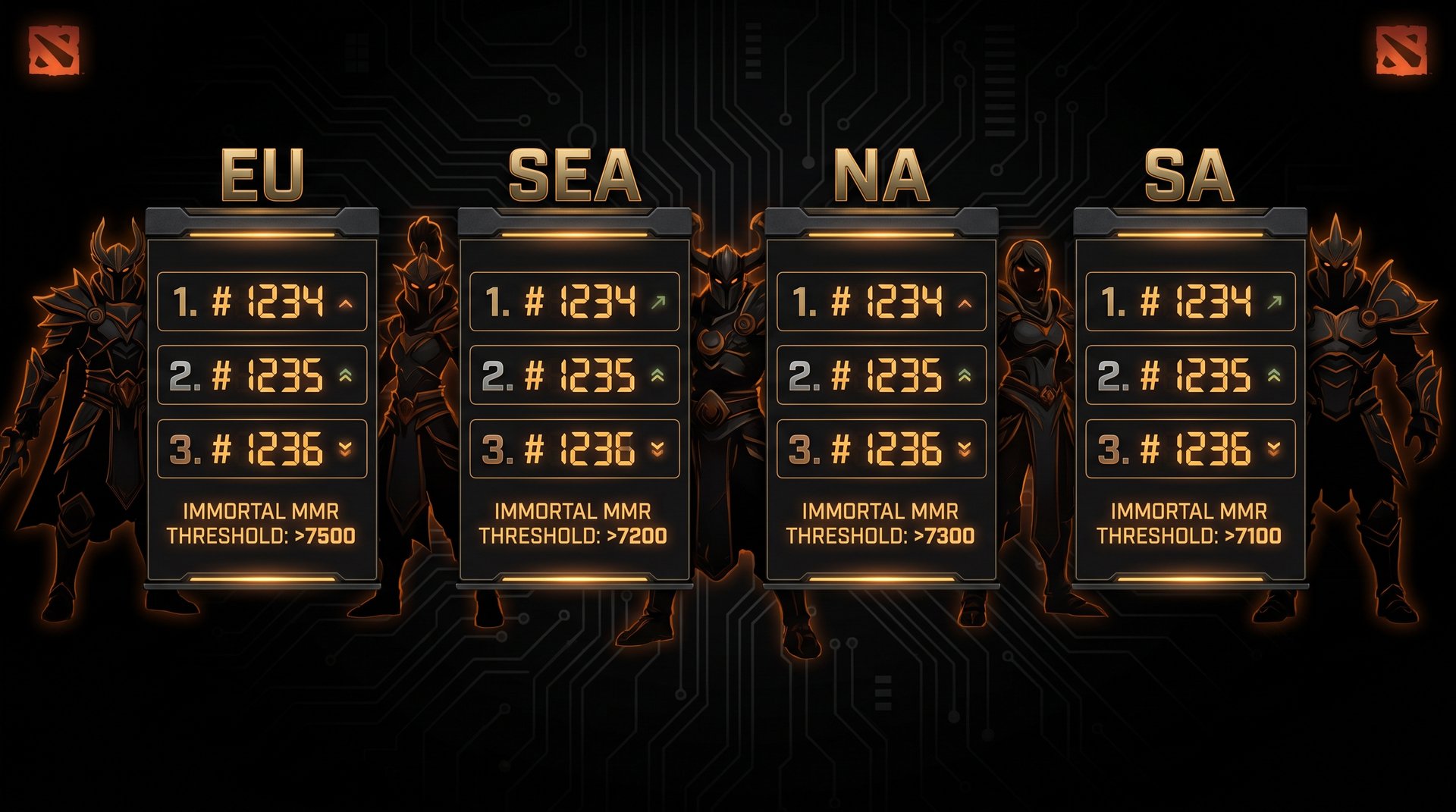
Regional Differences in the MMR Ceiling
The practical MMR ceiling varies significantly by server region, for two reasons: the density of high-skill players, and the size of the opponent pool at extreme ratings.
| Region | Approx. Leaderboard Entry (2026) | Active Players Near the Top | Practical Ceiling |
|---|---|---|---|
| EU (Western + Eastern) | ~7,000-8,500 MMR | Highest density globally | 17,000+ (current record) |
| SEA | ~6,500-7,500 MMR | High — significant pro presence | ~15,000+ MMR |
| CN (China servers) | ~6,500-7,500 MMR | High — many pro players grind here | ~15,000+ MMR |
| NA | ~5,800-6,800 MMR | Medium — smaller active pool at extreme end | ~12,000-14,000 MMR |
| SA (South America) | ~5,600-6,500 MMR | Lower — smaller professional player base | ~11,000-13,000 MMR |
These numbers reflect community tracking data and leaderboard observations — they are not official Valve figures. The thresholds shift between seasons as the player pool evolves and as professional players migrate between servers for practice or bootcamps.
Why EU has the highest ceiling
The EU server — which pools both Western and Eastern European players, and attracts many professionals who bootcamp or live in European cities — has the densest concentration of elite-level players globally. When you queue at 14,000+ MMR on EU, your opponents are current or recent professional players. That competitive pressure means win rates compress further toward 50% and MMR climbs slower — but also that the ceiling is genuinely higher because the opponent pool can sustain it.
The current all-time record holders, Yatoro and Nightfall, both reached their records on the EU server. No other region has produced confirmed MMR above 16,000 as of 2026. The EU server did not make them better players — they brought their skill there — but the available opposition quality and population density on EU is what made those numbers achievable at all.
Why lower-population servers have lower ceilings
On a smaller server like SA or NA, the top-rated player runs out of high-quality opponents before they can rack up the volume of wins needed to push into extreme MMR territory. At some point, the leaderboard rank-1 player on a small server is so far above their usual opponents that they win a large fraction of games effortlessly — which should push their MMR up fast. But the opponent pool at that extreme is so thin that games become unreliable indicators of skill, and players often shift servers rather than try to climb further on a small pool. The practical ceiling on a small server is lower because of population math, not because Valve set a lower cap there.
What Happens Above 13,000 MMR?
The games above 13,000 MMR are not simply faster versions of a 5,000 MMR game. They are a qualitatively different experience — the draft, the movement, the vision, the communication all operate on a compressed timeline with near-zero margin for error. We covered this in full detail in our dedicated guide: What Happens at 13,000 MMR Games.
For the purposes of understanding the ceiling: 13,000 MMR in EU places a player in roughly the top 50 to 150 active accounts in the region, depending on the season. Every player in that lobby is either a current professional or a dedicated high-level pub grinder who has been playing at a near-professional level for years. Games feature fully scripted laning phases from the draft, proactive vision that anticipates enemy movement 30 to 60 seconds in advance, and essentially no tolerance for positional errors.
Above 13,000, the game quality keeps rising in the same direction — more precision, more preparation, more reading of opponent tendencies from their account history. The ceiling is not a place where the game becomes static or stops rewarding skill. It is a place where the rewards of skill are compressed into smaller and smaller advantages because every opponent is also operating at an extreme level.

The Current MMR Record — How High Has It Actually Gotten?
The highest confirmed MMR in Dota 2 history is 17,000+, first achieved by Yatoro (Ilya Mulyarchuk, Team Spirit) in December 2025. This came after Yatoro had already broken the 16,000 barrier in November 2024 — a record that itself shattered what most of the community believed was an impossible ceiling at the time.
As of early 2026, Nightfall of Aurora also reached 17,000+ MMR and held the EU leaderboard rank 1 position in March 2026, briefly overtaking Yatoro. These two players sit at the absolute outer edge of where the MMR scale has ever registered a human player. A handful of other professionals — Nisha of Team Liquid, TaiLung of HEROIC, Satanic of Parivision — sustain ratings above 14,000 or 15,000, which themselves represent an extraordinary achievement.
The full history of how the record has risen — from the first 10,000 barrier in 2016 to 17,000 in 2025 — and detailed profiles of every top-ranked player are covered in our dedicated article: The Highest MMR Ever Recorded and Who Holds It. That post covers the record timeline, player profiles, and the controversy around boosted accounts attempting to set illegitimate leaderboard marks.
The important point for understanding the ceiling: the record has risen every few years as new players with both the raw skill ceiling and the time to grind reach the top. The 17,000 barrier may stand for a year or more, but based on how fast the ceiling rose from 16,000 to 17,000 (just over a year), the community expects further records in the 17,000-18,000 range eventually.
Why a Practical Ceiling Exists Even Without a Hard Cap
If there is no programmed cap, why does MMR seem to top out around a certain number? The answer is a combination of factors that create a real, functional ceiling even in the absence of a Valve-imposed limit.
Win rate compression against elite opponents
MMR is a measure of relative performance. At any skill level, the matchmaking system finds opponents who are roughly equivalent to you. The higher your MMR, the closer to your true ceiling your opponents are. At 15,000+ MMR, every opponent is one of the best public-match players on earth. The expected win rate of any player against these opponents — even one of the best in the world — converges toward 50%. When your win rate is 50%, your MMR does not move. To keep climbing, a player needs a sustained edge over even these opponents, which requires a skill gap so large that only a handful of people alive achieve it at any given time.
This is the core reason why MMR “plateaus” for most players and even for most professionals. It is not that the system stopped them — it is that their opponents finally matched them.
Server population and queue availability
Above a certain MMR on any server, the queue times lengthen dramatically because there are simply fewer players at that rating. In extreme cases at the top of smaller servers, a player at the very peak of the leaderboard might wait extended periods for a game. EU avoids this problem longer than other servers because of its depth of talent, but even on EU, games at 16,000+ MMR require the small cluster of players at that level to all be queuing around the same time. Yatoro’s record-breaking runs were done during periods of high activity on EU, when the available opposition was also at its peak quality.
Time and volume investment
Reaching the practical ceiling requires not just talent but sustained grinding. The players who sit above 15,000 MMR on the EU server are, almost without exception, professional players for whom ranked matchmaking is part of their job. Yatoro played 75 games over 8 days at nearly 80% win rate before crossing 16,000 — a pace that represents full-time professional effort. Most players — even talented ones who might theoretically have the ceiling to reach 12,000 or 13,000 MMR — never reach those numbers because the time investment required is incompatible with a normal life outside of professional esports.
The hero and meta learning curve
At extreme MMR, every patch changes what works. A player who was grinding one small hero pool at 14,000 MMR in one patch might find themselves at a disadvantage after a major update shifts the meta. Sustaining high MMR requires continuous adaptation — watching how patch changes affect the draft meta, updating item builds within hours of a new patch going live, and adjusting hero pools to match what is winning in the current version. This adaptation work is constant, and it represents a real friction on sustained MMR gains that gets more significant the higher you climb.
Key takeaway: The ceiling in Dota 2 is a product of opponent quality, server population, and time investment — not a hard-coded number. If you consistently outperform your opponents, your MMR will keep climbing regardless of how high it gets.
How This Affects Your MMR Goals
For most players, the relevant ceiling is not 17,000 MMR — it is the gap between where they are now and where they could realistically reach with focused effort. The ceiling concepts that matter for a 4,000 MMR player are completely different from those that matter for a 9,000 MMR player.
Your current MMR reflects a true rating, not a cap
If you have been playing ranked seriously for hundreds of games and your MMR has been stable around a certain number, that number reflects your current performance level against the opponents at that MMR. It is not a wall — it is your true rating. Climbing past it requires a genuine improvement in your decision-making, not a workaround or a lucky streak.
Understanding why you are at your current MMR — which decisions lead to losses, which game-phases you lose your advantage in, which matchups you do not play correctly — is the prerequisite for any meaningful climb. A number you cannot explain is a ceiling you cannot break through.
Boosting can move you faster through brackets you are ready for
If your goal is to reach the next major bracket, and you are confident your gameplay is already at the level required, a professional Dota 2 boost from TeamSmurf moves you through the current bracket faster without requiring you to build the variance buffer that solo grinding demands. Our boosters operate at Immortal level — they play in your games, at your bracket, using the decision-making patterns of players who live above your current ceiling.
This is not the same as a fabricated leaderboard result. It is a tool to move through brackets your skill can sustain, faster than the grind allows on its own. You can read more about how the process works and what to expect in our Dota 2 MMR boost guide.
Coaching gives you direct access to the ceiling
For players who want to understand what decisions separate their current bracket from the next one, coaching from high-MMR players provides direct access to the thinking behind elite-level play. A coach who plays at 8,000 or 10,000 MMR can watch your game and identify the specific patterns — vision timing, farming priority, positioning habits — that are holding your rating in place. That kind of targeted feedback is substantially faster than trying to learn it through thousands of solo games.
The question of whether Dota 2 boosting is safe for your account is also worth understanding before you make any decision. We address it directly in our guide: is Dota 2 boosting safe?
Ready to Push Your MMR Ceiling?
TeamSmurf is a Dota 2-only boosting and coaching service. Every booster on our roster plays at Immortal level. No account sharing with untrusted players — only specialists who have been screening since 2016.



