How Many Reports Get You Muted in Dota 2?

Getting muted in Dota 2 is one of the most frustrating experiences in the game — but Valve is deliberately vague about exactly how many reports it takes to trigger a communication ban. This guide breaks down everything that is actually known about the report and mute system, what thresholds exist, how real-time muting works, and what you can do to protect your account or recover a low communication score.
The short answer: Valve does not publish an exact report count. The mute system is driven by your communication score, a separate metric from your behavior score. When that score drops below certain thresholds, restrictions kick in automatically — and the process is partially automated with AI-driven chat analysis that can mute you mid-game, in real time.
Table of Contents
How Reports Work in Dota 2 in 2026
Valve overhauled the Dota 2 reporting system significantly in recent years, and the 2026 version is markedly different from the simple vote-based system that existed before 2020. Understanding the current mechanics is essential before trying to figure out how many reports get you muted.
Report Categories
Players can now submit reports under six distinct categories:
- Toxic Chat — abusive text communication
- Toxic Voice — abusive voice communication
- Smurfing — playing on an account below your skill level intentionally
- Griefing — intentionally sabotaging your team without feeding kills
- Cheating — use of unauthorized software or scripts
- Role Abuse — queuing for a role you do not intend to play
Each report category triggers a different internal review process. Toxic Chat reports feed directly into the real-time AI mute system. Griefing reports analyze item destruction patterns and gameplay actions. Smurfing reports pull in account history and MMR trajectory data. This means a single report for toxic chat can have immediate consequences, while a smurfing or griefing report may take longer to process.
No Cap on Reports
One major change from the old system: Valve removed the daily and weekly report cap. Previously players had a limited supply of reports to spend. Now you can report as many players as needed within a single session. This was done to encourage players to flag problematic behavior without rationing their reports. However, false or low-quality reports are also weighed by the system, and submitting reports that never result in action may reduce the weight your future reports carry.
Report Feedback
When one of your reports results in a penalty, Valve sends an in-game notification confirming that the player you reported was punished and which report category triggered it. This feedback loop helps players understand when their reports are effective and encourages good-faith use of the system.
The Communication Score System
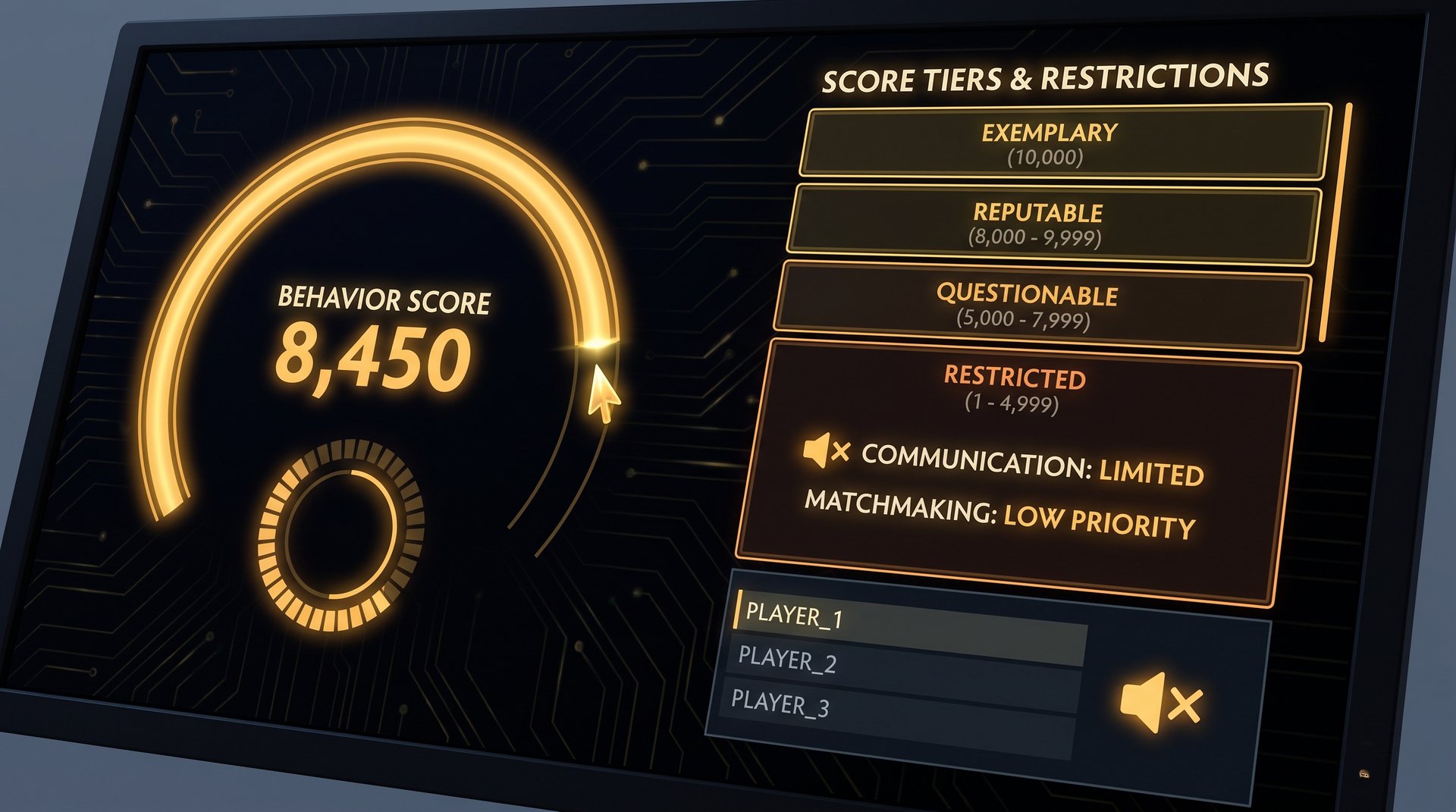
Since the dual-score update (rolled out starting in 2023), Dota 2 tracks two separate metrics for every account:
- Behavior Score — your overall in-game conduct, from 0 to 12,000
- Communication Score — specifically how you communicate via text and voice, also from 0 to 12,000
Before this split existed, a single behavior score handled everything. Now the two are tracked independently. You can have a high behavior score but a low communication score, which means you play cleanly but talk badly. The reverse is also possible — you get reported for griefing but your chat stays clean.
Both scores default to around 10,000 for new accounts and change over time based on reports, commendations, and automated chat analysis.
What Affects Your Communication Score
Your communication score goes down when:
- Other players report you for Toxic Chat or Toxic Voice
- The AI chat analysis system flags your messages as abusive during live games
- You receive consistent negative reports across multiple games in a short window
Your communication score goes up when:
- Teammates commend you after a match
- You complete games with clean chat and no reports
- A period of time passes without new toxic reports (slow natural recovery)
Valve does not publish the exact point values attached to each event, but community reports consistently indicate that a single commendation adds significantly less than what a single toxic report removes. This asymmetry is intentional — the system is designed to punish bad behavior more than it rewards good behavior in the short term.
Mute Thresholds: Communication Score Restrictions by Tier
These thresholds are based on community-reported observations and third-party guides. Valve has not officially published an exact table, so treat these as estimates that are accurate as of mid-2026 but may shift with future patches.
| Communication Score | Status / Restriction |
|---|---|
| 10,000 — 12,000 | Full access. Can coach others and ping ally abilities. |
| 8,000 — 9,999 | Cannot coach other players. Ally ability pinging disabled. |
| 7,000 — 7,999 | Voice chat restricted. No tipping or commending. |
| 6,000 — 6,999 | No text chat in matches. Mini profile customization disabled. |
| 3,000 — 5,999 | Map drawing disabled. All communication on 30-second cooldown. |
| 0 — 2,999 | Severe restriction. 30-second shared cooldown for all communications in every game. |
The most impactful threshold is the drop below 6,000 — at that point you lose text chat entirely. This is what most players describe as “getting muted in Dota 2.” You can still use pings and preset communication wheels, but typed messages and voice chat are gone until your score recovers.
Real-Time In-Game Muting
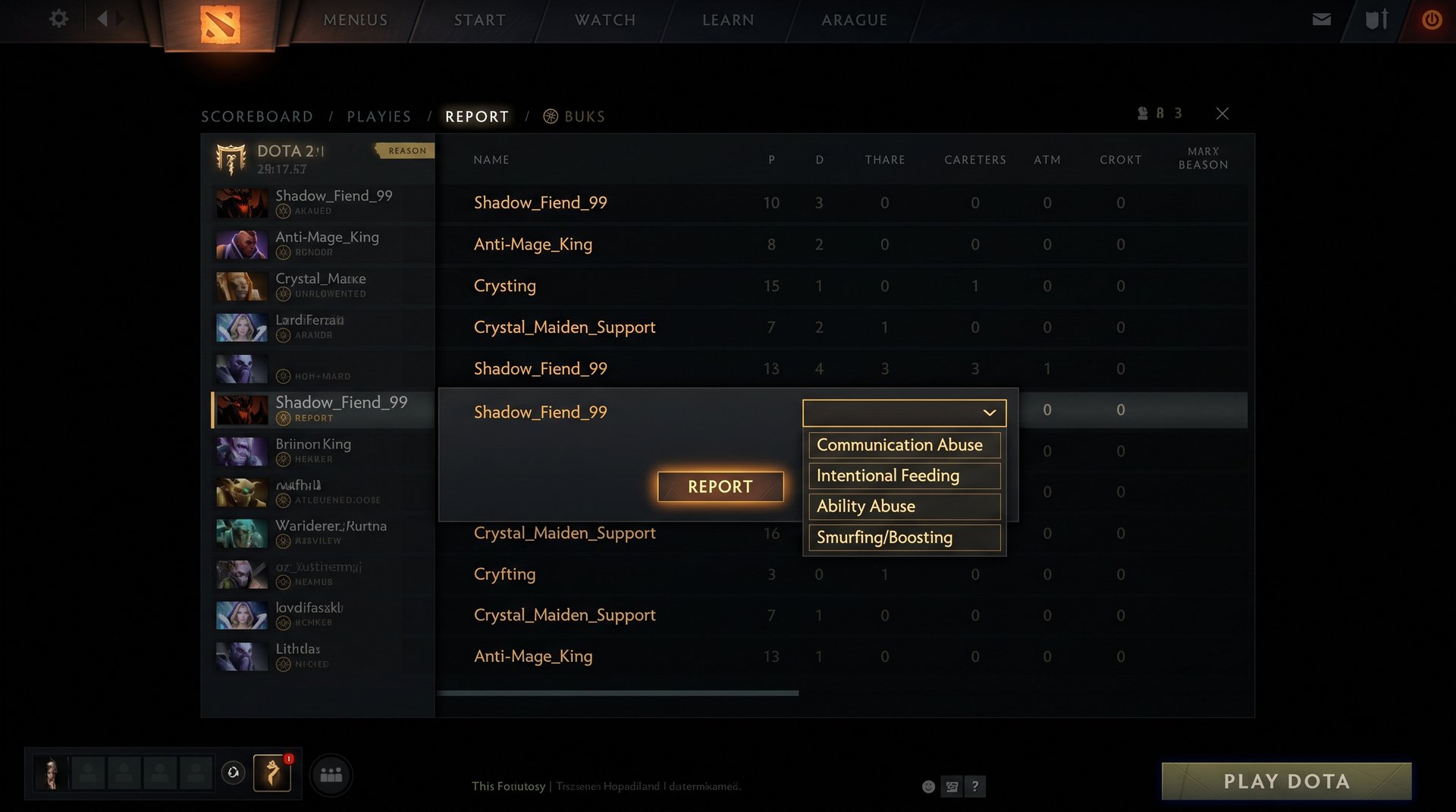
The most significant change to the Dota 2 mute system is the real-time component. When a player submits a Toxic Chat report against you during an active game, Valve’s system immediately analyzes the flagged message. If the AI determines the content is toxic, you are muted for all players for the remainder of that game — instantly, without waiting for the match to end.
What the Real-Time Mute Does
During a real-time mute applied mid-game:
- Your text chat is silenced for all players — both your team and the enemy team
- Your voice chat is cut for the rest of the match
- You retain access to pings and the preset communication wheel
- You face a 30-second cooldown on all communication actions
This means a single toxic message, if reported and confirmed by the AI system in the same game, can cost you your communication ability for the rest of that match. The speed is intentional — Valve wants toxic players removed from the conversation before they can do further damage to the game environment.
Does a Mid-Game Mute Affect Your Score?
Yes. A mid-game mute backed by the AI system applies a penalty to your communication score. The exact deduction amount is not published by Valve, but based on community testing it appears to be a meaningful hit — large enough that a few back-to-back incidents can push a previously high communication score below a key threshold within a short span of games.
How Many Reports Does It Actually Take to Get Muted?
This is the question almost everyone asks, and the honest answer is: Valve does not say. There is no official threshold like “five reports in one week gets you muted.” The system works through your communication score, not through a raw report count.
However, based on extensive community testing and Steam forum discussions over multiple years, here is what players have consistently observed:
Key Community-Reported Patterns
- Multiple reports in a single game have diminished effect. If five players on the enemy team all report you for toxic chat in the same match, the system does not treat that as five separate incidents. Valve’s documentation notes that patterns across multiple games matter more than report volume in one session.
- Repeated reports across consecutive games have much stronger impact. Getting reported in two or three matches in a row for the same category is far more likely to trigger a meaningful score drop than a pile-on in one game.
- The AI text analysis matters more than the report itself. For Toxic Chat, the report is essentially a flag that directs the AI to analyze your messages. If the AI confirms the content is toxic, the penalty is applied. If the AI disagrees, the report may have little to no effect on your score.
- Starting communication score affects the threshold significantly. A player at 9,000 communication score can absorb more reports before hitting a mute threshold than a player sitting at 6,500.
Based on these patterns, the rough community estimate is that 2 to 5 confirmed toxic chat incidents across separate games within a short window can push a player below the 6,000 text chat threshold, depending on where their score starts. But this is an estimate based on player reports, not official data from Valve.
Why Valve Keeps the Threshold Hidden
This is deliberate design. If Valve published an exact number — say, “four reports mutes you” — players would learn to stay just under that number while still being toxic. By keeping the system opaque, they make it harder to game. The AI-driven component adds further unpredictability, since the mute can trigger before the match even ends if the content is flagged as sufficiently abusive.
This same philosophy is why MMR mechanics are only partially disclosed — Valve prefers to prevent optimization of the system over transparency about its exact workings.
Behavior Score vs Communication Score: What Is the Difference?
These two scores are related but distinct, and they control different aspects of your Dota 2 experience.
| Metric | What It Controls | Primary Inputs |
|---|---|---|
| Behavior Score | Matchmaking pool, queue times, ranked access, game pause ability | Abandons, griefing reports, feeding, AFK behavior |
| Communication Score | Chat, voice, tipping, coaching, map drawing, mini profile | Toxic chat reports, toxic voice reports, AI text analysis, commendations |
A key distinction: behavior score gates your access to ranked play and affects your matchmaking quality. If your behavior score drops below 3,000, you cannot play ranked and get placed in a shadow matchmaking pool with other low-score players. Communication score does not affect which lobby you enter — only whether you can communicate freely within it.
Behavior Score Thresholds
For reference, here are the main behavior score gates (also community-reported estimates):
- 10,000+ — Full access, including the ability to coach other players
- 7,000+ — Can request coaching in games; eligible for post-game item drops
- 5,000+ — Can pause the game; map drawing enabled
- 3,000+ — Ranked access retained
- Below 3,000 — Ranked locked; placed in low-priority matchmaking pool with other low-score players
If you are concerned about your behavior score alongside your communication score, the TeamSmurf behavior score guide covers all the ways to check and improve it in detail.
How to Recover a Low Communication Score
If your communication score has dropped below a key threshold, recovery is slow but achievable. Here is a practical approach:
Short-Term Actions
- Play without using text or voice chat. This sounds obvious but is the most effective approach. No chat means no toxic chat reports. Use pings and the preset wheel exclusively until your score recovers.
- Focus on commendations. Every commendation you receive gives your communication score a positive push. Play well, play selflessly, and make it easy for teammates to want to commend you after the match.
- Win games with clean play. Completing games with no reports filed against you, combined with good behavior, accelerates recovery. The system rewards consistent absence of negative events more than it rewards individual good moments.
What Does Not Help?
- Spam-commending friends to farm score. Commendations from the same account repeatedly have diminishing returns and may be flagged by the system.
- Taking long breaks. Your score does not recover meaningfully just from not playing. The recovery mechanism requires active positive gameplay.
- Appealing to Valve support for individual bans. Communication restrictions from the automated system are generally not reversed unless there is a clear system error.
How Low Communication Scores and Bans Affect Your MMR Climb
A communication ban does not directly change your MMR or prevent you from playing ranked games. But the indirect effects are real and significant:
- Coordination loss. Dota 2 is one of the most communication-intensive games in the genre. Losing text chat and voice chat in ranked matches makes it significantly harder to coordinate smoke ganks, jungle rotations, and late-game item purchases. Your win rate will likely drop while muted.
- Teammate frustration. Muted players who cannot communicate clearly are more likely to get reported by frustrated teammates for griefing or role abuse — even when playing fairly. This creates a downward spiral where being muted leads to more reports.
- Matchmaking pool quality. If your behavior score also drops alongside your communication score, you will be placed in lower-quality lobbies where games are harder to control and climb from.
Many players who find themselves in this situation turn to professional Dota 2 boosting services to push their MMR during periods where mutes make solo climbing exceptionally difficult. High-skill players can win games without relying on voice coordination in ways that lower-bracket players cannot. If you are wondering whether this is a viable path, the safety analysis of Dota 2 boosting covers the risk profile in detail.
The Downward Spiral Problem
One of the most common complaints on Valve’s issue tracker involves the reinforcing loop between communication restrictions and further reports. Players who are muted cannot defend themselves verbally when teammates misunderstand their decisions. Frustrated teammates then report the muted player for griefing. This adds to behavior score damage on top of the communication score damage that already exists.
If you are in this situation, the fastest way out is to play passive, non-controversial roles — support, position 5, heroes with simple kits — and avoid any in-game decisions that might look like griefing from the outside. Plays that make sense to you but are confusing to teammates are the highest-risk category when you cannot explain your reasoning through chat.
Frequently Asked Questions
Struggling to Climb While Muted or Dealing With Toxic Lobbies?
Communication bans make solo MMR climbing significantly harder. TeamSmurf’s expert boosters win games without relying on vocal coordination — ideal for accounts working through communication restrictions.