


How Long Is a Dota 2 Game? Average Match Length by Rank and Mode (2026 Data)

The most common question new players ask before committing to Dota 2: “How long does a game actually take?” The honest answer is that match length varies more than most guides admit — and it varies in ways that matter for your schedule and your climb.
This guide gives you the exact average match length by rank (Herald through Immortal), a breakdown by game mode, and a clear explanation of why games at lower brackets typically run longer than games at the top. All figures are drawn from Dotabuff and Stratz community aggregate data (Oct 2026).
What You Will Find Here
Average Dota 2 Match Length by Rank (2026 Data)
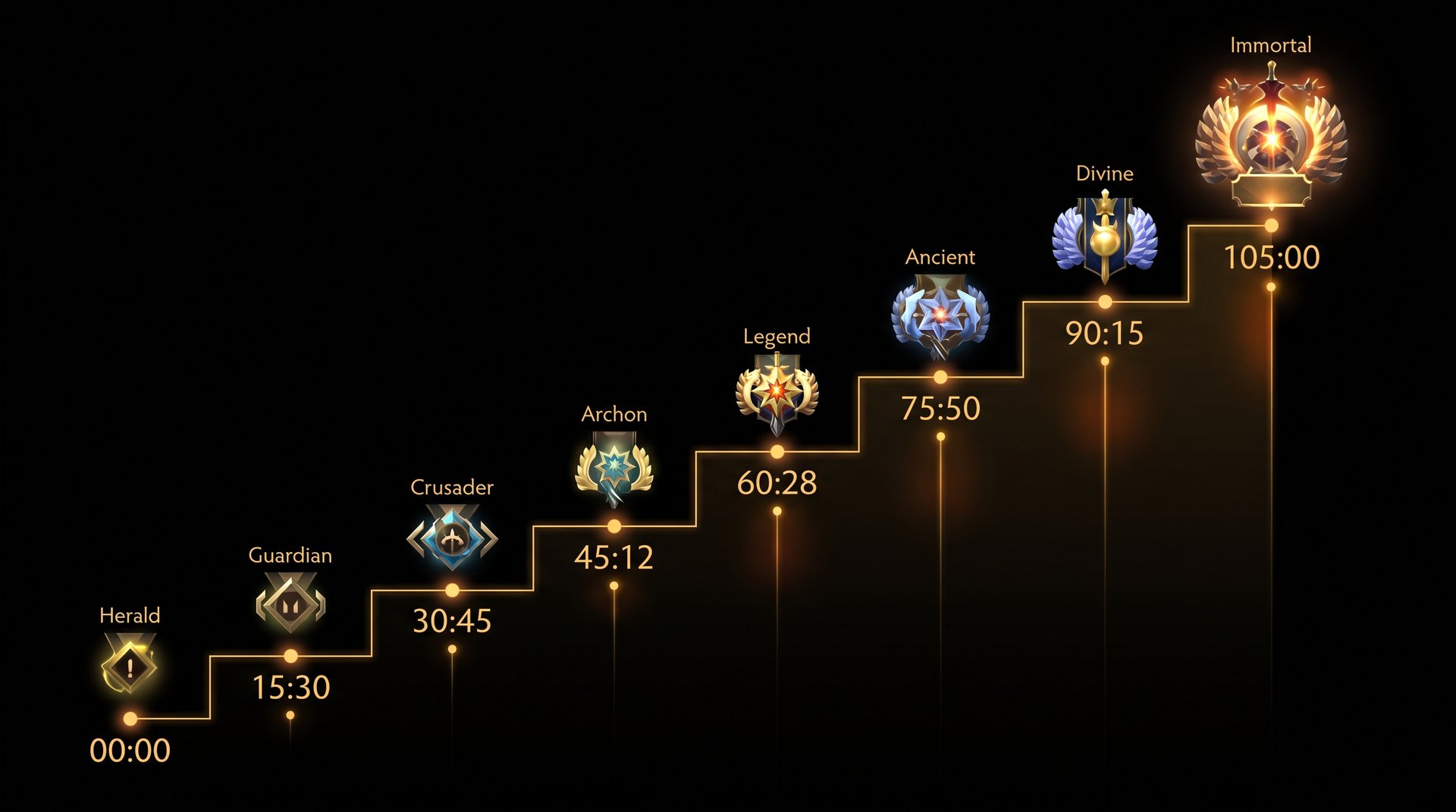
Based on Dotabuff and Stratz community aggregate data collected through September-October 2026, covering millions of public matches across all brackets, the average Dota 2 Ranked All Pick game lasts approximately 38-40 minutes across all ranks combined. The range is meaningfully wider than that figure suggests: the slowest bracket averages around 41-42 minutes, while top Immortal lobbies cluster closer to 35-37 minutes.
The table below gives per-rank averages. These are community-sourced figures (Stratz/Dotabuff, Oct 2026) — they represent the median over a large sample and will shift modestly with each major patch.
| Rank | Avg. Match Length | MMR Range | Typical Range |
|---|---|---|---|
| Herald | 42 min | 0 — 770 | 30 — 65 min |
| Guardian | 41 min | 770 — 1540 | 28 — 62 min |
| Crusader | 41 min | 1540 — 2310 | 27 — 60 min |
| Archon | 40 min | 2310 — 3080 | 25 — 58 min |
| Legend | 40 min | 3080 — 3850 | 25 — 55 min |
| Ancient | 39 min | 3850 — 4620 | 22 — 55 min |
| Divine | 38 min | 4620 — 5420 | 20 — 50 min |
| Immortal | 36 min | 5420+ | 18 — 48 min |
Source: Dotabuff/Stratz community aggregate data, Oct 2026. Figures are medians over a rolling 30-day sample of public Ranked All Pick matches. Individual games vary widely within each bracket.
The key pattern here: Herald through Crusader games run about 5-6 minutes longer on average than Divine and Immortal games. That is not a small difference when you are trying to plan your day around Dota — at three games per session, the lower-bracket player is spending an extra 15-18 minutes per session just on game length. If you are stuck in this bracket and want to understand the mechanical reasons why, read our full MMR boosting guide, which covers the specific habits that keep players anchored at lower ranks.
Average Dota 2 Match Length by Game Mode
Rank is only one variable. The game mode you choose changes average match length dramatically — Turbo cuts roughly 40% off a typical ranked game, while Ability Draft tends to run slightly longer than All Pick because hero kits are more chaotic and fights are less predictable.
| Game Mode | Avg. Match Length | Notes |
|---|---|---|
| Ranked All Pick | 38 — 42 min | Varies by bracket (see rank table above) |
| Turbo | 23 — 28 min | Gold/XP bonuses accelerate the tempo significantly |
| All Random | 36 — 41 min | Random picks often reduce draft synergy; games can end faster |
| Single Draft | 36 — 40 min | Similar to All Random in pacing |
| Ability Draft | 40 — 48 min | Broken combos can extend games; chaotic fights delay decisive moments |
| Captains Mode (pro) | 40 — 50 min | Played primarily in organized matches; longer draft phase adds to session time |
Source: Dotabuff mode-breakdown community aggregate data, Oct 2026.
If you need to know which modes count toward your MMR ladder, our guide on which game modes affect MMR in Dota 2 covers exactly that — including why Turbo games are popular for practice but not for ranked progression.
Why Lower-Bracket Games (Herald — Archon) Go Longer
The 5-6 minute gap between Herald and Immortal is one of the most data-consistent findings in Dota 2 community statistics. It has persisted across major patches for years, including through the significant map rework in 7.33 and the facets introduction in 7.36. There are four structural reasons for it, and understanding them is directly useful for your own improvement.
1. Objectives are ignored in favour of kills
At Herald through Archon, fights happen constantly — but those fights often do not convert into towers. A 5-0 teamfight advantage at 25 minutes that results in zero towers pushed is a wasted opportunity. High-bracket players instinctively trade fight wins for objectives; lower-bracket players celebrate the kill and then return to farming. The game drags on because no one is applying decisive pressure on the Ancient.
The practical consequence: look at your last 10 replays. After every teamfight you won, how many structures did you destroy before re-farming? If the answer is “usually zero,” you have found the main driver of your above-average game lengths.
2. Buyback misuse extends otherwise-decided games
In the mid-game, the correct use of buyback is to defend your base when a fight loss would otherwise be game-ending. At lower brackets, buybacks are frequently used at the wrong moment — burning 25% of your net worth to re-enter a fight that does not threaten your base. The result is that games that should end at 35 minutes instead reach 45-50 minutes as the momentum advantage seesaws without a decisive push.
The fix is simple: before using buyback, ask yourself one question: “If I don’t buyback, does the enemy team threaten my barracks or Ancient within the next 90 seconds?” If no, hold the gold.
3. Poor tempo awareness keeps games in stalemate
High-ground defence becomes very strong once the defending team has a Buyback. Many lower-bracket carries do not time their item power spikes correctly, attempting high-ground pushes before they have the net worth to force the issue. Failed high-ground pushes are one of the most common reasons games extend far past the natural finishing window — the attacking team spends resources, fails, and the game resets to a farm phase.
4. Games that could end are played out through indecision
Unlike League of Legends, Dota 2 has no surrender vote. This is a feature, not a bug — comebacks from a 20,000 gold deficit happen regularly enough that playing it out has real value. But it also means that genuinely one-sided games at lower brackets are extended by 10-15 minutes simply because the losing team does not have the mechanical tools to recognize when they are out of meaningful options, and the winning team does not know how to close.
If you want to understand how long it actually takes to improve enough to close games faster and climb out of this bracket, our guide on how long it takes to get good at Dota 2 covers the skill timeline in detail — it is a different question from match length but equally useful for planning your time investment.
Why Divine and Immortal Games Are Shorter
The counter-intuitive finding for players new to Dota 2 is that Immortal lobbies — the most competitive bracket — actually produce shorter average games than Herald. Three factors drive this:
Faster objective conversion
Immortal players convert teamfight wins into tower pushes almost automatically. The mental shift from “I won this fight” to “I will now destroy every available objective” is so deeply ingrained that it happens in seconds. What takes lower-bracket players 5 minutes of hesitation happens in 30 seconds at the top level. This single habit difference accounts for a large portion of the bracket gap in average game length.
Concession culture on barracks falls
At Divine and Immortal, experienced players recognize the game-ending thresholds more clearly. When both barracks fall, the defending team often relocates toward the Ancient tower and accepts the end rather than delaying 15 minutes with a base that cannot win. This cultural norm around “gg” is entirely absent in lower brackets — not because lower-bracket players are stubborn, but because they cannot read the game state clearly enough to know when they are out of meaningful options.
Draft and tempo coordination
Immortal drafts are built with an explicit game plan — typically a timing window around a specific item spike (say, a 20-minute Roshan fight or a 25-minute barracks push). When that timing fires, the game often ends. Lower-bracket drafts are more chaotic: five heroes that each have independent win conditions rarely coordinate a decisive push moment, which is why the stalemate extends to 40+ minutes.
If you want to understand your own draft decision-making and timing at a deep level, working with an Immortal coach is the fastest way to compress the learning curve — see Dota 2 coaching at TeamSmurf for one-on-one sessions focused on exactly this type of analysis.
How Long Is a Dota 2 Turbo Game?
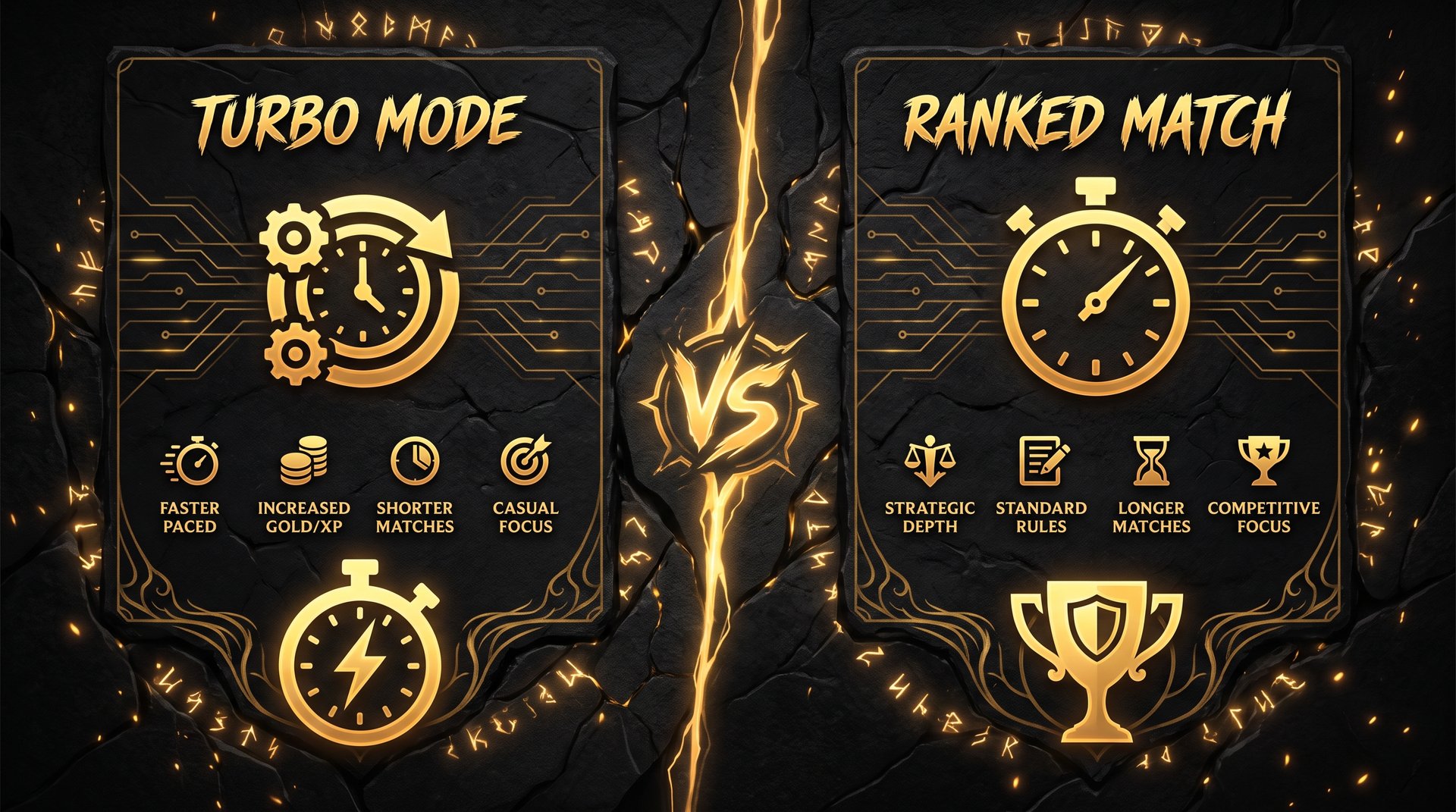
Turbo mode was added specifically to create shorter, lower-stakes games. It delivers on that promise consistently. Based on Dotabuff community data through October 2026, the average Turbo game lasts 23-28 minutes. The gold and experience multipliers (roughly 1.6x and 1.4x respectively compared to normal) accelerate item spikes and level thresholds so that the mid-game timing arrives about 10 minutes earlier than in a standard ranked game.
What Turbo changes about game length
- Teamfights start earlier: With faster gold income, key items like Blink Dagger and Black King Bar arrive at 12-14 minutes instead of 18-22 minutes. This pulls the fight-heavy mid-game window forward and means games often close before the 25-minute mark.
- Death timers are not reduced proportionally: Turbo does not shrink death timers at the same rate as it accelerates item acquisition. Late-game deaths are still punishing. This accelerates the push-for-Ancient decision once a team gets a decisive advantage.
- No full ranked MMR impact: As noted in our guide on which modes affect MMR, Turbo does not award the same ranked MMR as a standard game. This makes it valuable for practice but not as a substitute for ranked climbing.
If you are a new player evaluating time commitment, Turbo mode is a genuinely useful way to learn heroes and item builds without a 40-minute commitment per game. It is not a ladder replacement, but as a learning tool it is excellent.
The Shortest and Longest Possible Dota 2 Games
How short can a Dota 2 game get?
In public matchmaking, games very rarely end before 15 minutes because the building and structure destroy timers make an Ancient rush mechanically impossible without a completely coordinated effort. The shortest legitimate public matches typically end between 15-20 minutes — usually the result of an extremely lopsided early game where one team takes multiple Tier 1 and Tier 2 towers by the 12-minute mark and pushes directly to high ground. At pro level where everything is coordinated, some games have ended closer to 12-14 minutes.
In professional competition, anything under 20 minutes is considered extremely fast by modern standards. The shortest tournament matches in Dota 2 history occurred in games where one team committed to a base-race strategy and lost it decisively.
How long can a Dota 2 game get?
The longest Dota 2 match ever recorded in a standard environment lasted over 6 hours. In standard matchmaking, games beyond 90 minutes are extremely rare but not impossible. Defensive itemisation (Guardian Greaves, Dazzle, Omniknight) combined with strong melee-range Ancient protection can extend games to 60-70 minutes at lower brackets. At higher MMR, games that reach 60 minutes are unusual because both teams have the tactical awareness to force a resolution.
Practical budgeting: plan 45 minutes per game if you are between Herald and Ancient. Plan 40 minutes if you are at Divine. Plan 38 minutes if you are at Immortal level. Add 10 minutes for queue and draft time and you are looking at roughly 50-55 minutes per game session slot.
How to Stop Playing Unnecessarily Long Games
The gap between a 35-minute decisive win and a 50-minute drawn-out game at Archon is almost always explained by one of three failure modes. Fixing any of them will shorten your average game without playing worse — in fact, the habits that shorten games correlate directly with winning more.
1. Push after the teamfight, not 2 minutes after
The window after a successful teamfight where the enemy team has long death timers is worth approximately 45 seconds to 2 minutes of free pushing. Most lower-bracket players use some of that window but abandon the push at the outer tower edge when an enemy respawns and starts walking back. The correct decision: commit fully to destroying the structure you targeted during the fight-win, then reassess from there. Partial pushes that reset to a farm phase are the single most common driver of extended game times.
2. Secure Roshan when the opportunity is clear
Roshan, when secured and converted to an Aegis hold, is the single most reliable mechanism for forcing a decisive push in the following 5 minutes. Many lower-bracket teams win teamfights and then ignore the Roshan pit for 10 minutes, allowing the enemy to recover. The decision flowchart is simple: if you just won a fight that killed 3+ enemies with 30+ second timers, check if Roshan is alive. If yes, go immediately. The Aegis nearly always converts to a push, and pushes end games.
3. Identify your hero power spike and commit to it
Every carry and midlaner has a net worth threshold where they are strongest relative to the enemy lineup. Ignoring that window — farming past your peak for one more item — is one of the most common ways competent players extend their own games unnecessarily. If your peak timing is 30 minutes with a 4-item Storm Spirit, that is when you should be forcing the issue, not farming a fifth item to feel safer. If you want to understand why your games specifically go long at a deep level, a session with an Immortal coach at TeamSmurf coaching will identify your specific habit patterns faster than months of solo analysis.
A note on boosting and game length
One option players consider when game length and slow improvement frustrate them is Dota 2 MMR boosting. A boosted account will produce shorter games because the players in higher lobbies are better at closing out, but it does not fix the underlying mechanical habits that cause long games. Coaching addresses the root cause; boosting addresses the bracket. Both have their place. To understand the safety side of the service question, our guide on whether Dota 2 boosting is safe covers account risk in detail.
Other Factors That Affect Match Length
Even within the same rank and mode, individual game length varies. The variables with the most impact beyond those already discussed are:
Hero draft composition
Push lineups (Lycan, Broodmother, Pugna, Nature’s Prophet, Chen) are capable of ending games at 20-25 minutes if not countered directly. Pick-off lineups that can isolate and kill enemies through the map create longer game states because they never generate a decisive 5v5 moment. Draft five carries with no push mechanism and expect your game to extend past the 45-minute mark regardless of bracket.
Server region and latency
High-ping lobbies (common in Southeast Asia and South America during peak hours) produce longer games because mechanical precision is lower — players miss skill shots, misclick, and commit to fights at wrong moments more often. This adds approximately 2-4 minutes to SEA and SA median game times compared to EU and NA, according to Dotabuff regional data.
Patch-specific tempo
Valve patches periodically shift gold income rates, tower health, and item costs — all of which directly change average match length. Aggressive economy patches (frequent in the 7.33-7.34 era) produced shorter games. Patches that buff defensive items and early tower health push average length up. The figures in this guide reflect the 7.41f era (Oct 2026). After each major patch, check Stratz or Dotabuff for updated aggregate figures as the community data catches up with the meta shift.
Time of day and queue imbalance
Off-peak matches (late night in your region) produce longer games because matchmaking expands its MMR tolerance to fill lobbies faster. When Herald players are matched alongside Archon players due to queue imbalance, the resulting games are chaotic and typically run longer than the median for either bracket. If you consistently see 50+ minute games in the same bracket, check whether your peak play hours coincide with off-peak server load in your region.
Frequently Asked Questions
Want Shorter, More Decisive Games?
If your games consistently run long, a single coaching session with an Immortal player is often the fastest way to identify the exact habit costing you 10+ minutes per game. TeamSmurf coaches analyze your specific replays and give you one concrete thing to fix per session.



