How Fast Does Smurf Detection Work in 2026?

If you have ever wondered whether Valve actually does anything about smurf accounts in Dota 2 — or how long a smurf can survive before getting caught — you are in the right place. In 2026, smurf detection in Dota 2 is more aggressive than it has ever been, but it is also more nuanced than a simple “play 10 games and get banned” rule.
This guide breaks down exactly how the system works, how fast it typically acts, what triggers a faster response, and what the numbers from Valve’s own ban waves tell us about the system’s real-world effectiveness. All factual claims about Valve’s enforcement actions are sourced from public announcements or verified reporting; where figures are community estimates, we label them as such.
Table of Contents
What Is Valve’s Smurf Detection System?
Valve has never published a full technical specification of its anti-smurf system, but between official blog posts, confirmed ban waves, and community research, we can piece together a clear picture. The system is a layered combination of account-creation barriers, behavioral monitoring, matchmaking segregation (the Smurf Pool), and periodic manual or automated ban waves.
The key point most players miss is this: detection and punishment are two separate events. Valve’s system can identify a likely smurf within a handful of games. The punishment — whether that is a Smurf Pool placement, a temporary penalty, or a permanent ban — often comes later, and sometimes much later, during a scheduled ban wave.
So when people ask “how fast does smurf detection work,” the honest answer is: detection can happen quickly, but the resulting action depends on the severity of the account’s behavior and where we are in Valve’s enforcement cycle.
How the Detection Works — Step by Step
Phase 1: Account Creation Barriers
Valve’s first line of defense is stopping smurf accounts before they enter ranked play at all. As of 2026, a phone number must be linked to a Steam account before the account is eligible for ranked matchmaking. This alone raises the cost of smurfing because most players cannot indefinitely create new phone-verified accounts.
The system also tracks IP addresses at login. Multiple accounts logging in from the same IP address — even across different Steam profiles — create a linkage in Valve’s records. This does not result in an instant ban, but it seeds the behavioral monitoring system with a prior probability that a new account may be associated with an experienced player.
Phase 2: Behavioral Signal Collection
Once an account is in the system, Valve’s detection algorithm monitors a combination of behavioral signals over each match. These signals include:
- Win rate relative to rank — a genuinely new player at Herald or Guardian should not be winning 70-80% of their games in the first 20 matches
- Last-hit rates and GPM/XPM — mechanical performance far above what is expected for a fresh account is a strong indicator
- Hero pool and item builds — highly optimized builds from a level-1 account suggest prior knowledge
- Reaction times and ability usage patterns — machine learning can compare how a player controls a hero vs. what statistical baselines look like for genuine beginners
- Associated account history — if the IP or device is linked to a high-MMR account, that context weighs on the new account’s classification
This is why simply losing on purpose for a few games does not reliably fool the system. The behavioral fingerprint across multiple data points is harder to fake than a single metric like win rate.
Phase 3: Automated Action or Human Review
Once enough signals accumulate, the system takes one of several actions: route the account into the Smurf Pool (see below), flag it for an upcoming ban wave, or in some cases apply an immediate restriction. Valve has described their approach as a combination of “manual and automatic analysis,” meaning some accounts are processed algorithmically while obvious or repeat offenders may receive expedited review.
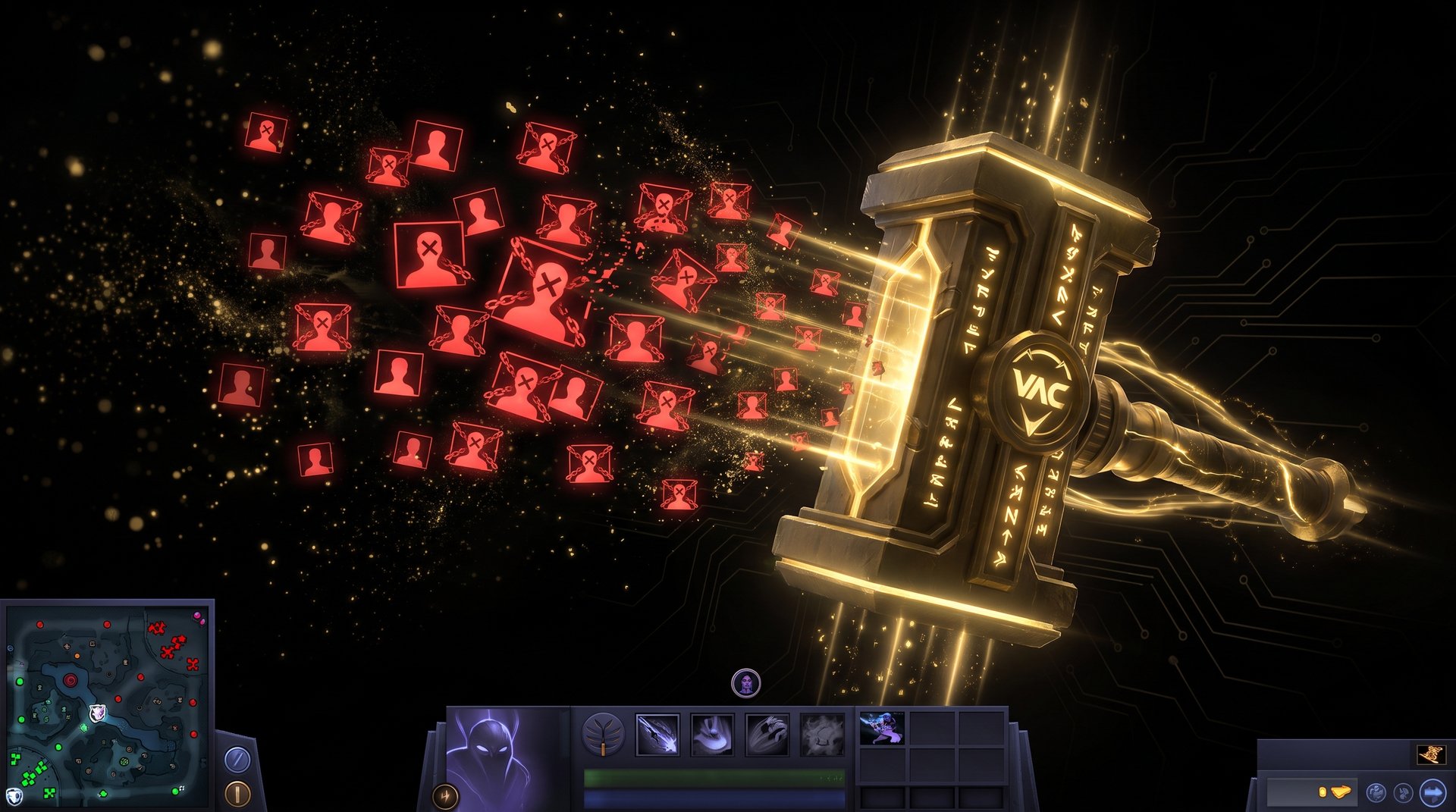
How Fast Does Detection Actually Happen?
This is the question most players come here to answer, and it is also the most variable one. Based on available evidence — Valve’s blog posts, community research, and third-party data — here is a reasonable breakdown of the timeline:
| Stage | Typical Timeframe | Notes |
|---|---|---|
| Account creation barrier check | Instant | Phone number and prior IP/device checks happen at account creation and first login |
| Early behavioral flagging | 5-10 games (estimate) | Community estimate based on reported experiences; Valve has not confirmed a specific number |
| Smurf Pool placement | 10-20 games (estimate) | Community estimate; the account begins matching against other suspected smurfs before a permanent action |
| Formal ban / enforcement action | Days to months | Depends on enforcement cycle; ban waves are periodic, not instant |
| Ban wave processing | Batched; multiple per year | Valve has run ban waves tied to major events (TI, Frostivus) and ad hoc throughout the year |
The “5-20 game” range for initial flagging is a community estimate — players who have been flagged and reported their experiences on Reddit and the Steam forums consistently point to this window, but Valve has never published an official number. Treat it as a reasonable approximation, not a guarantee.
What is confirmed is that detection does not require hundreds of games. The behavioral signals a skilled player produces at low rank are statistically unusual enough that the algorithm can build high confidence within a short session. The delay between detection and action is primarily a function of how Valve batches its enforcement rather than how long it takes the system to identify a smurf.
The Smurf Pool — Detection Without a Permanent Ban

The Smurf Pool is one of the most significant — and least understood — tools in Valve’s anti-smurf arsenal. It is a hidden matchmaking layer that routes accounts flagged as potential smurfs into games predominantly against other flagged accounts, rather than against genuine low-rank players.
From Valve’s perspective, this achieves two things. First, it immediately reduces the harm a smurf causes to normal players — they are no longer stomping beginners. Second, it creates a controlled environment where the smurf’s behavior can continue to be observed before a permanent action is taken, reducing false positives from triggering permanent bans on new players who are simply improving unusually fast.
How the Smurf Pool Affects Gameplay
Players who have been placed in the Smurf Pool report that their games feel increasingly difficult for their stated rank — opponents play at a much higher level than the MMR bracket suggests. The games may also feel different in terms of hero diversity and strategic execution, since they are effectively playing in an unofficial “smurfs vs. smurfs” queue.
Notably, the Smurf Pool is not publicly disclosed by Valve. Players typically realize they are in it when their match quality shifts noticeably. There is no in-client notification. This invisibility is intentional — it avoids giving smurfs a clear signal to pause activity and wait for the designation to expire.
Getting out of the Smurf Pool is possible if the system determines it made a mistake — a legitimate beginner who happened to perform unusually well may see their match quality normalize over time. But for actual smurfs, the Pool is typically a staging area before permanent action.
Valve’s Ban Waves — Verified Numbers
The clearest evidence that detection works comes from the scale of Valve’s enforcement actions. These are publicly confirmed numbers from official Dota 2 blog posts and verified reporting:
- Frostivus end-of-year ban wave (Winter 2024): 65,594 smurf accounts were permanently banned in a single enforcement action. Valve published this figure in the official Dota 2 Frostivus blog post.
- Pre-TI14 ban wave: More than 75,000 accounts were suspended for smurfing, win trading, and related violations ahead of The International 14.
- Additional wave (2024-2025): Valve permanently banned approximately 90,000 smurf accounts in another large-scale action covering months of accumulated data.
- “Bloodbath” ban wave: Valve themselves described one enforcement period as a “bloodbath” — it was notable enough that professional-level players were caught in it, demonstrating that high-MMR accounts are not exempt from scrutiny.
These numbers tell an important story: Valve is not ignoring smurfing, and the detection system is clearly accumulating data at scale. Tens of thousands of accounts per enforcement cycle means the pipeline is constantly filling — what varies is when the valve opens to let the bans through.
It also means that if you are playing ranked Dota 2 MMR and encountering smurfs, there is a meaningful chance the system has already flagged them and is simply waiting on the next enforcement cycle.
What the Ban Wave Numbers Mean for You
If you are a legitimate player frustrated by smurfs, these numbers are actually encouraging. Valve is banning tens of thousands of smurf accounts multiple times per year. The system works — it just does not work in real-time, which is the source of most player frustration.
What Triggers Detection Faster
Not all smurf accounts are treated equally by the detection system. Certain behaviors appear to accelerate how quickly the system acts:
Extremely High Win Rates at Low MMR
A win rate of 70% or above in the first 20 games at Herald or Guardian is a very strong statistical signal. The system’s baseline model for how a genuinely new player performs makes this kind of rate nearly impossible without prior high-level experience.
Multiple Accounts on the Same Hardware or IP
If you already have a high-MMR account and you create a new one, the IP and device linkage increases the prior probability that the new account is a smurf. The system does not need to wait as long for behavioral confirmation because it already has contextual information from the associated account.
Reported Accounts
While Valve has not confirmed that player reports directly trigger automated bans, a high report rate on a new account almost certainly feeds the behavioral signal weighting. Accounts that are reported for smurfing repeatedly are more likely to be reviewed or added to the next ban wave sooner.
Win Trading
Win trading — intentionally losing games as a coordinated group to help one account climb — is treated as a separate but related offense. It is easier for the system to detect because the patterns (mutual losses, coordinated teams, impossible gameplay statistics) are highly anomalous. Several of the large ban waves explicitly included win traders alongside smurfs.
Does Detection Affect Boosting Accounts?
This is a legitimate question for anyone considering a Dota 2 boosting service or looking at whether boosting carries detection risk. There is an important distinction to understand here.
Smurf accounts — where an experienced player creates a brand-new account to play against beginners — generate the exact behavioral signals the system is trained to catch: impossibly high win rates at the lowest ranks, mechanical performance far above bracket norms, and often IP linkage to high-MMR accounts.
Professional MMR boosting, by contrast, operates on an existing account that already has a rank history. A booster playing on your account is not starting at Herald with a blank slate — they are playing at a rank that is, by definition, below their actual skill level. The signal profile is different: a series of wins at, say, Archon level by a player who performs like a high Immortal will look unusual, but the account history context is different from a fresh account stomping beginners.
This does not mean boosting is risk-free from Valve’s enforcement perspective — account sharing does violate the Steam Subscriber Agreement. But the specific detection mechanisms designed to catch smurf accounts (new account + low rank + impossibly high performance) are not the primary threat model for boosted accounts. If you want to understand the full risk picture, our guide on is Dota 2 boosting safe covers this in detail.
If you are looking for the safest way to improve your MMR, the answer is a professional service that uses region-matched VPNs, offline/invisible mode, and plays at natural win rates rather than stomping at 90%. That approach minimizes any behavioral anomalies. Our Dota 2 MMR boost service is built around exactly those principles.
Summary — The 2026 Smurf Detection Timeline
To pull everything together: Valve’s smurf detection system in 2026 is multi-layered and genuinely effective, but it does not operate on a single “games played before banned” timer. Here is the condensed version:
- Account creation: Phone verification and IP/device checks happen immediately. Linkage to existing high-MMR accounts seeds the detection profile.
- Early games (estimated 5-20): Behavioral signals accumulate. The system builds a confidence score on whether this is a smurf. (Community estimate — not a Valve-confirmed number.)
- Smurf Pool placement: Before a permanent ban, many flagged accounts are silently routed into smurf-vs-smurf matchmaking. This can happen within the first few weeks of activity.
- Ban wave: Accounts that have accumulated sufficient evidence are permanently banned in batch enforcement actions. Valve runs multiple per year, with tens of thousands of accounts affected each time.
The system is not instant, but it is persistent. Data accumulated over months is processed in bulk. The accounts Valve banned in the Frostivus wave had been active for varying lengths of time — the system had simply been collecting evidence and processed it all at once.
For legitimate players, the takeaway is that smurfs you encounter are likely already flagged and will face consequences in the next enforcement cycle. For anyone considering whether to smurf: the question is not “will I get caught” but “when.”
Frequently Asked Questions
Want to Climb Without the Risk?
Skip the smurf route entirely. Our professional Dota 2 boosters play on your account with region-matched VPNs, invisible mode, and natural win rates — no red flags, no smurf pool, no ban wave exposure.