


Herald MMR Range 2026: Herald 1-5 Numbers and What Those Games Look Like

Herald MMR in Dota 2 covers the range from 0 to 769 MMR across five sub-ranks (Herald 1 through Herald 5). If you want to know exactly which number you need to reach the next star — or to leave Herald entirely — the table below has every threshold.
Herald 5 ends at 769 MMR. Hit 770 and you enter Guardian 1. Each star spans exactly 154 MMR, and the gap holds across the current 2026 ranked season.
Herald MMR Range Table 2026
| Sub-rank | MMR Range | MMR Width | Next Milestone |
|---|---|---|---|
| Herald 1 | 0 — 153 | 154 MMR | Herald 2 (154 MMR) |
| Herald 2 | 154 — 307 | 154 MMR | Herald 3 (308 MMR) |
| Herald 3 | 308 — 461 | 154 MMR | Herald 4 (462 MMR) |
| Herald 4 | 462 — 615 | 154 MMR | Herald 5 (616 MMR) |
| Herald 5 | 616 — 769 | 154 MMR | Guardian 1 (770 MMR) |
Each sub-rank spans 154 MMR. You earn roughly +30 MMR for a ranked win and lose roughly -30 for a loss under the current 2026 calibration system. That means climbing from Herald 1 to Guardian 1 requires a net gain of around 770 MMR — approximately 26 more wins than losses from the absolute floor.
What Herald 1 Games Actually Look Like (0-153 MMR)
Herald 1 is the calibration floor. Many players here are either new to the game, returning after a very long break, or playing on a freshly calibrated account. Games at this sub-rank share a handful of universal traits that repeat themselves match after match.
The single biggest factor in Herald 1 matches is the death count. It is normal to see match summaries with 60 to 70 total team deaths. Players have not yet internalized that dying is almost always a bigger setback than missing a kill. Lane phase ends when someone dies five times in the first ten minutes and concedes the entire lane, not because of itemization or creep equilibrium management.
Last hits are sparse — averages of 30 to 50 CS at the 20-minute mark are typical across all roles. Supports buy courier once and often rotate to the mid lane for no clear strategic reason. Junglers appear frequently even when the heroes chosen have no meaningful jungle presence. The minimap goes dark around the five-minute mark and stays dark; ward coverage is near zero outside of the starting observer ward placed at the river.
One genuine positive: at this sub-rank, individual mechanical outplays win games outright. If one player knows their hero kit and uses spells efficiently, they can carry 1v5 in a way that is simply not possible at higher ranks where BKBs and positioning fundamentals exist. Herald 1 is frequently described as a “farming simulator mixed with chaos” — and the chaos can work for you if you know your hero kit better than your opponents.
Herald 2: 154-307 MMR — Learning the Basics
Moving from Herald 1 to Herald 2 usually signals that a player has absorbed the basic lesson that dying is costly. Death counts drop noticeably, and a more meaningful change appears: players begin to respect big ultimates. Enemies will spread out when they see Enigma on the opposing team — at least some of the time.
Itemization at Herald 2 remains largely instinct-driven rather than win-condition-driven. Carries occasionally build Midas before Power Treads. Supports routinely skip boot upgrades entirely. Smoke of Deceit is almost never purchased. Runes are contested at the bounty timer but not systematically tracked at the 2-minute and 4-minute windows.
Lane matchups start mattering here. Players begin to recognize strong lane combos and will sometimes select them intentionally. Rotations from the support are rare but they happen — typically when the mid hero is being destroyed and the support makes a panic rotate to save a dying tower.
If you are stuck in this sub-rank, the most effective approach is picking a self-sufficient hero that does not depend on your team to function. Nature’s Prophet, Sniper, and Juggernaut have historically high win rates in the Herald 2 bracket because they can farm independently and push objectives without coordination. Check the best Dota 2 improvement tools available if the grind is taking longer than expected.
Herald 3: 308-461 MMR — The Awareness Threshold
Herald 3 is often called the “awareness threshold” sub-rank. Players here have typically watched enough content to know concepts like lane equilibrium, pulling, and stacking camps — but they apply them inconsistently. A Herald 3 player might pull the camp correctly three times in a single game and then forget entirely for the next six matches.
Mid lane fights at this MMR become actual duels. Players start tracking rune timers, and power rune denial — purposely contesting an enemy heading for the river rune — becomes a real contest. Smoke ganks appear occasionally: rare and usually poorly timed, but they show up. Teams start buying wards as a group effort rather than as a solo support obligation.
Teamfights at Herald 3 coalesce around obvious moments: Roshan spawning, or the enemy team grouping visibly near a barracks. The fights are still messy, but there is a recognizable attempt at coordination. BKBs get purchased when players remember to buy them.
The primary ceiling at Herald 3 is resource allocation under pressure. When a fight goes wrong, players pool into each other and feed multiple deaths rather than retreating and regrouping. If you can consistently practice the discipline of “cut losses, do not feed free kills,” Herald 3 tends to resolve itself relatively quickly compared to the lower sub-ranks.
Herald 4: 462-615 MMR — The Drafting Sub-rank
Herald 4 is where intentional hero drafting starts to emerge. Players at 462-615 MMR will recognize a hard counter before the game begins and occasionally ban it. They maintain a small pool of heroes they feel confident on and default to that pool when the draft gets complicated.
Communication in Herald 4 is still chaotic but more tactical than emotional. Players will ping the Roshan icon as a way to call an objective without using voice chat. “Missing mid” pings actually happen with some reliability. Teams acknowledge a Mega-push threat without being told multiple times in all-chat.
Farming efficiency begins diverging noticeably here. The top-performing player in any Herald 4 match is typically doing 10 to 12 CS per minute — still far below the 18+ of high-MMR carries, but a visible gap from the rest of the lobby. This is the sub-rank where learning to deny creeps and maintain efficient farming patterns pays the biggest per-game MMR dividends.
Heroes with strong solo-kill potential — Storm Spirit, Invoker, Void Spirit — start appearing in the mid lane and dominating when piloted by someone who has done the work. The gap between “knows the hero” and “does not know the hero” is widest at Herald 4 because there is no team infrastructure to cover a knowledge deficit the way there is at Guardian or above.
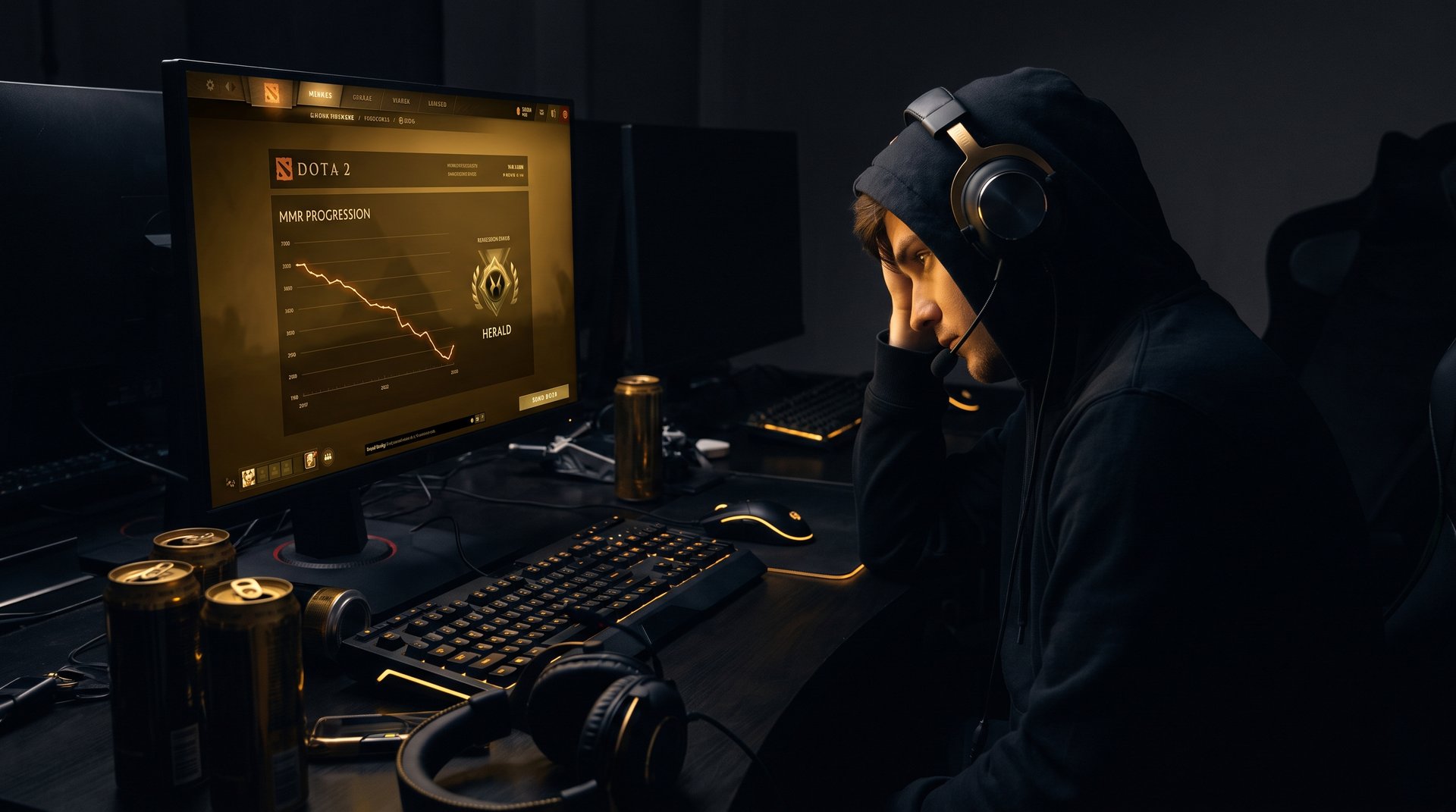
Herald 5: 616-769 MMR — The Exit Door
Herald 5 is the final sub-rank before Guardian. At 616 to 769 MMR, players have cleared most of the “I did not know that was a thing” mistakes that define the lower Herald brackets. The remaining mistakes are primarily execution-based rather than knowledge-based.
Roshan timers are actively tracked at Herald 5. Aegis denial — intentionally letting Roshan kill an out-of-position enemy hero — happens as a purposeful decision rather than an accident. Ward placement moves beyond the river: high-ground spots above the base ramps appear regularly in the ward log.
Teleport scrolls are used defensively. When the bottom barracks come under threat, the team will TP to defend. This sounds like a basic habit but it is a genuine behavioral shift from lower Herald brackets where TPs were used almost exclusively offensively or forgotten in the inventory entirely.
The frustrating truth about Herald 5 is that many players have been here for months or years. The MMR gap between Herald 5 and Guardian 1 is only 154 points on paper, but the behavioral gap is significant. Guardian 1 players draft with intent, test their item timing against a clock, and play with consistent tempo throughout the match. If you have been sitting at Herald 5 and feel like you are executing but not climbing, a structured review of your decision-making at the 20-25 minute mark — where games at this sub-rank are typically decided — will almost always reveal a recurring pattern worth addressing.
Herald vs Guardian: Where the Gap Actually Lives
| Gameplay Factor | Herald (0-769 MMR) | Guardian (770-1539 MMR) |
|---|---|---|
| Last hits at 20 minutes | 30-60 average | 70-110 average |
| Ward coverage | Minimal, reactive | Consistent river + basic highground |
| Smoke of Deceit usage | Rare, 0-1 per game | 1-2 smokes per game standard |
| TP scroll usage | Primarily offensive | Both offensive and defensive |
| Roshan timer tracking | Sporadic | Mostly consistent |
| BKB purchase timing | Situational, often late | Closer to optimal power-spike timing |
| Draft awareness | Role-filling | Starting to counter-pick intentionally |
The table captures the observable differences, but the real gap is anticipatory: Herald players react to what is happening on screen. Guardian players anticipate what is about to happen. That 3-to-5 second mental lead is what makes 770 MMR feel like a wall rather than just a number on a calibration chart.
How Many Players Are in Herald? Distribution in 2026
Based on community rank-distribution data tracked on Dotabuff across the 2026 ranked season, Herald holds roughly 15-17% of all ranked players. That makes it the second-largest bracket by population, just behind Guardian which accounts for approximately 22-24% of the player base.
Within Herald, the distribution skews toward the lower sub-ranks. Herald 1 and Herald 2 combined account for more than half of Herald’s population. This reflects how many new players calibrate below 300 MMR and then grind their way upward over weeks or months of play.
Common Patterns Across All Herald Brackets
After reviewing thousands of matches from Herald accounts, TeamSmurf has identified a short list of behaviors that appear consistently regardless of the specific Herald sub-rank. These are the patterns most worth addressing if you want to leave the bracket permanently.
- Farming while the enemy team is visible. If all five enemies are on the minimap and none are near you, that is the best possible moment to contest Roshan or push a tower. Herald players continue farming neutral creeps instead. Guardian players push the advantage.
- Spell usage without follow-through. A Herald Earthshaker will land Echo Slam on three heroes, get a triple kill, and then back off because the ability is on cooldown. The correct play is to immediately right-click the weakened survivors. The ability did its job — now the physical damage does its job.
- Support building damage items at 20 minutes. Supports at Herald frequently itemize toward Daedalus or Aghanim’s Scepter once their carry is ahead. This removes the support from their protective function. A Glimmer Cape or Force Staff bought at that timing is a larger win contribution than any damage item the support could build.
- Fixed starting items regardless of lane matchup. Herald players buy the same starting items every game on a hero. Spending 30 seconds looking at the enemy hero’s stats to decide between Stout Shield and Quelling Blade is a free advantage that costs nothing except attention.
- Abandoning the win condition when ahead. A team that gets First Blood and two early towers will often attempt a five-man push at the ten-minute mark instead of allowing their carry to farm into a power spike. Trading a meaningful early advantage for an uncertain 10-minute engagement is one of the most common ways Herald wins convert into losses.
The Fastest Path Out of Herald: What Actually Works
There is a lot of conflicting advice about escaping Herald, but the approaches that consistently produce results reduce to two levers: hero mastery and win condition clarity.
Hero Mastery First
Pick one or two heroes and play them until you understand every interaction that affects your win condition. At Herald, hero mastery matters more than general game knowledge because your team is not going to execute the complex macro plays described in guides. What they will do is follow a winning hero who is making decisive plays — even if they do not fully understand the reasoning behind those plays. Dragon Knight, Phantom Assassin, Wraith King, and Viper are popular picks for Herald climbers because their win conditions are clear and their skill floors are achievable within 20 to 30 games of focused practice.
If you want to see what higher-MMR gameplay looks like on your specific hero before committing fully to the grind, TeamSmurf’s coaching service pairs you with an Immortal-ranked player who reviews your replays and identifies your ceiling-level mistakes directly. Many Herald players find that one or two recurring decision errors account for the majority of their losses.
Win Condition Clarity
Know at the draft screen what your win condition is and let that knowledge guide every decision from minute one. If you are playing Medusa, you are not trying to win the game at 15 minutes. Every decision — farming priority, retreat versus fight, TP response — runs through the filter of “does this give Medusa enough space to hit her power spike at the 30-35 minute mark?”
The MMR boosting guide on TeamSmurf covers how Immortal players approach win condition drafting in detail, with role-specific examples by hero class. Even if boosting is not something you are considering, the frameworks in that guide offer the most structured Herald exit plan available.
For a full landscape overview of services that can accelerate the climb, the best Dota 2 boosting services comparison explains what to look for in a legitimate provider and which ones have a track record of safe, consistent results.
If you want to understand the risk and ethical considerations first, is Dota 2 boosting safe walks through Valve’s position, the community norms, and the practical risk profile in straightforward terms.
Frequently Asked Questions
Ready to Leave Herald Behind?
TeamSmurf places Immortal-ranked boosters on your account to move your MMR to any target bracket — Guardian, Archon, Legend, or higher. Every order includes a full money-back guarantee and account security protection.
Get an MMR Boost Book a Coaching Session



