

Is 2K MMR Bad? Where Guardian and Crusader Really Sit in 2026

You are sitting at 2,000 MMR — or somewhere close to it — and you want to know the truth. Is 2K MMR bad? Is it embarrassing? Should you be worried? The short answer is no, and the data backs that up. But the full picture is more interesting than a simple yes or no.
This article covers exactly where Guardian and Crusader sit in the 2026 ranked player pool, what the MMR numbers mean, what games genuinely feel like in both brackets, and what it actually takes to push higher. We used Stratz rank distribution data (June 2026, 7.1 million+ calibrated accounts) to give you precise percentile numbers — not guesses.
In This Guide
- The Short Answer: Is 2K Bad?
- Full 2026 Rank Distribution Table
- What Is Guardian MMR? (770-1,539)
- What Is Crusader MMR? (1,540-2,309)
- Where Exactly Does 2K Sit?
- Is 2K MMR Bad? The Honest Answer
- What Separates 2K from 3K+ Players
- Habits Holding 2K Players Back
- How to Climb Out of Guardian and Crusader
- Frequently Asked Questions
The Short Answer: Is 2K MMR Bad?
No. 2K MMR is not bad. It is approximately average for a dedicated ranked Dota 2 player in 2026.
At 2,000 MMR you are playing in the Crusader 3 range — right near the middle of the entire ranked player distribution. Based on Stratz data from June 2026 covering 7.1 million+ accounts, the median ranked player sits at approximately Crusader 5 (~2,309 MMR). That means 2K is slightly below the median, but you are still ahead of roughly 44 to 48 percent of the entire calibrated player base.
To put it differently: if you lined up every ranked Dota 2 player, you would beat roughly 4 or 5 out of every 10 in a fair skill comparison. That is not “bad.” That is average — and average in a game with a notoriously brutal learning curve means you have already learned things that the bottom 40% of players have not figured out yet.
The reason 2K feels bad is comparison bias. If your friends play at 4K or 5K, you are comparing yourself to the top 8% of the player base. That is a bad reference point. Compare yourself to the full distribution instead.
Full 2026 Rank Distribution Table
Here is the complete ranked distribution across all brackets, based on the same Stratz dataset referenced in our Is 3K MMR Good? analysis. Guardian and Crusader are highlighted because that is where this article focuses.
| Rank | Approx. MMR Range | Percentile (est.) | Top % of Players |
|---|---|---|---|
| Herald 1-5 | 0 — 769 | 0.25 — 14.15 | Bottom 14% |
| Guardian 1-5 | 770 — 1,539 | 18 — 34 | Top 66-82% |
| Crusader 1-5 | 1,540 — 2,309 | 38 — 54 | Top 46-62% |
| Archon 1-5 | 2,310 — ~3,079 | 57 — 70 | Top 30-43% |
| Legend 1-5 | ~3,080 — 3,849 | 73 — 82 | Top 18-27% |
| Ancient 1-5 | 3,850 — 4,619 | 84 — 90 | Top 10-16% |
| Divine 1-5 | 4,620 — ~5,419 | 92 — 96 | Top 4-8% |
| Immortal | 5,420+ | 99+ | Top 1% |
A few things that stand out from this table. First, the Guardian bracket (770-1,539 MMR) covers about 16 percentage points of the player population — it is a wide band. Second, Crusader spans from the 38th to 54th percentile, making it the closest bracket to the true median. Third, 2K MMR sits right in the middle of Crusader, which means you are near the center of the entire ranked population.
Compare that to Archon and above: reaching Archon 1 (around 2,310 MMR) already puts you in the top 43% of players. The difference between Crusader and Archon sounds small — about 300 MMR — but it moves you from “median player” to “above average,” which is why that boundary is worth understanding.
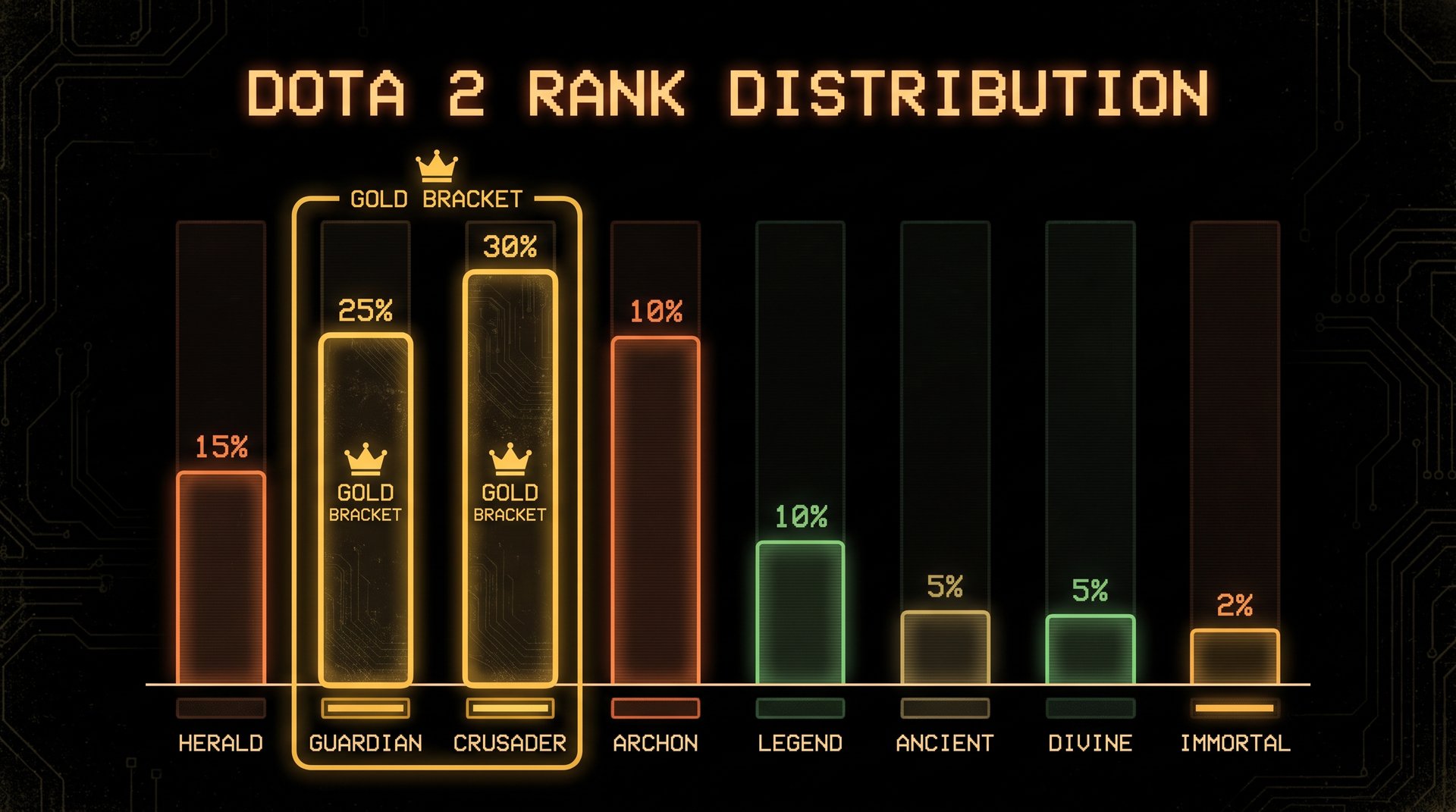
What Is Guardian MMR? The 770 to 1,539 Range
Guardian is the second-lowest bracket in Dota 2, sitting above Herald and below Crusader. It spans from approximately 770 MMR at Guardian 1 to 1,539 MMR at Guardian 5. Players in this bracket represent roughly the 18th to 34th percentile of all ranked accounts — which means you are ahead of a meaningful chunk of the player base, but still in the lower half overall.
Guardian 1 Through 5 — The Exact Numbers
| Medal | Approx. MMR | Stars | Percentile (est.) |
|---|---|---|---|
| Guardian 1 | 770 — 923 | 1 star | ~18th |
| Guardian 2 | 924 — 1,077 | 2 stars | ~21st |
| Guardian 3 | 1,078 — 1,231 | 3 stars | ~26th |
| Guardian 4 | 1,232 — 1,385 | 4 stars | ~30th |
| Guardian 5 | 1,386 — 1,539 | 5 stars | ~34th |
Note: these per-star breakdowns are community estimates based on the 770-1,539 range being divided into 5 equal segments. Valve has never published the exact star thresholds within a medal. The overall Guardian range (770-1,539) is reliably tracked; the per-star cutoffs are approximate.
What Games Feel Like at Guardian MMR
Guardian matches in 2026 have a recognizable texture that anyone who has played there will immediately recognize. Here is what to expect:
- Drafting is mostly hero preferences, not counters. Players pick heroes they like or are comfortable with. Hard counters are occasionally recognized after the fact but rarely planned for in draft.
- Laning has real variation. Some players get 25-35 last hits at 10 minutes. Others struggle under 15. The variance is large because lane mechanics — pulling, stacking, equilibrium control — are inconsistently understood.
- Runes and objectives are loosely contested. Bounty runes are sometimes collected; Lotus Pools are often ignored entirely. Roshan goes to whoever shows up first with their team, not whoever has the optimal setup.
- Supports are frequently underleveled. Position 4 and 5 players at Guardian often overstay in lane or roam without impact, leaving them with minimal net worth. Ward coverage exists but is inconsistent.
- Fights happen when someone initiates, not when the game state says to fight. Decisions about when to push, when to farm, and when to force a fight are largely reactive rather than planned.
- Games go late frequently. Because neither team is reliably closing out leads, comebacks are common. The same lead that wins in a higher bracket can evaporate at Guardian.
None of this is meant to be dismissive. Guardian players are learning. The habits above are not permanent — they are the specific gaps that, once identified, become the fastest path to improvement. The bracket is genuinely learnable if you focus on the right things.
What Is Crusader MMR? The 1,540 to 2,309 Range
Crusader is where the player distribution reaches its most populated zone. It spans from approximately 1,540 MMR at Crusader 1 to 2,309 MMR at Crusader 5, covering the 38th through 54th percentile of all ranked players. This is the closest bracket to the statistical median in Dota 2 — the “average” ranked player is in Crusader.
Crusader 1 Through 5 — The Exact Numbers
| Medal | Approx. MMR | Stars | Percentile (est.) |
|---|---|---|---|
| Crusader 1 | 1,540 — 1,693 | 1 star | ~38th |
| Crusader 2 | 1,694 — 1,847 | 2 stars | ~41st |
| Crusader 3 | 1,848 — 2,001 | 3 stars | ~45th |
| Crusader 4 | 2,002 — 2,155 | 4 stars | ~49th |
| Crusader 5 | 2,156 — 2,309 | 5 stars | ~54th |
Same caveat as the Guardian table: per-star MMR splits are community estimates. The overall Crusader range (1,540-2,309) is well-established in the community tracking data.
Where 2K MMR Specifically Falls
2,000 MMR places you right in the Crusader 3-4 transition zone. Based on the distribution data, you are approximately at the 47th percentile of all ranked players. That means about 53% of the player pool is at or above you — you are just a hair below the median.
This context matters enormously. “2K MMR” gets used as shorthand for “low rank” in community discussions, but community discussions about MMR are dominated by the vocal minority at higher brackets. The players laughing at 2K on Reddit are statistically more likely to be 4K-5K — which is the top 5-8% of the player pool. Their perception of “low” is distorted by their own position in the distribution.
What Games Feel Like at Crusader MMR
Crusader games are noticeably different from Guardian — not dramatically different, but the improvement is real:
- Last hitting is more consistent. Most Crusader players can get 40-55 CS at 10 minutes in a fair lane. The floor is higher than Guardian, even if the ceiling is not yet spectacular.
- Ability usage is more intentional. Players understand what their spells do and generally try to use them at the right moment rather than randomly. Skill combos are more reliably executed.
- Map awareness is developing. Crusader players check the minimap more often than Guardian players. Rotations happen — not always at the optimal moment, but they happen. Smoke ganks appear occasionally.
- Basic item builds are more correct. Crusader players generally buy the right core items for their hero. The variance is more in timing and luxury-item decisions than in fundamental build direction.
- Games still have large momentum swings. Crusader games share Guardian’s tendency to see leads evaporate. The player with the best game sense at the critical moments — when to force fights, when to rat, when to group — still has a very high impact on outcomes.
- Toxicity can affect play. Crusader is one of the brackets where chat-induced tilting is a real factor. Players are invested enough to care but not yet experienced enough to consistently separate results from emotions.
Where Exactly Does 2K Sit in the Broader Picture?
2,000 MMR occupies a specific and actually quite defensible position in the Dota 2 ranked ecosystem. Here is how it compares to the benchmarks players usually reference:
| MMR Benchmark | Approx. Rank | Approx. Percentile | Context |
|---|---|---|---|
| 1,000 MMR | Guardian 2 | ~21st | Bottom third of ranked players |
| 2,000 MMR | Crusader 3-4 | ~47th | Near the median — average player |
| 3,000 MMR | Archon 5 – Legend 1 | ~71st | Top 29% — solidly above average |
| 4,000 MMR | Ancient 1-2 | ~86th | Top 14% — genuinely good player |
| 5,000 MMR | Divine 1-2 | ~92nd | Top 8% — exceptional skill level |
| 6,000 MMR+ | High Immortal | Top 1% | Near-professional or professional |
The jump from 2K to 3K is roughly 1,000 MMR — and it moves you from the 47th percentile to the 71st. That is a meaningful shift: from below-average to solidly above-average. It is achievable for any player who commits to deliberate improvement over several months.
If you are thinking about how to close that gap, the TeamSmurf MMR Boosting Guide walks through what the fastest legal paths look like. And if you want a side-by-side look at what life at 3K feels like vs where you are now, our Is 3K MMR Good? article covers that bracket in the same level of detail.
Is 2K MMR Bad? The Honest Answer
No. 2K MMR is not bad. Here is the honest, data-backed breakdown:
- You are average or very close to it. 2K sits near the 47th percentile of all ranked Dota 2 players. Average is not bad.
- You are ahead of a meaningful portion of the player base. Nearly half of all ranked players are below 2K MMR. This includes a large number of players who are genuinely trying to improve and struggling to do so.
- You have learned real things. Getting to 2K means you understand Dota 2 at a level that most casual players do not. You know how to lane, you know what items do, you understand the basic flow of a game.
- The gap to “good” is measurable and closable. The difference between 2K and what most people would call “genuinely good” (around 4K, top 14%) is real but not insurmountable. Players have climbed from 2K to 4K in 12-18 months with focused effort.
What 2K is: a legitimate starting point for a player who is ready to improve. What 2K is not: a ceiling, a character flaw, or evidence that you cannot get better at this game.
What Actually Separates 2K from 3K+ Players
This is the section that matters most if you are trying to climb. The gap between 2K and 3K is not mostly mechanical — it is mostly decision-making and game-sense. Here is what higher-bracket players consistently do better:
| Area | Typical 2K (Crusader) | Typical 3K+ (Archon+) |
|---|---|---|
| Objective timing | Reacts to kills, then maybe pushes | Knows what objective to take after every fight |
| Resource pressure | Farms when safe, fights when initiated | Creates pressure deliberately to deny the enemy safe farm |
| Vision control | Wards near the fountain or highground | Wards to contest specific objectives and map zones |
| Itemization flex | Follows a fixed build regardless of matchup | Adjusts core items based on enemy lineup and game state |
| Death avoidance | Dies in greedy positions or tilted after a loss | Values BKB timing, positioning, and respects power spikes |
| Team coordination | Individual plays hoping teammates follow | Communicates specific objectives and executes plan |
Notice that most of these gaps are about decision-making, not mechanical execution. A 3K player does not have dramatically better last-hitting than a 2K player. They have dramatically better understanding of what to do with a lead.
This is actually good news. Decision-making is learnable much faster than mechanical skill. Watching your own replays and identifying the specific moment in each loss where you made the wrong call is one of the highest-leverage activities a 2K player can do. You do not need to grind 10,000 more last hits — you need to understand three to five key decision moments per game better than you currently do.
The Habits That Keep Players Stuck at 2K MMR
Based on patterns we see repeatedly from players who have spent time in the Guardian and Crusader brackets, these are the behaviors most likely to prevent progression:
1. Playing Too Many Heroes
Variety feels like improvement but often is not. At 2K, the biggest gains come from mastering 2-3 heroes deeply — understanding their power spikes, their limits, and their ideal play patterns in every common game state. Spreading across 15 heroes keeps you permanently in the “figuring out what to build” phase instead of the “winning through execution” phase.
2. Playing for Kills Rather Than Objectives
The score screen shows kills. The victory condition is buildings. At 2K, players frequently take a winning fight and then mill around rather than immediately converting it into a barracks or a Roshan. The window after a won teamfight is often the most important decision point in a Dota 2 game, and using it poorly neutralizes the advantage.
3. Ignoring Role Discipline
Guardian and Crusader matches frequently see cores under-farming because they stop to fight, and supports over-farming because they want the items. Role discipline — carries staying on the efficient farm path, supports creating space — is one of the most impactful habits to build. It is not glamorous, but it is real.
4. Treating Losses as Random Events
Believing that losses are your teammates’ fault prevents learning. Every loss contains decisions you made that reduced your chances of winning. Some losses are indeed unwinnable — but most are not. Reviewing your five biggest mistakes from a loss (not your teammates’ mistakes) builds the improvement loop that actually raises MMR.
5. Playing on Tilt
After a loss, especially a frustrating one, the next game has a significantly higher chance of being another loss. Playing when tilted changes your decision-making at a neurological level. The discipline to stop after two consecutive losses and come back the next day is worth more MMR than most in-game improvements.
How to Climb Out of Guardian and Crusader in 2026
There is no single technique that moves you from 2K to 3K overnight. But there is a clear progression of skills that consistently produces upward movement. Here is a realistic framework:
Phase 1: Pick One Role and Three Heroes (Weeks 1-4)
Pick the role you find most impactful in your current games. For most 2K players, this is a position 1 (carry) or position 4 (soft support) because these roles have clear win conditions that are achievable without relying entirely on teammates. Pick three heroes that fit your style and have straightforward power spikes. Learn them deeply. Do not deviate for one to two months.
Phase 2: Build the Objective Habit (Weeks 3-8)
After every won teamfight, before celebrating, ask yourself: what is the nearest objective? Barracks? Roshan? Tier 2 tower? Force yourself to answer and then move toward it. This single habit — converting fights into objectives — is responsible for the largest single MMR jump most improving players experience.
Phase 3: Replay Review (Ongoing)
Watch one replay per day. Do not watch to feel bad. Watch with a specific question: “At what moment in this game did I lose the most advantage?” Usually this is one decision around 25-35 minutes — a fight that did not need to happen, a farm path that was inefficient, a key item that was delayed too long. One lesson per replay, applied to the next game, compounds quickly.
If you want to accelerate this process significantly, a session with a high-MMR coach who can watch your games live and give real-time callouts is one of the most efficient uses of time available. The TeamSmurf coaching service connects you with coaches who play in the 6,000+ MMR range and can identify the specific decisions holding back your particular playstyle — not generic advice.
For players whose primary constraint is time rather than skill, MMR boosting is a legitimate option. If you need to reach a specific bracket to play with friends or to unlock certain features, a boost gets you there. You can read about how the process works and what protections are in place at Is Dota 2 Boosting Safe? and what makes a service trustworthy at Best Dota 2 Boosting Services.
Ready to Leave 2K Behind?
Whether you want a coach to fix the specific habits holding you at Crusader, or you need to reach a target MMR bracket on a timeline, TeamSmurf has the Dota 2-specialist team to get it done. Every booster and coach plays at 6,000+ MMR.


