


Earthshaker Guide Dota 2 (2026): Blink Combos & Build

Earthshaker is one of Dota 2’s most satisfying heroes to play well and one of the most punishing to play poorly. The gap between a 5-man Echo Slam that ends a team fight in two seconds and a Blink into nobody is enormous — and it all comes down to execution, positioning, and understanding exactly how the combo works.
This guide covers the current 7.41e build, the Blink combo mechanics in detail, Fissure placement strategy, and how Aftershock stacks give you free stun time that most players leave on the table. Whether you play him as a pos 3 offlaner or a roaming pos 4, the principles are the same: set up, go in, chain everything, clean up.
In This Guide
Hero Overview: What Earthshaker Does and Why He Works
Earthshaker is a melee strength hero whose entire kit revolves around one goal: get close to a grouped enemy team, stun everything, and deal amplified burst damage before anyone can react. He plays as a position 3 offlaner, a roaming position 4 semi-support, or in rare cases a position 5 hard support when his team needs a disruptor over a traditional healer or aura carrier.
His value in 7.41e comes from the fact that the current meta rewards physical damage fights and controlled initiations. When Earthshaker blinks in and lands a 5-man Echo Slam, he does not just deal damage — he chains each unit hit back through every other unit nearby, meaning the more grouped your enemies are, the harder the burst. Against five heroes standing within 400 units of each other, a single well-aimed Echo Slam can erase half the health of every hero in the pack before a single spell gets cast back.
The core reason to play Earthshaker right now: he is one of the few initiators who does not require expensive items to come online. Blink Dagger plus one support item is enough to start winning teamfights. In a patch where the meta has shifted toward physical damage carries with straightforward timings, having an initiator who can create instant chaos and isolate carry heroes behind a Fissure wall is extremely powerful.
Earthshaker Abilities Guide
Fissure (Q)
Fissure is a targeted ground-rupture ability that creates a line of impassable terrain, stuns all enemies in the path, and deals damage. The wall lasts 8 seconds and blocks movement for both teams — which is the first thing most players misuse. Fissure is not just a stun. It is terrain creation that can trap an enemy carry inside your team’s kill zone, block escape paths during a fight, or cut off rotation routes before a critical objective.
Key mechanical details: the stun applies to units hit by the eruption, not to units that simply walk into the wall afterward. Units already in the path when you cast it get stunned. Units who walk into the wall after it spawns are just blocked, not stunned. This matters when chasing a fleeing hero — if they are already past the wall’s origin point, Fissure only blocks retreat, not stuns them again.
The 300-unit width of the eruption is narrower than players expect. Aim slightly ahead of a moving target. If you are casting Fissure through a Blink, the cast happens at your landing point, so position your Blink to land where Fissure will cut through the enemy group rather than behind them.
Enchant Totem (W)
Enchant Totem empowers your next attack to deal significant bonus damage based on your base damage, with a 2.25-second window to land the attack. This is the ability that most support Earthshaker players undervalue. A fully-leveled Enchant Totem hitting a squishy support hero is a kill threat in its own right — and every Enchant Totem cast also procs Aftershock.
In lane, level Enchant Totem when you want to threaten kill rotations or deny the enemy carry with last-hit pressure. In teamfights, use Enchant Totem inside the combo to add both the physical hit and an Aftershock proc to the chain. The sequence — Blink, Fissure, Echo Slam, Enchant Totem — gets you three Aftershock procs on targets within range plus the raw physical damage of the empowered hit.
Aftershock (E — Passive)
Aftershock is Earthshaker’s identity in teamfights. Every time he casts a spell, it triggers a small shockwave around him that deals damage and applies a stun to all nearby enemies within 300 units. The stun duration and damage scale with level. Leveling Aftershock early is essential because every stun in your full combo chains with it — Fissure procs Aftershock, Echo Slam procs Aftershock, Enchant Totem procs Aftershock. A full four-spell combo generates multiple Aftershock procs in rapid succession.
The practical impact: a target standing within 300 units of you during the full combo experiences not just the stuns from each spell but the Aftershock stun on top of each cast. This near-constant lockdown is what makes diving a carry with Earthshaker so lethal. Even if Echo Slam does not hit the carry perfectly, the Aftershock stuns keep them in place while your team follows up.
Echo Slam (R — Ultimate)
Echo Slam deals initial damage to all units in an area and then causes each hit unit to send out an echo that bounces between nearby units. The key mechanic: the echoes chain. Each echo from the initial hit can trigger its own echo off nearby units, creating a cascade. The damage from the echoes is substantial — and against a clustered team it multiplies rapidly.
Aghanim’s Scepter upgrades Echo Slam so the echoes can bounce back to the original unit that triggered them, massively increasing total damage against a single target or a small cluster. Against a grouped team, standard Echo Slam is often stronger because the bounces distribute across more targets. Against two or three heroes, Scepter makes Echo Slam hit significantly harder per hero.
Earthshaker 7.41e Build: Items, Skill Order and Talents
Skill Order
| Level | Ability | Reason |
|---|---|---|
| 1 | Fissure | Early kill threat and lane control from level 1 |
| 2 | Aftershock | Start stacking Aftershock damage with level 1 Fissure |
| 3 | Enchant Totem | Complete the combo, threaten kills at level 3 |
| 4 | Aftershock | Aftershock is your primary damage amplifier — prioritize it |
| 5 | Aftershock | – |
| 6 | Echo Slam | Ultimate unlocked — rotations become game-winning |
| 7-10 | Aftershock max, then Fissure | Max Aftershock first for the stun duration; Fissure for damage and longer wall |
Core Item Build (7.41e)
| Item | Timing | Why You Buy It |
|---|---|---|
| Boots of Speed | Minute 2-4 | Mobility to land Fissure and rotate |
| Arcane Boots | Minute 6-10 | Mana sustain — ES is mana-hungry without supports |
| Blink Dagger | Minute 12-18 | Core item, mandatory — enables the entire combo |
| Aghanim’s Shard | Minute 20-25 | Applies Aftershock to Fissure hits — major upgrade |
| Eul’s Scepter / Veil of Discord | Minute 22-28 | Eul for mana and setup; Veil to amplify Echo Slam magic damage |
| Aghanim’s Scepter | Minute 28-35 | Echo Slam echoes can bounce back to origin — higher single-target and small-group burst |
| Force Staff / Boots of Travel | Late game | Extra mobility for initiations from unexpected angles |
Blink Dagger is the mandatory first big item, period. There is no Earthshaker build without it — not because other mobility items do not technically work, but because Blink is instant, cannot be interrupted by damage if you triggered it before taking the hit, and gives you the angles Force Staff cannot reach. Anyone telling you to rush a different item first has not played the hero correctly.
The priority after Blink is Aghanim’s Shard at 25 minutes. Shard applies your passive Aftershock to every unit hit by Fissure, not just units in your melee range. This means a Fissure through a grouped team with Shard active applies a full Aftershock stun on every hero in the line — before you even cast Echo Slam. This dramatically increases the total lockdown duration your combo delivers.
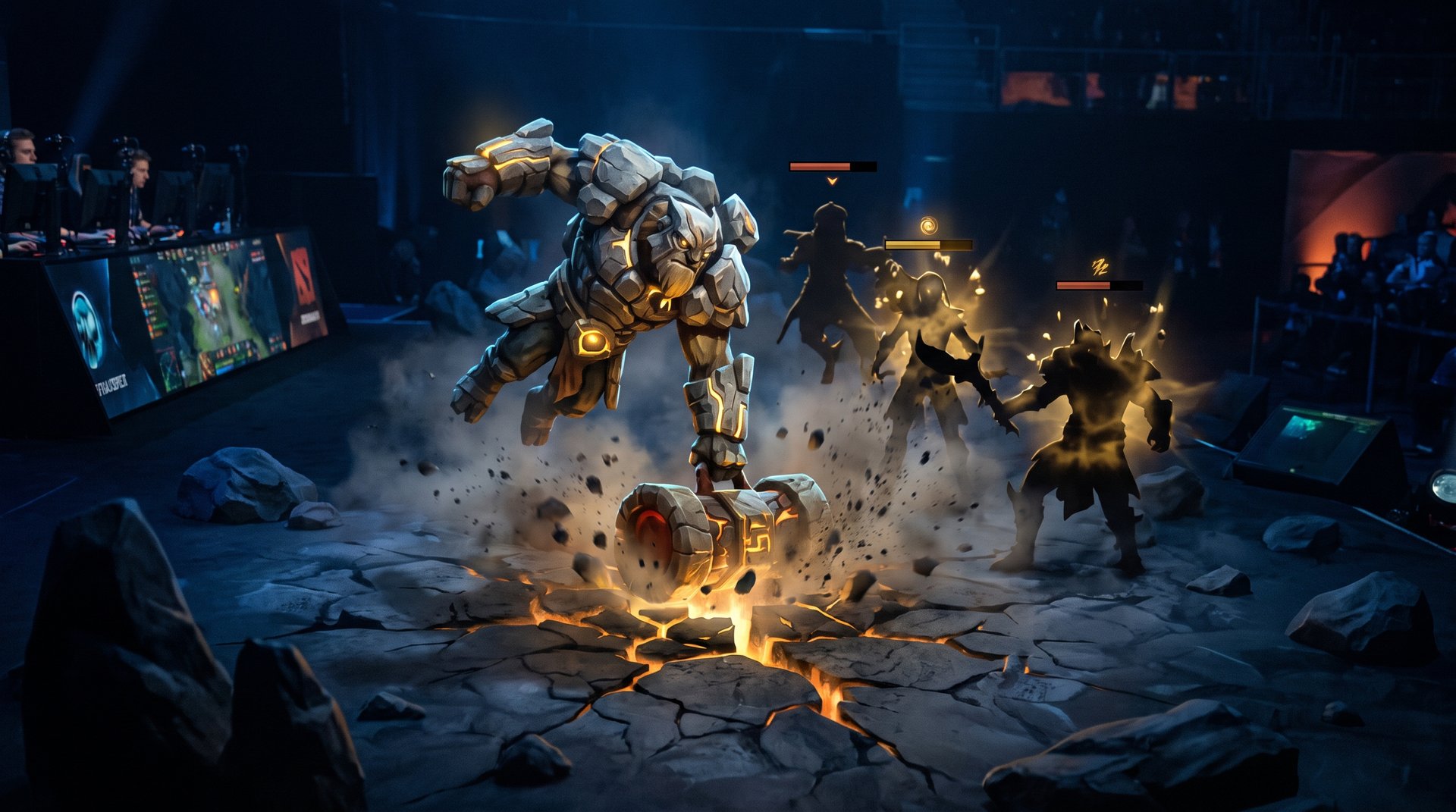
The Blink Combo: How to Land Echo Slam Every Time
This is the section most Earthshaker guides skip. Everyone knows the combo exists. Very few players can execute it consistently under pressure, with a team chasing, from unpredictable angles. Here is the full breakdown of how the Blink + Echo Slam initiation actually works at a mechanical level.
The Standard Initiation Sequence
The sequence that maximizes total stun and damage output:
- Blink Dagger to your target location — land inside or behind the enemy group, not in front of it. You want enemies between you and your team so Fissure can cut them off from retreating.
- Cast Echo Slam immediately — Echo Slam is cast at your landing position. The echoes bounce off all nearby units. Cast it first because it has no cast time and the bounce damage is higher the more units are grouped.
- Fissure through the enemy group — cast Fissure to pin enemies and block escape routes. The Aftershock from the Fissure cast adds an additional stun pulse around you. With Aghanim’s Shard, Fissure itself applies Aftershock to every hero it hits in the line.
- Enchant Totem and hit the highest-priority target — the empowered attack deals substantial physical damage and procs another Aftershock pulse around you. Aim for the carry or mid hero.
Total Aftershock procs in this sequence: three (Echo Slam, Fissure, Enchant Totem). Each one applies its stun to all units within 300 units. A target standing near you for the full combo takes roughly 3-4 seconds of combined stun time from multiple overlapping sources — and that is before your teammates add their own lockdown.
Where to Blink In
The single most common mistake: blinking directly in front of the enemy team. When you do this, Fissure goes behind them (from your perspective) and blocks your team from following up. You want to blink to a position where the enemy is between you and your allies. Think of yourself as the anvil — your team is the hammer. You land behind the enemy, Fissure pins them in place from behind, and your team walks into them from the front.
The second scenario — blinking to a side angle — is correct when the enemy has a teleport-reliant hero or an escape ability that could take them through your Fissure block. From the side, your Fissure can cross their retreat vector while still being within Echo Slam range of the main group.
Blink Timing: When to Go In
Earthshaker’s initiation window depends on one thing: your Blink Dagger being off cooldown. The Blink Dagger goes on a 3-second cooldown when you take damage. This means you cannot initiate while being hit, which forces a very specific play pattern: step back, wait 3 seconds out of tower range or behind terrain, then commit. Any Earthshaker player who loses this habit will constantly find themselves trying to Blink while the cooldown is ticking and missing the window entirely.
The best initiation windows in 7.41e: during smoke ganks before a Roshan fight, when the enemy team is pushing a tower without vision on your position, or after a support buys a sentry and places it to reveal yourself on purpose as bait. Earthshaker is one of the few heroes who can turn “getting spotted” into the setup for the initiation rather than the end of it, because your Blink does not care about being detected — only about not taking damage in the 3 seconds before you go in.
Fissure Placement: The Skill That Separates Good from Great
Fissure placement is the highest-skill-expression element of playing Earthshaker well. A properly placed Fissure does four things at once: stuns enemies in the path, blocks their escape, blocks their backup from getting in, and gives your team a chokepoint to follow up through the gap you leave for them.
The “Trap” Cast
The trap cast is Fissure through the back of the enemy group, parallel to the enemy team’s retreat path. This blocks the fastest exit route. The enemy carry is now stuck between your team advancing from the front and the impassable wall behind them. Fissure lasts 8 seconds — a lot of time to clean up before anyone can get around the wall.
Common mistake: casting Fissure perpendicular to the enemy retreat path. This creates a wall that enemies can just run around the end of. Unless the wall extends all the way to an actual piece of map terrain (a cliff, a tree line, the river), it only delays retreat rather than blocking it.
The “Cut Off” Cast
When the enemy team is split and part of them is trying to rotate in for backup, a Fissure across the rotation path removes that option entirely. You are not even using it to stun — you are using the terrain to fight a 5v4 instead of a 5v5. This is an advanced use that most players never think about: Fissure as map control, not as a stun.
The “Save” Cast
In defense, Fissure can be cast between an ally who is being chased and the pursuing enemy. The enemy is stunned by the eruption and then physically blocked by the wall. Your ally escapes. This requires you to predict the enemy’s movement and land Fissure with the target’s body in the path — if they are already past the wall’s activation zone, they just walk away while the wall goes up behind them. Aim slightly ahead of a moving target to catch them in the eruption.
Aftershock Stacking: Unlocking the Free Damage
Aftershock is the most underappreciated part of the Earthshaker kit among players below Ancient rank. The stun is short per proc and the radius (300 units) is small enough that targets can walk out of it during the cast animation. But in the context of a full combo, Aftershock makes the difference between “enemy is stunned for 1.5 seconds” and “enemy cannot move for 3+ seconds because every spell you cast locks them in place again.”
What Aftershock Actually Does
Every spell cast triggers Aftershock within 300 units of Earthshaker. The damage and stun duration scale with Aftershock’s level. The stun is independent of other stun sources — it applies on top of the stun from Fissure, on top of the lockdown from Echo Slam. This stacking is legal because each Aftershock pulse is a separate instance of crowd control.
In a complete 4-spell combo (Echo Slam, Fissure, Enchant Totem, and for instance a second Enchant Totem after Aghanim’s Shard buffs), you apply three or four Aftershock procs. Each proc restarts the stun timer for any target still in range. Against a hero who cannot instantly blink out, this effectively extends your lockdown by multiple seconds beyond what the individual spell stuns provide.
Maximizing Aftershock Impact
Stay close. Aftershock has a 300-unit radius — smaller than most players assume. If you Blink in and then back away while casting spells, your Aftershock procs miss the primary targets. Your combo position should land you 100-200 units from your priority target, not 400 units away “safely” at Fissure range. Close positioning maximizes Aftershock coverage and also keeps you in range for the Enchant Totem hit.
With Aghanim’s Shard active, Fissure applies Aftershock to every hero hit in the line regardless of their distance from you. This is the Shard’s main power spike: Fissure was previously relevant only to heroes near you when cast, but with Shard the entire line of heroes stunned by Fissure also eats an Aftershock pulse. A 5-hero Fissure with Shard is five Aftershock procs happening simultaneously along the wall.
Laning Phase Guide
Earthshaker’s laning phase depends heavily on his role. As a pos 3 offlaner, you are attempting to harass the enemy safe lane carry and keep them from farming freely. As a pos 4, you are protecting your carry while setting up for level 3 kill attempts.
Earthshaker Offlane (Pos 3)
Your level 1 Fissure in the offlane is your primary tool. Fissure at level 1 deals damage and stuns heroes in the path — if your support pulls the enemy carry into the Fissure path, that is a kill attempt before minute 3. The classic offlane approach: stand behind the enemy support, Fissure through both the support and the carry, let your pos 5 follow up with additional damage.
What to avoid in the offlane: using Fissure to clear waves. The cooldown is too long to waste on creeps in the early levels. Fissure for kill setups, Enchant Totem for last-hitting efficiently when you need to stay close to the creep wave.
Earthshaker Support (Pos 4/5)
As a support, your level 3 power spike is enormous. Fissure plus Aftershock plus Enchant Totem is a full kill attempt on any hero without a blink or escape — cast Fissure to stun and block, use Enchant Totem for the empowered attack, and the Aftershock procs chain the stuns together. At level 3, this sequence can kill a squishy support or severely damage a carry with poor positioning.
Position 4 Earthshaker pairs best with a safe lane carry who can output burst damage quickly — Juggernaut, Wraith King, or a right-click carry who closes the gap fast. You provide the stun chain and they deliver the follow-up damage. This combination is particularly strong in 7.41e where physical carry heroes are in a stronger relative position.
Midgame and Teamfight Execution
Once Blink Dagger is complete, Earthshaker transitions from a lane hero into a map presence threat. Every rotation becomes a potential 5-man smoke setup. Every lost fight the enemy team has creates a Roshan opportunity where one good Blink-Echo Slam ends the next 60 seconds of game state.
The midgame priority: buy Blink, start looking for Roshan setups, and force the enemy team to group up. Earthshaker gets exponentially more valuable the more heroes are in Echo Slam range. If the enemy team splits into two-hero lanes across the map, your ability to win fights drops dramatically. Your job is to create situations where grouping happens — fake pushes, smoke ganks into mid river, Roshan baits, high-ground defense where enemies naturally stack.
In Teamfights
Do not blink in until you can hit at least three heroes. A two-hero Echo Slam is a wasted ultimate if those heroes were not the primary threat. Save the initiation for moments when the full enemy team is within 500 units of each other — before a push, during a smoked gank that gets reversed, or while they are attempting to kill Roshan and are huddled in the pit.
The Roshan pit is the best Earthshaker initiation in Dota 2. The geometry of the pit forces enemies to cluster in a small space. A Blink over the wall, Echo Slam into the pit, Fissure to block the only exit, and the entire enemy team takes maximum echo damage with no escape. Even a partial execution of this wins most Roshan fights instantly.
Want consistent results from a high-MMR player piloting Earthshaker for you? Our boosters run this exact setup on every account. Learn the mechanics here, then let us execute if your schedule does not allow the practice time required.
Talents and Facets
Talent Tree
| Level | Left Talent | Right Talent | Recommended Pick |
|---|---|---|---|
| 10 | +25 Damage | +200 Mana | +200 Mana — ES is constantly mana-starved; this extends your fight uptime |
| 15 | +10% Spell Amplification | +20 Fissure Damage | +10% Spell Amp — amplifies all spell damage including Echo Slam echoes |
| 20 | +50 Aftershock Damage | -2s Fissure Cooldown | +50 Aftershock Damage — each Aftershock proc hits harder; excellent in prolonged fights |
| 25 | Enchant Totem: Double Strike | +20% Echo Slam Damage | Depends on role — Double Strike for pos 3 carry-hybrid; +20% Echo Slam for pure initiator |
Facets
Earthshaker has two facets that change how his abilities function. The standard “rocky” facet suits most situations: it modifies how Fissure terrain interacts with unit pathing, giving you additional flexibility in how you use the wall in teamfights. The alternative facet enhances Aftershock’s area or damage amplification, which pairs well with a build that leans heavily into the spell-cast chain rather than the Fissure wall setup.
For pub games at Legend and below, the standard facet provides more consistent results because Fissure placement is the higher-variance element — getting the wall right wins fights. At Ancient and above, either facet works depending on your team composition and your preferred initiation style. A team with multiple stuns benefits more from Aftershock amplification because the enemy is already locked down by other sources. A team short on crowd control wants the Fissure utility facet to compensate.
Counters and Matchup Table
| Hero | Counter Type | How to Play Around It |
|---|---|---|
| Faceless Void | Hard counter | Chronosphere traps you inside and prevents any follow-up. Do not initiate if Void has his ultimate — wait or bait it first |
| Lion | Counter | Hex + Finger cancels your combo. Build Blink of Blink Dagger rather than initiating into Lion’s range |
| Silencer | Counter | Global Silence ends your combo mid-sequence. Eul’s Scepter lets you break silence by going into the air briefly before committing |
| Puck | Soft counter | Dream Coil and Orb of Wands reduce your initiation windows. Focus Puck as the first Fissure target to prevent the coil from landing |
| Nyx Assassin | Counter | Carapace reflects your Enchant Totem hit back at you. Watch for Nyx positioning and save Totem until Carapace expires |
| Dragon Knight | Good matchup | Low mobility, wants to group up — ideal Echo Slam target. Initiate into him freely |
| Wraith King | Neutral | Reincarnation wastes your combo if you do not have enough follow-up. Save one Aftershock proc for the resurrection timing |
How Earthshaker Fits Into Your MMR Climb in 7.41e
Earthshaker is a high-ceiling hero whose reward scales with how well you can read fights before they happen. At Herald and Guardian, the hero underperforms because fights are messy and enemies do not group predictably. From Crusader upward, fight patterns become readable enough that you can anticipate where to position for the initiation.
The single best habit for faster improvement: watch your own replays after games where you got 1-2 kills on your Echo Slam and ask why the enemies were not grouped. Usually the answer is that you committed too early — before the enemy team had committed to a position. Earthshaker rewards patience. Blink in when the enemy is already in motion toward an objective, not when they are spread across the map.
If you are stuck at a specific bracket and the Earthshaker combo keeps getting interrupted or missing, the difference between where you are and where you want to be is almost always positioning and timing rather than reaction speed. Our MMR boosting guide covers the general principles of rank climbing, and our Dota 2 coaching service can do a direct replay review of your specific combo execution and tell you exactly what to fix.
Want to Climb Faster with Earthshaker?
Our Immortal-rank players know this hero inside out. Whether you want coaching on the Blink combo, or want to skip the grind while the meta is in your favor — we have you covered.


