

Best Dota 2 Stats Trackers 2026: Dotabuff vs Stratz vs D2PT

You finished a rough match. You open a stats tracker to figure out where it went wrong. But which one are you opening — Dotabuff, Stratz, or Dota2ProTracker? And are you even using the right tool for the question you are trying to answer?
All three are legitimate Dota 2 stats trackers. All three pull from the same Valve API. But they serve very different purposes. Dotabuff is the oldest community tracker, with a deep personal history and a paid tier that unlocks coaching-level analysis. Stratz is the fully free alternative with arguably richer visualizations. Dota2ProTracker — known as D2PT — ignores your personal stats entirely and instead maps the meta through the lens of professional and 7,000+ MMR games.
This guide breaks down every meaningful difference between the three, gives you a clear comparison table, and tells you which tracker to open depending on what you actually want to know. Focus keyword throughout: dota 2 stats tracker.
What Is in This Guide
Side-by-Side Comparison: Dotabuff vs Stratz vs D2PT
The table below covers the five dimensions that matter most when picking a Dota 2 stats tracker: pricing model, hero win-rate data quality, match history depth, mobile access, and coaching or meta features.
| Feature | Dotabuff | Stratz | D2PT (Dota2ProTracker) |
|---|---|---|---|
| Free / Paid | Free tier + Dotabuff Plus (~$6/month) | Completely free (STRATZ+ exists) | Completely free |
| Hero Win-Rate Data | Free: overall patch stats. Plus: deep historical + matchups | Full hero stats, all brackets, free | Pro and 7,000+ MMR games only, last 8 days |
| Match History Depth | Free: recent history. Plus: lifetime archive | Full history, all time, free | Last 8 days (Valve API replay window) |
| Personal Account Tracking | Yes — your own match history and hero stats | Yes — full account tracking and visualizations | No — pro and high-MMR players only |
| Mobile App | No dedicated app | No dedicated app | No dedicated app |
| Coaching / Meta Features | Hero Mastery Tool, TrueSight (Plus only) | Road to Grandmaster, Knowledge Base (free) | Position-specific meta builds, D2PT Rating |
| API Access | Limited public endpoints | Full GraphQL API (free) | No public API |
| Best For | Personal improvement, long-term history | Deep free analytics, visual data, coaching | Understanding the meta, itemization, pro drafts |
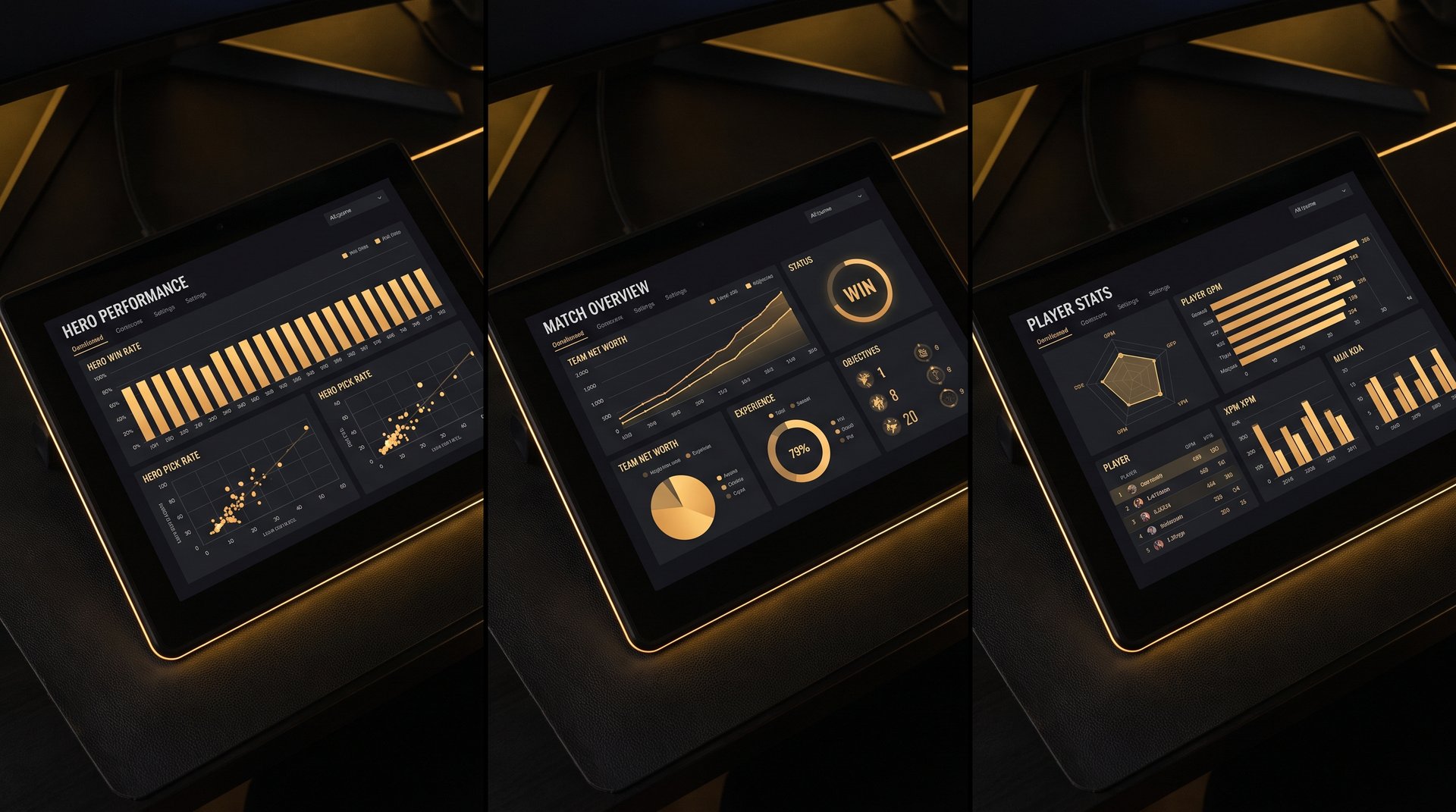
Dotabuff — The Veteran Dota 2 Stats Tracker
Dotabuff is where most players start when they first want to look at their own Dota 2 stats. It has been around longer than almost any other Dota 2 community tool, owned and operated by Elo Entertainment Inc. The URL is simple, the interface is familiar, and within seconds of connecting your Steam account you can see your recent matches, win rates, and hero performance.
What the Free Tier Covers
The free version of Dotabuff is genuinely useful. You get:
- Full match history for recent games, including K/D/A, GPM, XPM, items, and duration
- Hero statistics at the global level — win rates, pick rates, and ban rates for the current patch
- Player search — find any player whose stats are set to public and inspect their hero pool
- Peer comparison — see how your performance metrics stack up against other players at your rank
- Hero guides — community-submitted builds with the ability to filter by position and patch
For a casual improvement loop, this is already more than enough. You play a game, you open Dotabuff, you look at your net worth curve, you identify that you were farming the wrong camps during a mid-game lull. That workflow costs nothing.
What Dotabuff Plus Adds
Dotabuff Plus is the paid subscription tier, priced at around $6 per month. The features it unlocks are aimed at players who want to go beyond surface-level stats:
- TrueSight — advanced match breakdown that identifies decision-making patterns and key turning points
- Hero Mastery Tool — tracks your performance on each hero across a large sample of games, identifying consistency problems versus single-match variance
- Lifetime data retention — by default, detailed match stats are retained for a shorter window; Plus extends this indefinitely
- Hero matchup data — how your hero performs specifically against each enemy hero in the pool
- Friends news feed — tracks the activity of players on your friends list
- Personal dashboard — a curated view of your improvement metrics over time
If you are playing Dotabuff as a self-coaching tool — meaning you watch your own replays and cross-reference what the tracker says about your tendencies — the Plus tier is a legitimate investment. The Hero Mastery Tool in particular helps you identify whether your winrate on a hero is a skill problem or a matchup problem, which changes how you should be spending your practice time.
For a deeper breakdown of how to use Dotabuff data the way a coach actually reads it, see our guide: How to Read Dotabuff Like a Coach (Without Getting Misled). That post covers the specific stats that matter for diagnosis versus the vanity numbers most players obsess over.
Dotabuff Pros
- Most recognizable, widely linked community tracker
- Hero guide ecosystem is active and well-filtered
- TrueSight gives decision-point analysis beyond raw numbers
- Long match history archive with Plus
- Easy to share profile links to coaches or teammates
Dotabuff Cons
- Deep analysis locked behind the Plus paywall
- UI feels dated compared to Stratz
- No mobile app for on-the-go checks
- Match history depth limited on the free tier
- Less rich data visualizations than Stratz
Stratz — The Free Analytics Engine
Stratz takes a deliberately different philosophical position from Dotabuff: the core website is completely free to use, and always has been. There is no feature wall you hit after looking at three matches. The team behind Stratz has stated this publicly — unlike other Dota 2 stats sites, the full feature set is available without a subscription.
This means that if you are comparing Dotabuff vs Stratz from a pure value standpoint and you do not want to pay, Stratz wins that comparison easily. You get richer visualizations, full historical data, and advanced analytics without entering a credit card.
Core Features That Make Stratz Stand Out
Stratz covers all the basics that Dotabuff does — match history, hero stats, player profiles — but adds several features that are either paywalled on Dotabuff or simply absent:
- Visual match timelines — gold and XP advantage charts per lane, with annotated events. You can see exactly when a fight shifted the trajectory of a game.
- Lane analysis — detailed breakdown of the laning phase, including last hits, denies, and damage traded by minute
- Hero player rankings — ranked lists of the best players on each hero globally, with stats backing the ranking
- League and tournament data — professional match coverage including the International 2026 and DPC leagues
- Knowledge Base — educational articles about the game’s mechanics, integrated with the data
- Road to Grandmaster — tracks the ranked performance of high-MMR players climbing the leaderboard
- GraphQL API — a fully documented, free API for developers who want to build tools on top of the data
STRATZ+ — What the Premium Tier Offers
Stratz does have a STRATZ+ premium tier. However, the vast majority of features that matter for regular players are available in the free version. STRATZ+ is positioned for power users and those who want to support the platform financially, rather than being a paywall that locks out useful analysis. Most players using Stratz as a Dota 2 stats tracker will never feel the need to upgrade.
The GraphQL API access is also free, which sets Stratz apart as the preferred data source for third-party tools, overlays, and coaching platforms that need programmatic access to match data.
Stratz Pros
- Fully free — no paywall on core analytics
- Best visual match analysis of the three trackers
- Lane-phase breakdown is detailed and actionable
- Free GraphQL API for developers and coaching tools
- Active development and community Discord
- Road to Grandmaster feature for tracking top players
Stratz Cons
- Interface can feel information-dense for new users
- No mobile app
- Hero guide ecosystem is less developed than Dotabuff
- Brand recognition is lower — harder to share with less tech-savvy teammates
- Some niche features require familiarity with the UI to find
D2PT (Dota2ProTracker) — Pro Meta Decoded
D2PT is the tracker that does something the other two do not: it ignores your games completely. Dota2ProTracker exclusively tracks professional players and accounts rated approximately 7,000+ MMR. The entire platform is built around answering one question: what are the best players in the world doing right now?
This makes D2PT fundamentally different from Dotabuff and Stratz. You cannot look up your own profile on D2PT. What you can do is see, with a 24-48 hour lag, which heroes the top players are spamming, what items they are buying on each hero in each position, and how the meta is shifting game by game.
The D2PT Rating System
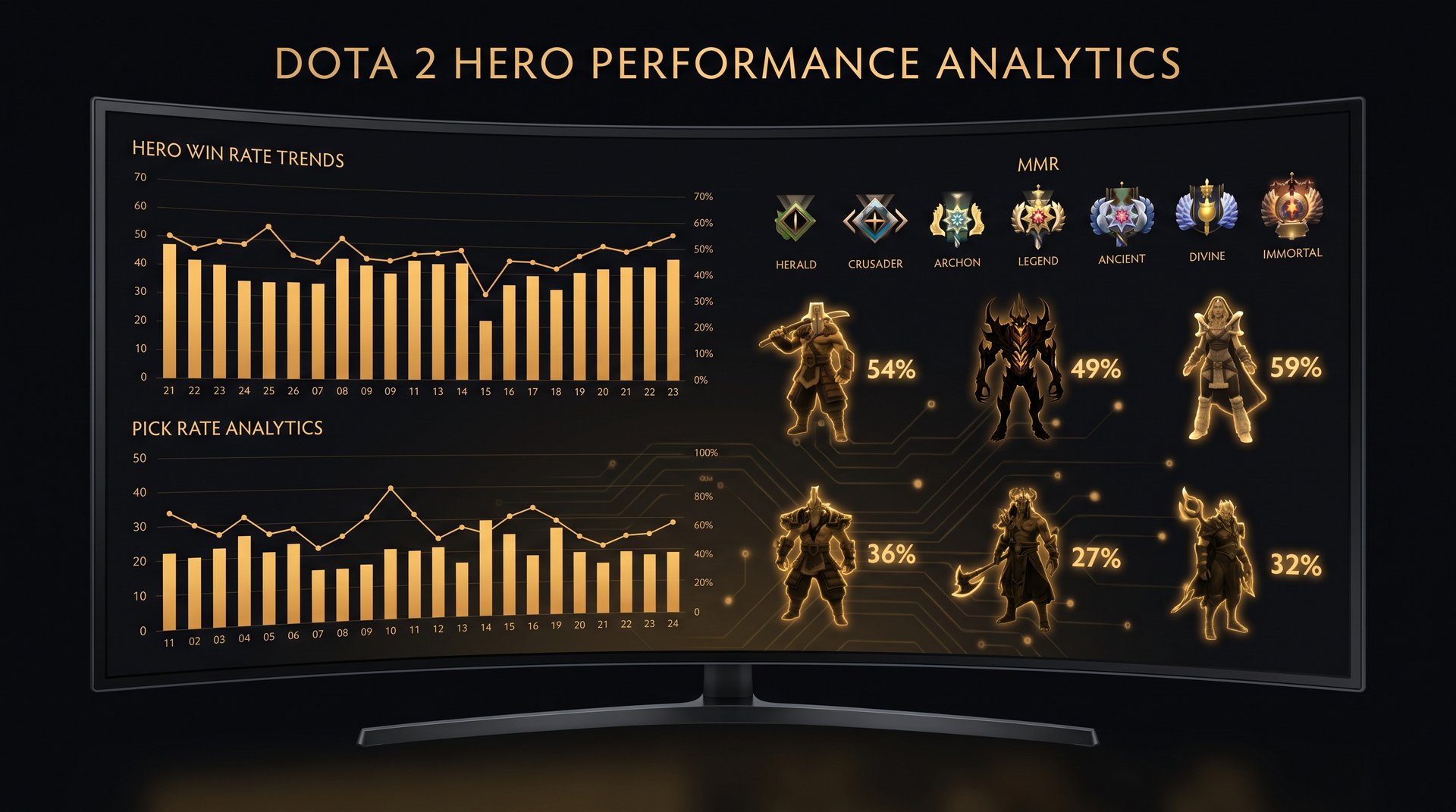
D2PT calculates a D2PT Rating for each hero — a composite score (out of 100) that factors in win rate, contest rate, and overall prevalence in the tracked game pool. As of the current patch (7.41f), Pudge and Rubick are consistently showing up in the top slots for support positions, which reflects the current meta emphasis on catch and setup. These ratings update based on the last eight days of data, which aligns with the eight-day window Valve keeps replays available through the API.
The eight-day data window is a constraint, not a design choice. Valve only makes replay data available for eight days. Every stats tracker has to work within this limitation, but D2PT leans into it — the site is specifically optimized to give you the freshest possible meta read rather than historical trends.
How to Use D2PT for Your Own Rank
D2PT tracks 7,000+ MMR games, which represents the top fraction of a percent of the player base. If you are in the 3,000 to 5,000 MMR range, some of what D2PT shows will not directly translate. The tempo and coordination differences between those brackets mean that heroes viable at the highest level sometimes underperform in pubs at lower ranks.
That said, D2PT is still the most reliable source for answering questions like:
- Which items should I be rushing on this hero? — D2PT item builds reflect what the highest-MMR players are converging on, which is usually 1-2 patches ahead of popular third-party guides
- Which skills are being maxed first? — Skill progression in high-MMR games often differs from default builds in ways that matter at your level
- Is this hero contested in the meta? — If a hero has a high D2PT Rating and is being picked in nearly every game at the top, it is likely worth your time to learn it
- What is the pro draft preference? — Tournament data on D2PT shows draft trends, ban priorities, and positional preferences across TI 2026 and DPC events
The practical use case: before a ranked session, open D2PT, filter by position, and look at the top-rated heroes. Cross-reference with your own comfort picks in Dotabuff or Stratz to find the overlap between what is strong and what you can pilot confidently. That intersection is your queue.
D2PT Pros
- Best source for current meta itemization and skill builds
- Updated daily from high-MMR and pro game data
- D2PT Rating gives a clear single-number meta indicator
- Tournament coverage integrated with player stats
- Completely free, no sign-up required
- Position filtering makes it immediately actionable
D2PT Cons
- No personal account tracking — cannot look up your own games
- Data limited to last 8 days (Valve API constraint)
- High-MMR bias — not all conclusions transfer to lower brackets
- Less useful for understanding why you personally lost a game
- No mobile app
Which Dota 2 Stats Tracker Should You Use?
The honest answer is that these tools are not in competition with each other. They answer different questions. Here is a practical decision guide:
For a typical ranked player running a serious improvement loop, the workflow looks like this: after a match, review the timeline on Stratz to identify laning phase and key fight mistakes. Once a week, open Dotabuff to look at your hero pool win rates across a larger sample. Before queuing, open D2PT to check whether your hero is currently strong and what the meta item builds look like. None of these steps cost you money if you use Stratz and D2PT as your primary tools.
If you run hero guides or player coaching on Dotabuff, the Plus tier is worth the cost. If you are a developer, Stratz’s GraphQL API is the obvious choice. If you just want to know what is strong right now, D2PT gives you the clearest answer in the fewest clicks.
Turning Stats Into Actual MMR Gains
Stats trackers are a diagnosis tool. They tell you what happened. They do not tell you how to change it. That gap — between knowing you have a 42% win rate on Phantom Lancer and actually fixing it — is where most improvement stalls.
There are three ways players close that gap:
1. Self-Coaching With the Right Data
The most common approach. You use Dotabuff or Stratz to identify patterns — low XPM on supports, negative K/D trading in the laning phase, poor hero timing — and then deliberately work on those issues. This works well for players in the 3,000 to 5,000 MMR range who have clear mechanical gaps. At higher brackets, the issues become more subtle and self-diagnosis gets harder. Check our MMR boosting guide for context on the thresholds where self-coaching stops being efficient.
2. Getting Coaching From a Higher-Ranked Player
A coach can look at your Dotabuff or Stratz profile and within minutes identify patterns you have been unable to see yourself. They have seen the same mistakes hundreds of times across different players and can point directly at the root cause. Our Dota 2 coaching service works exactly this way — share your tracker profile in the session, and the coach walks through your data before touching any replay footage. The tracker data sets the agenda; the replay provides the evidence. If you want to know whether working with a coach is right for your current rank and goals, read our guide to Dota 2 improvement services.
3. Calibration and Rank Recovery
Sometimes the data shows you are playing at a level above your current rank — your stats in higher-bracket games are strong, your farm efficiency is well above bracket average, but you are stuck in a bracket because of behavioral score issues, bad calibration, or a losing streak you could not escape. In those cases, it is worth understanding the safety and risk profile of different rank recovery options before making a decision. The stats give you the baseline; the decision about how to act on them is yours to make with full information.
Frequently Asked Questions
Want Faster Results Than Stats Alone Can Give You?
Stats trackers show you what is happening. Coaching and rank recovery help you act on it. TeamSmurf is a Dota 2-only service — our boosters and coaches specialize exclusively in Dota 2, which means they know the current patch, the current meta, and the specific bracket problems that hold players back at every rank.


