

Dota 2 MMR by Country 2026: Where the Highest-Rated Players Live

Dota 2 is played in every country on Earth, but the distribution of high-MMR players is anything but even. Some countries produce an extraordinary number of Immortal-ranked players relative to their population. Others have millions of players who cluster in the middle brackets. If you want to understand why your server feels harder at certain hours, why certain countries dominate professional rosters, or simply where the game’s most skilled pub players are concentrated, this breakdown gives you the full picture for 2026.
This guide covers MMR distribution by country across every major server region, examines which nations produce the most leaderboard-ranked players per capita, and explains the structural reasons behind the numbers. If you are looking for the leaderboard entry thresholds themselves (how many MMR it takes to rank in each region), that is covered in our separate guide on Dota 2 leaderboard requirements by region. If your goal is choosing which server to queue on for ranked play, read our SEA vs EU vs NA server comparison instead. This post focuses on the countries themselves — the geography of Dota 2 skill.
What’s in This Guide
- How country data is collected in Dota 2
- SEA: Philippines, Malaysia, Indonesia
- Eastern Europe and CIS: Russia, Romania, Bulgaria
- China: the sealed leaderboard
- Western Europe: France, Germany, UK
- NA and SA: Peru’s rise, NA’s ceiling
- Why some countries punch above their weight
- Country MMR overview table
- What this means for your games
- FAQ
How Country Data Is Collected in Dota 2
Valve does not publish official country-level MMR statistics. The country distribution data available comes from two sources: the Dota 2 leaderboard, where each ranked player’s country flag is publicly visible, and third-party aggregators like Dotabuff, Stratz, and OpenDota, which index public player profiles and allow filtering by country.
The leaderboard shows the top approximately 5,000 players per server region (the exact cutoff varies by region — see our leaderboard requirements guide for current thresholds). This is a small and elite sample, but it is the most reliable data available because every player on it has a verified, publicly displayed country flag. For the broader Immortal bracket below the leaderboard, Dotabuff and Stratz community data provide a much larger sample, though it only covers players who have linked their accounts to those platforms.
A few important caveats before looking at the numbers:
- VPN usage inflates some country counts. Players using VPNs to connect to a region’s server can appear under a different country flag.
- Smurf accounts skew the top of the leaderboard in some regions. Players with multiple accounts may show up under different countries depending on which account’s profile they have set as their flag.
- China is a separate case. The majority of Chinese Dota 2 players use the Perfect World (PW) client, which runs on a separate server cluster with its own leaderboard. The Steam-side China numbers undercount the true Chinese player base significantly.
With those caveats clear, here is what the data actually shows across each major region in 2026.
SEA: The Philippines, Malaysia, Indonesia and the World’s Highest MMR Density
The Southeast Asia server produces the highest density of extremely high-MMR players relative to any other region in the world. The Philippines, Malaysia, and Indonesia together account for the majority of SEA leaderboard entries, with the Philippines consistently contributing more top-1,000 leaderboard players than any other single country on the SEA server.
Philippines: The Global Epicenter of High-MMR Play
The Philippines has the most overrepresented Dota 2 player population in the world relative to general gaming demographics. Filipino players make up a dominant share of the SEA server leaderboard and have produced a disproportionate number of the world’s top professional players. TI champions and top-30 global ranked players with Philippine flags have been a consistent pattern through multiple seasons.
The reasons are both cultural and structural. Dota 2 (and its predecessor, DotA on Warcraft III) has had deep roots in Philippine internet cafe culture since the early 2000s. The game is not just popular in the Philippines — it is part of the social fabric of youth culture in urban and semi-urban areas. High-volume play from a young age, competitive internet cafe environments that serve as informal training grounds, and a deeply competitive community mindset all compound to produce high average skill.
Community-sourced data from public Dotabuff player profiles (filtering by country flag among ranked players who have opted into public tracking) consistently shows Philippine-flagged players making up roughly 30 to 40 percent of the SEA server’s top 1,000 leaderboard positions, though this number fluctuates with seasonal recalibrations and VPN activity.
Malaysia: Consistent Depth in the High Bracket
Malaysia contributes the second or third largest group of SEA leaderboard players depending on the season. Malaysian players are well-represented not just at the top of the leaderboard but throughout the 6,000 to 8,000 MMR range, suggesting strong overall development of the player pool rather than a small peak of exceptional individuals.
Malaysia also has a strong collegiate and amateur competitive scene that feeds into the professional scene, giving the country a consistent pipeline of improving players. Several Malaysian players have reached the 9,000+ MMR range on the SEA leaderboard in 2025 and 2026.
Indonesia: Volume Plus Growing Elite
Indonesia has the largest raw player count of any SEA country in Dota 2, which translates into significant leaderboard presence even if the per-capita skill density is lower than the Philippines. Indonesian internet cafe culture mirrors that of the Philippines, and the competitive scene has been growing rapidly since TI 11 drove a regional interest spike.
The median Indonesian leaderboard player sits slightly lower on the MMR scale than the median Philippine or Malaysian leaderboard player, but the sheer volume means Indonesia consistently places players in the top 500 of the SEA server.

Other SEA Countries
Thailand, Vietnam, Singapore, and Myanmar all contribute meaningfully to the SEA server player base. Thai and Vietnamese players in particular have been growing their leaderboard representation through 2025 and 2026. Singapore produces fewer raw numbers but has a higher-than-average ratio of players in the 6,000 to 8,000 MMR range, likely due to the country’s relatively high average income and access to stable, low-ping server connections.
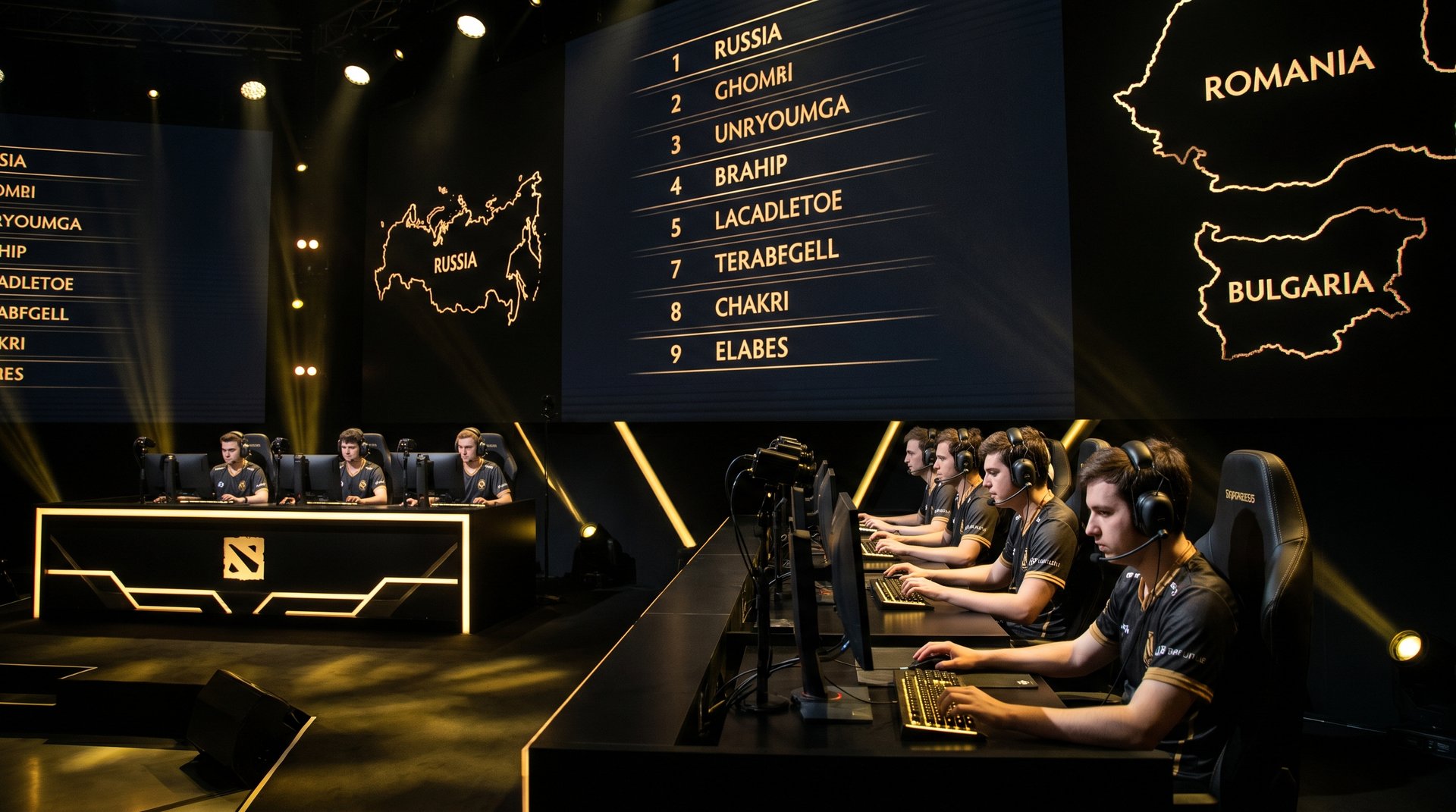
Eastern Europe and CIS: Russia, Romania, Bulgaria Dominate EU Server Numbers
The EU server leaderboard is heavily skewed toward Eastern European and CIS-region players. Russia, Romania, and Bulgaria together account for a substantial majority of EU leaderboard entries. This has been a consistent pattern since Dota 2 launched, and the 2026 data continues the trend.
Russia: The Largest Single Country on the EU Server
Russian players constitute the largest single national group on the EU server leaderboard by a considerable margin. Russia has a massive overall Dota 2 player base — it is one of the top-3 countries in the world by total registered Dota 2 accounts on Steam. The size of the player pool alone guarantees strong leaderboard representation, but Russia also benefits from the same cultural factors that drove SEA adoption: widespread internet cafe culture in the 1990s and early 2000s, a strong amateur competitive scene, and a gaming culture that views Dota 2 as a status-significant skill game rather than a casual pastime.
Russian players have been consistently present at the top of the EU server leaderboard and have produced a large number of professional players across TI history. In community tracking of public EU leaderboard profiles, Russia typically accounts for 35 to 50 percent of all flagged EU leaderboard players, depending on the season.
Romania: Punching Well Above Its Weight
Romania is the most overrepresented country on the EU server relative to its population. A country of approximately 19 million people regularly places more players in the EU top-500 leaderboard than much larger Western European nations like France or Germany.
Romanian Dota 2 culture is deeply rooted in the same internet cafe wave that drove SEA and Russian adoption. The game spread in Romania during the DotA era, and the community has maintained competitive intensity through the transition to Dota 2. Several top-50 EU server leaderboard players with Romanian flags have been visible through 2025 and into 2026.
The per-capita leaderboard representation of Romania is one of the highest of any country in the world, rivaling that of the Philippines relative to its server population. For a country its size, Romania’s Dota 2 output is genuinely remarkable.
Bulgaria: A Small Country, an Outsized Leaderboard Presence
Bulgaria has a population of about 6 million and regularly places players in the EU top 500 and occasionally the top 100. Bulgarian Dota 2 culture has been consistently high-skill since the DotA era, and the country has produced several well-known professional players who have competed at TI and in regional leagues.
The density of high-MMR Bulgarian players per capita is among the highest in Europe. Like Romania, Bulgaria benefits from a long history of competitive play, good server connectivity to EU servers (low ping), and a gaming culture that treats Dota 2 competency as genuinely meaningful.
Ukraine and Kazakhstan
Ukraine was historically a major contributor to the EU server leaderboard, and Ukrainian-flagged players have been well-represented in the top 500 across multiple seasons. The disruptions of 2022 to 2024 affected the Ukrainian player base considerably, and while Ukrainian players continue to compete and rank, the volume of top leaderboard entries has been lower than in pre-2022 seasons.
Kazakhstan is notable as a CIS-region country that contributes meaningfully to the EU server top 2,000. Kazakh players typically queue on EU due to better ping than on SEA, and several high-rated Kazakh players have placed in the EU top 500.
China: The Sealed Ecosystem
China is a special case that cannot be directly compared to other server regions. The vast majority of Chinese Dota 2 players use the Perfect World (PW) client, which connects to dedicated Chinese server infrastructure with a separate leaderboard. The PW leaderboard has historically required a higher MMR threshold to rank than any other region in the world — the top-5,000 threshold on Chinese servers regularly sits at 8,000+ MMR, compared to 6,000 to 7,000 on EU and 5,500 to 6,500 on SEA in 2025 and 2026 seasons.
This means that a player ranked in the Chinese leaderboard is, on average, a higher-caliber player than a leaderboard-ranked player on most other servers. The Chinese Dota 2 player base is estimated in the tens of millions, and the competitive depth at the top of the ecosystem is very high. Professional Chinese teams have historically been among the most consistent contenders at TI, and the Chinese pub environment at high MMR is considered among the most demanding in the world.
Chinese players on Steam accounts (who queue on the regular server infrastructure rather than the PW client) are a small fraction of the total Chinese player base. For this reason, Steam-side metrics significantly undercount China’s actual Dota 2 population and skill density.
Western Europe: France, Germany, and the UK
Western European countries — France, Germany, the UK, Sweden, the Netherlands, and others — are well-represented in the EU server leaderboard but at a significantly lower density per capita than Eastern European countries. The reasons are partly structural (less internet cafe culture, higher average income means more casual gaming contexts) and partly cultural (Dota 2 never achieved the same cultural saturation in Western Europe that it did in Eastern Europe and SEA).
France
France has a large gaming population and is one of the larger Western EU countries by total Dota 2 players. French-flagged players appear in the EU top 2,000 consistently but rarely in the top 200. The French competitive scene is active and has contributed players to regional leagues, but the country does not produce elite leaderboard players at the rate of Romania or Bulgaria despite having roughly triple the population of each.
Germany
Germany has a similar profile to France — large player base, consistent leaderboard presence in the 1,000 to 3,000 range, but relatively few top-200 EU players. The German Dota 2 scene has historically been more oriented around semi-professional and amateur competitive play than producing pub ladder climbers.
Sweden and the Nordic Countries
Sweden has a strong esports culture generally, and Swedish-flagged players punch above their weight on the EU server. Sweden’s population of 10 million produces a per-capita leaderboard rate that is better than most Western European countries, though still below Eastern European levels. Finland and Denmark also contribute consistently to the EU top 2,000.
North America and South America: Peru’s Rise, NA’s Ceiling
The NA server has a lower absolute MMR ceiling than EU or SEA. The threshold to achieve leaderboard rank on NA has historically been lower than on EU or SEA — in 2025 and 2026, the NA leaderboard cutoff has sat in the 5,500 to 6,500 MMR range depending on the season. This is not because NA players are worse at individual mechanics, but because the NA server has a smaller total Immortal-bracket player pool, meaning there is less competition for leaderboard positions.
United States
The US contributes the largest raw number of NA server leaderboard players. Several US-flagged players have reached the top 50 on NA and competed professionally. The US competitive scene is backed by relatively strong infrastructure and prize pool investment, but the cultural depth of Dota 2 in the US is thinner than in Southeast Asia or Eastern Europe — many high-skill US players have backgrounds in other competitive games and switched to Dota 2 later.
Peru: The Dominant SA Country
Peru is the most overrepresented country on the SA (South America) server, both in terms of raw leaderboard count and per-capita density relative to other SA countries. Peru has a strong Dota 2 culture rooted in the same internet cafe wave as SEA and Eastern Europe, and the country produces high-volume play at every bracket.
Peruvian players account for a majority of the SA server leaderboard in most seasons. The SA leaderboard threshold is lower than EU or SEA due to the smaller total player pool, but the top-rated Peruvian players are genuinely high-skill by global standards — several have qualified for international competitions and competed credibly at events that include EU and SEA teams.
Brazil and Argentina also contribute significantly to the SA server, with Brazil having the largest raw player count of any SA country by a wide margin. Brazilian players are spread across a very wide MMR range, with strong presence in the 3,000 to 6,000 bracket.
Why Some Countries Produce More High-MMR Players
The patterns above are not random. The countries that consistently produce the most high-MMR players per capita share a set of structural and cultural characteristics that compound over time.
Internet Cafe Culture and Early Competitive Exposure
The single strongest predictor of Dota 2 per-capita skill density is the prevalence of internet cafes (or their equivalents) in the late 1990s to early 2010s. The Philippines, Romania, Bulgaria, Russia, and Peru all have strong histories of internet cafe gaming, which created environments where players were exposed to the game in a social, competitive context from a young age. Players who start competitive gaming at 10 to 14 years old in an environment where they are immediately matched against and mentored by more experienced players develop mechanical skills and game sense that takes home players years longer to acquire.
Economic Accessibility and Volume of Play
In countries where disposable income is lower relative to internet cafe costs, gaming cafes become a shared resource that encourages high-volume play on a per-session basis. Players who queue multiple games per visit, in an environment with social pressure to perform, develop skill faster than players who play casually at home. This is the same dynamic that made Korean PC bangs the origin point for the world’s best StarCraft and later League of Legends players.
Cultural Significance of the Game
In Southeast Asia and parts of Eastern Europe, Dota 2 skill carries genuine social status. Knowing you are Immortal-ranked is a meaningful identity marker in communities where the game is widely played and respected. This social incentive drives sustained effort over years — players grind to high MMR not just because they want to, but because it matters in their social context. In countries where Dota 2 is more of a hobby than a cultural institution, the drive to push to the highest brackets is less intense.
Professional Pipeline Effects
Countries that have produced successful professional players create role models that inspire the next generation of competitive players. The Philippines producing TI champions and top global leaderboard players in multiple seasons creates a visible ceiling for aspiring Filipino players and a cultural narrative that Filipinos are among the best in the world at this game — which feeds back into the motivation of pub players. This feedback loop is self-reinforcing: success produces inspiration, inspiration produces effort, effort produces more success.
Country MMR Overview: Leaderboard Presence by Region (2026)
This table summarizes the relative standing of major countries on their respective server leaderboards, based on community tracking data from public leaderboard profiles on Dotabuff and OpenDota. Numbers reflect approximate proportions rather than exact counts, which change with each season recalibration. Percentages represent approximate ranges observed across the 2025-2026 ranked seasons.
| Country | Server | Leaderboard Share (est.) | Notable Characteristic |
|---|---|---|---|
| Philippines | SEA | 30-40% of top 1,000 | Highest per-capita density globally |
| Malaysia | SEA | 15-20% of top 1,000 | Deep 6K-8K player pool |
| Indonesia | SEA | 10-15% of top 1,000 | Largest raw player count in SEA |
| Russia | EU | 35-50% of top 1,000 | Largest absolute EU leaderboard group |
| Romania | EU | 8-12% of top 1,000 | Highest per-capita rate in Europe |
| Bulgaria | EU | 4-7% of top 1,000 | Extraordinary output for its population size |
| Ukraine | EU | 5-10% of top 1,000 | Historically strong; slightly lower post-2022 |
| China (PW) | CN (separate) | Separate ecosystem | Highest absolute leaderboard MMR threshold |
| United States | NA | 40-55% of top 1,000 | Largest NA country; lower absolute ceiling |
| Peru | SA | 50-65% of top 1,000 | Dominant SA country; strong per-capita density |
| Brazil | SA | 15-25% of top 1,000 | Largest SA player pool; spread across brackets |
| France | EU | 3-5% of top 1,000 | Large player base; low per-capita leaderboard rate |
| Sweden | EU | 2-4% of top 1,000 | Best Western EU per-capita rate |
What Country MMR Distribution Means for Your Pub Games
Understanding where the world’s highest-MMR players are concentrated has practical implications if you are actively trying to climb, selecting a server to queue on, or thinking about how a boost or coaching session from a top-bracket player translates to real game improvement.
Server Difficulty at the Same MMR Is Not Equal
A 5,500 MMR player on the EU server is not playing against the same caliber of opponents as a 5,500 MMR player on the SEA server. The EU server has a larger and more competitive Immortal bracket due to Russia’s sheer player volume, which pushes the average MMR of opponents in any given game upward. The SEA server is similarly competitive at high brackets due to the Filipino and Malaysian player density.
If you are considering using an MMR boost to reach a target bracket, this context matters: reaching 6,000 MMR on the EU server means competing in a different pool than 6,000 MMR on NA. The MMR boosting guide covers this in detail, including how our boosters account for server-specific difficulty when estimating completion time.
What Country Data Tells You About Opponents
If you regularly see Romanian, Bulgarian, or Russian players in your EU games at 5,000+ MMR, you are playing against players from countries with statistically high per-capita skill development. This does not mean every individual player from those countries is exceptional, but it does mean the cultural and training context that produced them is stronger than in countries with lower per-capita leaderboard rates.
Similarly, on the SEA server at 5,500+ MMR, Filipino-flagged opponents are the most common single national group you will encounter. Understanding that these players likely have years of high-volume competitive experience — potentially starting in internet cafes in their early teens — helps frame the challenge accurately rather than attributing difficulty to unfair matchmaking.
Coaching From High-MMR Players in These Countries
The practical upside of this distribution is that the coaching market benefits from it. TeamSmurf’s coaches are drawn from the high-MMR pools of these exact countries — players who developed their skills in the most competitive pub environments in the world. If you are looking at Dota 2 coaching to accelerate your improvement, working with a player who peaked in the SEA or EU leaderboard means working with someone whose skill was forged in the game’s most competitive public matchmaking environments.
The safety profile of working with boosters and coaches from these regions is the same as anywhere else — our screening process does not filter by country, but by skill verification and account security practices. You can read about our full approach in the guide on whether Dota 2 boosting is safe.
How Country Distribution Maps to Pro Rosters
The country distribution of high-MMR pub players maps very closely to the country distribution of professional Dota 2 players. The Philippines, Russia, Romania, Bulgaria, Malaysia, and China produce a massively disproportionate share of professional players relative to their size or economic output. This is not a coincidence — professional players come from high-density pub environments, and those environments are concentrated in the countries discussed in this guide.
When you look at the rosters of top-12 teams at any recent TI, the majority of players carry flags from the countries that dominate the leaderboard data above. The correlation is almost exact. This is the strongest evidence that the country-level patterns in pub MMR are real and structural, not statistical noise. For more context on the best Dota 2 boosting services, the same geography applies — top-rated services recruit boosters from the same high-density national pools discussed here.
Stuck Below Your Country’s MMR Ceiling?
Whether you’re on the SEA server grinding against Filipino and Malaysian Immortals, or on EU facing Romanian and Russian top-bracket players, TeamSmurf’s boosters are drawn from the exact same high-MMR pools. Real players, real games, fully transparent.
Get an MMR Boost Book a Coaching Session



