SEA vs EU vs NA: Which Server Is Hardest at the Same MMR?

Not all 4,000 MMR is created equal. A 4,000 MMR player on the South American server and a 4,000 MMR player on EU are playing in fundamentally different competitive environments — and anyone who has played on multiple servers knows the gap is significant. The question of which server is hardest at equivalent MMR is one of the most hotly debated topics in Dota 2, and the answer has real practical consequences for how you should approach climbing.
This guide breaks down every major Dota 2 server — EU, SEA, NA, CIS, and SA — using leaderboard data, player pool size, pro player migration patterns, and observations from our boosters who have played across all regions. We also answer the server-hopping question directly: yes, you can boost your MMR number by playing on easier servers, and we will tell you exactly how much that matters and where the limits are.
Table of Contents
- How Dota 2 Server Regions Work
- Player Pool Size and Matchmaking Quality
- Leaderboard MMR Thresholds by Region
- EU: The Hardest Competitive Server
- SEA: Huge Pool, Wildly Uneven Skill
- NA: The Easiest Major Server for Climbing
- CIS: High Mechanics, Low Coordination
- SA: Smallest Competitive Scene, Easiest Inflation
- Full Region Difficulty Comparison Table
- Pro Player Migration: The Best Evidence We Have
- Does Server-Hopping Actually Work for MMR?
- The Verdict: Which Server Should You Play?
- FAQ
How Dota 2 Server Regions Work
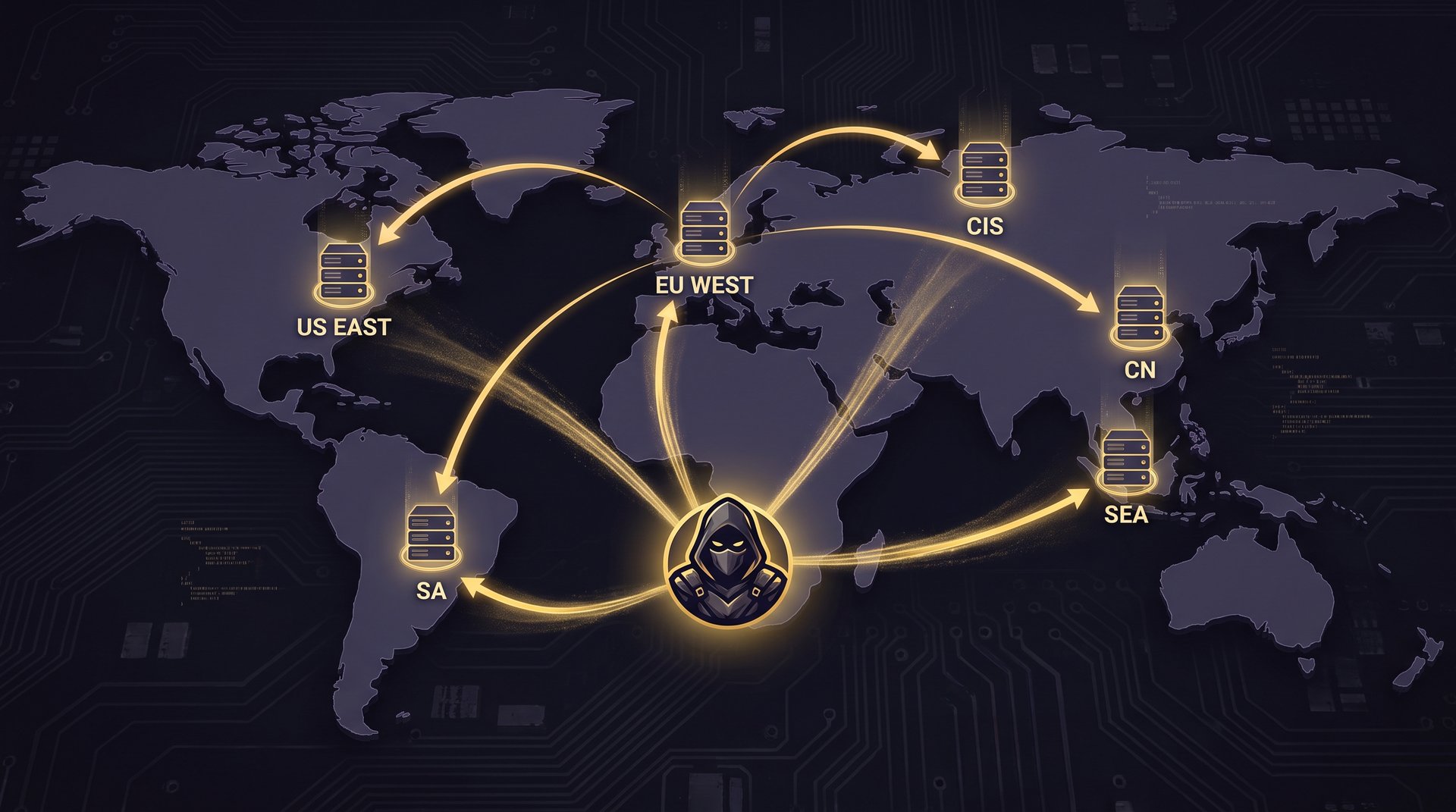
Dota 2 lets you select your preferred server region in the client settings, and the matchmaking system will prioritize games on your selected region. You can also enable additional regions if you are willing to accept higher ping, which is the mechanism that makes server-hopping possible. Your MMR number is shared globally — there is no separate EU MMR or NA MMR. There is one number, and it follows you across every region you play on.
What changes between regions is the quality and competitiveness of the player pool you are matched into. Valve’s matchmaking tries to find games within approximately 150-200 MMR of your rating, but when the player pool on a given server is small, it expands that range significantly to find a match within an acceptable wait time. This means on a low-population server like NA, you are more likely to play with people significantly above or below your actual bracket than you would be on EU or SEA.
Ping matters too. Most players get 20-40ms on their home region and 80-180ms on distant regions. At high MMR, the mechanical precision required means that playing at 150ms ping puts you at a real disadvantage. Server-hopping to get easier games only helps if your ping on the target server is manageable — otherwise the easier opponents cancel out the ping handicap.
What “Hardest Server” Actually Means
When players say one server is harder than another at the same MMR, they mean: if you transferred a 5,000 MMR player from Server A to Server B with their same MMR rating, they would win more or fewer games on average than 50%. A harder server means your 50% winrate bracket requires genuinely stronger play than the same number on an easier server. This has been tested extensively by players who have accounts on multiple regions and report consistent patterns.
Player Pool Size and Matchmaking Quality
The foundational driver of regional difficulty is player pool size. A larger pool means the matchmaking system has more options to find genuinely comparable opponents. The smaller the pool, the more the system has to compromise — either expanding MMR range to find opponents, or filling with players from adjacent brackets who are not a real skill match.
Based on community data from OpenDota, which tracks public match metadata, the approximate share of global Dota 2 activity by region looks like this:
| Region | Estimated Activity Share | Ranked Pool Density | Matchmaking Quality |
|---|---|---|---|
| SEA | 35-40% | Very High | Strong (but fragmented) |
| EU | 25-30% | Very High | Excellent at all brackets |
| CIS | 15-18% | High | Good above 3,000 MMR |
| NA | 8-10% | Low-Medium | Weak above 5,500 MMR |
| SA | 5-8% | Low | Weak above 4,500 MMR |
| Australia (OCE) | 1-2% | Very Low | Weak above 3,500 MMR |
Pool size alone does not determine difficulty — a large pool full of players who all play poorly at the same bracket still produces easy games. The combination of pool size and average skill ceiling within the server is what matters. EU and SEA both have large pools, but their difficulty profiles are different in important ways.
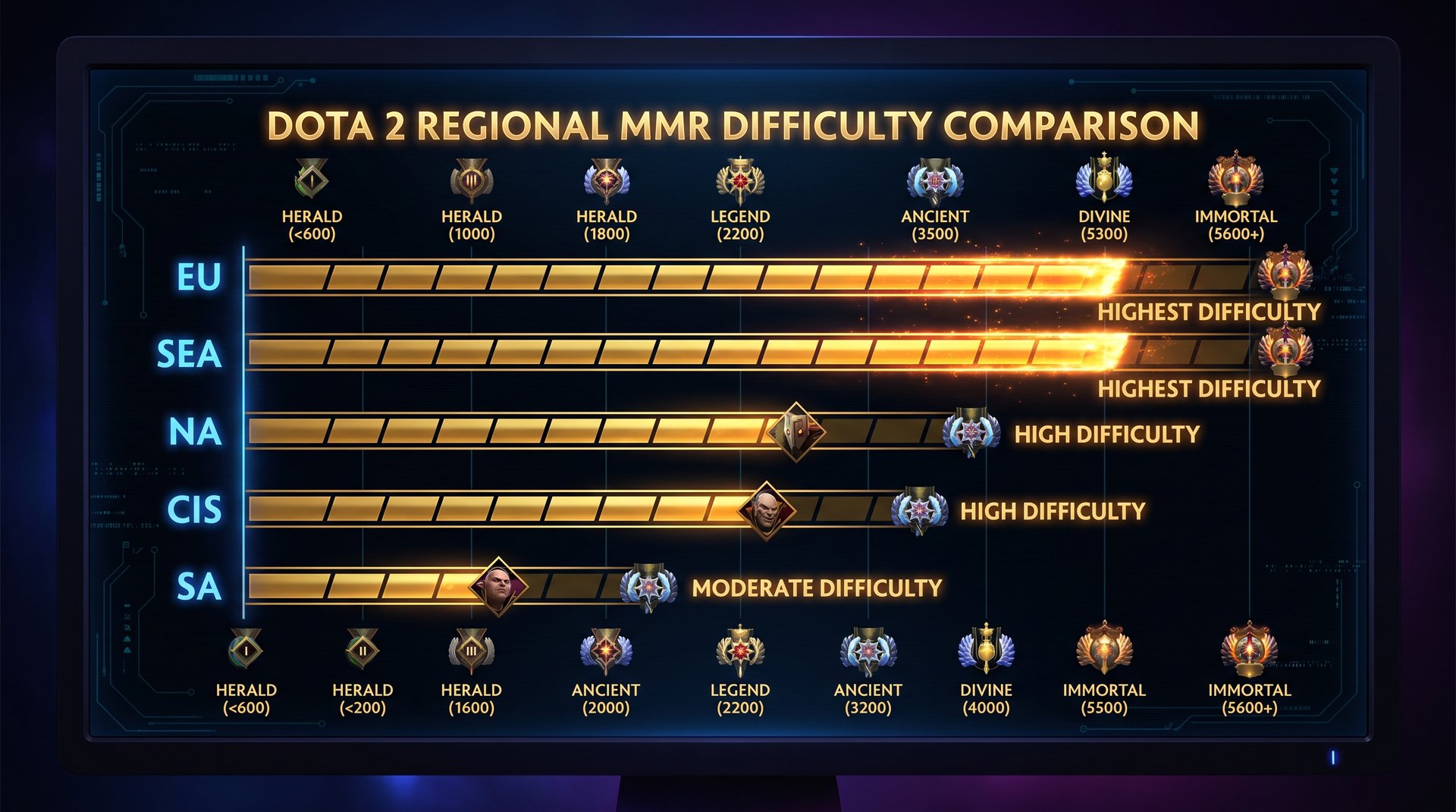
Leaderboard MMR Thresholds by Region
The most objective data point available is the MMR required to reach the regional leaderboard. Valve sets leaderboard access at the top 5,000 players per region (Immortal players only), and the minimum MMR to appear on the board varies significantly. Higher thresholds mean the entire upper bracket of that region is more compressed and competitive.
Based on community tracking as of mid-2026 (data aggregated by the Dota 2 community via API tools and published in multiple community forums):
| Region | Approximate Leaderboard Entry MMR | Top-1 Player Approximate MMR | Active Leaderboard Players |
|---|---|---|---|
| SEA | ~10,000-10,500 | ~13,000+ | 5,000 (full) |
| EU | ~9,500-10,000 | ~12,500+ | 5,000 (full) |
| CIS | ~9,000-9,500 | ~12,000+ | 5,000 (full) |
| NA | ~7,500-8,500 | ~10,500+ | 2,000-4,000 (incomplete) |
| SA | ~6,500-7,500 | ~9,500+ | 1,500-3,000 (incomplete) |
| Australia | ~5,500-6,500 | ~8,000+ | 500-1,500 (very incomplete) |
Note: these thresholds shift with each seasonal recalibration and active player counts. For current numbers, check the Dota 2 leaderboard requirements by region guide which is updated regularly. The direction is consistent: SEA requires more MMR to hit the board than EU, EU more than CIS, and NA significantly less than both.
EU: The Hardest Competitive Server Bracket for Bracket
EU (Europe West and Europe East combined for matchmaking purposes) is the consensus hardest server for competitive play at mid-to-high brackets. The reason is a combination of factors that compound each other: high player density, the highest concentration of active professional players practicing in pubs, and a culture that emphasizes individual mechanical skill and draft awareness.
Why EU Feels Harder at Every Bracket
The EU server has produced the largest share of top-tier professional Dota 2 players over the game’s history. Team Secret, OG, Liquid, and the bulk of TI-winning rosters have been EU-based or EU-practice teams. The result is that EU pubs at 6,000-9,000 MMR regularly feature active professional players and coach accounts — not just occasionally, but as a structural feature of the bracket.
Beyond pro players, EU benefits from the European regional qualification system that feeds into the DPC. Teams actively competing in regional leagues practice in EU pubs, and that practice cascades down. A 5,000 MMR EU player has shared lobbies with higher-bracket players who are themselves preparing for league competition. The skill transfer is real even if not always visible in individual game quality.
EU also has better communication standards at mid bracket. While communication in pubs is never perfect, EU players in the 4,000-7,000 MMR range are more likely to ping objectives, coordinate initiations, and respond to draft needs than equivalent-MMR players on CIS or SEA. This creates games where being outplayed feels less like individual mistakes and more like getting genuinely outcoached.
EU Difficulty by Bracket
- Herald-Crusader (0-2,000): Comparable to other regions — raw basics are the bottleneck everywhere.
- Archon-Legend (2,000-4,000): Noticeably harder than NA or SA. Positioning and farm patterns are cleaner.
- Ancient-Divine (4,000-6,500): Significantly harder. Draft awareness and itemization are more consistent.
- Immortal (6,500+): The hardest pub bracket in the world outside of Chinese servers. Pro players frequent this range.
SEA: Huge Pool, Wildly Uneven Skill Across Sub-Regions
SEA is the most complex server to characterize because it is not one coherent server — it is a matchmaking pool that spans Southeast Asia, covering the Philippines, Indonesia, Thailand, Vietnam, Singapore, Malaysia, and more. Each country has its own Dota 2 culture, playstyle, and skill ceiling, and they all share the same matchmaking server.
The SEA Dichotomy: Top vs Mid Bracket
At the very top (8,000+ MMR), SEA is genuinely among the hardest servers in the world. The SEA region has consistently produced world-class players — Topson (2x TI winner), Mindcontrol, Mushi, and many others developed their skills on SEA pubs. The leaderboard threshold being higher than EU is partly explained by a small cluster of exceptionally skilled players pushing the entire bracket upward.
However, at mid bracket (2,000-5,000 MMR), SEA plays very differently. Several factors reduce the effective difficulty compared to what the raw MMR number implies:
- Language barriers: A Filipino player, an Indonesian player, and a Thai player may all speak their home language in voice chat, making coordination difficult. This is not a cultural criticism — it is a structural feature of a multi-national server. Compared to EU where English dominates, SEA pubs at mid bracket have systematically worse in-game communication.
- High smurf density: SEA historically has had among the highest smurf account rates of any region. Account purchasing and leveling services targeting SEA players mean the MMR calibration below 4,000 is noisier. You will face more extreme skill mismatches than on EU or CIS at the same nominal rating.
- Internet infrastructure variation: Players across the SEA region have highly variable ping and connection quality. This creates in-game behavior that looks like poor play but is actually connectivity — an issue that is more pronounced than on EU or NA where infrastructure is more consistent.
Where SEA Sits vs EU
The community consensus is that SEA at 4,000-7,000 MMR is slightly easier than EU at the same bracket due to the coordination and communication factors. Above 8,000 MMR, the gap closes or reverses. For practical climbing purposes, a player on SEA at 5,000 MMR is in a less organized environment than their EU equivalent.
NA: The Easiest Major Server for Competitive Climbing
NA (North America) is the easiest of the four major competitive servers by broad consensus — and this is not a recent phenomenon. The reason is primarily structural: the NA Dota 2 player base has always been smaller relative to the region’s internet-connected population compared to Europe or SEA. Dota 2 lost ground to League of Legends in North America early in its history and never fully recovered that audience.
Why NA MMR Is Inflated Relative to Other Regions
Matchmaking inflation on NA works like this: with fewer players in a given MMR range, the system has to draw from a wider bracket to fill games in reasonable queue times. A 5,000 MMR NA player regularly plays with 4,200-5,800 MMR opponents. On EU at the same rating, the range is much tighter. This means the NA player’s MMR is calibrated against a noisier sample, and the effective skill required to hold 5,000 MMR on NA is lower than on EU.
The data point that consistently makes this clear: many EU players who move to NA for team practice (or who play NA accounts for supplemental games) report climbing 500-800 MMR within weeks without any meaningful change in their play quality. The inverse — NA players who move their practice to EU — usually see a temporary MMR drop before re-stabilizing.
NA at High Bracket: A Different Problem
Above 7,000 MMR on NA, the pool becomes so thin that matchmaking breaks down in a different way. You begin seeing the same players repeatedly, including semi-professional and professional players who are essentially using pub matches to warm up between scrims. This creates a strange phenomenon where the very top of NA pub is actually quite competitive — but the bracket from 4,000-7,000 is significantly more forgiving than EU or SEA equivalents.
Using a professional Dota 2 boosting service on NA will show you this effect clearly: our boosters consistently report that equivalent MMR ranges on NA take fewer games per 100 MMR gained than on EU, because the lobby compositions are less consistently dangerous.
CIS: High Mechanics, Lower Team Coordination
The CIS server (Russia and former Soviet Union countries) is the most interesting outlier. CIS players have a well-documented reputation for extremely aggressive and mechanically skilled individual play, combined with lower-than-average team coordination at mid bracket. The result is a server that is hard in a specific way — individual skill — while being forgiving in another way — team cohesion.
The CIS Playstyle and What It Means for Climbing
CIS pubs at 3,000-6,000 MMR are characterized by fast, chaotic games with high individual action rates. Players are more likely to solo dive, attempt aggressive plays without team commitment, and make unilateral decisions than EU players at the same bracket. If you are a mechanically excellent player who struggles with team-dependent heroes, CIS is actually one of the better servers to climb on — your individual performance matters more per game.
If you rely on team coordination, itemization decisions, and macro play, CIS mid bracket is frustrating. The server rewards a specific kind of hero pool — high impact individual carries, farming heroes with self-sufficiency, and cores that can solo win games without much help.
At the top bracket (8,000+ MMR), CIS narrows the gap with EU significantly. CIS has produced multiple top-10 MMR players in the world and the region feeds the DPC circuit with consistently strong teams. The top of CIS pub is legitimately difficult.
SA: The Lowest Bar to Climb
South America is the smallest of the major Dota 2 servers in terms of competitive player density. Brazil dominates the SA player base, with Peru and Argentina also contributing meaningfully. While the server has produced professional players and a passionate community, the small absolute player count means that MMR on SA is the most inflated of any major region.
A player at 5,000 MMR on SA is almost certainly a better player than their MMR indicates relative to the global community. The pool is thin enough that the system regularly places players 400-600 MMR apart in the same game. SA leaderboard entry requirements are the lowest of any populated server, not because SA players are less skilled in absolute terms, but because the population does not push the bracket ceiling the way EU or SEA does.
For players who are located in South America, this does not mean you are having easy games — you are playing against the people available on your server. But if you are considering playing SA accounts as an experiment, you will find the same nominal MMR bracket is noticeably less demanding than EU or SEA.
Full Region Difficulty Comparison Table
This table synthesizes our assessment of each server across the dimensions that matter most for climbing. Ratings are relative, not absolute — a “Hard” mid bracket means it is harder than average across all servers, not that it is objectively difficult.
| Region | Low Bracket (0-3k) | Mid Bracket (3k-6k) | High Bracket (6k+) | Smurf Rate | Coordination Quality | Overall Difficulty |
|---|---|---|---|---|---|---|
| EU | Medium | Hard | Very Hard | Low-Medium | Excellent | Hardest Major Server |
| SEA | Medium-High | Medium | Very Hard | High | Variable | Hard (uneven) |
| CIS | Medium | Medium-Hard | Hard | Medium | Below Average | Hard (mechanical focus) |
| NA | Easy-Medium | Medium | Hard (thin pool) | Low | Good | Easiest Major Server |
| SA | Easy | Easy-Medium | Medium | Low-Medium | Average | Easiest Overall |
Pro Player Migration: The Best Evidence We Have
The most credible evidence for regional difficulty is where professional players choose to practice. Players who are paid to improve at Dota 2 and have no obligation to play on any particular server consistently reveal their preferences through their behavior — and the pattern is unambiguous.
EU Dominates as the Practice Server
The Dota 2 professional scene has consistently seen players migrate to EU for serious practice, regardless of their home region. Several well-documented patterns:
- NA pros practicing on EU: Multiple North American professional organizations have relocated to Europe during DPC seasons specifically to access harder pub competition. The stated reason, consistent across different organizations and eras, is always the same: EU pubs provide better preparation for LAN competition than NA pubs at the same bracket.
- SEA pros on EU: Top-tier SEA players who have played in both regions typically describe EU as harder at equivalent MMR for coordinated play, even while acknowledging that the very top of SEA has individual mechanical skill that matches EU.
- Team bootcamps in Europe: Many teams based outside Europe fly to bootcamp in Europe before major LAN events specifically to get concentrated time on EU pubs. If regional server difficulty were equivalent, there would be no reason to incur the cost of relocation.
This pattern is the cleanest evidence available because it reflects decisions made by people with real incentives to be right. No professional organization is going to spend money on EU bootcamps if NA pubs were comparably competitive. The market has answered the question.
Does Server-Hopping Actually Work for MMR?
Yes. Playing on NA or SA when you are normally an EU player will, under the right conditions, allow you to climb MMR faster than on your home server. The mechanism is straightforward: the same MMR bracket contains less skilled opponents on average, and your win rate increases accordingly until the system recalibrates you to a level where you are no longer favored.
However, several factors complicate this in practice:
The Ping Problem
For a European player to play on NA servers, they are looking at 100-180ms latency depending on their location. In the lower brackets, this is manageable. Above 4,000 MMR, the mechanical precision required — last hitting, spell timing, reaction to initiation — becomes noticeably affected at 150ms. Many players find that the advantage of easier opponents is partially offset by the mechanical disadvantage of high ping, making the actual MMR gain slower than expected.
The Convergence Problem
Valve’s matchmaking is designed to find your true skill level over time. If you are genuinely better than your current bracket on any server, you will climb. If you reach a bracket where you are not winning more than 50% of your games, you will stop climbing. Deliberately playing on an easier server inflates your number, but the system will eventually find the ceiling of your performance even on that server. You cannot climb infinitely by server-hopping — you will hit a ceiling approximately equal to your real skill level adjusted for the regional difficulty gap.
Is Server-Hopping Safe and Does Valve Penalize It?
Valve does not have any known policy against playing on multiple regional servers. There is no penalty for selecting a different region in your Dota 2 client settings. The system is designed to accommodate players who travel or who want to play with friends on other servers. The safety of your account is not affected by regional server selection.
The practical constraint is the one already discussed: ping and matchmaking pool limitations make server-hopping less effective than it might appear in theory. Our boosters at TeamSmurf who test across regions consistently report that the fastest climbing path for most players is to improve on their home server rather than accumulating inflated MMR on easier servers.
What Actually Transfers When You Return to Your Home Server
Nothing from your time on another server transfers to your home server rating. Your MMR is a single global number, but your matchmaking on each server draws from the regional pool independently. If you gained 500 MMR by playing NA while based in Europe, you bring those 500 MMR points back to EU pubs — where the competition will be harder than the NA games that produced them. Many players report a “snap-back” effect where MMR gained on easier servers is lost relatively quickly when returning to home-server play.
The complete MMR boosting guide covers the most effective approaches to sustainable rank improvement, including which methods produce durable gains versus temporary number increases.
The Verdict: Which Server Should You Play?
Based on all of the above, here is our practical recommendation by player type:
- Serious climbers wanting real skill improvement: Stay on EU if you have access. The harder environment accelerates genuine skill development. The players you practice against are better, and your MMR gain reflects real growth.
- Players trying to reach a specific MMR number for a goal (account requirements, team tryout cutoffs): If you have acceptable ping on NA or SA, playing there will reach your target faster. Just understand that the number is softer than an equivalent EU rating.
- SEA players: Your home server is legitimately competitive at high bracket. If you are stuck below 5,000 MMR, the bottleneck is probably not server difficulty — it is individual fundamentals.
- NA players: Your server gives you a real advantage for number climbing but limits your preparation for competitive play. If you aspire to LAN competition, consider regular EU practice sessions despite the ping cost.
- CIS players: The mechanical skill focus of your server is an advantage for developing individual performance. Team-oriented hero pools may feel harder to succeed with than on EU.
If you want to skip the server debate entirely and reach your target MMR by the fastest safe method, our MMR boost service works on all regional servers with boosters who have proven performance in each region. You specify your server, your current bracket, and your target, and our team handles the rest. Every order comes with account protection guarantees and is completed by players who have hit Immortal on the requested server.
Boost Your MMR on Any Server
TeamSmurf operates on EU, SEA, NA, CIS, and SA. Our boosters are region-native Immortal players — they know every server’s dynamics and will climb your bracket efficiently without exposing your account to risk.