

Dota 2 Items: Every Item Explained, by Category

Items are the engine of every Dota 2 match. Every gold coin you earn goes toward changing your hero’s power curve — a cheap Ring of Basilius in the first three minutes can win a lane; a Divine Rapier at 45 minutes can win the game. Unlike other MOBAs where items slot neatly into a fixed build, Dota 2 gives you a shop of roughly 200 purchasable items and expects you to assemble the right combination every game based on your hero, your role, the draft, and the enemy lineup.
This hub covers every Dota 2 item category: what belongs there, when to buy it, and which specific items matter most for climbing ranked. Whether you are a Herald figuring out what to spend your starting gold on, or an Ancient player looking for the situational tech that wins a draft, the categories below will orient you. Each section links to our deeper item guides for players who want the full breakdown.
Contents
Starting Items
Starting items are purchased at the fountain before the first creep wave. Your budget is 600 gold — enough for a small handful of items that set your lane phase. The goal is survival and early fighting power: regeneration to trade in lane, stats to win exchanges, and in some cases a specific component needed for your first big item.
Every hero in every role buys at least one Tango (75 gold) to sustain off creep hits. Carries and offlaners add a Stout Shield (200 gold) or a Quelling Blade (75 gold) to trade or last-hit efficiently. Supports typically stack Observer Wards (0 gold since 7.23), Clarity Potions (50 gold), and Iron Branches (50 gold each) to max out starting stats on a budget. The Faerie Fire (75 gold) is a one-charge heal that also provides a small agility bonus — carries often grab one for the clutch save.
Key starting items at a glance:
- Tango — Tree-eating regen, the universal first slot. Buy two sets if you plan to give one to your mid laner.
- Healing Salve — 100 gold for larger burst regen; weak in trades (cancels on damage from heroes).
- Iron Branch — 50 gold for +1 to all stats, plants into a tree for one Tango charge. The value ratio is absurd.
- Stout Shield — 200 gold damage block for melee heroes. Wins trades in the 1 and 3 positions.
- Quelling Blade — 75 gold last-hit bonus for carries; also chops trees.
- Orb of Venom — 150 gold slow-on-hit; opens early kills in aggressive lanes with right-click heroes.
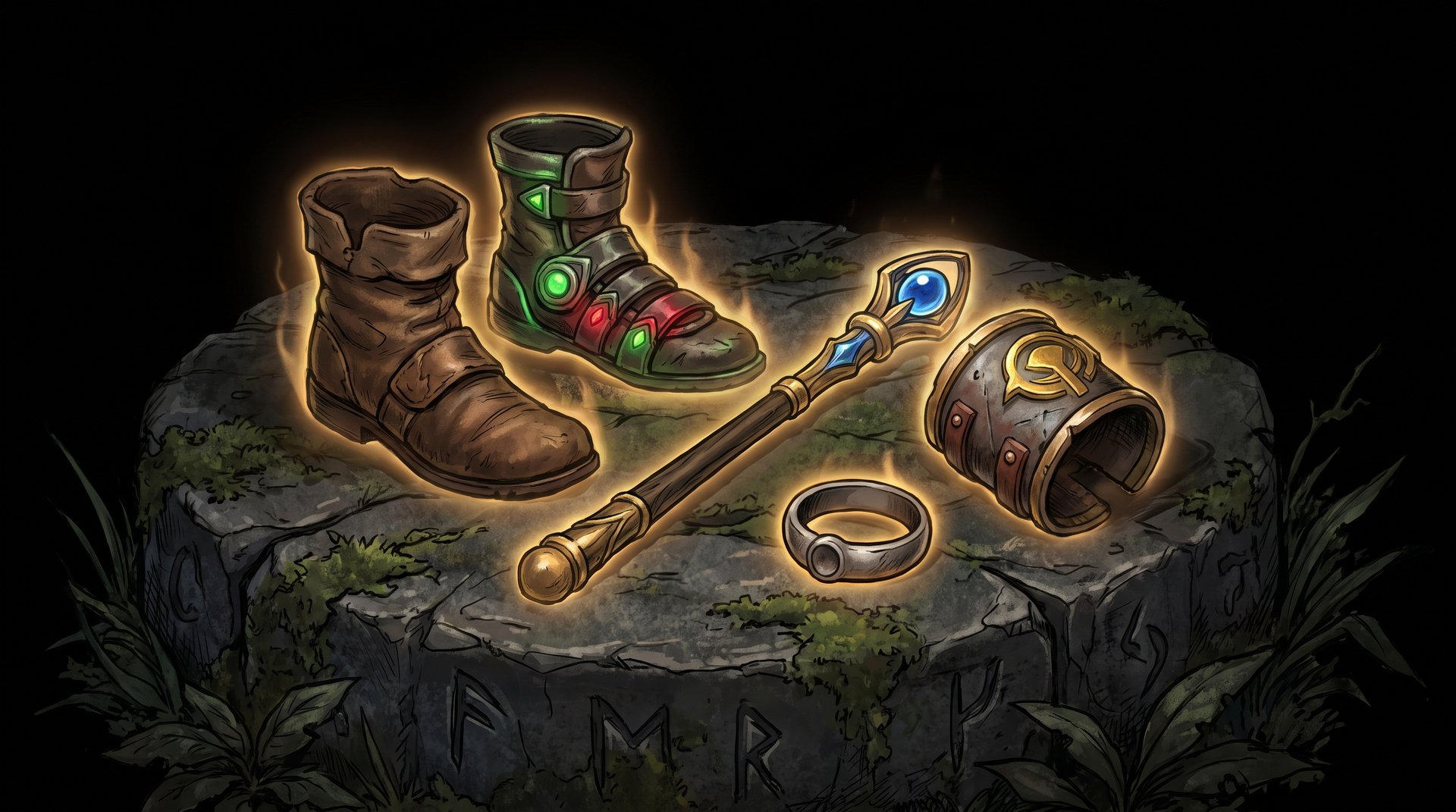
Early Game Items (Laning Phase Completions)
Early game items are those you finish between roughly 5 and 15 minutes into the match. They are the first meaningful power spikes and often define whether you win or lose the lane. The decision tree here is: does my hero need mobility (boots), sustain (Soul Ring, Urn), stats (Wraith Band, Bracer, Null Talisman), or an aggressive tool (Bottle, Blight Stone)?
Boots are the most important early game purchase for almost every hero. Phase Boots (1450 gold) suit physical damage dealers and offlane initiators. Power Treads (1400 gold) are the default for carries and mid heroes who need the attribute toggle for mana management and survivability. Arcane Boots (1500 gold) are the support choice, providing a team mana burst that recharges every 55 seconds. Tranquil Boots (975 gold) suit supports who roam constantly and need to regenerate between fights without using consumables.
The Magic Wand (450 gold, builds from Magic Stick) is one of the highest value-per-gold items in the game. Every charge is a mini-heal and mana restore; in a spell-heavy lane you can accumulate 15+ charges for an emergency burst. Nearly every hero should have a Magic Stick early and upgrade it when possible.
Key early game items:
- Phase Boots / Power Treads / Arcane Boots / Tranquil Boots — Pick one based on your role.
- Magic Wand — Builds from Magic Stick; high fight-survival value in spell-heavy lanes.
- Bracer / Wraith Band / Null Talisman — 500-gold stat bundles for strength, agility, and intelligence heroes respectively; each gives a small passive bonus on top of the stats.
- Soul Ring — 770 gold mana-on-demand for strength heroes. Converts a chunk of HP into mana once every 25 seconds.
- Bottle — 700 gold for mid heroes; stores three charges of regen and can be refilled at the fountain or by capturing runes.
- Urn of Shadows — 875 gold support item; stores charges from hero kills and delivers a heal or a damage-over-time to enemies.
Mid Game Items (Timing Windows)
Mid game items come online between roughly 10 and 30 minutes. They define tempo: a finished Blink Dagger or a completed Black King Bar is the signal for your team that fights can now start. Many mid game items are “core” for specific heroes — meaning a Pudge without a Blink Dagger or an invoker without an Aghanim’s Scepter is playing far below potential. The most important mid game items include mobility tools, magic immunity, and farm accelerators.
The Blink Dagger (2250 gold) is one of the most impactful items in Dota 2. It costs nothing to activate except a 12-second cooldown (15 seconds if you took damage in the last three seconds from an enemy hero or tower), teleports you 1200 units instantly, and enables almost any hero with a stun or initiation ability to create fights out of nothing. Initiators like Axe, Earthshaker, Enigma, and Sand King become dramatically stronger the moment Blink completes.
The Black King Bar (4050 gold) — commonly called BKB — grants 10 seconds (first use) of magic immunity, protecting you from most crowd control abilities. Carries who are getting chain-stunned in fights need this item to function. The BKB duration decreases by 2 seconds with each use, bottoming out at 3 seconds, which is why you want to win before relying on it too many times.
Key mid game items:
- Blink Dagger — The gold-standard initiation and escape tool. Cancels on damage; cannot be purchased by heroes with strong base movement speed above 325 without additional conditions.
- Black King Bar (BKB) — Magic immunity for carries and semi-carries who are targeted in fights.
- Aghanim’s Scepter — 4200 gold; upgrades the ultimate of almost every hero in a unique way. Worth buying if your hero’s Aghs upgrade changes your game plan significantly.
- Hand of Midas — 2050 gold; attack speed and XP on a 90-second cooldown. A farm accelerator that pays off if bought before 12 minutes.
- Hurricane Pike — 4150 gold ranged carry option combining Dragon Lance with Force Staff; provides both stats and an active escape/repositioning tool.
- Diffusal Blade — 2800 gold agility item; purges buffs (including Haste rune), burns mana, and provides a slow on illusion heroes like Phantom Lancer and Anti-Mage.
- Radiance — 5175 gold burn-damage aura. Scales with illusions, great for split-push and illusion heroes, but a large gold investment that delays fights.

Late Game Core Items
Late game items are the power peaks that fully-farmed carries reach between 30 and 55 minutes. At this tier, items cost 4000 to 5700 gold or more and often completely reshape a hero’s damage profile or durability. A fully-farmed carry with a complete 6-slot inventory (generally 6 items + possibly a tome or other consumable) should be able to fight and win 1-on-1 against almost anyone on the enemy team.
The Divine Rapier (5150 gold total) is the highest raw damage item in Dota 2 — +330 damage — but it drops on death and can be picked up by any hero, including the enemy. It is a desperation item when your team needs to end the game immediately, or a snowball item for a hero who is so far ahead that losing it would not cost them the game. The Butterfly (4750 gold) provides evasion, attack speed, and agility, making it the best damage-and-survivability item for most right-click carries against physical lineups.
Key late game core items:
- Butterfly — 35% evasion plus attack speed and damage; a carry’s best friend against physical lineups.
- Heart of Tarrasque — 5500 gold; massive HP and regeneration; the go-to for strength cores who need bulk in late fights.
- Satanic — 5050 gold; lifesteal plus an active that triples lifesteal for 3.5 seconds; the come-back item for a carry who is getting burst down.
- Daedalus — 5150 gold; +88 damage with a 25% critical strike at 225% damage. The raw damage king for physical carries.
- Eye of Skadi — 5500 gold; universal attack modifier that slows, reduces regen and lifesteal, and provides a huge stat block. Counters lifestealing enemies.
- Divine Rapier — 5150 gold; drops on death. The “end the game now” item for desperate situations or heroes so fed they can absorb the risk.
- Monkey King Bar — 4975 gold; 35% chance for a pure damage proc that cannot be evaded. The counter to evasion items like Butterfly and Windwaker.
- Assault Cuirass — 5125 gold; attack speed aura, armor aura, and armor reduction on enemies. A team-fight powerhouse for cores who want to push and fight.
| Category | Timing | Budget Range | Example Key Items |
|---|---|---|---|
| Starting | 0:00 | 50-600 gold | Tango, Iron Branch, Stout Shield |
| Early Game | 5-15 min | 450-1,500 gold | Phase Boots, Magic Wand, Bracer |
| Mid Game | 10-30 min | 2,000-5,200 gold | Blink Dagger, BKB, Aghs Scepter |
| Late Game Core | 25-50 min | 4,500-5,700 gold | Butterfly, Heart, Satanic, Rapier |
| Support | 8-30 min | 1,000-4,500 gold | Glimmer Cape, Force Staff, Mekansm |
| Situational | Any | 1,500-5,700 gold | Linken’s, Nullifier, Scythe of Vyse |
| Neutral (drop) | 0-37+ min | Free (drops) | Tier 1-5 per time window |
| Consumables | Throughout | Free-200 gold | TP Scroll, Smoke, Observer Ward |
Support Items
Support items are designed for heroes who spend gold on the team rather than themselves. Supports typically cannot afford expensive cores, so their item pool focuses on utility: healing, saving allies, creating vision, and amplifying team fight potential at low cost. A support with a well-timed Force Staff save or a Glimmer Cape on a dying carry can swing a fight that the raw numbers said was over.
The Force Staff (2300 gold) is one of the most flexible items in the game. It pushes any unit — ally or enemy — 600 units in the direction they are facing. Use it to save a carry from a right-click initiator, to push an enemy out of a fortification, or to cross terrain as a pseudo-blink. Its 20-second cooldown means you can often use it twice in extended team fights. The Glimmer Cape (1950 gold) grants invisibility to an ally for 5 seconds (with magic resistance) on a 14-second cooldown — one of the best “save your carry” tools in the game at its price point.
Key support items:
- Arcane Boots — 1500 gold; burst mana restore for the team; first item for most position 5 supports.
- Mekansm — 1900 gold; AoE heal plus armor aura; strong for early fighting and supports staying near the team.
- Guardian Greaves — 4050 gold; upgrades Mekansm with a dispel and a much larger heal; end-game support power item.
- Force Staff — 2300 gold; push any unit 600 units; the best low-cooldown utility item supports can buy.
- Glimmer Cape — 1950 gold; invisibility and magic resistance for an ally on 14-second cooldown.
- Lotus Orb — 3850 gold; reflects targeted spells back at the caster; counters lockdown and makes supports much more durable.
- Solar Crest — 3400 gold; shine it on an ally for armor and attack speed, or on an enemy to reduce their armor significantly.
- Pipe of Insight — 3825 gold; magic resistance aura plus a team barrier against magical damage bursts; counters heavy magic lineups.
- Vladmir’s Offering — 2075 gold; lifesteal, armor, and damage aura; popular on strength supports who stay near the front line.
Situational Items
Situational items address specific threats from the enemy lineup. A good Dota 2 player reads the draft and adjusts their build to counter what the enemy is doing — you do not copy a fixed build from a tier list every game. Situational items are why Dota 2 has more counter-play than most MOBAs: almost every ability or item strategy has an answer in the shop.
The Linken’s Sphere (4600 gold) blocks one targeted ability every 12 seconds, including disables from heroes like Bane or Doom. If the enemy draft revolves around a single targeted ultimate to win fights, Linken’s shuts it down. The Nullifier (4700 gold) is the counter to Linken’s and other defensive items — it dispels buffs on a hero and prevents them from using items for 5 seconds. If the enemy carry has a Linken’s Sphere or a Manta Style, Nullifier removes both before your teammates can follow up.
Key situational items:
- Linken’s Sphere — 4600 gold; spell block on a 12-second charge. Buy against single-target burst or disables.
- Nullifier — 4700 gold; item-purge and debuff on an enemy. Buy against Linken’s, Manta Style, or heroes who survive on buffs.
- Scythe of Vyse — 5675 gold; hex disables a hero for 3.5 seconds and is blocked by BKB but still goes through a high percentage of magic immunity abilities. The hardest crowd control in the game.
- Orchid Malevolence — 3825 gold; silence for 5 seconds and a damage amplifier that fires at the end. Build against casters and cores who rely on abilities.
- Eul’s Scepter of Divinity — 2750 gold; cyclone yourself or an enemy for 2.5 seconds; used to dodge spells, set up stuns, or break enemy channeled abilities.
- Ghost Scepter — 1500 gold; makes you ethereal (cannot be attacked physically) for 4 seconds. Cheap counter to right-click cores; combine with Ethereal Blade for a kill combo.
- Aeon Disk — 3000 gold; when you drop below 80 HP, triggers a brief invulnerability and a dispel; passive survival tool for supports and carry heroes who get jumped on.
- Silver Edge — 5200 gold; breaks passives on enemies (removes Bristleback’s damage reduction, Spectre’s Dispersion, etc.) for 4 seconds on hit.
- Crimson Guard — 3675 gold; active physical block barrier for your entire team; counters right-click carries in early team fights.
Neutral Items
Neutral items are dropped by jungle creeps and cannot be purchased. They appear on a timer-based system tied to creep waves: Tier 1 items drop from 0 to 7 minutes, Tier 2 from 7 to 17, Tier 3 from 17 to 27, Tier 4 from 27 to 37, and Tier 5 at 37 minutes onward. Each team gets one neutral item per tier drop, placed in the neutral item stash at the fountain. Heroes can equip one neutral item each in a dedicated slot that does not count against the normal 6-item inventory.
Because neutral items are free, their value is dictated entirely by how well they fit the hero using them at the right time. A Tier 1 Ironwood Tree (passive stats) on a support who cannot afford early items is strong. A Tier 5 Pirate Hat (grants gold passively) on a farming carry who already has a full inventory slot to spare can accelerate their final item by thousands of gold.
Key neutral items by tier:
- Tier 1 (0-7 min): Ocean Heart (regen near water), Ironwood Tree (stats + tree creation), Chipped Vest (attack speed on taking damage), Broom Handle (attack range + damage for melee).
- Tier 2 (7-17 min): Grove Bow (attack range), Imp Claw (on-attack damage proc), Titan Sliver (universal attribute scaling), Orb of Destruction (armor reduction on hit).
- Tier 3 (17-27 min): Paladin Sword (lifesteal plus bonus healing), Quickening Charm (cooldown reduction), Cloak of Flames (retaliatory burn aura), Nemesis Curse (spell amp).
- Tier 4 (27-37 min): Mind Breaker (silence on hit), Havoc Hammer (AoE knockback active), Rattlecage (thorns passive), Ninja Gear (phase-boots-like dodge passive).
- Tier 5 (37+ min): Pirate Hat (passive gold generation), Book of the Dead (summons a lich unit), Apex (raw attribute conversion), Mirror Shield (spell reflection chance).
For the full tier-by-tier ranked breakdown, see our Neutral Items Tier List 2026.
Consumables
Consumables are single-use or limited-charge items bought throughout the game for healing, vision, or tactical advantages. Unlike other categories, consumables are repurchased constantly — a good support player buys Observer Wards and Sentry Wards every time they respawn, and every hero should be carrying a Town Portal Scroll at all times after the laning phase.
The Town Portal Scroll (50 gold) is the most important consumable in the game by a large margin. Teleporting to a tower to defend or to a teammate for a kill attempt is the number one mechanical skill gap between lower and higher brackets. Players who die to ganks after 10 minutes without a TP Scroll lose far more MMR than players who buy one every time. On a shared cooldown of 80 seconds, TPing to a far lane is always worth the 50 gold.
Key consumables:
- Town Portal Scroll — 50 gold; teleport to any friendly building. Buy one every time you die or use yours.
- Smoke of Deceit — 50 gold; makes your nearby team invisible to wards and creeps for 35 seconds or until you attack; the standard tool for 5-man rotations and Roshan takes.
- Observer Ward — 0 gold (free); provides vision over a large area for 7 minutes. Supports buy and place these — they are the primary source of map information.
- Sentry Ward — 100 gold; reveals invisible units and enemy wards in a small radius. Used to deward the enemy’s Observer Wards and to counter invisible heroes.
- Dust of Appearance — 80 gold; active AoE that reveals invisible units around the caster for 12 seconds. The mobile counter to Bounty Hunter, Riki, and Clinkz.
- Tango — 75 gold; eats trees for HP regen. Used throughout the game for low-cost lane sustain or a quick regen in the field.
- Clarity — 50 gold; mana regen over time. Interrupt it on an enemy to cancel the regen and deal damage.
Item Tier List: Best Purchases in 7.41f
The current patch as of this writing is 7.41f. Item balance shifts with every major patch as Valve adjusts costs, stats, and ability effects. The list below reflects the community-verified top-rated purchases at each tier for general pub play in 7.41f — meaning items that deliver strong value across a wide range of heroes and game states, not just niche-carry optimals.
S-tier items this patch (best value per gold spent, widest applicability) include Blink Dagger for any hero with initiation, Black King Bar for cores in spell-heavy metas, Force Staff for supports, and Glimmer Cape as the best cheap save. A-tier items with high win-rate correlation include Aghanim’s Scepter on the heroes who receive a gameplan-changing upgrade (roughly 60 of the 122 heroes in the current patch benefit significantly), Solar Crest for kill-lane supports, and Guardian Greaves for late-game position 4/5 players.
Items that dropped in value in 7.41f include Ethereal Blade (reduced proc damage) and Dragon Lance (range bonus reduced). Items that gained value include Orchid Malevolence (higher silence duration against intelligence heroes) and Assault Cuirass (armor and speed aura reworked to benefit teams fighting under towers). For the full breakdown with every item change ranked, see our Dota 2 7.41f Item Tier List.
Item Resources on This Site
TeamSmurf has in-depth item guides for every major item topic. Use the links below to go deeper on any category:
- Best Items by MMR Bracket — Which items win games at Herald, Archon, Legend, Ancient, and Immortal, with different priorities at each rank.
- Neutral Items Tier List 2026 — Every neutral item ranked by tier with recommended heroes for each drop.
- Best Aura Items 2026 — Which aura items deliver the most team value per gold, by lineup type.
- Best Defensive Items by Role — Survival purchases for each position, from cheap Ghost Scepter to late-game Heart of Tarrasque.
- Best Escape Items by Role — The items that let you survive a gank and live to fight the next one, matched to your role and hero type.
- Dota 2 7.41f Item Tier List — Complete patch-current item rankings with S/A/B/C tiers for every purchasable item in 7.41f.
If you want to understand which items appear in the builds of the highest-MMR players and why, the MMR boosting guide covers drafting and item decision-making from an Immortal-rank perspective. And if you are asking whether getting a high-MMR coach to review your item timings is worth it, see our breakdown of the best Dota 2 boosting services and the safety considerations for boosting.
Ready to Put These Items to Use at a Higher Rank?
Knowing what to buy is half the equation — execution under pressure is the other half. Our Immortal-rank boosters and coaches at TeamSmurf can accelerate your climb by showing you exactly which items to rush, when to deviate from the standard build, and how to itemize against the enemy draft in real time.
Boost My MMR Get Coaching


