


Dota 2 GPM and Last-Hit Benchmarks by Rank: What Good Farm Looks Like at Every Medal

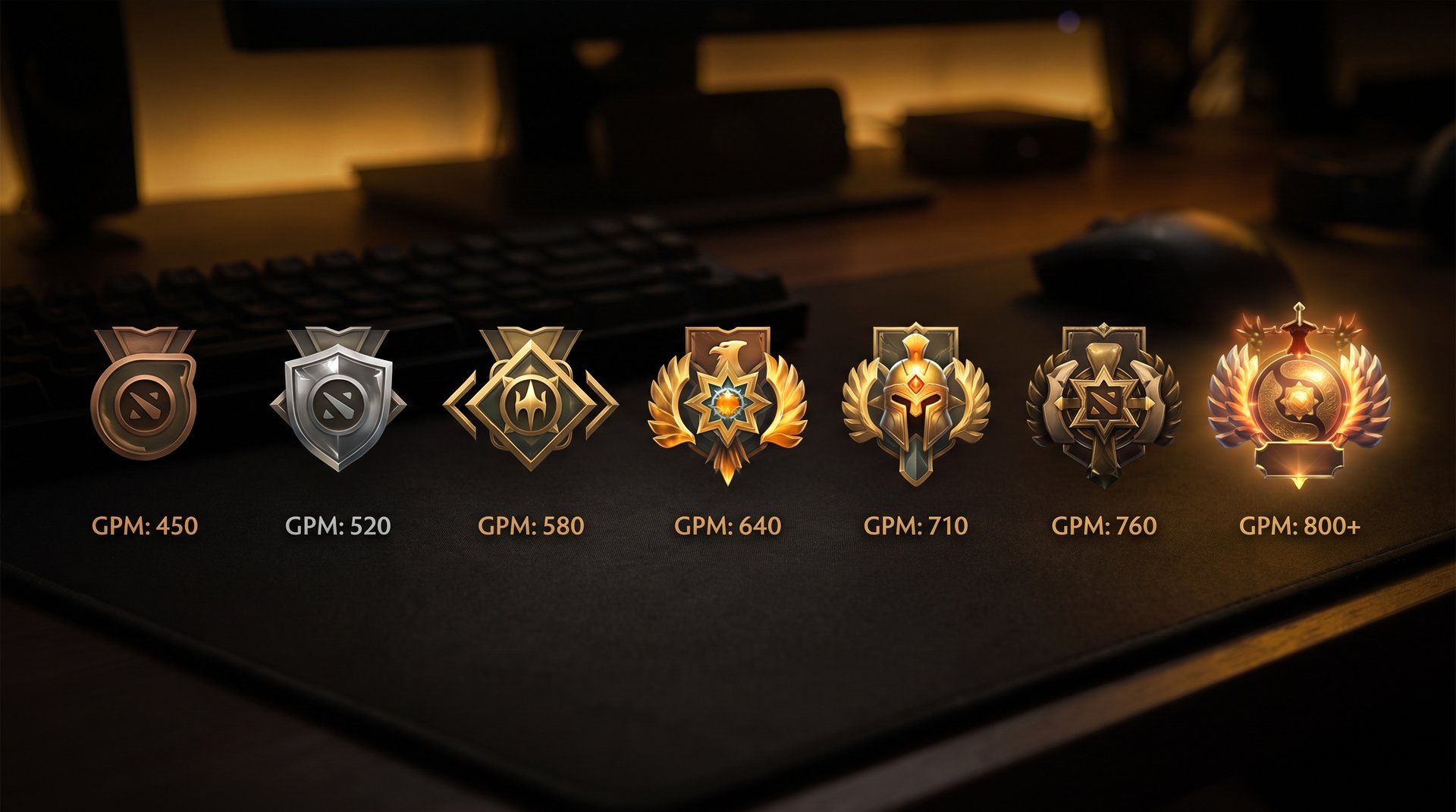
At Herald you average around 380-450 GPM on a carry. At Archon it is 580-660. At Divine it climbs past 840, and Immortal players regularly post 880-960+ GPM in pub games. Last hits tell the same story: a Herald carry lands roughly 25-35 CS at 10 minutes while an Ancient player hits 75-85 in the same window.
These are not made-up benchmarks. The numbers below are derived from OpenDota’s public benchmark API — percentile data covering millions of pub games — mapped to rank brackets using Stratz rank distribution data. If your GPM sits below the range for your medal, you have a concrete, fixable problem: your farm is leaving gold on the table every game.
Use this page as a diagnostic. Find your rank in the main table, compare your actual numbers from Dotabuff or Stratz, and then scroll to the improvement section for exactly what to fix.
Contents
GPM and Last-Hit Benchmarks by Rank
The table below shows median carry-position benchmarks by rank bracket. All figures are for Pos 1-3 (carry, mid, offlane) in ranked pub games. Supports will have substantially lower GPM — see the role breakdown section below. LH@10, @20, and @30 represent cumulative last hits at those timestamps in an average-length game.
| Rank / Medal | Avg GPM (Carry) | LH @ 10 min | LH @ 20 min | LH @ 30 min | Percentile |
|---|---|---|---|---|---|
| Herald (1-5) | 380-450 | 25-35 | 75-95 | 140-160 | Bottom 7% |
| Guardian (1-5) | 450-515 | 35-45 | 95-115 | 175-200 | 7-23% |
| Crusader (1-5) | 515-585 | 45-55 | 115-135 | 220-250 | 23-46% |
| Archon (1-5) | 585-665 | 55-65 | 135-160 | 260-290 | 46-68% |
| Legend (1-5) | 665-755 | 65-75 | 160-180 | 295-325 | 68-85% |
| Ancient (1-5) | 755-840 | 75-85 | 180-200 | 340-375 | 85-94% |
| Divine (1-5) | 840-885 | 82-93 | 195-215 | 375-400 | 94-98% |
| Immortal | 885-970+ | 90-115+ | 210-235+ | 415-450+ | Top 2% |
Source: OpenDota benchmark percentile data (opendota.com), rank distribution via Stratz (stratz.com/players/ranks), pub games all regions, 2025-2026 aggregate. Carry/core positions only.
How to Read These Numbers
GPM (gold per minute) is your total net gold earned divided by game duration in minutes. It combines lane gold from last hits and denies, kill gold, passive income (base + items like Hand of Midas), and objective bounties. It does not include unreliable gold that was spent before being converted — so a carry who buys items early and dies before farming further will show lower GPM than the raw number suggests.
LH (last hits) counts the creeps and neutrals your hero delivered the killing blow to. Unlike GPM, LH is a pure farming efficiency metric — it does not include kill gold, passive income, or objective bounties. This makes it a cleaner diagnostic for lane mechanics specifically.
How to use the table
The benchmarks are population medians for the rank bracket. Half of all carry players in that bracket fall above the listed number and half fall below. If your Dotabuff shows you averaging consistently below the lower end of your bracket’s range, your farming is holding back your winrate. If you are above the upper end, your farm is not the limiting factor — look at decision-making, vision, and teamfight instead.
LH@10 and LH@20 are laning/mid-game milestones. LH@30 is a full-game farming audit. Each tells a different story:
- LH@10 below bracket — laning mechanics issue. You are losing creep equilibrium, missing last hits, or dying too early. This is fixable with demo mode drills.
- LH@20 below bracket — transition issue. You are leaving the lane efficiently but not converting into stacks, jungle, or secondary lane farm after laning ends.
- LH@30 below bracket, GPM on target — you are getting kill gold or objective bounties to compensate, which is fine. GPM is the real number that matters.
GPM by Role at Each Rank
Carry GPM and support GPM are not comparable. A Divine support hitting 400 GPM is farming aggressively for their role; a Divine carry at 400 GPM is severely underfarming. The table above covers Pos 1-3. Here is how the numbers break down by role at each bracket.
| Rank | Pos 1 (Safe Carry) | Pos 2 (Mid) | Pos 3 (Offlane) | Pos 4 (Soft Support) | Pos 5 (Hard Support) |
|---|---|---|---|---|---|
| Herald | 380-450 | 370-440 | 290-360 | 220-280 | 180-240 |
| Guardian | 450-515 | 440-510 | 350-420 | 250-310 | 205-265 |
| Crusader | 515-585 | 505-575 | 415-480 | 280-345 | 230-295 |
| Archon | 585-665 | 570-650 | 475-545 | 315-385 | 255-325 |
| Legend | 665-755 | 645-735 | 540-620 | 355-430 | 285-360 |
| Ancient | 755-840 | 730-820 | 615-695 | 400-480 | 320-400 |
| Divine | 840-885 | 815-860 | 690-760 | 450-530 | 360-440 |
| Immortal | 885-970+ | 860-950+ | 760-850+ | 510-600+ | 410-500+ |
Estimates derived from OpenDota benchmark percentile data by role and rank distribution. Individual variation is high, especially at Pos 3-5 where playstyle determines farm priority significantly. Data: pub games, all regions, 2025-2026.
Why carries and mids lead
Pos 1 and Pos 2 are farming priority positions by design. The safe lane carry gets pull camp stacks, jungle rotations, and their team’s courier priority. The mid lane has solo XP and gold from the center lane plus early Rune income. Pos 3 offlaners survive on what they can contest in an unfavorable lane, which is why Ancient offlaners at 615-695 GPM are performing just as efficiently as a Crusader carry in relative terms.
Support GPM tells a different story entirely. A Pos 5 who reaches 360-440 GPM at Ancient is probably taking farm they should not be — stealing jungle from the carry or farming during a teamfight window. A Pos 5 at 280-350 GPM at Ancient is more likely doing their job correctly: warding, rotating, and keeping the carry safe. Do not optimize support GPM upward blindly.
If you are playing off-role and want to understand the MMR cost, see our analysis on playing off-role and the impact on MMR.
Last-Hit Milestones Deep-Dive
Last hits are the mechanical foundation of GPM. Before items, passives, and kill gold scale, your ability to last-hit determines how quickly you hit power spikes. Here is what each timestamp benchmark actually means in practice.
LH at 10 minutes — laning report card
Ten minutes captures roughly the first two creep waves plus whatever you farmed during lane rotations. The “perfect” lane CS in a good matchup is around 80-90 (every melee creep plus most ranged), but that rarely happens in pub games where opponents contest and deny. The benchmarks in the table above are realistic pub medians, not theoretical maximums.
At Herald and Guardian, the main loss vector is attack command timing — players click too early or too late and the tower or an enemy hero steals the last hit. At Crusader and Archon, the more common issue is poor equilibrium management: the lane pushes under tower and CS becomes difficult. By Legend and above, 65-75 CS at 10 is standard because players have internalized equilibrium and know when to last-hit vs deny vs pull.
LH at 20 minutes — the transition test
Minutes 10-20 are where pub games diverge most dramatically by rank. Lower-bracket players frequently lose 5-10 minutes in this window by: (1) staying in a dead lane past its expiry, (2) farming a stacked camp without having set the stack themselves at :53, or (3) base-ing to buy items without checking the minimap for a free wave to farm first. By contrast, Ancient and Divine players extract near-perfect value from the 10-20 window by chaining camp stacks, neutral spawns, and secondary lane rotations into a seamless farm cycle.
LH at 30 minutes — the endgame baseline
Thirty-minute LH is the benchmark you see displayed on post-game scoreboards. It is widely used as a coaching reference because it is a single number that captures both laning efficiency and mid-game farming discipline. For a carry aiming at a benchmark rank, the 30-min LH numbers in the main table above should be memorized as reference points.
For a full breakdown of how gold generation works in the game including stacks, pulls, and bounty runes, see our Dota 2 economy guide.

How to Improve Your GPM
GPM improvement is a compound problem. There is no single fix — it comes from laning mechanics, mid-game decision-making, and item timing all working together. Here is a practical roadmap by the phase of the game where you are losing gold.
Step 1 — diagnose where you lose the gold
Before drilling anything, run this check on your last 20 games: compare your LH@10 to your LH@20 to your LH@30. If the rate drops after 10 (meaning you gained fewer LH in minutes 10-20 than 0-10), your transition is the problem, not your laning. If the 10-minute number is already below bracket, your laning mechanics need work first.
Step 2 — fix laning CS with demo mode
Open any match, pick a carry hero you play frequently, go to the safe lane, and spend 10 minutes doing nothing but last-hitting. Count the CS at 10 minutes. Do this daily for a week. The improvement comes from building the attack animation timing muscle memory specific to each hero. Anti-Mage, Juggernaut, and Drow Ranger all have different attack points and require different timing windows. Generic advice to “last-hit better” is not useful — hero-specific repetition in demo mode is.
Step 3 — set stacks before you clear them
Stack camps at :53 (neutral camps reset at :00, so you need to aggro them and pull them out between :53 and :58 to prevent the spawn timer from resetting and triggering a double spawn). If you are at Herald or Guardian, the single highest-GPM habit change available to you is learning to set and clear one large or ancient camp every minute between minutes 8-20. This alone can add 50-80 GPM to a 35-minute game.
Step 4 — track your farm cycle rhythm
Immortal carry players follow an implicit farm cycle that repeats every 60-90 seconds: lane wave — neutral camp (or stack clear) — check minimap — decide next wave vs rotation. At lower brackets the pattern breaks when teamfights interrupt the cycle without the player recovering it afterward. Getting hit once in a teamfight at minute 14 should cost you one camp at most. Getting hit once at minute 14 and then spending the next 4 minutes hanging around the fight location costs you an entire item’s worth of gold.
Step 5 — optimize item timing around farm windows
Going to base at the wrong time is one of the least-discussed GPM killers. A rule of thumb from high-MMR carries: only base if your items will change your farming speed in the next 5 minutes, or if you are about to die. Basing at 400 gold short of a Power Treads to get your 10 tangoes back is a mistake if there is a wave about to hit your second tower. Track your item component costs and base only when the timing lines up with a natural dead zone (your courier just delivered, a teamfight is resetting, the wave is far away).
For a priority-ordered guide to carry item choices in the current patch, see our best items for climbing MMR.
Common Mistakes That Kill Your GPM
These are the five GPM-destroying habits that appear most frequently in games below Ancient, sourced from coaching session patterns our Immortal coaches see regularly.
1. Farming ancients without ownership
Ancient camps are the highest gold-per-minute neutral objective in the game, but they are contested territory. At Legend and below, carries frequently attempt to solo ancient stacks before they have the items or HP to do so efficiently, dying and losing both the farm and the respawn time. Know your hero’s power curve — Alchemist can solo ancient stacks at minute 8. Anti-Mage typically cannot until minute 20+. Trying to force it early loses more gold than it gains.
2. Standing in lane during the 7-12 minute dead zone
Between roughly minutes 7 and 12, the safe lane bounty rune cycle has expired and the pull camp has been contested or depopulated. Carries who continue standing in the safe lane during this window are earning roughly 60-80 gold per minute from a nearly empty lane rather than 150-200 from a stacked camp rotation. This is a pure GPM loss that does not show up obviously in the replays but compounds significantly over the course of a game.
3. Chasing kills instead of farming
Kill gold is seductive but unreliable. A carry who leaves a stacked large camp to chase a 50% support across the map will often trade 200-300 gold in lost farm for 150-200 kill gold — a net loss before accounting for travel time. The correct calculation: if the kill is within 10 seconds walking distance and you are confident you will catch it, take it. Otherwise, farm.
4. Not buying a Quelling Blade early
A Quelling Blade gives melee carries roughly 7-10% more last-hit damage on creeps, which translates directly into a 7-10% increase in CS in contested lanes where HP margins are narrow. At 175 gold it is the highest GPM-per-gold early game item in the game for melee carries. Skipping it in favor of extra regen is almost always incorrect at any rank where the opponent knows how to deny.
5. Ignoring the mid-lane creep wave during a fight near it
When your team or the enemy team fights near the mid-lane river, there is almost always a full wave of 5-6 creeps that nobody claims. A carry who rotates through mid on the way back to their lane after a fight can claim 200-300 extra gold that would otherwise be absorbed by towers or expire. This habit is second-nature at Divine and Immortal; it is essentially unknown at Archon and below.
How Good Coaching Actually Fixes Your Farming
Reading a benchmark table and knowing your GPM is below-bracket are the easy parts. Knowing exactly which habit in your specific gameplay is causing the gap — and how to fix it before your next game — is where an Immortal coach with replay access outperforms any guide.
Our coaches at TeamSmurf have reviewed thousands of games across all rank brackets. In a typical 60-minute coaching session for a Legend or Ancient player, the farming improvements identified usually account for 60-100 additional GPM per game — the equivalent of one full item tier per match. Over 20 games, that compounds into a meaningful MMR edge without changing heroes, items, or anything else.
If your GPM is below bracket and you want a direct answer for your specific games rather than general advice, our Dota 2 coaching service puts you in front of an Immortal player who will review your replays and give you a game-specific action list.
If you are looking for the broader picture — how different services compare, what coaching vs boosting costs, and which makes sense for your situation — our comparison of the top Dota 2 boosting and coaching services has the full breakdown. For players who just want their rank to reflect their actual skill, the complete MMR boosting guide explains the process clearly.
For a related performance metric, our guide to what counts as good KDA by rank uses the same benchmark-table format as this page and lets you cross-reference farm efficiency against combat performance at your bracket.
Frequently Asked Questions
Your Farm Is Losing You MMR
If your GPM is below the bracket range for your medal, an Immortal coach can identify the exact habit causing the gap in a single session. TeamSmurf coaches review your replays, pinpoint where you lose gold (laning, transition, or mid-game decisions), and give you a 3-5 point action list to implement in your next game.
No generic advice. Your replays, your specific farm pattern, your fix.


