


Dota 2 Buyback Rules 2026: Cost Formula, Cooldown and Gold Penalty (Table)

Buyback is one of Dota 2’s highest-stakes decisions — but only if you know the exact numbers. This page is a pure rules reference: the cost formula, the 8-minute cooldown, the gold penalty, respawn behaviour after a buyback death, and every case where the button is simply greyed out. If you want the strategic “when should I buy back” analysis, the buyback decision essay covers that angle. This post is the number sheet.
All values current for Patch 7.41f. Jump to any section via the table of contents below.
Contents
What Is Buyback in Dota 2?
Buyback is an in-game mechanic that allows a dead hero to immediately respawn at their team’s base fountain by paying a gold cost. The moment you confirm the purchase, your hero reappears at the fountain with the same health and mana they would normally recover to on a standard respawn — no bonus, no penalty on those stats. You skip the remaining death timer entirely.
Buyback is NOT a free or cheap option in the late game. At 20,000 net worth the cost is 1,538 gold. At 30,000 it reaches 2,308 gold. That is often more than a full item component, and you lose it permanently. The mechanic is intentionally punishing to prevent trivially winning team fights by respawning unlimited times.
Key things to know before diving into the numbers:
- Buyback uses your current net worth to set the price — it scales with your wealth.
- The cooldown starts the moment you confirm the buyback, not the moment you die.
- Some deaths explicitly deny the buyback button: Aegis revive, Reaper’s Scythe.
- A second death after buying back carries a heavy respawn penalty.
Buyback Cost Formula and Full Table
The buyback cost formula in Dota 2 is:
Minimum: ~100 gold at very low net worth. Scales with every gold you accumulate.
Net worth is the total value of all gold you have spent on items plus the gold currently in your pocket. It tracks your full economic output over the game, not just what you are currently carrying. Selling items reduces your net worth and therefore reduces your buyback cost — though selling items to afford a cheaper buyback is usually a bad trade.
The formula has no published hard ceiling in the game files. In a 60-minute game where a core has reached 50,000+ net worth the cost exceeds 3,800 gold. Practically, most buybacks in ranked games happen in the 8,000 to 25,000 net worth range.
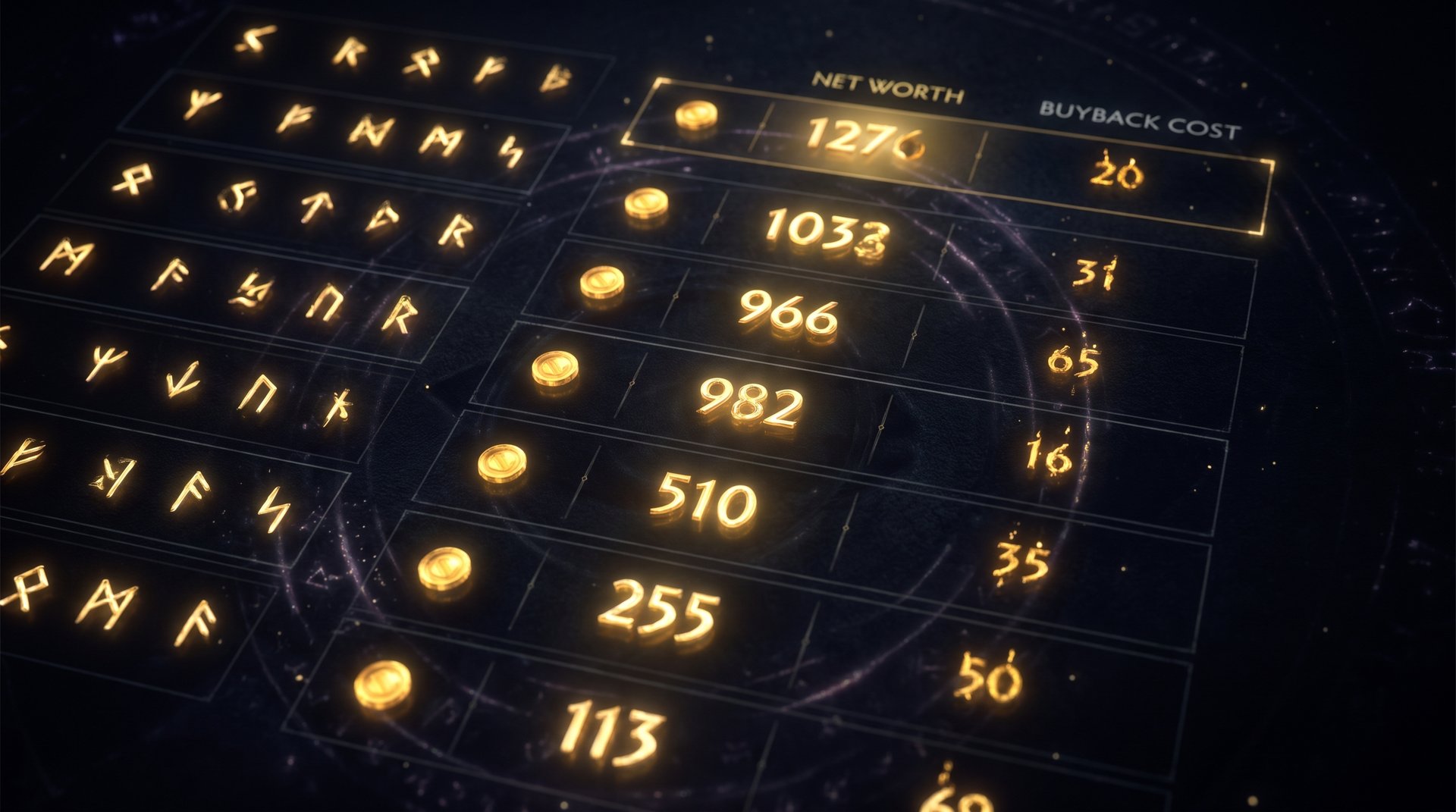
Buyback Cost Table by Net Worth Bracket (Patch 7.41f)
| Net Worth | Buyback Cost | Typical Game Time | Example Hero |
|---|---|---|---|
| 2,600 | 200 gold | 5-8 min | Support at lane start |
| 5,000 | 385 gold | 10-12 min | Support with boots + wards |
| 7,500 | 577 gold | 15-18 min | Carry before first big item |
| 10,000 | 769 gold | 18-22 min | Carry post-first major item |
| 12,500 | 961 gold | 22-26 min | Mid hero mid-game spike |
| 15,000 | 1,154 gold | 25-30 min | Core with two items |
| 17,500 | 1,346 gold | 28-33 min | Core building third item |
| 20,000 | 1,538 gold | 30-38 min | Pos 1 farming peak |
| 22,500 | 1,730 gold | 33-40 min | Mid-game peak many carries |
| 25,000 | 1,923 gold | 38-45 min | Core with 4+ items |
| 27,500 | 2,115 gold | 42-50 min | Late-game core |
| 30,000 | 2,308 gold | 45-55 min | High-net-worth carry |
| 35,000 | 2,692 gold | 55-65 min | Very late game pos 1 |
| 40,000 | 3,077 gold | 65+ min | Hyper-farmed core |
| 50,000 | 3,846 gold | 70+ min ultra-late | Snowballed carry |
Formula: cost = floor(net_worth / 13). Values are rounded down per game engine. Community-verified against Dota 2 in-game values.
A few things stand out in this table. At 5,000 net worth — a position that describes many supports in the early-to-mid game — a buyback costs less than 400 gold, or roughly two sets of sentries. At 30,000 net worth, a buyback costs more than a Hyperstone. The decision is very different at those two price points.
Also note the implication for item selling: if you sell a 4,000 gold item to reduce your net worth by 4,000, you save about 307 gold on the buyback (4,000 / 13). That is almost never a rational trade. Net worth buyback reduction only makes practical sense if you have an item you were planning to sell anyway.
Buyback Cooldown: 8 Minutes (480 Seconds)
After using buyback, the cooldown is exactly 8 minutes (480 seconds). The timer starts the instant you click Confirm on the buyback dialogue — not when you appear at the fountain, not when you die. It is a hard per-hero timer; your teammates can use their own buybacks on any cooldown independent of yours.
8-Minute Cooldown Table (reference)
| Time After Buyback | Cooldown Remaining | Status |
|---|---|---|
| 0 sec | 480 sec | Just used — not available |
| 60 sec (1 min) | 420 sec | Cooling down |
| 120 sec (2 min) | 360 sec | Cooling down |
| 240 sec (4 min) | 240 sec | Halfway through cooldown |
| 360 sec (6 min) | 120 sec | Almost ready |
| 480 sec (8 min) | 0 | Available again |
The 8-minute cooldown is intentionally long. It means that if you use buyback to defend a barracks siege in the mid-game, you will not have buyback available again for the next 8 minutes. Teams who are aware of an enemy’s buyback cooldown will time their next objective push to land before that cooldown expires.
The cooldown is displayed in the HUD at the bottom of your screen. It is also visible to your teammates on the scoreboard, which means tracking enemy buyback cooldowns from the scoreboard is a legitimate macro skill in higher-ranked play. Understanding when enemies have no buyback is one of the core skills our coaches focus on in Dota 2 coaching sessions.
Gold Penalty and Respawn Timer After a Buyback Death
Buying back and dying again is one of the most punishing things that can happen to a player in Dota 2. There are two distinct penalties:
Respawn Timer After Buyback Death
If you use buyback and then die before your original death timer would have expired, you receive the full death timer based on your current level — with no reduction. You do not get a shortened timer for having recently bought back. In practice this means:
- You buy back at minute 35 with a normal 50-second death timer remaining.
- You respawn, go to the fight, and die again 20 seconds later.
- Your new respawn timer is the FULL level-based timer (typically 55-60 seconds at that game time) — not a reduced version.
This is sometimes called a “double death” in the community and it is almost always catastrophic. Not only have you spent the buyback gold, you are now out for the full timer on a second death and the enemy team has 3-5 minutes to take objectives with no counter available from you.
Gold Penalty
When you die after buying back within the original respawn window, the enemy team collects the full gold bounty from your death. This is on top of the gold you already spent on the buyback itself. The net worth bounty is transferred to the enemy hero who scored the kill, including streak gold if applicable.
Respawn Timer by Level Reference
| Hero Level | Base Respawn Timer | With Bloodstone (approx.) |
|---|---|---|
| 1 | 14 sec | 8 sec |
| 5 | 22 sec | 16 sec |
| 10 | 32 sec | 25 sec |
| 15 | 47 sec | 39 sec |
| 20 | 57 sec | 48 sec |
| 25 | 65 sec | 54 sec |
| 30 (talent cap) | 70 sec | 58 sec |
Base respawn timers scale with level and game time. Bloodstone charges reduce the timer. Values are approximate community-sourced figures for 7.41f; exact values can be verified in the Dota 2 wiki.
The critical number is not the buyback cost itself — it is the combination of buyback cost + the full timer that follows a post-buyback death. When a 20,000 net worth core buys back (1,538 gold spent) and then dies immediately, they lose the buyback gold AND grant the enemy a bounty AND sit out for a full 57-second timer at level 20. That is an enormous swing.
When Buyback Is Denied
There are three states in which the buyback button is grayed out and unavailable:
1. Buyback Cooldown Active
As covered above: once you use buyback, you cannot use it again for 8 minutes. The most common “denied” situation in ranked play.
2. Aegis of the Immortal
See the Aegis section below for the full mechanics. The short version: if you die while you have an active Aegis charge, Aegis revives you automatically in place — you never enter the dead state that allows buyback. The button is not shown because the game considers you to have been revived, not dead.
3. Reaper’s Scythe (Necrophos Ultimate)
See the dedicated section below. Reaper’s Scythe contains an explicit “prevents buyback” clause for the death it causes.
Aegis of the Immortal: No Buyback Available
The Aegis of the Immortal is the first item Roshan drops. It grants a one-time revive effect: if the Aegis holder dies, they are instantly revived in place with full health and mana after a short re-animation timer. Critically, this revive consumes the Aegis charge and happens automatically — the player does not need to click anything.
Because the Aegis triggers an automatic in-place revive, the game does not register you as entering the normal dead state. The buyback button is not available during an Aegis revive. There is no way to “choose” buyback over Aegis; Aegis always fires first if it is active in your inventory when you die.
This interaction is important when Roshan is contested. If a team wins Roshan, picks up the Aegis on their carry, and then loses a team fight, the Aegis death does NOT deplete their buyback. They could theoretically fight again and still have full buyback available — a massive advantage. This is why teams who fail to contest Roshan often concede the objective rather than dying for nothing.
Understanding the Aegis — when to contest Roshan and when to push — is one of the late-game skills that separates higher MMR players from the bracket below them. If your team is struggling with macro decisions like this, our MMR boosting guide breaks down the decision-making framework that gets players out of stuck brackets.
Reaper’s Scythe: Buyback Explicitly Prevented
Reaper’s Scythe is the ultimate ability of Necrophos. When a hero is killed by Reaper’s Scythe, the game applies a special death modifier: the target cannot buy back for that specific death. This is written directly into the ability’s text and is not a side-effect.
This makes Necrophos uniquely powerful in the late game. In a standard team fight, a core who dies can immediately buy back and re-enter. A core killed by Reaper’s Scythe must sit out the full respawn timer with no option. In the late game, at high MMR, picking up a Reaper’s Scythe kill on the enemy carry in a high-ground fight is often immediately followed by a roshan kill or a barracks push — the team knows the carry cannot return.
Other abilities that modify death (like Shallow Grave from Dazzle, which prevents death while active) do not interact with buyback — if Shallow Grave times out and the hero dies normally, buyback is available as usual.
Buyback Quick Rules Checklist
| Situation | Buyback Available? | Notes |
|---|---|---|
| Normal death, cooldown not active | Yes | Standard case |
| Cooldown still ticking (within 8 min of last buyback) | No | Button grayed out |
| Death via Reaper’s Scythe | No | Explicit ability clause |
| Death while Aegis is active | No | Aegis revives you instead |
| Death during Aegis revive animation | Yes | Aegis already consumed |
| Death after buying back (within original window) | No (cooldown) | Full timer + gold penalty |
| First death this game (never used buyback) | Yes | First use is always available |
| Death in fountain | Yes (but pointless) | Already at base — no reason |
Buyback Mistakes and MMR: What Lower-Bracket Players Get Wrong
Buyback errors account for a significant number of ranked games lost in the Herald-to-Archon bracket, based on patterns our coaches see across sessions. The most common mistakes are not about the rules themselves — players generally understand “you can buy back” — but about the cost math and timing:
Mistake 1: Panic Buyback With No Map Pressure
Buying back when the enemy team is not on your side of the map accomplishes nothing except spending gold. If no objective is at immediate risk, dying means you sit out the respawn timer while still accumulating passive gold. Buying back in that situation costs you 1,000-2,000 gold and gains you one wave of push at best.
Mistake 2: Buying Back Without Checking the Cooldown
Players in lower brackets often do not realize their buyback is on cooldown until the moment they click the button. Good players habitually track their own buyback cooldown and factor it into how aggressively they play. If your buyback is on cooldown, you should be playing more conservatively — especially in the late game.
Mistake 3: Double Death
As covered in the gold penalty section: buying back and dying again immediately is almost always worse than simply not buying back. The total cost of a double death (buyback gold + full respawn timer + bounty) can cost your team 3,000-5,000 net worth in swing gold. This is one of the single most game-losing events in ranked Dota.
Mistake 4: Forgetting Net Worth Reduces Buyback Cost
Selling an item you do not need can reduce buyback cost, but the savings are rarely enough to justify the item loss. The math rarely works out. The only exception is selling a completed item you planned to rebuild (e.g. selling a partial component for temporary liquidity) and being about to buy back for a crucial fight.
If buyback mistakes are contributing to lost games in your bracket, a structured MMR gain can reset the environment while you work on the decision-making. TeamSmurf offers Dota 2 MMR boosting carried out by high-MMR players who understand exactly when and when not to use buyback — if you want to study from live replays of correct decisions rather than grinding out the learning curve solo, check out our coaching option where you play alongside a coach who explains every call.
FAQ — Buyback Rules
Stuck in a Bracket Where Buyback Mistakes Cost Games?
Knowing the rules is only the first step. Applying them correctly under pressure — recognizing when a buyback wins the game vs. when it wastes 2,000 gold — is a skill that takes hundreds of games to internalize. Our high-MMR players make these decisions correctly every game.
Browse our Dota 2 services and see which option fits your goal:
View MMR Boost Options Book a Coaching Session


