
How Behavior Score Affects Every Aspect of Your Dota 2 Experience

Your behavior score is the single most important number in your Dota 2 account — more important than your MMR, your medal, or your win rate. Bold claim? Let us explain.
Your MMR determines your rank. But your behavior score determines everything else: the quality of your teammates, the length of your queues, how likely you are to be punished, how much weight reports against you carry, and even your probability of winning. Two players at the exact same MMR can have completely different Dota 2 experiences based solely on their behavior scores — one gets coordinated teammates who communicate and try their best, while the other gets toxic flamers who give up at minute five.
This guide covers absolutely everything about the Dota 2 behavior score system. We’ll explain the exact mechanics of how it’s calculated, what raises and lowers it, the real impact at every score range, proven methods to recover from a low score, myths that mislead players, and why fixing your behavior score might be the single best thing you can do for your MMR.
Table of Contents
- What Is Behavior Score?
- How Behavior Score Is Calculated
- What Raises Your Behavior Score
- What Lowers Your Behavior Score
- The Experience at Every Score Range
- Impact on Matchmaking Quality
- Impact on Queue Times
- How Behavior Score Interacts with Reports
- The Low Priority Connection
- Behavior Score and MMR: The Hidden Link
- The Turbo Method for Quick Recovery
- Advanced Recovery Strategies
- Pro Players and Behavior Score
- Behavior Score Myths Debunked
- FAQ
1. What Is Behavior Score?
Behavior score is a numerical rating from 0 to 10,000 that represents how positively (or negatively) you interact with the Dota 2 community. It was introduced by Valve to improve matchmaking quality by grouping players with similar behavioral profiles together.
You can check your behavior score in your Dota 2 profile. It displays as a number alongside a colored indicator:
| Score Range | Indicator | Meaning |
|---|---|---|
| 9,000 — 10,000 | Green smiley | Excellent behavior |
| 6,000 — 8,999 | Yellow neutral | Normal behavior |
| 3,000 — 5,999 | Orange frown | Below average behavior |
| 0 — 2,999 | Red angry | Poor behavior |
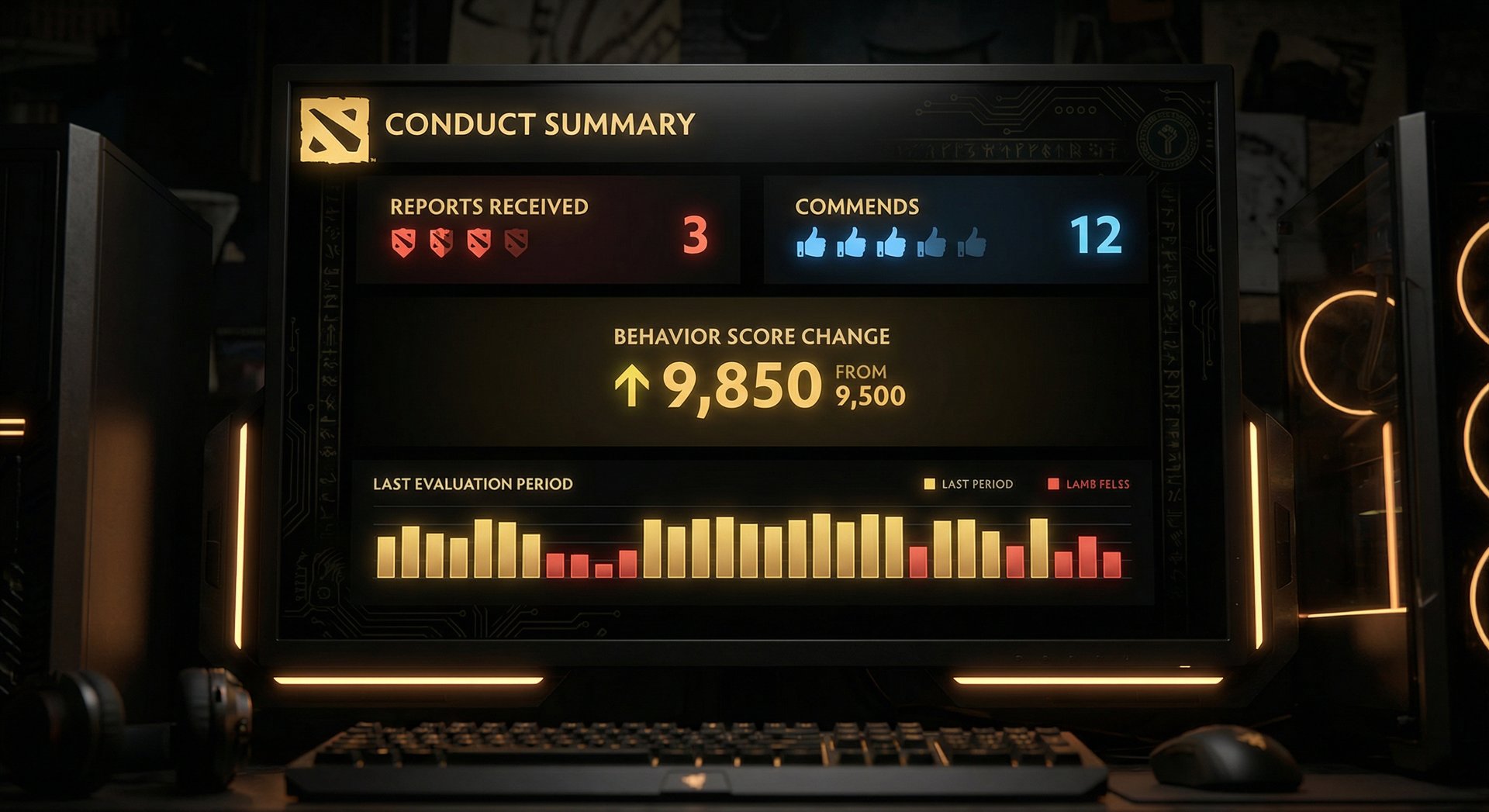
Your behavior score updates after a behavior score summary, which occurs approximately every 15 games (this number varies and isn’t fixed). The summary shows you how many reports you received, how many commends you got, and how many abandons you had during that evaluation period.
A Brief History
Behavior score wasn’t always visible to players. In Dota 2’s early years, it existed as a hidden variable that Valve used behind the scenes for matchmaking. The community discovered it through console commands (developer 1; dota_game_account_debug), and after years of community pressure, Valve eventually made it a visible, front-and-center feature of the player profile.
Key milestones:
- 2015: Hidden behavior score system implemented.
- 2017: Score made partially visible through conduct summaries.
- 2019: Full behavior score number displayed in player profiles. Scale changed from letter grades (A+, A, B, etc.) to the 0-10,000 numerical system.
- 2020-present: Continued refinements to how score interacts with matchmaking, reports, and penalties.
2. How Behavior Score Is Calculated
Valve has never published the exact formula for behavior score calculation. However, through extensive community testing, data mining, and our own analysis of thousands of accounts at Team Smurf, we can describe the system with high confidence.
The Core Formula (Approximate)
Behavior score changes are calculated during each evaluation period (~15 games) based on four primary factors:
| Factor | Effect on Score | Approximate Weight |
|---|---|---|
| Reports received | Decreases score | ~-200 to -400 per report |
| Commends received | Increases score | ~+10 to +25 per commend |
| Abandons | Decreases score heavily | ~-500 to -1,000 per abandon |
| Games played without incident | Slowly increases score | ~+10 to +30 per clean game |
Key observations:
- Reports are weighted FAR more heavily than commends. One report can undo 10-20 commends. This asymmetry means it’s much easier to lose behavior score than to gain it.
- Abandons are the single most damaging action. A single abandon can drop your score by 500-1,000 points — the equivalent of 20-50 reports’ worth of commends to recover.
- “Clean” games (no reports, no abandons) provide a small passive increase. This is why playing many games without incident is the most reliable way to raise your score.
- The rate of recovery slows at higher scores. Going from 3,000 to 6,000 is faster than going from 7,000 to 10,000. The system has diminishing returns near the cap.
The Evaluation Period
Your behavior score doesn’t update after every game. Instead, it updates in batches after approximately 10-15 games (community consensus suggests ~15, but it varies). During this evaluation period, all reports, commends, abandons, and clean games are tallied and a net change is applied to your score.
This means:
- You won’t see immediate feedback from a single bad or good game.
- A bad streak of games where you get reported multiple times can result in a sudden, large drop when the summary updates.
- Conversely, a long stretch of clean games will result in a satisfying jump when the summary processes.
3. What Raises Your Behavior Score
Raising your behavior score is a marathon, not a sprint. Here are all the factors that contribute to score increases, ranked by effectiveness.
Playing Games Without Getting Reported (Most Important)
The single most effective way to raise your behavior score is simply playing games where nobody reports you. Each clean game adds a small amount to your score. Over 15 clean games, you can expect a behavior score increase of approximately 200-500 points.
This sounds simple, but for players with low behavior scores, it’s challenging because their matchmaking pool is full of players who report liberally.
Receiving Commends
Commends from other players provide a small score boost. While each individual commend doesn’t add much (~10-25 points), they compound over time. Strategies to earn more commends:
- Play support well. Supports who ward, save teammates, and make space get commended far more than cores.
- Be positive in chat. A simple “wp” or “nice play” after a good teamfight earns goodwill.
- Commend others. Players who receive commends are more likely to commend back. Make it a habit to commend at least one player after every game.
- Don’t ask for commends. Ironically, asking for commends annoys people and can lead to reports instead.
Playing Turbo Games
Turbo games count toward your behavior score evaluation just like regular games, but they’re significantly shorter (15-25 minutes vs. 35-50 minutes). This makes Turbo the most time-efficient way to play clean games. We’ll cover the Turbo method in detail later in this guide.
Winning Games
While winning doesn’t directly increase your behavior score, it has an important indirect effect: winning teams report less. When you win, your teammates are happy. Happy teammates don’t report you. This is why improving your gameplay (and thus your win rate) helps maintain a high behavior score.
4. What Lowers Your Behavior Score
Understanding what tanks your behavior score is crucial for avoiding the downward spiral. Here are the factors, ranked from most to least damaging.
Abandoning Games (Most Damaging)
A single abandon can drop your behavior score by 500-1,000 points. This is by far the most damaging single action. Two abandons in a short period can devastate an otherwise healthy behavior score.
Remember: the system treats all abandons equally. It doesn’t matter if your internet died, your power went out, or your cat stepped on your power strip. An abandon is an abandon.
Receiving Reports
Each report you receive lowers your behavior score by approximately 200-400 points. The exact value depends on:
- Report type: Gameplay reports (feeding, griefing) may be weighted differently than communication reports.
- Reporter’s credibility: Reports from players who report rarely carry more weight than reports from players who report every game.
- Validity: Valve’s overwatch system can review reports for accuracy. Reports that are clearly unjustified may carry less weight.
Communication Abuse
Excessive use of voice or text chat in negative ways can result in reports and communication bans. While communication bans (mutes) are separate from behavior score, the reports that trigger them also lower your behavior score.
Playing Poorly (Indirect)
Playing badly doesn’t directly lower your behavior score. However, poor play leads to lost games, which leads to frustrated teammates, which leads to reports. This is particularly dangerous at low behavior scores where teammates report more readily.
5. The Experience at Every Score Range
The Dota 2 experience varies dramatically based on your behavior score. Here’s what to expect at each range, based on feedback from thousands of players across all brackets.
9,000 — 10,000: Paradise
- Teammate quality: Excellent. Most players communicate, try their best, and don’t give up.
- Toxicity level: Low. You’ll encounter the occasional tilted player, but outright griefing is rare.
- Queue times: Fastest possible for your MMR and region.
- Report tolerance: High. You can absorb occasional reports without significant score drops.
- LP probability: Very low. You’d need multiple abandons or a massive spike in reports to reach LP.
- Overall experience: This is how Dota 2 is meant to be played. Competitive, sometimes frustrating, but generally fair and enjoyable.
7,000 — 8,999: Normal
- Teammate quality: Good to average. Most games have cooperative teams, but you’ll see more tilt and flame.
- Toxicity level: Moderate. Expect flame in 1 out of every 3-4 games.
- Queue times: Normal. No noticeable increase.
- Report tolerance: Moderate. A few reports won’t hurt much, but sustained reporting will start dropping your score.
- LP probability: Low to moderate. An abandon plus some reports could trigger LP.
- Overall experience: Perfectly playable. This is where the majority of the player base sits.
5,000 — 6,999: The Warning Zone
- Teammate quality: Noticeably worse. More players give up early, flame, or refuse to cooperate.
- Toxicity level: High. At least one toxic player in most games.
- Queue times: Slightly longer, especially at off-peak hours.
- Report tolerance: Low. A bad day can push you toward LP.
- LP probability: Moderate. You’re one bad game session away from LP.
- Overall experience: Frustrating. Games feel coin-flippy, with outcomes often determined by which team has fewer griefers.
3,000 — 4,999: Purgatory
- Teammate quality: Poor. Intentional feeders, griefers, account buyers, and serial abandoners are common.
- Toxicity level: Extreme. Flame, slurs, and threats are constant.
- Queue times: Significantly longer (5-15 minutes at many MMRs).
- Report tolerance: Very low. Even a few reports can trigger LP.
- LP probability: High. Most players at this range visit LP regularly.
- Overall experience: Miserable. Games are decided before they start based on who has the most griefers. Many games have early abandons from one side. Climbing MMR is extremely difficult because game quality is so low.
0 — 2,999: Hell
- Teammate quality: Abysmal. Nearly every player is here for a reason — serial feeders, account sellers, or boosted accounts spiraling down.
- Toxicity level: Maximum. All-chat flame, ping spam, ability abuse, intentional feeding — every game.
- Queue times: Extremely long (10-30+ minutes). At very low scores (sub-1,000), you might not find games at all during off-peak hours.
- Report tolerance: None. You’re in and out of LP constantly.
- LP probability: Near 100%. You likely spend more time in LP than out of it.
- Overall experience: Unplayable by normal standards. This is the LP death spiral zone. Most players at this level either create new accounts or quit Dota 2 entirely.
The takeaway: Behavior score IS your Dota 2 experience. A 3,000 MMR player at 10,000 behavior score has better, more enjoyable games than a 6,000 MMR player at 3,000 behavior score. If you’re not having fun in Dota, check your behavior score before blaming anything else.
6. Impact on Matchmaking Quality
Valve’s matchmaking algorithm uses behavior score as a matchmaking parameter alongside MMR. This means the system tries to group players with similar behavior scores together.
How It Works
- Primary matchmaking factor: MMR (skill level)
- Secondary factor: Behavior score (behavioral profile)
- Tertiary factors: Party size, language preference, region, queue time
The matchmaker first tries to find players at your MMR range with similar behavior scores. If it can’t find enough players quickly, it relaxes the behavior score requirement — meaning longer queues result in more mixed behavior score lobbies.
The Practical Impact
At 10,000 behavior score, your teammates and opponents are almost all 9,000+. The games are competitive and fair.
At 5,000 behavior score, the matchmaker might group you with players ranging from 3,000 to 7,000. This creates chaotic, unpredictable games where one team might have a griefer and the other doesn’t.
At 2,000 behavior score, you’re in the smallest player pool. The matchmaker takes whoever is available, resulting in massive skill disparities alongside behavioral issues.
The “Smurf Detection” Connection
Valve’s smurf detection system also interacts with behavior score. Accounts flagged as potential smurfs are often placed in a separate matchmaking pool. If your behavior score is low AND you’re flagged as a smurf (new account with high performance), you’ll face the harshest matchmaking conditions possible.
7. Impact on Queue Times
Behavior score has a direct, measurable impact on how long you wait for games.
| Behavior Score | Typical Queue Time (Popular Region) | Typical Queue Time (Low Pop Region) |
|---|---|---|
| 9,000 — 10,000 | 1-4 minutes | 3-8 minutes |
| 7,000 — 8,999 | 2-5 minutes | 5-12 minutes |
| 5,000 — 6,999 | 4-8 minutes | 8-20 minutes |
| 3,000 — 4,999 | 6-15 minutes | 15-30+ minutes |
| 0 — 2,999 | 10-30+ minutes | 30+ minutes (may not find games) |
At the extremes, low behavior score players might spend more time in queue than actually playing Dota. This adds insult to injury — not only are your games worse, but you wait longer for them.
8. How Behavior Score Interacts with Reports
The report system and behavior score form a feedback loop that can be either virtuous or vicious.
Report Weight Varies by Behavior Score
Not all reports are equal. The system considers:
- The reporter’s behavior score: Reports from high-behavior-score players carry more weight. The system assumes that a 10,000 BS player who rarely reports is more credible than a 3,000 BS player who reports every game.
- The reporter’s report frequency: Players who report constantly have their reports devalued. If you report every game, your reports eventually carry almost no weight.
- The reported player’s behavior score: Reports against low-BS players may be weighted differently than reports against high-BS players, though the exact mechanics are debated.
The Overwatch System
Valve introduced the Overwatch system to add human review to the report process. When a player is reported, the game can be flagged for review by other players (acting as “jurors”). These jurors watch the replay and determine whether the reported behavior actually occurred.
- Guilty verdicts result in stronger penalties (more behavior score loss, LP, or bans).
- Not guilty verdicts may reduce the penalty or nullify the report.
- Not all reports go to Overwatch — the system selects cases based on severity and reporting patterns.
Report Limits
Players receive a limited number of reports per week (approximately 3-5, replenished weekly). Additionally, reports that result in action (the reported player receives a penalty) return the report to the reporter, incentivizing accurate reporting.
9. The Low Priority Connection
We covered this extensively in our Low Priority removal guide, but here’s a summary of how behavior score connects to LP:
- Lower behavior score = lower LP threshold. High-BS players can absorb more infractions before triggering LP.
- LP further damages behavior score. The toxic LP environment leads to more reports, creating a downward spiral.
- Escaping LP doesn’t fix your behavior score. You exit LP with a lower score than you entered, making re-entry more likely.
- Breaking the cycle requires active score recovery (covered in the recovery sections below).
If you’re currently in LP, check our dedicated guide: Stuck in Dota 2 Low Priority? The Complete Guide to Getting Out Fast. For professional help, Team Smurf offers both LP removal and behavior score recovery services.
10. Behavior Score and MMR: The Hidden Link
Here’s something many players don’t realize: your behavior score directly affects your ability to climb MMR. Not because the system awards more or less MMR based on behavior, but because of the matchmaking quality difference.
The Math
Consider two players, both 3,500 MMR:
Player A (10,000 behavior score):
- Gets cooperative teammates 80% of games
- Encounters griefers/feeders maybe 5% of games
- Games are competitive — outcome depends on skill
- Effective win rate if truly 3,500 skill: ~52%
- Climbs steadily with consistent play
Player B (4,000 behavior score):
- Gets cooperative teammates 40% of games
- Encounters griefers/feeders 25% of games
- Many games are decided by who has more griefers, not skill
- Effective win rate if truly 3,500 skill: ~48-50%
- Stagnates or drops despite being skilled enough to climb
The conclusion: If you feel like you’re stuck in “MMR hell,” your behavior score might literally be the reason. Fixing your behavior score improves your matchmaking quality, which improves your win rate, which lets you climb. It’s not a theory — it’s math.
The Fastest Way to Gain MMR Might Be Fixing Your Behavior Score
If your behavior score is below 8,000, you might gain more effective MMR per hour by playing Turbo games to raise your behavior score than by grinding ranked. Once your score is 9,000+, your ranked games become more winnable, and your MMR climbs naturally.
This is counterintuitive — most players think the way to gain MMR is to play more ranked. But if your behavior score is tanking your game quality, playing ranked is actively making things worse (more losses → more tilt → more reports → lower score → worse games → more losses).
For players who want to combine behavior score recovery with MMR gains, Team Smurf’s MMR boosting service can handle both simultaneously.
11. The Turbo Method for Quick Recovery
This is the most popular and proven method for rapidly recovering behavior score. Here’s the complete playbook.
Why Turbo Works
- Games are shorter — 15-25 minutes vs. 35-50 minutes for regular games. This means you can play more games per hour.
- Turbo games count toward behavior score updates — they have the same weight as regular games in the evaluation period.
- Players are less competitive/toxic — Turbo is seen as a casual mode, so players report less frequently.
- Lower stakes = less tilt — Since nothing “matters” in Turbo (no ranked MMR), players are more relaxed.
The Turbo Recovery Protocol
Follow this exact protocol for maximum behavior score recovery:
- Queue Turbo exclusively. No ranked, no unranked All Pick. Only Turbo until your behavior score is where you want it.
- Pick simple, non-controversial heroes. Heroes like Crystal Maiden, Ogre Magi, Lion, or Jakiro. Avoid heroes that attract reports (Techies, Nature’s Prophet, Pudge).
- Play support every game. Support players get commended more and reported less. Yes, even in Turbo.
- Buy wards and support items. This signals to your team that you’re trying. Visible effort = fewer reports.
- Mute all at game start. Don’t engage with chat. Just play.
- Commend 1-2 players after every game. This encourages reciprocal commends.
- Don’t abandon under any circumstances. Even if the game is 0-20 at 10 minutes, play it out. Abandoning resets your progress catastrophically.
- Play 3-5 Turbo games per session. Don’t marathon 15 games — fatigue leads to tilt leads to reports.
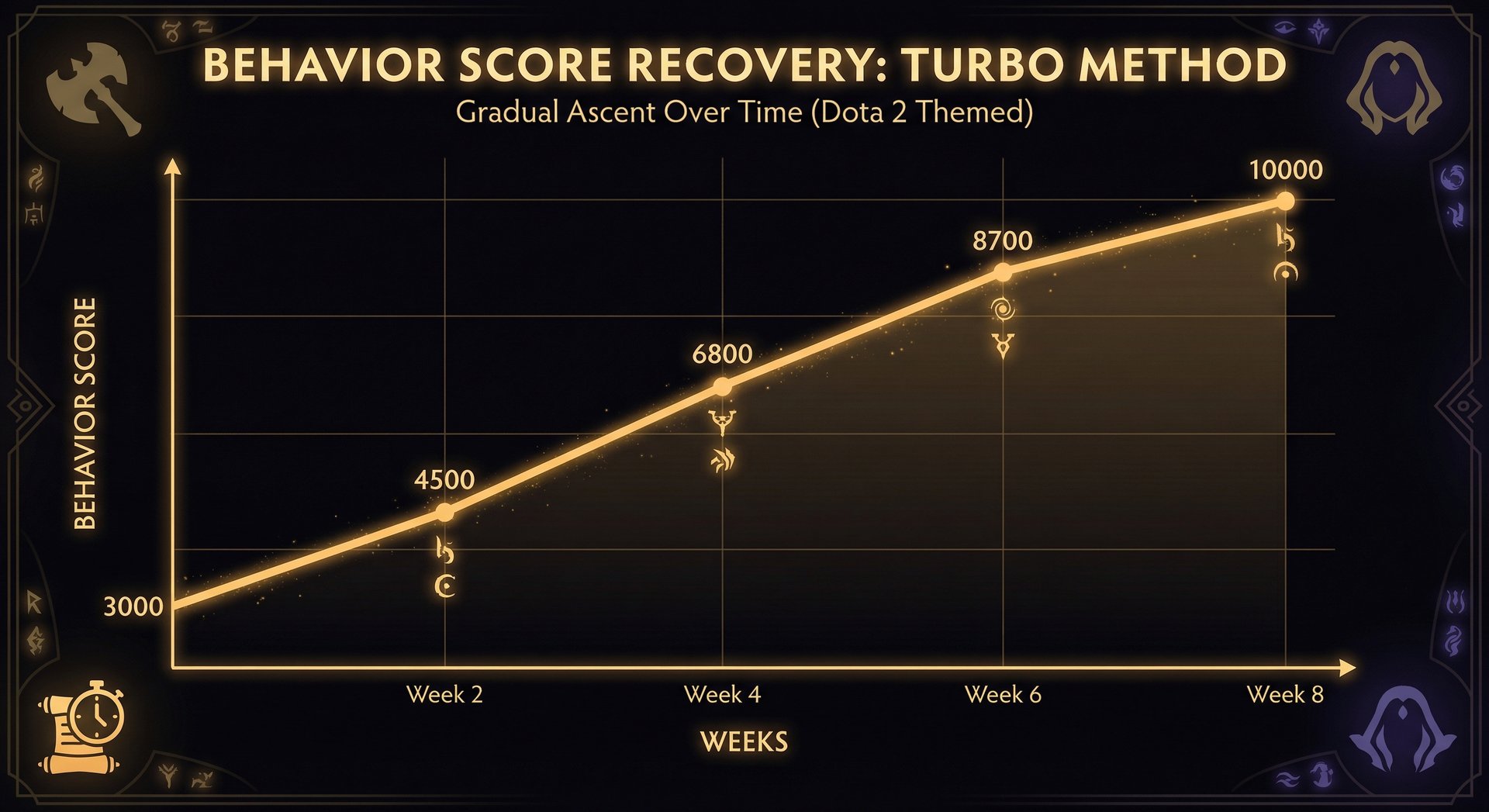
Expected Recovery Timeline
| Starting Score | Target Score | Games Required (approx.) | Time at 4 games/day |
|---|---|---|---|
| 8,000 | 10,000 | 30-50 games | 1-2 weeks |
| 6,000 | 10,000 | 60-100 games | 2-4 weeks |
| 4,000 | 10,000 | 100-150 games | 4-6 weeks |
| 2,000 | 10,000 | 150-250+ games | 6-10 weeks |
| 0-1,000 | 10,000 | 250-400+ games | 8-14+ weeks |
As you can see, recovery from very low behavior scores takes a significant time investment. At sub-2,000 scores, many players find it more practical to either create a new account or use a professional service for accelerated recovery.
12. Advanced Recovery Strategies
Beyond the Turbo method, here are additional strategies for recovering behavior score faster.
The “Model Citizen” Approach
For your next 50 games, become the most positive player in every match:
- Use voice chat positively. Make callouts, compliment good plays, suggest (don’t demand) strategies.
- Never blame teammates. Even if they’re clearly at fault. Blame leads to flame leads to reports.
- Tip players after good plays. Tipping costs you nothing and creates goodwill.
- Pick what the team needs. If your team has 4 cores, pick support without complaining. Being the “bigger person” prevents the all-core flame war that gets everyone reported.
- GL HF at the start, GG WP at the end. Every game. Even losses. These small gestures are noticed.
Optimal Times to Play
Queue during times when the player pool is largest and most relaxed:
- Weekday evenings (6-10 PM) — large player pool, most people are relaxed after work/school.
- Weekend afternoons — casual crowd is online, fewer tryhards = less toxicity.
- Avoid late night (midnight-4 AM) — smaller pool, more drunk/tilted players, worse match quality.
- Avoid ranked reset days — everyone is on edge during calibration periods.
The “Abandon Insurance” Setup
Since abandons are the most damaging behavior score action, invest in preventing them:
- Wired internet connection (not WiFi).
- UPS (Uninterruptible Power Supply) for your PC — protects against power outages.
- Mobile hotspot ready as backup internet.
- Close all unnecessary programs before playing — prevents crashes.
- Verify Dota 2 game files periodically in Steam to prevent corrupted file crashes.
When DIY Isn’t Enough
If your behavior score is below 3,000, DIY recovery becomes extremely difficult because:
- Your matches are so toxic that you’ll receive reports even when playing well.
- The emotional toll makes it hard to maintain the “model citizen” approach.
- Queue times are so long that each game represents a major time investment.
- The spiral effect means you might lose score as fast as you gain it.
In these situations, a professional coaching service can help identify what’s causing your reports and provide actionable behavioral changes. Alternatively, Team Smurf offers behavior score recovery services where professional players with clean playstyles raise your score efficiently.
13. Pro Players and Behavior Score
Professional Dota 2 players provide interesting case studies for behavior score dynamics.
High Behavior Score Pros
Many professional players maintain 10,000 behavior scores despite playing at the highest, most competitive level. Players like Puppey, KuroKy, and Cr1t- are known for maintaining positive behavior in pubs. Their approach proves that you can be intensely competitive without being toxic.
Notorious Low Behavior Score Pros
Some pros are infamous for low behavior scores and frequent LP visits. Without naming names, certain top-tier players have been open about their struggles with the system. Common patterns include:
- Extremely competitive mindset that leads to frustration with “lesser” teammates.
- High stream viewership that encourages dramatic, reportable behavior.
- Playing on multiple accounts, some with artificially low behavior scores.
Even at the highest skill level, low behavior score creates the same problems: longer queues, worse teammates, and more frustrating games. Skill doesn’t immunize you from the system.
What Pros Do to Maintain High Scores
Professional players who maintain 10,000 behavior score share common habits:
- They mute liberally. At the first sign of toxicity, they mute the offending player.
- They never type in anger. If they’re frustrated, they express it off-mic, not in chat.
- They focus on their own play. Instead of blaming teammates, they look for ways they could have played better.
- They treat pubs as practice. Every game is an opportunity to improve, not a referendum on their teammates’ abilities.
For more on the pro player mindset, check out Liquipedia’s Dota 2 portal for player profiles and competitive insights.
14. Behavior Score Myths Debunked
Myth: “Commend trading raises your behavior score fast”
Partially true but overrated. While commends do raise your score, each commend adds only ~10-25 points. Even if you could somehow get 10 commends per game through trading, that’s only 100-250 extra points per game. Compare that to a single report costing you 200-400 points. The math shows that avoiding reports matters far more than collecting commends.
Myth: “Behavior score doesn’t affect matchmaking above 8,000”
False. While the difference between 8,000 and 10,000 is less dramatic than between 3,000 and 6,000, players consistently report better match quality at 10,000 versus 8,000. The matchmaker uses the exact number, not ranges.
Myth: “You can raise behavior score by staying silent/muted”
Partially true. If you have a communication ban (mute), you can still gain behavior score by playing clean games. The mute itself doesn’t prevent score recovery. However, being muted means you can’t communicate with your team, which can lead to gameplay misunderstandings and indirect reports.
Myth: “Buying items for teammates raises behavior score”
False. In-game actions like buying wards, tipping, or sharing items have no direct effect on behavior score. They only matter indirectly (teammates who see you warding are less likely to report you).
Myth: “Behavior score resets with new seasons”
False. Your behavior score persists across all Dota 2 patches, updates, and seasonal resets. The only thing that resets with new seasons is your ranked calibration — behavior score carries over permanently.
Myth: “Playing in a party protects your behavior score”
Partially true. Party members generally don’t report each other (though they can). Playing with friends means fewer potential reporters. However, the enemy team can still report you, and party queue games still count toward your behavior evaluation.
Myth: “Low behavior score means you’re matched with smurfs”
Partially true. Valve’s smurf detection can place detected smurfs in lower behavior score pools. So while it’s not a direct rule, low behavior score matchmaking does tend to include more smurfs and account buyers than high behavior score matchmaking.
Final Thoughts: Your Behavior Score Is Your Dota 2 Quality of Life
We’ve covered every aspect of the behavior score system — how it works, what affects it, and how to fix it. The core message is simple: behavior score is the single biggest determinant of your Dota 2 experience quality.
If you’re enjoying Dota and climbing steadily, your behavior score is probably fine. Keep doing what you’re doing.
If Dota feels miserable — toxic teammates, long queues, constant LP, games decided by griefers — your behavior score is likely the root cause. The good news is that it’s fixable. The Turbo method works. Playing clean games works. Being positive works. It just takes time and consistency.
For players who want faster results, or who are trapped in the sub-3,000 death spiral, professional help is available. Team Smurf offers behavior score recovery services that can restore your score efficiently, giving you a clean slate to maintain through better habits.
And once your behavior score is healthy, you might be surprised at how much easier it becomes to climb MMR. Better teammates, shorter queues, more competitive games — it all compounds. Fix your behavior, and the rest follows.
Good luck, and keep that score green.
Frequently Asked Questions
Fix Your Behavior Score, Fix Your Dota Experience
Team Smurf offers behavior score recovery and LP removal services to get you back to quality games fast.
Written by Team Smurf’s Immortal-rank analysts — Last verified February 2026



