


Best Tank Heroes in Dota 2 (2026): Frontliners Who Don’t Die

Not every hero needs to deal the most damage. Some heroes win team fights simply by refusing to die. This list covers the 10 tankiest heroes in Dota 2 ranked purely by raw durability — passive sustain, damage reduction, HP scaling, and the ability to soak punishment so your carry can clean up behind you.
This is not a list of the best initiators or disablers. If you want heroes who charge in, drop an ultimate, and walk away with full HP while your opponents burn their cooldowns, you are in the right place. We break down exactly what makes each hero hard to kill, which bracket they shine in, and when you should pick them.
What We Cover
What Actually Makes a Hero Tanky in Dota 2?
Durability in Dota 2 comes from four distinct sources, and the best tanks combine at least two of them. Understanding this distinction helps you pick the right frontliner for the matchup rather than just grabbing the hero with the highest base HP.
High base HP and STR growth is the most obvious source. Strength heroes add 20 HP per point of STR, so heroes like Centaur Warrunner (4.4 STR/level) and Dragon Knight (3.7 STR/level) scale into enormous HP pools naturally without needing HP items early. You can invest your gold into damage or utility while still being hard to burst.
Passive damage reduction is the rarest and most powerful form of tankiness. Bristleback’s Bristleback passive and Tidehunter’s Kraken Shell do not care about the enemy’s items, armor reduction, or ability pierce. A flat 40% reduction from behind (Bristleback) or 17 points of flat damage block per hit (Tidehunter at max level) remains effective even against right-click carries who have built damage items, because it reduces every single hit regardless of how much damage the attack deals.
Passive sustain — regeneration and lifesteal — turns the fight into a war of attrition that long-duration battles favor. Dragon Knight regenerates 14 HP per second from Dragon Blood alone, before any regen items. Over a 10-second fight that is 140 HP recovered, the equivalent of a full Salve used mid-fight. Heroes with consistent HP recovery force enemies to burst them faster or concede that attrition will eventually win.
Spell immunity or damage immunity windows separate heroes who tank physical damage from heroes who tank everything. Wraith King’s Reincarnation is an entire second life. Doom’s Scorched Earth gives him regen plus movement speed — and his Doom ability, while offensive, occupies one enemy so that hero stops contributing to killing Doom himself.
The heroes below are ranked by how reliably they combine these properties at different stages of the game. To understand how to itemize around these tanks, see our guide to the best defensive items by role in 2026.
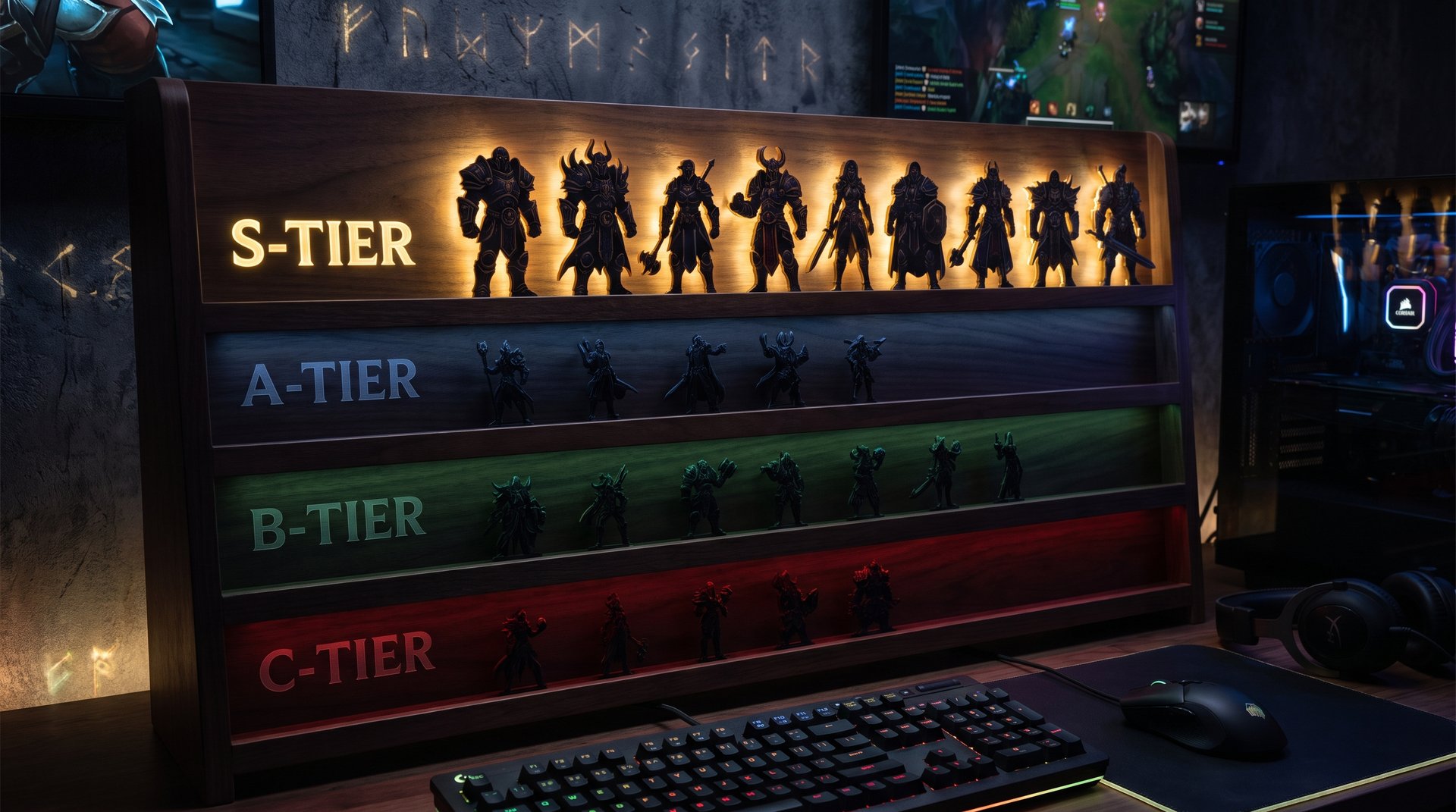
Tank Hero Tier List: Quick Reference
| Tier | Hero | Primary Tank Mechanic | Best Bracket | Role |
|---|---|---|---|---|
| S | Bristleback | 40% rear damage reduction (passive) | All ranks | Offlane / Roam |
| S | Tidehunter | 17 flat damage block per hit (passive) | All ranks | Offlane / Support |
| S | Dragon Knight | 5.4 armor + 14 HP/s regen (passive) | All ranks | Offlane / Mid |
| S | Wraith King | Full reincarnation on death | Herald — Archon | Carry / Offlane |
| A | Pudge | Permanent STR stacking (Flesh Heap) | Herald — Crusader | Roam / Offlane |
| A | Underlord | 30% enemy attack damage reduction (aura) | Archon — Legend | Offlane |
| A | Mars | 45% rear + 30% side damage reduction (passive) | Legend — Immortal | Offlane |
| A | Centaur Warrunner | Massive base STR + Return passive | Archon — Immortal | Offlane |
| B | Axe | Counter Helix + Blade Mail reflect | Archon — Divine | Offlane / Jungle |
| B | Doom | Scorched Earth regen + high STR growth | Legend — Immortal | Offlane |
S-Tier: The Frontliners Who Simply Refuse to Fall
These four heroes are the gold standard for durability in the current patch. Each one has a passive or near-passive survivability mechanic that works whether or not the player makes good decisions — which is why they perform across all skill brackets.
Bristleback — Turn Around and Win
Bristleback is the most mechanically forgiving tank in Dota 2. His passive ability, also called Bristleback, reduces damage he receives from the sides by 24% and from behind by 40% at max level. This is not an active toggle, it does not have a cooldown, and it cannot be dispelled. Every enemy attack and every targeted spell that hits Bristleback from the rear deals 40% less damage. Period.
The loop that makes him unkillable in extended fights works like this: each time Bristleback takes 250 damage from behind or 375 damage from the sides, he releases a Quill Spray. Quill Spray deals area-of-effect magic damage and, more importantly, each stack of Quill Spray on an enemy increases the damage of future sprays. Enemies who attack him from behind are simultaneously spreading stacks and triggering Warpath, which gives Bristleback bonus movement speed and damage per spell cast. The longer the fight goes, the harder he hits, and the more damage he shrugs off.
Why he is ranked S: The 40% rear damage reduction requires no items to function and scales with nothing enemies can buy. A carry who has built Desolator still deals 40% less on rear hits. Bristleback also naturally builds Hood of Defiance and Pipe of Insight, which cover his one weakness — magic damage — leaving him nearly invulnerable to both damage types simultaneously.
Best for: All ranks from Herald to Immortal. Lower-bracket players benefit from the forgiving passive; higher-bracket players add item efficiency and positioning knowledge on top.
Tidehunter — The Damage-Block Passive That Never Stops
Tidehunter is one of only a handful of heroes with a flat damage-block passive. Kraken Shell blocks 17 damage per hit at max level. Unlike armor, which reduces damage by a percentage, flat damage block matters most against right-click carries who attack frequently. A carry landing 40 attacks during a 45-second siege deals 680 less damage to Tidehunter than to any other hero on the team — before armor calculations even apply.
Kraken Shell also has a second function: when Tidehunter accumulates 600 incoming damage, all negative status effects are removed from him. In fights where enemies try to chain-stun him, the passive resets his status immunity window, letting him continue to position for Ravage. This makes him extremely difficult to control once the fight extends past the first few seconds.
Tidehunter’s base stats compound this. He has 625 base HP and 6.0 base armor at level 1, with 3.3 STR gain per level. By level 16 without items, he sits at roughly 2,400 HP. Combined with Kraken Shell and natural armor from items like Crimson Guard or Shiva’s Guard, he is a consistent frontliner throughout all three stages of the game.
Why he is ranked S: Flat damage block is the hardest form of tankiness to itemize against. Enemies cannot “counter” Kraken Shell with any item in the game — the only answer is burst damage, and Tidehunter’s HP pool is large enough to survive most burst windows if he built correctly.
Best for: All ranks. He is especially dominant at Legend and below, where burst combos are less coordinated and extended fights are more common.
Dragon Knight — The Regen Machine That Armors Up Mid-Fight
Dragon Knight has the highest natural regeneration of any hero in this tier list, and it comes from a passive that costs nothing. Dragon Blood at max level gives him 5.4 armor and 14 HP regeneration per second. Over a 12-second team fight that is 168 HP recovered passively — before any regen items, lifesteal, or healing from supports. He also gains a massive STR bonus (56 points) from his Elder Dragon Form buff, adding another 1,120 HP when transformed.
What distinguishes Dragon Knight from other STR tanks is the compound nature of his survivability. His armor from Dragon Blood plus base armor stacks to make physical attacks inefficient against him. His passive HP regeneration means he is always recovering HP between fights, so he arrives at the next engagement healthier than most heroes. And when he activates Elder Dragon Form, both his survivability and his threat level increase simultaneously — enemies cannot simply ignore him or he will control the team fight with Corrosive Breath’s armor reduction.
Dragon Knight is also one of the cleanest Blade Mail + Black King Bar users in the game. BKB gives him spell immunity during his transform, and Blade Mail combined with his high HP turns him into a lethal target to attack. If you are learning to play tanky front-line heroes to climb MMR, Dragon Knight is the most reliable starting point because his toolkit is straightforward and his passive does most of the work.
Why he is ranked S: Passive armor, passive regen, high STR growth, and a strong BKB-synergy transformation make him independently durable across every stage of the game.
Best for: All ranks. Particularly effective at Herald through Legend where enemies do not consistently punish his lack of mobility.
Wraith King — One Extra Life Per Fight
No other hero in Dota 2 survives a team fight the way Wraith King does. Reincarnation gives him a second life with full HP and mana, stunning nearby enemies for 3 seconds when he reincarnates. At level 6 the cooldown is 27 seconds. With the Aghanim’s Scepter upgrade it drops to 14 seconds — meaning in a prolonged 30-second fight, he can die and come back twice.
Reincarnation is not passive survivability in the same way Bristleback’s passive is, but the net effect on durability is the same or greater: Wraith King effectively has double the HP of any other hero his size. Enemies must deal his full HP twice to actually kill him. Combined with Vampiric Aura, which provides 24% lifesteal to himself and nearby creeps at max level, Wraith King also regenerates meaningfully during the fight in between his two life pools.
He pairs naturally with Skeleton King skeletons from Mortal Strike crits and the Wraith King talent tree, which forces enemies to manage additional skeleton units while trying to focus him down. In lower brackets especially, the combination of “he has two lives” and “there are suddenly four skeletons attacking you” creates chaos that is difficult to deal with. To understand more about how ranks affect which tanks dominate, check out our guide to Dota 2 services and ranking up.
Why he is ranked S: A full extra life is the single most powerful survivability mechanic in the game. No item build, no itemization counter, and no ability in Dota 2 cancels a Reincarnation that has not been prevented by a specific ability like Axe’s Culling Blade.
Best for: Herald through Archon. At Legend and above, enemies start coordinating Culling Blade and abilities that prevent Reincarnation (Doom, Primal Roar, etc.).
A-Tier: Heroes Built to Absorb Sustained Punishment
The A-tier heroes are not quite as passively unkillable as the S-tier, but they have scaling mechanisms or conditional survivability that makes them extremely hard to kill in the right context. Each one requires a bit more thought than the S-tier heroes, but rewards correct play with standout durability.
Pudge — The HP Pool That Never Stops Growing
Pudge’s Flesh Heap passive is unique in Dota 2: every time an enemy hero dies within 1,400 units of Pudge, or every time Pudge kills a unit himself, he permanently gains 1.0 STR. Since STR gives 20 HP per point, a Pudge who has stacked 100 Flesh Heap charges has an additional 2,000 HP on top of his already-high base HP. In a 35-minute game at lower brackets where fights are frequent and heroes die near Pudge often, it is realistic to stack 70-100 charges.
Flesh Heap also gives Pudge 4% magic resistance at max level for each stack. At 80 stacks that is 320% additional magic resistance reduction — capped, but even 50 stacks provides significant magic damage reduction on top of his natural Hood of Defiance builds.
Pudge is ranked A-tier rather than S because his durability is heavily game-state dependent. A Pudge who is behind in kills or who has not been present for fights may have fewer than 30 stacks, meaning his HP advantage is much smaller. He is also a melee hero with no reliable gap-close passive, so he can be kited easily in coordinated games. His peak durability at Herald through Crusader is S-tier level, which is why he appears high on this list despite the bracket caveat.
Best for: Herald through Crusader. The longer and messier the game, the more Flesh Heap stacks he accumulates, and the more impenetrable his HP pool becomes.
Underlord — The Aura That Shrinks the Entire Enemy Team
Underlord’s Atrophy Aura is one of the most underappreciated tank mechanics in Dota 2. At max level, nearby enemy heroes lose 30% of their base attack damage. This is not a debuff that can be dispelled or purged — it is a constant aura reduction that applies to every enemy hero within 900 units at all times. In a standard team fight where all 5 enemies are clustered, every single opponent is dealing 30% less physical damage to Underlord and every ally near him.
Combined with Underlord’s naturally massive HP pool (he has among the highest base HP in the game at 700 and 3.5 STR per level), the Atrophy Aura means enemies need to use burst magic damage to kill him efficiently. That is why Underlord naturally builds Pipe of Insight and Eternal Shroud to cover his magic damage weakness — once both armor and magic damage are partially mitigated, he becomes genuinely difficult to kill from either direction.
Underlord’s Dark Rift also serves as an emergency escape that competitors in the tank role cannot match. If Underlord is about to die in a side lane, he can teleport himself and nearby allies to safety. It is a 3-second channel with no cooldown sharing with other teleport methods. For a hero who is designed to absorb punishment, having an emergency exit when the punishment exceeds his capacity is a meaningful survivability backstop.
Best for: Archon through Legend. He requires some awareness of when to use Dark Rift and how to position the Atrophy Aura effectively, which limits his impact at very low brackets.
Mars — The Hero Who Gets Tougher as You Attack His Flanks
Mars has one of the best conditional damage-reduction passives in the game. Bulwark reduces physical damage received from his sides by 30% and from behind by 45%. Unlike Bristleback, where the reduction is fixed from any angle at the rear, Mars’s Bulwark is strongest when he faces the enemy team and absorbs attacks from multiple flanks simultaneously — the exact positioning he wants in a front-line role.
In a 5v5 fight where two enemies are attacking Mars from his left side and two from his right, each of those four enemies is dealing 30% less physical damage. Only the one attacking from directly in front deals full damage. Combined with Mars’s high base armor (he starts at 4.67 base armor at level 1 and builds Blade Mail or Crimson Guard early), physical damage becomes largely irrelevant by the mid-game.
Arena of Blood, Mars’s ultimate, adds a further survivability layer: enemy physical projectiles cannot pass through the ring wall. This effectively means melee enemies inside the ring deal reduced damage from Bulwark positioning, while ranged enemies outside cannot auto-attack through the ring at all. For the 4.5 seconds the arena is active, Mars is effectively immune to a significant portion of incoming physical damage.
Best for: Legend through Immortal. Bulwark requires correct positioning to maximize — standing at the wrong angle nullifies much of its value. At Immortal level, Mars is one of the strongest frontliners in the game when played correctly.
Centaur Warrunner — Pure Strength Made Physical
Centaur Warrunner has among the highest base STR gain in Dota 2 at 4.4 per level. By level 16 without items he has roughly 2,600 HP — comparable to a Tidehunter with a Heart of Tarrasque. He reaches this HP pool organically through leveling, which means his item budget is freed up for utility, aura items, and survivability stacking on top.
Return, his passive, reflects 80 damage back at melee attackers at max level plus a 1.2-second stun. Every time a melee carry right-clicks Centaur, they take 80 magic damage and briefly stop attacking. In fights where right-click carries are the primary threat, Return makes Centaur increasingly dangerous to attack and naturally deters sustained focus. This is the tank ideal: costing enemies resources to kill you, not just absorbing the damage silently.
Stampede, Centaur’s ultimate, provides a team-wide movement speed boost and a passive stun on unit collision that Centaur himself benefits from by running through enemies. It is also an escape that lets him reposition when low on HP, similar to Underlord’s Dark Rift but shorter-range and less telegraphed. Centaur pairs especially well with MMR-accelerating strategies based on maximizing fighting and snowballing from Double Edge + Return interactions.
Best for: Archon through Immortal. His Blink Dagger + Berserker’s Call (or Blink + Double Edge) initiation pattern requires game sense that develops above Crusader.
B-Tier: Situationally Unkillable With the Right Setup
The B-tier heroes are not globally tanky in the way S-tier heroes are — their durability is conditional. Axe is nearly immortal if the enemy team builds only right-click damage but folds to burst magic. Doom has enormous HP and regen but his tankiness comes from occupying one enemy, not from universal damage reduction. Both are powerful picks in the right matchup; they simply require more specific conditions to deliver S-tier-level survivability.
Axe — The Hero That Punishes Attackers
Axe does not have passive damage reduction the way Bristleback and Tidehunter do. What he has is a set of mechanics that make him expensive to kill. Counter Helix procs on a random chance (17% at max level) every time Axe takes a physical hit, dealing 165 AoE magic damage to all nearby enemies. Each time a right-click carry attacks Axe, there is roughly a 1-in-6 chance they trigger a 165-damage nuke on themselves and every nearby enemy. A carry landing 20 attacks per second triggers Counter Helix roughly 3.4 times per second, dealing 561 AoE magic damage per second passively.
Berserker’s Call forces nearby enemies to attack only Axe for 3.5 seconds at max level and gives him 40 bonus armor during that window. 40 bonus armor translates to roughly 74% physical damage reduction. Axe during a max-level Berserker’s Call with base armor items is absorbing roughly 80-85% of incoming physical damage while Counter Helix detonates repeatedly around him. This is the closest Axe gets to passive invincibility — and it is extremely powerful in the right fight.
He is B-tier because outside of his Berserker’s Call window, he has no passive survivability. He relies on being in melee range, his Call has a 14-second cooldown at max level (before talents), and magic burst from multiple sources can kill him without giving Counter Helix a meaningful impact. Against a team with heavy magic burst, Axe is not a reliable tank — he is a brawler who forces specific interactions. BKB solves the magic problem but delays his tank item purchases.
Best for: Archon through Divine. He requires Blink Dagger timing and Berserker’s Call placement knowledge, which limits him at Herald level.
Doom — Durable in Long Games, Dependent on Doom Landing
Doom Bringer has 3.7 STR growth per level and a base HP of 638, which puts him in Dragon Knight territory for raw HP. Scorched Earth at max level grants 28 HP regeneration per second for 16 seconds — the equivalent of regenerating 448 HP during a sustained team fight, which is more than any item can provide during a fight of that length.
What makes Doom’s tankiness conditional is that it is tied to using Doom on the right target. When Doom silences and prevents an enemy hero from casting spells, he removes one opponent’s ability to contribute to killing Doom himself. Against a lineup with one critical burst hero — an Invoker, a Lina, a Skywrath Mage — Dooming that hero before the fight starts means Doom absorbs less magical burst than any other frontliner in the game for those 13 seconds.
However, if Doom uses his ultimate poorly, or the enemy lineup has distributed burst rather than one key caster, his raw HP and Scorched Earth regen are doing the heavy lifting — and that is A-tier tankiness rather than S-tier. He is also highly item-dependent: without Blink Dagger he cannot reliably position for Doom, and without BKB he is vulnerable to chain-disable which negates Scorched Earth’s regen mid-stun.
Best for: Legend through Immortal. Doom requires game-sense to identify and target the right hero with his ultimate, which develops above Archon level.
Which Tank Hero Should You Pick at Your Rank?
The best tank hero for pure durability depends significantly on the skill level of both you and your opponents. At lower brackets, passive survivability that requires no decision-making is king. At higher brackets, conditional survivability scales much better because you can execute the conditions reliably.
| Rank Bracket | Best Tank Pick | Runner-Up | Why This Bracket Favors Them |
|---|---|---|---|
| Herald — Crusader | Wraith King | Pudge | Two lives win fights that drag on; Flesh Heap stacks accumulate in messy, long games |
| Archon — Legend | Bristleback | Dragon Knight | Players start building counters but rarely coordinate magic burst consistently; Bristleback’s passive dominates |
| Legend — Ancient | Tidehunter | Underlord | Flat damage block resists the right-click carry meta; Atrophy Aura scales well as physical damage output increases |
| Divine — Immortal | Mars | Centaur Warrunner | Bulwark positioning rewards skillful play; Centaur’s Return passive punishes the coordinated right-click carries common at this level |
Items That Multiply Tankiness for Every Hero on This List
Hero selection sets your durability baseline, but itemization determines whether you survive the crucial fight at 35 minutes. The right items do not just add HP — they cover the specific weakness of your hero’s passive. For a detailed breakdown of every defensive item, visit our guide to the best defensive items by role in Dota 2.
The core principles are:
- Physical tank (Bristleback, Tidehunter, Mars): their passives already handle physical damage. Build Hood of Defiance, Pipe of Insight, or Eternal Shroud to patch the magic damage weakness. Vanguard into Crimson Guard adds more physical block on top of existing passive reduction for overwhelming physical mitigation.
- HP-scaling tanks (Dragon Knight, Centaur, Wraith King): their survivability scales with STR, so items that give large STR bonuses (Sange, Heart of Tarrasque, Eternal Shroud, Armlet of Mordiggian) amplify passive tankiness faster than armor or HP regen items do.
- Regen tanks (Pudge, Doom): Bloodstone synergizes extremely well with high-HP heroes who benefit from charges regenerating HP during fights. Holy Locket on Doom during Scorched Earth nearly doubles the regen output.
- All tanks: Black King Bar remains the universal solve for the magic burst problem. The heroes on this list who are most vulnerable to burst — Axe, Doom, Wraith King — all benefit from BKB as a mid-game timing item that converts them from conditional tanks to full-fight frontliners.
Struggling to Survive Team Fights?
Our Immortal coaches can show you exactly how to itemize and position your tank hero to survive the hardest fights at your rank. One session covers itemization order, positioning by hero, and how to read when to initiate versus absorb.
Book a Coaching Session



