Battle Cup October 2026 Guide

Battle Cup is one of Dota 2’s most competitive recurring features — a real tournament bracket that puts your team to the test every weekend against players at your skill level. Unlike a regular pub game, winning a Battle Cup match means something. You worked for it as a coordinated squad, and the rewards make sure everyone knows it.
If you and your stack have been thinking about entering Battle Cup October 2026, this guide covers everything you need: what Battle Cup actually is, the exact steps to register your team, the ticket and Dota Plus requirements, how the division system and bracket format work, what prizes are on the line, and the tactical tips that separate winning teams from first-round exits. Read all the way through and you will go in prepared.
In This Guide
What Is the Dota 2 Battle Cup?
The Dota 2 Battle Cup is a weekly in-game tournament mode organized by Valve and hosted directly inside the Dota 2 client. Teams of five register as a group and compete in a single-elimination bracket against other teams at a similar skill level. Unlike esports events you watch from the sidelines, Battle Cup is something you play — a real competitive structure with real prizes, available to regular players every weekend.
Battle Cup has been a fixture of the Dota 2 competitive scene since its introduction during The International 2017 compendium era, when Valve first gave the community access to in-client tournament play. Over the years the format has been refined, the division system has been calibrated more accurately, and the prize pool of cosmetic rewards has grown more attractive. Today, Battle Cup is the gold standard for organized pub competition in Dota 2. It is the closest most players will ever get to the structure of a real tournament without applying to a third-party league.
Why Battle Cup Matters for Pub Players
Battle Cup matters for several reasons beyond bragging rights. First, it forces you to play as a coordinated five-stack, which develops habits — pre-game drafting communication, role clarity, in-game shot-calling — that translate directly into higher MMR when you return to ranked matchmaking. Players who run Battle Cup regularly tend to improve their team play faster than those who grind solo queue exclusively.
Second, Battle Cup matches carry psychological weight that pub games do not. Every player on your team has a shared stake in the outcome. That accountability tends to bring out better decision-making: fewer tilted buybacks, more patient farming, more cohesive engagements. Playing under that light pressure in Battle Cup is good training for ranked games where the stakes feel similar.
Third, the rewards are legitimately worth earning. A full Battle Cup completion — winning all seven matches in your bracket — earns trophies and cosmetics that display your history in your profile. Stack enough trophies and other players notice. The trophy system is a visible record of your competitive results that carries across seasons.
How to Join Battle Cup October 2026
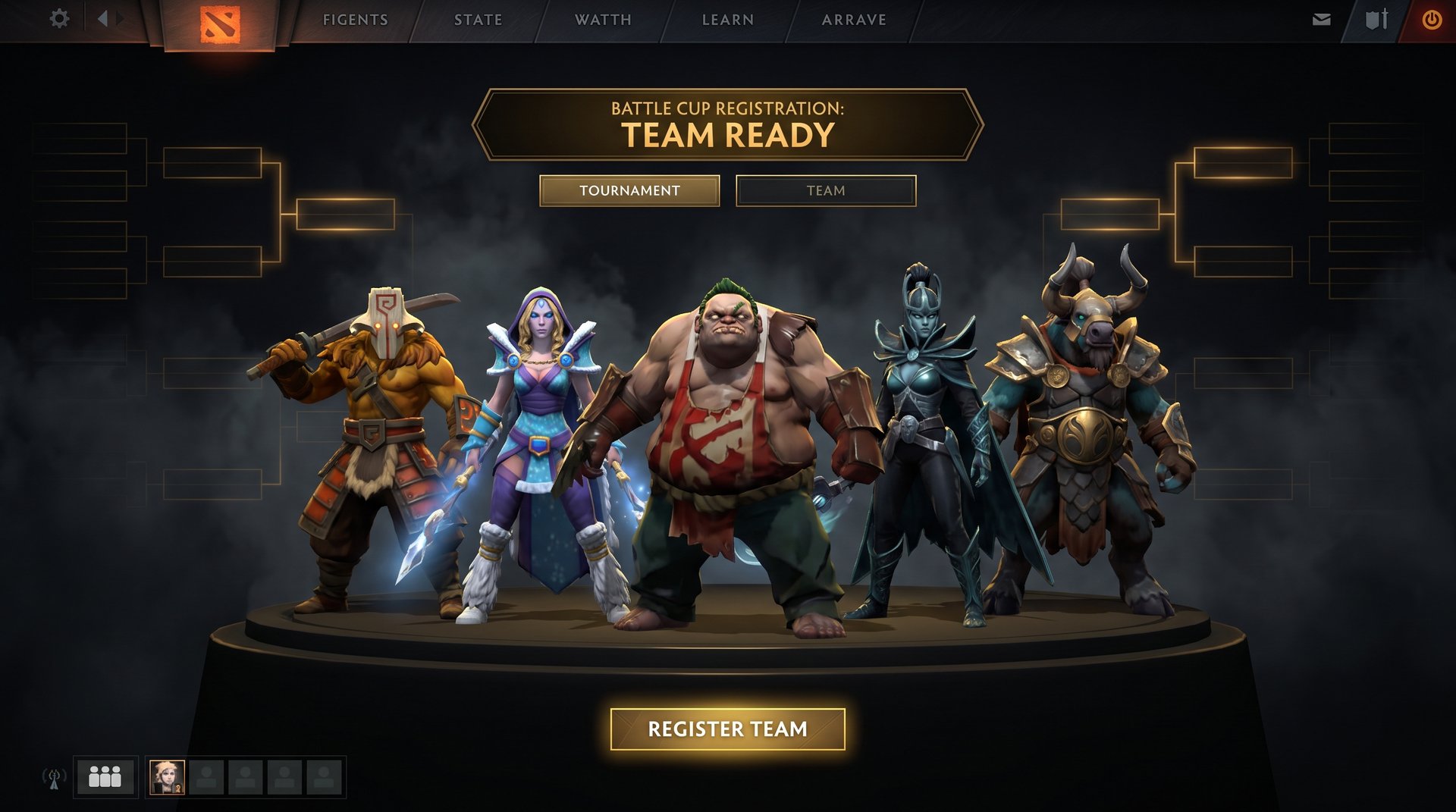
Joining Battle Cup October 2026 is done entirely from inside the Dota 2 client. You do not need to visit an external website, fill out a form, or contact an organizer. The entire registration process is built into the main menu. Here is the exact sequence of steps.
Step-by-Step Registration
Step 1 — Confirm your access. Before registering, make sure you have either an active Dota Plus subscription or a Battle Cup ticket in your inventory. Without one of these, you cannot participate. If you have neither, purchase a ticket from the Dota 2 shop inside the client or upgrade to Dota Plus (more on both options in the next section).
Step 2 — Open the Battle Cup registration window. During the registration period (which opens before the weekend the Cup runs), navigate to the main menu and select the Battle Cup banner or icon. The registration window shows the available divisions, the schedule for the upcoming weekend, and your team’s current status.
Step 3 — Form or join a team. Battle Cup teams consist of exactly five players. You can either create a new team and invite four friends, or accept an invitation from a friend who is setting up a team. All five players must confirm their participation before registration is complete. Partial teams cannot enter — you need a full roster of five.
Step 4 — Select your division. After forming your team, the system evaluates your roster and places you in an appropriate division. Division placement is based on the skill levels of all players on your team. You cannot manually select a division above the one the system assigns — but you can opt into a lower division than your assigned tier if you want a different challenge level (some stacks do this when the team MMR spread is very wide).
Step 5 — Confirm registration and wait for the bracket. Once all five team members have confirmed and a ticket or Dota Plus access has been validated for each, registration is finalized. The bracket populates with all registered teams for your division shortly before match time. You will see your first-round opponent, the match start time, and the lobby password you need to use to connect.
Step 6 — Show up on time. Each Battle Cup round has a match window. If your team does not connect and start the match within that window, you forfeit the round. Set a reminder, make sure all five players are online ahead of time, and designate one player as the host responsible for creating the lobby and entering the password.
Ticket and Dota Plus Requirements
Every player on a Battle Cup team needs access — either through a Battle Cup ticket or through Dota Plus. These are two separate paths to the same outcome. Here is how each works and which one makes more sense for different types of players.
Option 1: Battle Cup Ticket
A Battle Cup ticket is a one-time-use item that grants a single player access to one weekend’s Battle Cup. Tickets are sold directly in the Dota 2 in-game shop for approximately $0.99 USD, though the exact price can vary slightly by region. Each ticket is single-use — it covers one weekend and one team entry. If you want to enter the following week, each player on the team needs another ticket.
Tickets are the right option for players who want to try Battle Cup occasionally without committing to a subscription. If your group plays together a few times a year, tickets are the most cost-effective path. One important note: all five players must have their own tickets independently. You cannot buy a team package that covers multiple players.
Option 2: Dota Plus Subscription
Dota Plus is Valve’s monthly subscription service for Dota 2, priced at approximately $3.99 USD per month. Subscribers get access to Battle Cup every weekend it runs, without needing to buy individual tickets. Beyond Battle Cup access, Dota Plus includes hero challenges, the plus assistant (in-game draft suggestions and item timing recommendations), hero relics, and additional profile cosmetics.
For players who compete in Battle Cup frequently — more than four times a month — Dota Plus is significantly more cost-effective than buying tickets. It also makes spontaneous decisions to enter Battle Cup easy: no shopping for tickets, no worrying about whether you have inventory items available, just register and play.
| Access Option | Cost (Approx.) | Coverage | Best For |
|---|---|---|---|
| Battle Cup Ticket | ~$0.99 per player | One weekend, one team entry | Occasional participants |
| Dota Plus (Monthly) | ~$3.99 per player/month | All weekends in the month | Regular participants (4+ times/month) |
| Dota Plus (6-Month) | ~$9.99 per player | All weekends for 6 months | Committed players, best value |
Note that prices listed above are in USD and may vary by region or change with Valve updates. Always check the current price inside your Dota 2 client before purchasing.
The Division System Explained
Battle Cup uses a division system to match teams of similar skill levels. This is what makes the competition meaningful: you are not a Herald team randomly queued against Divine players. Every bracket is filled with teams at your skill tier, which keeps the competition close and the games honest.
When your team registers, the system looks at the MMR profile of your entire roster and assigns a division. The exact algorithm Valve uses is not published, but in practice the placement reflects a combination of the team’s average MMR and the highest-ranked player on the roster. A roster with one outlier player well above everyone else’s rank will typically be placed in a higher division than their average would suggest.
Division MMR Ranges (Approximate — Based on Current Medal System)
| Division | Medal Tier | Approx. Team MMR Range | Notes |
|---|---|---|---|
| Division 1 (Crusader) | Herald — Crusader | 0 — 2,156 MMR | Most welcoming tier, focus on fundamentals |
| Division 2 (Archon) | Archon | 2,157 — 3,076 MMR | Teams start coordinating drafts intentionally |
| Division 3 (Legend) | Legend | 3,077 — 4,091 MMR | Role specialization becomes important |
| Division 4 (Ancient) | Ancient | 4,092 — 5,245 MMR | Draft quality starts deciding games |
| Division 5 (Divine) | Divine | 5,246 — 6,000+ MMR | High-level mechanics, coordinated rotations |
| Division 6 (Immortal) | Immortal | Leaderboard-eligible | Top-tier pub competition, near-pro level play |
The MMR ranges above reflect the current Dota 2 medal structure as of patch 7.41d. These ranges can shift after major calibration resets. Check the Dota 2 MMR Table 2026 for the current exact ranges by medal and star level.
Bracket Format and Match Rules
Understanding the bracket structure before you enter Battle Cup is important for preparation. The format is single-elimination: one loss and you are out. Every game matters.
A standard Battle Cup bracket holds eight teams. That means three rounds of play: quarterfinals, semifinals, and the final. Win all three and you are the bracket champion for your division. In some large-scale Battle Cup events, the bracket may be extended, but the standard weekend format is seven matches total across the rounds (quarterfinal = match 1, semifinal = match 2, final = match 3). Seven wins in a full weekend event earns the highest tier of trophy.
Match Format by Round
The early rounds (quarterfinals and semifinals) are typically played as a single game — best of one. One decisive game, winner advances. There is no safety net. This format rewards teams that can draft quickly, execute cleanly in the first 40 minutes, and avoid the kinds of mistakes that end games in a single teamfight.
The final round may be played as a best of one or a best of three depending on the specific Battle Cup event configuration. In best-of-three finals, the team that wins two maps advances. Best of three adds a drafting layer: after dropping game one, teams must adapt their strategy rather than running the same draft again. This is where team communication and flexibility matter most.
Lobby and Timing Rules
Each match round has a defined start window. When your round begins, the client shows you your opponent, the lobby name, and the lobby password. One player from your team creates the game lobby using the provided settings, the opponent team joins, and the match begins. If either team does not start the lobby within the allotted window, they forfeit. This is strictly enforced — Battle Cup does not reschedule or make exceptions for late arrivals.
In-game settings for Battle Cup matches are fixed by the system: the map, starting gold, all abilities settings, and game mode are pre-set and identical for all matches in the event. Teams play on the current patch with standard ranked rules. There are no custom settings or exceptions.
Battle Cup October 2026 Schedule
Battle Cup events in Dota 2 are typically scheduled for weekend evenings, with registration opening a few days before the event and matches running across Saturday and Sunday. Valve has historically run Battle Cup on the last full weekend of each month, though the exact schedule for each individual event is announced inside the Dota 2 client and on the official Dota 2 social channels closer to the event date.
For Battle Cup October 2026, the event is expected to follow the standard pattern: registration opens mid-week, and matches run on the final Saturday and Sunday of October 2026. Because exact dates have not been officially confirmed at the time of writing, we recommend checking your Dota 2 client’s featured events section as October approaches — the event will appear there as soon as it is live for registration.
Registration typically stays open for 24 to 48 hours before the event. Once registration closes, brackets are finalized. Teams that miss the registration window cannot enter that weekend’s event and must wait for the next scheduled Battle Cup. Plan ahead and register as soon as the window opens — slot availability can fill quickly in popular divisions.
Prizes and Rewards
Winning Battle Cup matches earns your team cosmetic prizes and profile trophies. The exact reward tier depends on how many rounds you win — the further you advance in your bracket, the better the prizes.
Battle Cup Trophies
The flagship reward is the Battle Cup Trophy. These are unique cosmetic items that attach to your profile and display the tier of the event you won. Trophies are tiered — standard, rare, and prestigious tiers depend on how many matches you win across a single weekend and over time as you accumulate results across multiple Battle Cup events. The trophy stands as a permanent, visible record in your profile that other players can inspect.
Unlike most cosmetics in Dota 2 that can be purchased or traded, Battle Cup trophies are earned exclusively through competition. There is no store equivalent. That exclusivity is what gives them value in the community — when another player sees a high-tier Battle Cup trophy on your profile, they know you earned it on the field, not in a store checkout.
Cosmetic Item Rewards
In addition to trophies, Battle Cup participants and winners receive cosmetic items from the current seasonal item pool. These can include hero cosmetics, courier skins, and loadout items. The quantity and rarity of cosmetic drops scales with your performance in the bracket — winning more rounds grants access to higher-rarity drop pools.
Participants who enter but are eliminated in early rounds still receive participation items, so even a first-round exit is not without reward. However, the best drops are reserved for bracket winners, which adds meaningful incentive to win every match rather than treating Battle Cup as a casual experience.
| Result | Reward Tier | What You Get |
|---|---|---|
| Participation (any round) | Base | Entry stamp, cosmetic participation drop |
| Quarterfinal win | Bronze | Battle Cup Trophy (standard) + item drop |
| Semifinal win | Silver | Trophy upgrade + improved item pool |
| Bracket champion | Gold | Highest-tier trophy + rare cosmetic drops |
10 Tips for Winning Your Division
Battle Cup is not just a pub game with a bracket attached. Teams that treat it like a real tournament win significantly more often than teams that show up with a random draft and no plan. These ten tips come from thousands of hours of competitive Dota 2 experience and from patterns we see consistently in Battle Cup results across all skill divisions.
1. Draft as a Unit, Not Five Individuals
The single biggest mistake in Battle Cup is five players each picking their favorite hero without discussing synergies. Before registration, agree on a general draft philosophy: what your team’s preferred win condition is (teamfight, split push, pickoff, early aggression), which roles each player is most comfortable in, and which heroes you are collectively most confident on. A mediocre draft with strong team synergy beats a five-great-heroes lineup that falls apart in execution.
2. Know the Opponent’s Draft Before Your Last Pick
Assuming your last two picks are revealed after the opponent’s core draft, use those picks to address gaps. If the enemy has massive teamfight (Enigma, Tidehunter), your last pick should either interrupt their wombo combo (Silencer, Naga Siren, Rubick) or draft something that forces them to fight in unfavorable conditions rather than on their terms. In Battle Cup, you often have the same counterpick windows as in professional matches. Use them.
3. Assign a Shot-Caller Before the Game Starts
Indecision during teamfights kills more Battle Cup runs than mechanical skill deficits. Assign one player — the most experienced or the one with the best game-sense — as the shot-caller before the match begins. Their calls are final. Other players can suggest, but execution speed requires one clear voice. The team that moves as one unit in fights and objective plays wins far more often than the team debating during a Roshan fight.
4. Play Your Bracket Division Seriously
Some teams show up to a lower division than their average MMR suggests and expect to win without trying. This creates bad habits and wastes the competition. Compete at the level the system places you in. If you genuinely want a challenge, register at your true division. The goal should always be to win, not to farm trophies from easier brackets.
5. Prepare a 5-8 Hero Pool Per Role, Not Just 2
In a tournament setting, opponents will ban your comfort heroes if they scout your steam profiles or if your favorite hero is just strong in the current meta. Every player should be comfortable on at least five to eight heroes in their role. If you only play three supports and one of them gets banned, you are already disadvantaged before the first creep wave.
6. Understand the Best-of-One Stakes and Play Accordingly
Best-of-one matches punish greedy decisions far more harshly than ranked games. In ranked, you can absorb a bad buyback or a failed smoke because you have 50 more matches to correct it. In Battle Cup, one bad call can end your run. This means: do not gamble on Roshan unless you have a strong read, do not buyback into a lost fight, and do not extend into the enemy base unless you have a clear advantage. Play tight Dota.
7. Control Rune Timings and Vision Before Key Fights
Battle Cup teams in the Ancient and Divine divisions often separate themselves from lower-division play through superior map control. Before every major engagement, secure the closest rune (power rune or bounty), place sentries and observers at choke points, and make sure your opponent has no surprise vision on your setup position. A fight won through preparation is worth more than a fight won through individual mechanics, because preparation is repeatable.
8. Communicate with Pings, Not Frustration
Typing heated messages during a Battle Cup game is a direct path to losing. Tilt spreads. If a play goes wrong, call the next objective clearly (retreat to base, regroup at X, smoke at Y) rather than reviewing what just happened. Save the post-game analysis for after the match ends. During the game, every word typed is a moment not spent on the minimap, and every moment of frustration reduces reaction quality.
9. Identify the Enemy Carry and Pressure Them Early
Most Battle Cup matches are decided by the carry differential at 20-25 minutes. If the enemy carry is 2,000 gold ahead, their teamfight presence snowballs. Make slowing that carry a team priority from the first minutes: stack and contest the closest jungle camps on their side, send the offlaner to zone or harass rather than just survive, and use smoke calls to pick off the enemy position-4 or 5 early before the carry comes online. A carry denied early is a carry that cannot close games in the bracket’s 30-40 minute window.
10. Win the Draft on Objectives, Not Just Kills
The best Battle Cup teams build drafts around objective control — Roshan, towers, barracks — not just teamfight kill potential. A team with two strong pushers, a global, and a solid frontline can win games without ever winning a teamfight convincingly. Know what your draft is designed to achieve (push high ground at 25 minutes, take Aegis at 20, split-push both sides at 35) and execute that plan rather than chasing kills away from your win condition.
Getting Your MMR Ready Before Battle Cup
The division you enter Battle Cup in depends on your team’s current MMR profile. If your stack has one or two players lagging behind in rank, it drags the team into a lower division than the rest of the group belongs in, or in some cases the system places the team higher than the weaker players can comfortably perform. Getting everyone’s MMR aligned before Battle Cup October 2026 makes the experience better for the whole team.
Players who need to climb before the event have a few options. The most straightforward is structured MMR boosting through a professional service, which efficiently moves the account to the target bracket before the Cup. If you want to improve your own mechanics and understand why you are losing MMR, working with a Dota 2 coaching service is one of the fastest ways to identify and correct specific bad habits. Some players combine both — a coaching session to identify the root issues, then a structured climb to reach the target MMR tier before the event.
For players who want to understand the full competitive landscape and whether professional services are the right fit, our guide to the best Dota 2 boosting services covers what to look for, what to avoid, and why Dota 2-specialist boosters get better results than generalist services. If you are concerned about account safety, the is Dota 2 boosting safe breakdown addresses every concern in detail. Getting your MMR right before Battle Cup means your team competes in the division that matches your actual skill — which makes every game more competitive and every win more satisfying.
Battle Cup October 2026: Frequently Asked Questions
Climb Before Battle Cup — Hit Your Target Division
If your team needs to align MMR before October, TeamSmurf’s Dota 2-only boosters are the fastest and safest path. Every booster is Immortal-ranked, every order is VPN-secured, and results are guaranteed.