Stuck in MMR Hell The Definitive Guide to Breaking Free in Dota 2

You know the feeling. You’ve been 2,800 MMR for six months. You go on a five-game win streak and feel like you’re finally breaking through — then you lose seven in a row and end up right back where you started. Every other game has a griefer, a feeder, or someone who picks jungle LC in 2026. You know you’re better than your rank. The system must be broken. This must be MMR hell.
Sound familiar You’re not alone. “MMR hell” is the single most discussed topic in the Dota 2 community. And here’s the thing — it’s both real and not real, depending on how you define it. This guide will explain exactly what’s going on, why you’re stuck, and give you concrete, rank-specific action plans to break free.
We’ve coached and boosted thousands of accounts at Team Smurf. We’ve seen every bracket from the inside. We know exactly what holds players back at each level, and we know what it takes to break through. This is everything we’ve learned, distilled into one comprehensive guide.
Table of Contents
Is MMR Hell Real (Yes and No)
Let’s settle this debate once and for all.
The “No” Argument: MMR Hell Is a Myth
The statistical argument against MMR hell is straightforward and hard to refute:
- You are the only constant. Your teammates change every game. Your enemies change every game. Over 100+ games, the only consistent variable is you. If you’re truly better than your rank, you’ll eventually climb.
- Smurfs prove the system works. When an Immortal player creates a new account at 2k MMR, they don’t get “stuck.” They climb to their real rank rapidly, regardless of teammates. This proves the system can differentiate skill levels.
- The math doesn’t lie. If you’re a 4k player stuck at 3k, you have a statistical advantage in every game. The enemy team has 5 random 3k players; your team has 4 random 3k players and one 4k player (you). Over enough games, this advantage compounds into MMR gains.
- Valve’s matchmaking algorithm is designed to converge on your true skill level. It’s the same type of system used in chess (Elo), which has been proven effective across millions of players.
The data from Valve’s matchmaking system is clear: over a sufficient sample size, your MMR reflects your skill.
The “Yes” Argument: MMR Hell Is Real (Sort Of)
But here’s where it gets nuanced. MMR hell feels real, and there are legitimate reasons why:
1. Variance is brutal in small samples
You might be a “true 3.5k” player stuck at 3k. Over 500 games, you’d climb to 3.5k. But over 50 games Variance could keep you at 3k or even drop you to 2.7k. If you play 3–5 games a week, “500 games” is two years. That feels like hell even if it’s mathematically temporary.
2. The “crab bucket” effect
At certain MMR ranges, game quality is genuinely worse. More griefers, more account buyers, more smurfs, more toxic behavior. These games are harder to influence as an individual, even if you’re slightly better than average for that bracket.
3. Emotional compounding
Losing streaks cause tilt. Tilt causes worse play. Worse play causes more losses. This creates a negative feedback loop that can keep you below your “true” MMR for extended periods. You’re not stuck because of the system — you’re stuck because losing makes you play worse.
4. Skill plateaus are real
Sometimes you’re not “stuck” — you’ve reached your actual skill ceiling and need to develop new skills to break through. This isn’t the system being unfair. It’s you needing to improve in ways you haven’t identified yet.
The Truth: A Middle Ground
MMR hell isn’t a broken system trapping good players at low ranks. But it IS a real psychological and statistical experience where players feel stuck for weeks or months due to a combination of variance, tilt, unidentified weaknesses, and genuinely frustrating teammates.
The good news Every single one of these factors can be addressed. Let’s get into it.
The Psychology of Being Stuck
Before we talk about gameplay fixes, we need to talk about your brain. The mental game is at least 30% of what determines your MMR, and it’s the part most players completely ignore.
Confirmation Bias
You remember the game where your mid went 0-8. You don’t remember the game where the enemy mid went 0-8 and you got a free win. This is called confirmation bias — you selectively remember evidence that supports your existing belief (“my teammates are always bad”) and ignore evidence that contradicts it.
Exercise: For your next 20 games, write down after each game whether you won or lost and whether each team had a “bad player.” You’ll likely find that both teams get bad players at roughly equal rates.
The Locus of Control Problem
Psychologists distinguish between internal locus of control (believing you control your outcomes) and external locus of control (believing external factors control your outcomes).
Players stuck in “MMR hell” almost always have an external locus of control:
- “I lost because my support didn’t pull”
- “I lost because the enemy had a smurf”
- “I lost because of the matchmaking algorithm”
Players who climb consistently have an internal locus of control:
- “I lost, but I could have farmed faster in the early game”
- “The enemy had a smurf, but I could have avoided feeding him kills”
- “My support didn’t pull, so I should have adjusted my lane positioning”
This isn’t about blame. It’s about identifying the things you can control. You can’t control your teammates. You can control your own gameplay. Focusing on what you can control is the single most important mindset shift for climbing.
Tilt: The Silent MMR Killer
Tilt is responsible for more lost MMR than any gameplay mistake. Here’s what tilt does to your brain:
- Narrows your attention: You focus on what went wrong instead of what’s happening now
- Increases aggression: You make risky plays to “prove” you’re good, resulting in deaths
- Reduces communication: You stop coordinating with your team or start flaming
- Triggers rage-queuing: You queue for “one more game” when you should stop, guaranteeing a loss
- Creates tunnel vision: You stop checking minimap, miss ganks, and make poor decisions
The math of tilt: If you play 10 games in a session, games 1–5 might be at your true skill level. Games 6–10, if you’re tilted from a loss streak, might be 200–300 MMR below your actual ability. This alone can keep you from climbing.
The fix: Implement a hard loss limit. After 2 consecutive losses, stop playing ranked. Do something else — play unranked, take a break, watch a replay. Return when you’re calm. This single habit can gain you 200+ MMR within a month. It’s that significant.
Identity Attachment to Rank
Many players become emotionally attached to their rank number. When you see your MMR as part of your identity, every loss feels like a personal attack. This creates performance anxiety that actually makes you play worse.
The fix: Cover your MMR display (some people use tape on their monitor). Focus on playing well rather than winning. Paradoxically, when you stop caring about the number and focus on improving, the number goes up faster.
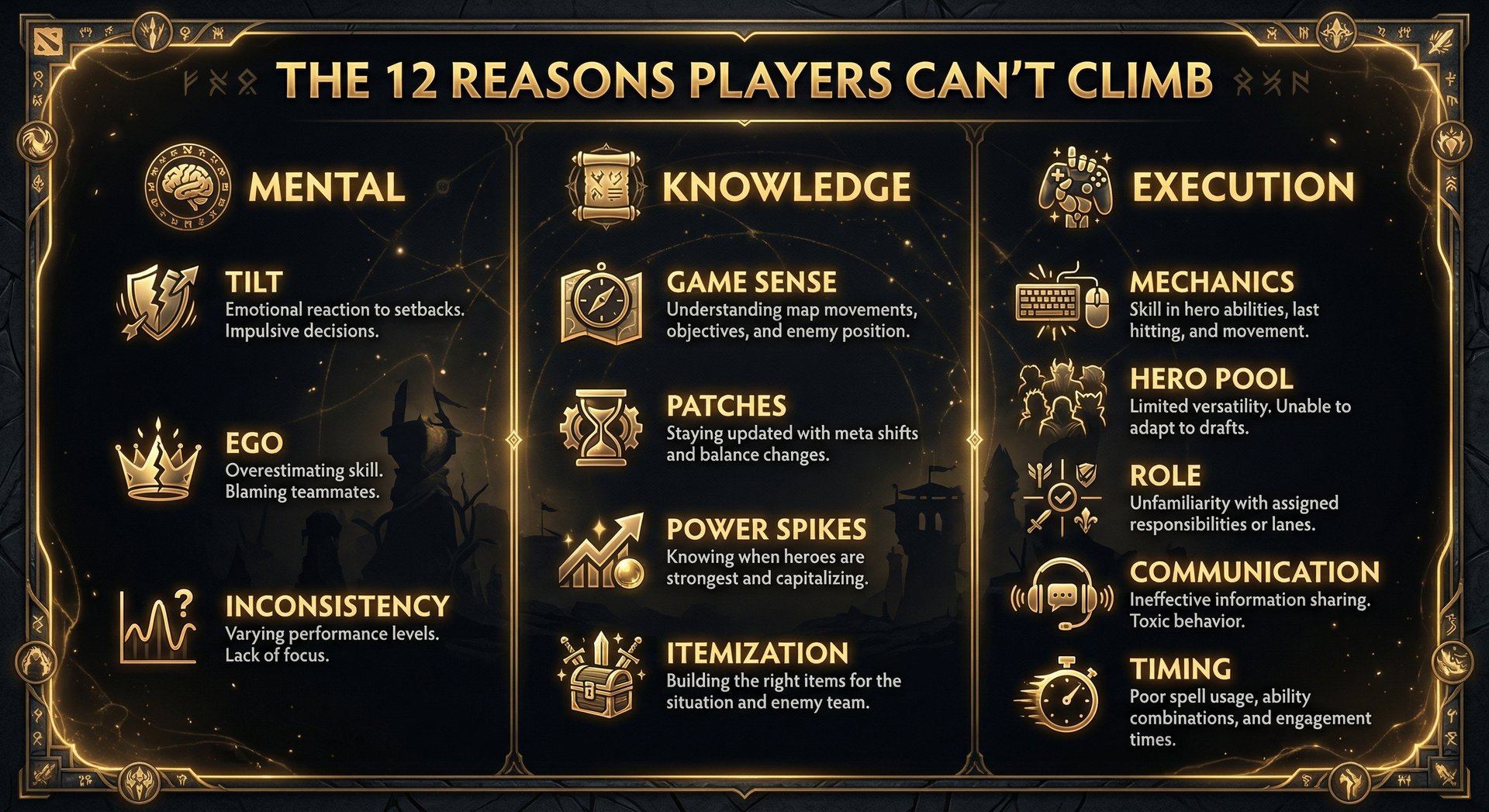
12 Specific Reasons You Can’t Climb (And How to Fix Each One)
This is the core of the guide. We’ve identified the 12 most common reasons players get stuck, based on thousands of coaching sessions and replay reviews at Team Smurf.
Reason #1: Poor Game Sense
What it looks like: You don’t know where enemies are without seeing them. You farm in dangerous areas of the map. You get ganked repeatedly. You don’t anticipate rotations.
Why it keeps you stuck: Game sense is the foundation of everything in Dota 2. Without it, even perfect mechanical skill won’t save you because you’ll be in the wrong place at the wrong time.
How to fix it:
- Look at the minimap every 3–5 seconds. Set a timer if you need to. This alone is transformative.
- When an enemy hero disappears from the map, assume they’re coming to kill you until proven otherwise.
- Before farming a lane or jungle camp, ask: “Is this safe Who could gank me here”
- Track enemy key abilities. Is Pudge missing from mid Stay away from dark areas.
- Watch your replays with the fog of war removed. You’ll be shocked at how many times enemies were obviously coming and you didn’t react.
Reason #2: Weak Mechanical Skill
What it looks like: Missing last hits, fumbling spell combos, mis-clicking items, poor micro on heroes like Chen or Visage.
Why it keeps you stuck: Every missed last hit is gold you don’t have. Every fumbled combo is a kill you didn’t get. Over 40 minutes, this adds up to being an entire item behind.
How to fix it:
- Practice last hitting in a private lobby for 10 minutes before every session. Yes, every session.
- For combo heroes (Invoker, Tinker, etc.), create a practice lobby and drill the combo 50 times.
- Use quick-cast on abilities where it benefits you (blink, hex, etc.).
- Customize your keybinds so every item slot is comfortable and accessible.
- If your mechanics plateau, your mouse/keyboard setup might be limiting you. Consider adjusting DPI or keybinds.
Reason #3: Tilting and Emotional Dysregulation
What it looks like: Flaming teammates, giving up at 15 minutes, rage-buying shadow amulet, queuing 10 games in a row after a loss streak.
Why it keeps you stuck: As discussed above, tilt destroys your performance. But it also gets you reported, tanks your behavior score, and puts you in worse matchmaking pools — creating a vicious cycle.
How to fix it:
- 2-loss limit: After 2 consecutive ranked losses, stop. No exceptions.
- Mute liberally: At the first sign of toxicity from a teammate, mute them. Don’t engage.
- Physical check-in: Between games, notice your body. Are your shoulders tense Jaw clenched Take 5 deep breaths before queuing.
- Reframe losses: Every loss contains a lesson. Find one thing you could have done better. That’s your ROI from the loss.
- Track behavior score: If it’s below 10,000, fixing it should be your #1 priority. Higher behavior score = better teammates = easier games.
Reason #4: Hero Pool Too Wide
What it looks like: Playing 20+ heroes across all roles. Never mastering any single hero. Picking whatever “feels right” in the draft.
Why it keeps you stuck: Jack of all trades, master of none. A player who has 500 games on 3 heroes will outperform a player who has 30 games on 20 heroes, every time. Deep hero knowledge — knowing every matchup, every power spike, every itemization option — only comes from repetition.
How to fix it:
- Pick 3–5 heroes maximum for ranked. Two for your main role, one or two for your secondary role.
- Choose heroes that are reliable across patches — heroes that don’t get nerfed into oblivion every update. Think Wraith King, Ogre Magi, Vengeful Spirit, not flavor-of-the-month picks.
- Commit to 50 games on each hero before adding a new one to your pool.
- Check our guide on the best heroes for climbing MMR for specific recommendations by bracket.
Reason #5: Playing the Wrong Role
What it looks like: Playing carry but having the lowest last hits in the game. Playing support but never buying wards. Queuing all 5 roles for faster queue times.
Why it keeps you stuck: Different roles require different skills. If your natural strengths (teamfight awareness, map reading, mechanical precision) don’t align with your chosen role, you’re fighting an uphill battle.
How to fix it:
- Be honest about your strengths. Good at last hitting and farming patterns → Carry or mid. Good at reading the map and rotations → Support. Good at creating chaos and space → Offlane.
- Try each role for 20 games and compare your win rates. The role with the highest win rate is likely your best fit.
- Don’t queue all roles. Specialize in 1–2 roles maximum.
Reason #6: Not Adapting to Patches
What it looks like: Building the same items and playing the same heroes regardless of patch changes. Still rushing Radiance on Spectre when the meta has shifted. Never reading patch notes.
Why it keeps you stuck: Dota 2 is a constantly evolving game. Patch updates can completely change which heroes, items, and strategies are strong. Players who don’t adapt are effectively playing a different game than everyone else.
How to fix it:
- Read patch notes on release day. Every single time.
- Check win rate data on Dotabuff/OpenDota after major patches to see what’s strong.
- Watch pro matches or high-level streamers to see how the meta has shifted.
- Be willing to drop heroes that got nerfed and pick up heroes that got buffed.
- Update your item builds — the “standard” build from 6 months ago might be terrible now.
Reason #7: Playing at the Wrong Times
What it looks like: Queuing ranked at 3 AM. Playing right after work when you’re exhausted. Squeezing in “one quick game” before you have to leave.
Why it keeps you stuck: Late-night queues have higher variance — more drunk players, more smurfs, more griefers. Playing when you’re tired or rushed means you’re not at peak performance. And “one quick game” mindset leads to sloppy play.
How to fix it:
- Find your peak hours: Most regions have “good” queue times (usually 6 PM–10 PM local time) when the player pool is largest and match quality is highest.
- Only play when rested and focused. If you’re yawning, play unranked or don’t play at all.
- Never play ranked when you have a time constraint. The anxiety of “I need to win fast” leads to poor decisions.
- Weekend mornings are often underrated — player pool is decent and people are relaxed.
Reason #8: Ignoring Power Spikes
What it looks like: Farming jungle when you have a 20-minute BKB + damage item timing. Missing fight windows. Not pushing advantages after winning teamfights.
Why it keeps you stuck: Every hero and item build has specific timing windows where they’re disproportionately strong. Missing these windows means the enemy catches up, and your advantage evaporates.
How to fix it:
- Know your hero’s power spike. For Phantom Assassin, it’s when BKB + Desolator comes online. For Dazzle, it’s levels 1–5 in lane.
- When you hit your power spike, force action immediately. Smoke with your team, take Roshan, push a tower.
- When the enemy hits their power spike, play defensively. Farm safe areas, avoid fights, wait it out.
- Check item timings after each game. Were your items early, on time, or late Late item timings indicate farming inefficiency.
Reason #9: Poor Itemization
What it looks like: Building the same items every game regardless of enemy lineup. Never buying BKB. Buying damage when you need survivability. Getting items in the wrong order.
Why it keeps you stuck: Dota 2’s item system is one of its deepest mechanics. The right item at the right time can swing a game. The wrong item can waste 4,000 gold and 8 minutes of farming.
How to fix it:
- Stop following static item guides blindly. Use them as starting points, then adapt based on the game.
- Learn when BKB is mandatory. Spoiler: it’s mandatory more often than you think, especially in lower brackets where teamfights are chaotic.
- Build items that counter the biggest threat. Enemy has a fed PA Build Halberd or Ghost Scepter. Enemy has three stuns BKB is non-negotiable.
- Watch what high-MMR players build in your hero’s games on Dotabuff’s “Guides” section.
- Consider neutral items. They’re free and incredibly powerful when chosen correctly.
Reason #10: Bad Communication
What it looks like: Never pinging, never using chat wheel, flaming instead of calling plays, not using voice chat for critical calls.
Why it keeps you stuck: Dota is a team game. Even if you’re mechanically superior, you need your team to coordinate with you. Good communication multiplies your entire team’s effectiveness.
How to fix it:
- Use pings liberally: Ping missing heroes, ping objectives, ping “on my way.”
- Use chat wheel: “Get Back,” “Push Now,” “Roshan” — simple, universal, language-barrier-proof.
- Make calls, not complaints: “Let’s smoke mid” is productive. “Why didn’t you help me” is not.
- Mute toxic players immediately. One toxic player can tilt your entire team if you engage with them.
- Positive reinforcement works: “Good job” after a teammate makes a play makes them play better. Yes, really.
Reason #11: Ego
What it looks like: “I’m definitely better than my rank.” Never watching replays. Blaming every loss on teammates. Refusing to play support because “I should be carrying.”
Why it keeps you stuck: Ego prevents learning. If you believe you’re already better than your rank, you won’t look for mistakes in your own gameplay. And if you can’t identify your mistakes, you can’t fix them.
How to fix it:
- Accept the possibility that you belong at your current rank. Just sit with that for a moment. It’s uncomfortable but necessary.
- Watch one replay per week. Focus exclusively on your own mistakes, not your teammates’.
- Ask yourself after every death: “What could I have done differently” Even if the death was “their fault,” there’s almost always something you could have done.
- Be willing to play any role. Sometimes the best way to climb is supporting a teammate who carries harder than you.
- Get a coaching session. Nothing kills ego faster than an Immortal player politely pointing out the 15 mistakes you made in one game. Our coaches do this with empathy and structure.
Reason #12: Inconsistency
What it looks like: You can play like a Divine player in one game and a Crusader player the next. Your performance varies wildly based on mood, hero, matchup, or time of day.
Why it keeps you stuck: Climbing requires consistent performance, not occasional brilliance. If you’re 4k in your best games but 2.5k in your worst, your actual MMR will settle somewhere in the middle — and it’ll feel like you’re stuck.
How to fix it:
- Identify what makes your “good” games good. Are you more focused Playing your best hero Well-rested Replicate those conditions.
- Narrow your hero pool to reduce variability.
- Develop pre-game routines: last-hit practice, stretching, water, checking patch notes.
- Play fewer but higher-quality games. Three focused games are worth more than ten autopilot games.
Bracket-Specific Problems: What Holds You Back at Each Rank
The reasons you’re stuck vary dramatically by rank. A Herald player and an Ancient player have completely different problems. Here’s what holds players back at each bracket.
Herald (0–769 MMR): The Fundamentals Bracket
What holds Herald players back:
- Not understanding what their hero does or what items to buy
- Missing 60–80% of last hits
- Not using abilities during fights (literally forgetting to press buttons)
- No concept of map positioning or when to retreat
- Dying 15+ times per game
- Not buying TP scrolls
The fix: Focus ONLY on two things: (1) die less, and (2) get more last hits. Everything else is noise at this bracket. Pick a simple hero (Wraith King, Ogre Magi, Lich) and play it 50 times.
Guardian (770–1539 MMR): The “I Know What to Do, But…” Bracket
What holds Guardian players back:
- Understanding concepts but not executing them consistently
- Extremely passive laning — standing behind creeps doing nothing
- No farming efficiency after laning phase
- Following teammates into bad fights instead of farming
- Building the same items every single game
- Zero vision game — neither buying, placing, nor using ward information
The fix: Focus on laning. Win your lane, then farm efficiently until your first major item timing. Stop joining random fights at 10 minutes. Buy wards if nobody else does (yes, even as a carry — a ward is 50 gold).
Crusader (1540–2309 MMR): The “Comfort Zone” Bracket
What holds Crusader players back:
- Decent mechanics but zero game sense — not reading the map
- Not understanding power spikes or timing windows
- Playing on autopilot — farming jungle without a plan
- Not pressing advantages after winning fights
- Terrible TP discipline — never having TP ready for counter-ganks
- Refusing to buy BKB ever
The fix: Start thinking about the game in phases. Laning phase → farming phase → fighting phase → high ground phase. Each phase has different priorities. And buy BKB when you need it. This alone can gain you 200+ MMR.
Archon (2310–3079 MMR): The “I’m Almost Good” Bracket
What holds Archon players back:
- Good mechanics but inconsistent decision-making
- Knowing what to do but choosing wrong timing
- Drafting poorly — picking into counters or not synergizing with team
- Inconsistent performance game to game
- Tilt — this bracket has the most emotional players
- Not adapting itemization to the specific game
The fix: Study decision-making. After every game, identify three decisions that changed the outcome. Watch replays of your losses and pinpoint the moments where you chose wrong. Mental game is critical here — implement the tilt-management strategies from earlier.
Legend (3080–3849 MMR): The “Plateau” Bracket
What holds Legend players back:
- Understanding the game well but lacking efficiency
- Slow farming patterns — wasting time between camps
- Poor Roshan timing — not prioritizing Roshan when possible
- Not using smoke effectively
- Split-push and map pressure concepts are weak
- Draft flexibility is limited — can’t adjust to what the team needs
The fix: Optimization. Time your farming routes. Practice stacking and pulling efficiently. Learn every smoke spot and when to use them. Watch high-level players on your main heroes and compare their efficiency to yours. The gap is usually 15–20% in GPM/XPM.
Ancient (3850–4619 MMR): The “So Close” Bracket
What holds Ancient players back:
- Micro-inefficiencies that add up over 40 minutes
- Mental game under pressure — choking in critical moments
- Not adapting to the specific game’s win condition
- Tunnel vision on their own hero while ignoring team dynamics
- Drafting is still a weakness — understanding counters but not synergies
- Inconsistency between “tryhard” games and “autopilot” games
The fix: This is where coaching has the highest value-per-session for the investment. The mistakes are subtle and hard to self-identify. An Immortal coach can spot patterns you’ve never noticed. Consider a coaching package. Also, read more about specific improvement strategies: Proven Ways to Increase Your MMR.
Bracket Problem Summary Table
| Bracket | #1 Problem | #1 Fix | Games to Next Rank |
|---|---|---|---|
| Herald | Basic mechanics missing | Die less, farm more | 50–100 |
| Guardian | Passive laning | Win your lane | 75–150 |
| Crusader | No map awareness | Check minimap every 5 sec | 100–200 |
| Archon | Inconsistent decisions | Watch replays, fix tilt | 150–250 |
| Legend | Efficiency gap | Optimize farming/timing | 200–350 |
| Ancient | Subtle mistakes | Get coaching | 250–500 |
The Dunning-Kruger Effect in Dota 2
If you’ve never heard of the Dunning-Kruger effect, it’s a cognitive bias where people with limited knowledge in a domain overestimate their competence. In Dota 2 terms: you think you’re better than you are because you don’t know enough to see your own mistakes.
How It Manifests in Dota
The Herald/Guardian player who watches pro Dota and thinks “I could do that.” They understand the concepts at a surface level but don’t appreciate the thousands of micro-decisions that separate their play from an Immortal’s.
The Archon player who’s convinced they’re “at least 4k” because they occasionally have 15-1 games. They don’t realize those games happened because the enemy was worse, not because they played at a 4k level.
The Legend player who blames every loss on teammates because they “never make mistakes.” They don’t see the 10 small mistakes per game that a higher-ranked player would instantly identify.
The Dunning-Kruger Curve in Dota Terms
| Stage | Typical Rank | Confidence Level | Actual Skill |
|---|---|---|---|
| “I’m amazing at this game” | Guardian–Crusader | Very High | Low |
| “I’m decent but stuck” | Archon–Legend | High | Medium |
| “I’m actually not that good” | Ancient | Medium | Medium-High |
| “I know how much I don’t know” | Divine | Lower | High |
| “I’m good but there’s always more” | Immortal | Calibrated | Very High |
The irony: the players who complain the loudest about being stuck in “MMR hell” are usually the ones most affected by Dunning-Kruger. They’re confident they’re better than their rank, but that confidence itself is the problem because it prevents self-assessment.
How to Escape the Dunning-Kruger Trap
- Watch your own replays. Not to validate how good you are, but to find every single mistake. Aim to find at least 5 significant mistakes per game.
- Watch an Immortal player play your hero at your rank. The gap will be humbling and educational.
- Get coaching. An external observer obliterates Dunning-Kruger because they show you exactly what you can’t see yourself.
- Track your stats over time. Not just MMR — track GPM, deaths per game, ward placements, TP usage. Data doesn’t lie.
- Accept that your rank is accurate. Use this as motivation to improve, not as an insult to resist.
Concrete Action Plans by Rank
Enough theory. Here are specific, actionable plans for breaking out of your current bracket. Follow these for 30 days and you will see results.
Herald → Guardian Action Plan
Duration: 2–4 weeks
- Pick ONE hero. Play it every game for 50 games. Recommended: Wraith King (carry) or Ogre Magi (support).
- Before each game, spend 5 minutes in last-hit trainer.
- In-game goal: Die fewer than 8 times. That’s it. If you die fewer than 8 times, you’ll win most games at this bracket.
- Buy TP scrolls. Always have one. Use it when a tower is being attacked.
- After each game, check your Dotabuff for last hits at 10 minutes. Try to beat your previous best.
Guardian → Crusader Action Plan
Duration: 3–5 weeks
- Choose 3 heroes for your main role. Master their laning phase.
- Learn to pull and stack as a support / manipulate creep equilibrium as a core.
- After winning a teamfight, immediately push a tower. Don’t go back to farming jungle.
- Buy at least one ward per game — even as a core. Place it where you’re farming.
- Implement the 2-loss rule. Stop playing ranked after 2 consecutive losses.
Crusader → Archon Action Plan
Duration: 4–8 weeks
- Set a phone alarm for every 5 seconds during games. Every time it buzzes, check minimap. Do this for 10 games until it becomes habit.
- Learn 3 power spikes for your main heroes and force action when you hit them.
- Always carry a TP scroll. If a teammate is getting ganked and you can help, TP in.
- Watch one replay per week. Identify 3 deaths that were avoidable and how you’d avoid them.
- Buy BKB when you need it. If the enemy has 2+ stuns that can target you in fights, you need BKB.
Archon → Legend Action Plan
Duration: 6–10 weeks
- Identify your win condition each game. “I win this game by…” (split-pushing, winning teamfights, taking early Roshan, etc.)
- Manage your mental game. Track tilt on a 1–10 scale before each game. Don’t play if you’re above 4.
- Learn one smoke play per week. Practice executing it with your team.
- Time enemy Roshan respawns and play around them.
- Consider one coaching session to identify blind spots. Book here.
Legend → Ancient Action Plan
Duration: 8–14 weeks
- Optimize farming patterns. Time yourself: how many camps per minute can you clear Aim for 10+ creep kills per minute on cores.
- Draft with intention. Learn 2–3 counter picks for the most popular heroes at your bracket.
- Focus on split-push and map pressure — don’t 5-man constantly.
- Watch pro replays of your main heroes once per week.
- Get coaching. At this level, the improvements are subtle and hard to self-diagnose. Read our coaching vs. boosting guide to decide the best approach.
Ancient → Divine Action Plan
Duration: 10–20 weeks
- Get a coaching package (5–10 sessions). At this level, self-improvement hits diminishing returns without external feedback.
- Master 2–3 heroes at a deep level — know every matchup, every item build, every timing.
- Develop shot-calling skills. Be the player who makes calls in voice chat.
- Study the current meta deeply. Know which heroes and strategies are strongest this patch.
- Play at consistent times when you’re at peak performance. No more late-night tilted sessions.
When to Consider Boosting vs. Self-Improvement
We’ve spent this entire guide telling you how to improve. But sometimes, improvement isn’t the right answer — or at least, it’s not the only answer.
Consider Boosting When:
- Your account is deeply tanked. If you’ve lost 2,000 MMR from tilt-queuing and now play in a bracket far below your actual skill, climbing back would take months. An MMR boost can restore you to where you belong.
- You want to play with friends. If your friend group is 2,000 MMR above you, the party queue restrictions make it impossible to play together. Boosting can bridge that gap.
- Time is your constraint, not skill. You’re a 4k player who can only play 3 games per week. Climbing from 3k to 4k at that rate would take 6+ months of focused play. Boosting saves you that time.
- You need a fresh calibration. Sometimes accounts get “stuck” in ways that feel unfair — old calibrations from years ago, decayed rank, or tanked behavior score affecting matchmaking. A calibration service can give you a clean start.
- Low priority is blocking everything. You can’t improve when you’re stuck in low priority. Get that resolved first.
Self-Improve When:
- You’re within 500–1000 MMR of your goal. Coaching and practice can close this gap in weeks.
- You have time and enjoy the grind. If playing Dota is fun and you have 10+ games per week, climbing is viable and satisfying.
- You’ve been boosted before and dropped back. If you can’t maintain the boosted rank, you need skill improvement, not another number change.
- You want long-term, permanent improvement. Coaching and practice compound. The skills you build now carry forward forever.
The Hybrid Approach
The most effective strategy combines both:
- Boost to close large gaps quickly (1000+ MMR)
- Coach to develop the skills to maintain and grow from the new rank
- Self-improve with deliberate practice between sessions
This gives you the fast results of boosting, the targeted improvement of coaching, and the deep learning of practice. It’s the approach our most successful clients use.
The “Fresh Start” Psychology
There’s a real psychological phenomenon behind wanting a fresh start. When your MMR has been stuck for months, the number itself becomes psychologically oppressive. You see “2,800” and feel defeated before the game even begins.
Why Fresh Starts Work (Sometimes)
Psychological reset: When you see a higher number on your profile, you play with more confidence. Confidence leads to better decision-making, better communication with teammates, and less tilt. This isn’t placebo — it’s a well-documented psychological effect.
Behavioral change: When you know you’re playing “above your level,” you naturally focus harder, play more carefully, and take fewer unnecessary risks. These are exactly the behaviors that lead to climbing.
Breaking negative associations: If your current account is associated with thousands of frustrating games, a fresh context can break the emotional patterns that contribute to tilting and autopiloting.
Why Fresh Starts Can Backfire
If you haven’t actually improved, a fresh start just puts you in harder games that you lose, and you end up back where you were — or lower. A fresh start without skill improvement is a temporary illusion.
New account calibration can be volatile. You might calibrate higher than your skill level and then drop painfully, which is psychologically worse than never having climbed.
The Right Way to “Fresh Start”
- Improve first. Use coaching, replay analysis, and deliberate practice to genuinely become better.
- Then boost or recalibrate. Use a calibration service or boost to put your number where your new skill level actually is.
- Maintain the new rank through continued focused play and the habits you’ve built.
This approach works because the fresh start is backed by real improvement, not wishful thinking.
Frequently Asked Questions
Ready to Climb Start Your Boost Today
Team Smurf is the #1 rated Dota 2 boosting service in 2026. Immortal-rank boosters, maximum safety, competitive pricing, 24/7 support.
Get MMR Boost
Calibration Service
Pro Coaching
Final Words: You Are Not Your MMR
Here’s the most important thing we can tell you: your MMR is a number that reflects your current skill level, not your worth as a person or your potential as a player.
Every Immortal player was once stuck at every bracket below them. They didn’t get there by complaining about teammates or blaming the matchmaking system. They got there by identifying their weaknesses, working on them systematically, and playing with intention.
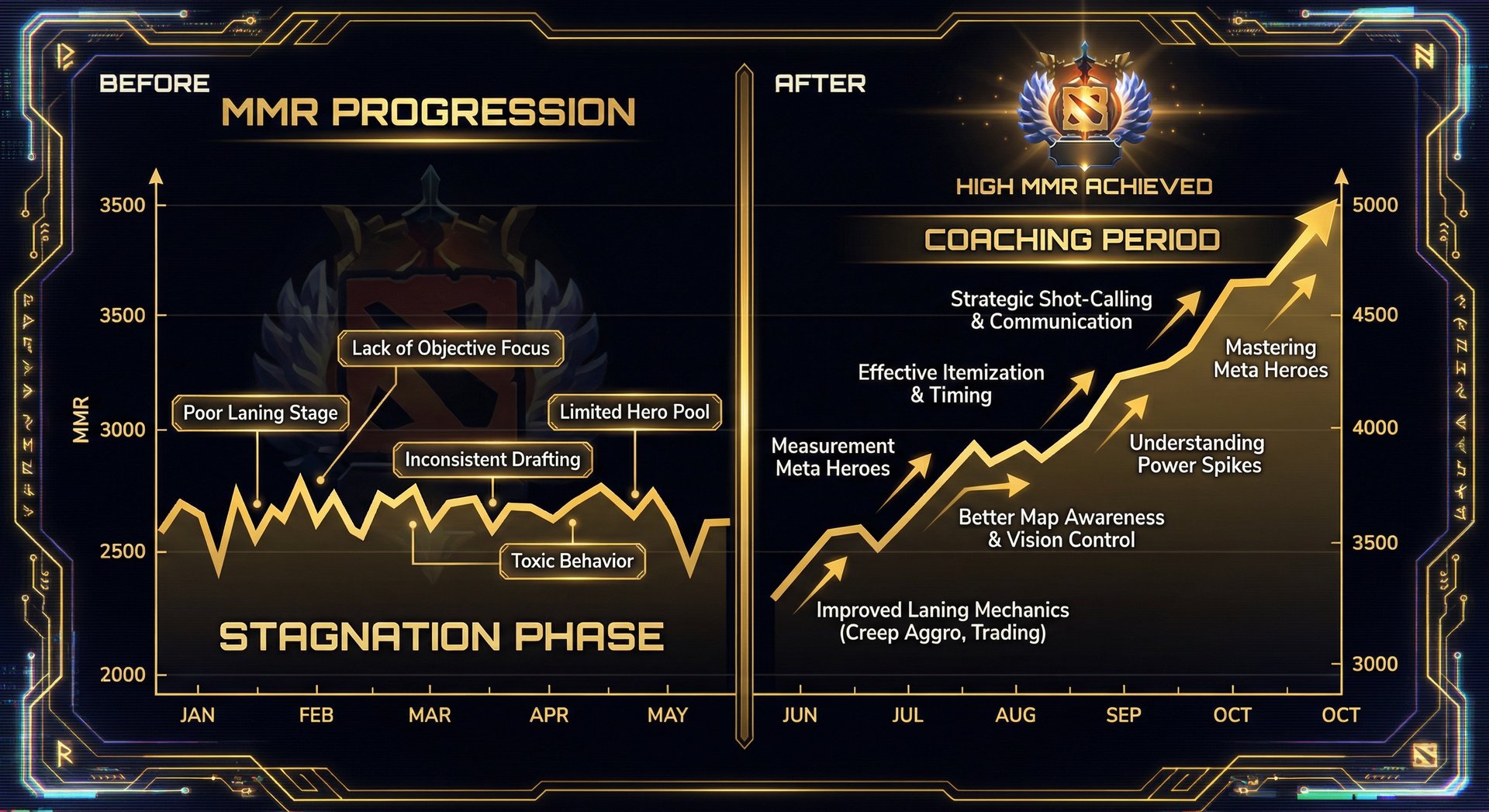
MMR hell isn’t a prison. It’s a plateau. And plateaus are broken through with the right combination of self-awareness, deliberate practice, and sometimes external help.
If you’re ready to break free:
- Start improving today with the action plans in this guide
- Get personalized coaching from Team Smurf’s Immortal coaches
- Close the gap quickly with a professional MMR boost
- Get a fresh start with our calibration service
The trench is real, but so is the way out. Stop blaming. Start climbing.
Written by Team Smurf’s Immortal-rank analysts — Rankings last verified February 2026