


Best Heroes for High Ping in Dota 2: Picks That Forgive 150 ms

You load into a Dota 2 match with 150ms ping. The enemy offlaner has Puck. You pick Invoker. Fifteen minutes later you have died four times to spells you technically should have dodged, your stuns have all whiffed by a frame, and your team is typing.
High ping does not punish every hero equally. Some heroes hit hard no matter what the scoreboard says next to your name. Their damage is spread across an area, their power comes from passives, or their critical timing windows are so generous that 150ms — or even 250ms — simply does not matter. This guide names those heroes, explains exactly why latency leaves them alone, and gives you a table you can reference at champion select.
Note: this is a different problem from clicking fewer buttons per minute. Low-APM heroes suit players with slower mechanics; the heroes below suit players whose mechanics are fine but whose connection is unreliable. The distinction matters — some high-APM heroes appear here because their timing windows are wide enough to absorb a 150ms spike.
In This Guide
Why Ping Punishes Some Heroes More Than Others
Ping is the round-trip delay between your input and the server acknowledgment. At 150ms your click lands on the server approximately one-sixth of a second after you pressed the button. That window is brutally unforgiving for heroes who rely on:
- Narrow-window skill shots — Invoker’s Ice Wall, Storm Spirit’s Ball Lightning positioning, Mirana’s Arrow. You have to lead the target, and 150ms collapses that lead.
- Reaction-based blinks and jumps — Puck’s Phase Shift, Anti-Mage’s Blink, Ember Spirit’s Remnants. You see the danger 150ms too late.
- Combo-dependent burst — Lion’s Hex into Finger, Lina’s stun setup, Skywrath’s full silence combo. The gap between spell 1 and spell 2 is usually under 200ms in optimal play. Add 150ms latency and the combo falls apart.
Heroes that avoid this problem share one or more of these properties: their abilities hit everything in a radius (not a specific unit), their power comes from passive stats or toggled auras, their most impactful spell has a global range so aim precision is irrelevant, or they are so durable that the occasional missed reaction does not cost them the fight.
Quick-Reference Table: Ping Tolerance by Hero
| Hero | OK at 150ms? | OK at 250ms? | Primary Reason |
|---|---|---|---|
| Axe | Yes | Yes | Berserker’s Call AOE + Culling Blade threshold check |
| Warlock | Yes | Yes | Global ultimate, summons act independently |
| Tidehunter | Yes | Yes | Ravage massive AOE, no timing combos |
| Bristleback | Yes | Yes | Passive-dominant kit, tanky, no skill shots |
| Underlord | Yes | Yes | Passive aura, Pit of Malice AOE, Dark Rift team TP |
| Wraith King | Yes | Mostly | Skeleton aura, Reincarnation safety net |
| Nature’s Prophet | Yes | Mostly | Global TP, summons, Sprout is area rooting |
| Silencer | Yes | Mostly | Global Silence instant cast, passives |
| Viper | Yes | Mostly | Toggled poison, Corrosive Skin passive |
| Omniknight | Yes | Mostly | Guardian Angel teamwide, Degen Aura melee |
| Timbersaw | Yes | Careful | Area chakram, tanky, mobile via hooks |
| Pudge | Mostly | Low ranks only | Hook hitbox forgiving at close range only |
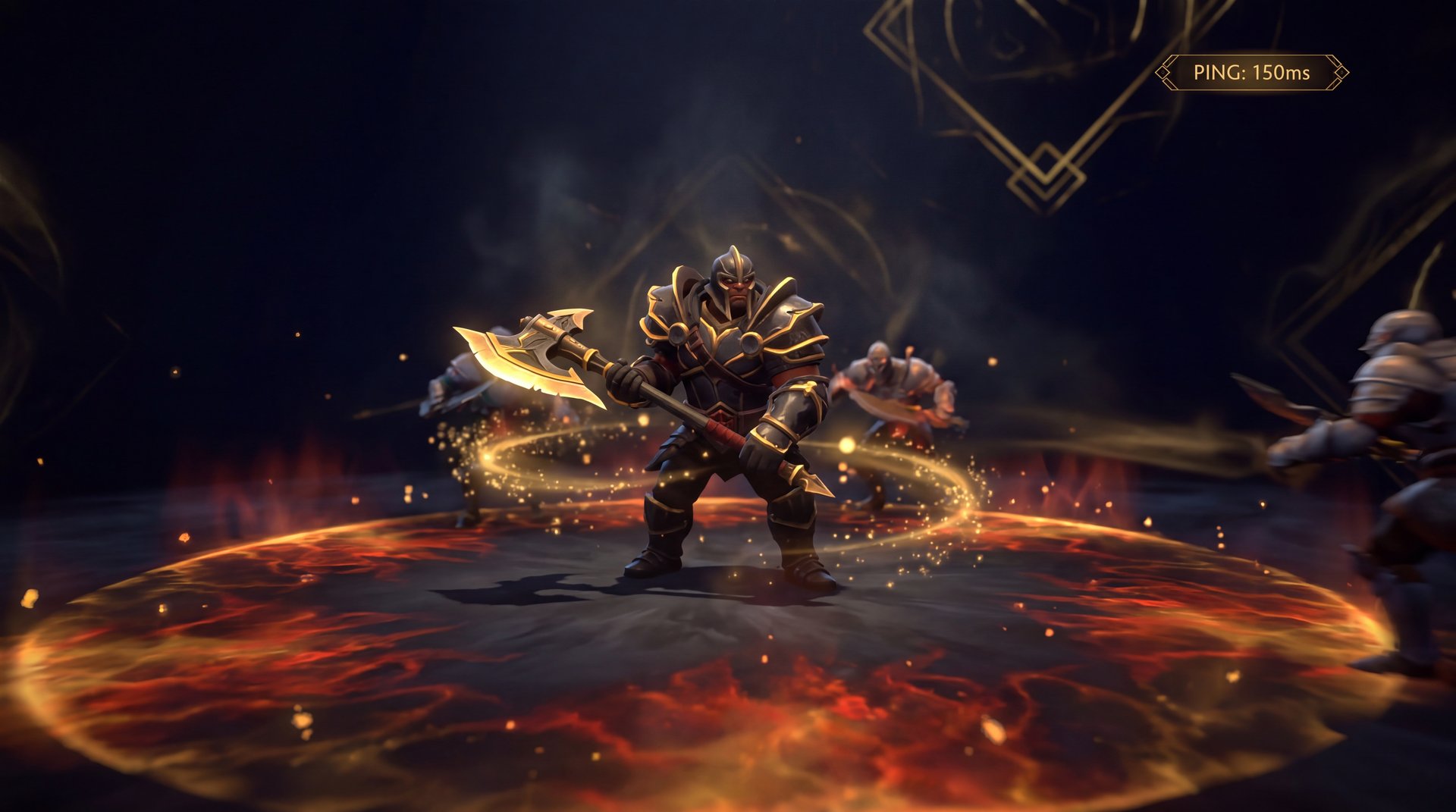
1. Axe — The Definitive High-Ping Offlaner
Axe is the single best hero to pilot on a bad connection, and the reason is almost embarrassingly simple: every key ability either hits everything around him automatically or checks a single threshold number.
Why ping does not hurt Axe
Berserker’s Call forces all nearby enemies to attack Axe. There is no aim, no timing window, no skillshot. You press it when you are in the middle of the enemy team. The server handles the rest.
Battle Hunger can miss a fast-moving target if your ping is very high, but it is not a core fighting ability — it is a harassment and slow tool that you use early and forget about.
Counter Helix is a passive. It procs automatically when enemies attack you. You do not press anything. At 300ms ping your Counter Helix still procs.
Culling Blade — the most feared ability in the game — is entirely a threshold check. If the target is below the HP threshold, they die. You do not need to react to anything. There is no timing window. You press the button when the number looks low, and the server confirms the kill or it does not. At 150ms or 250ms, the outcome is identical to a 20ms connection for any target already below threshold.
The only ping-sensitive part of Axe is spin-kiting at high ranks — expert Axe players weave between auto-attacks to proc Counter Helix optimally. For the vast majority of brackets, this is irrelevant. You walk into their team, call, and Culling Blade the person who dips below 250 HP. That loop is latency-proof.
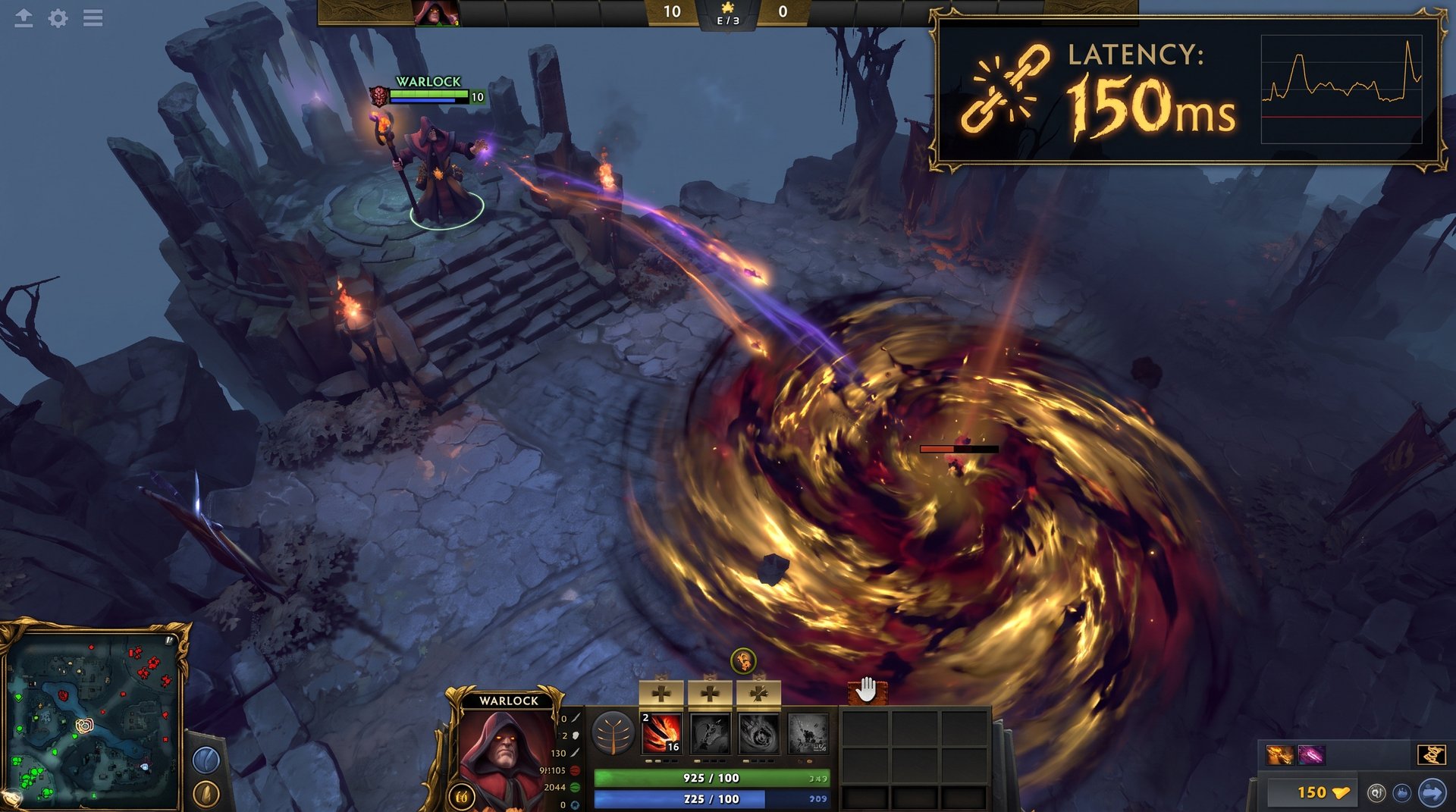
2. Warlock — Global Ultimate, Zero Aim Required
Warlock wins games in two ways: Chaotic Offering and Fatal Bonds plus Upheaval pressure. Both work fine at 150ms and above.
Why ping does not hurt Warlock
Fatal Bonds is a point-and-click spell on a single target with generous range. No prediction required. At 150ms you click the target 150ms late — the target still gets bonded.
Shadow Word is point-and-click on ally or enemy. Latency is irrelevant for targeted single-unit spells.
Upheaval is a channeled slow-field in a large AOE. You channel it in a chokepoint. There is no aim. Everything in the area slows to a crawl while you channel.
Chaotic Offering — the big ultimate — summons golems onto the battlefield and stuns a large area. The stun AOE is enormous (roughly 600 radius). More importantly, the golems continue acting without your input after they spawn. You cast once and three golems are on the field fighting for you. If you die to a ping spike after casting, the golems keep fighting.
Warlock is also a support, which means your farm priority is lower — you are less punished by the inefficiency that sometimes comes with high latency on last-hitting. The combination of a global ultimate, allies that act independently, and no skill shots makes Warlock the strongest high-ping support in the game.
3. Tidehunter — The Teamfight Nuke That Cannot Miss
Tidehunter has one of the highest teamfight ceilings in Dota 2 and almost none of it requires precise timing.
Why ping does not hurt Tidehunter
Gush is the most skill-shot-like ability on Tidehunter and it has a wide projectile. At 150ms you throw it slightly late — it hits the area your target was in 150ms ago. At close range it almost always connects.
Kraken Shell is a passive that removes debuffs and provides damage block. You do not press anything. Ever.
Anchor Smash is an instant AOE around Tidehunter. No target, no aim — press the button and everything nearby gets hit and loses base damage.
Ravage covers approximately 1,025 radius around Tidehunter. It hits every enemy on a normal-sized screen. You need to be in the right position — which requires map reading, not fast reactions — and press R. Even at 300ms the Ravage lands if you are in the middle of the team when you press it. The window for a good Ravage is measured in seconds, not milliseconds.
The only latency concern is initiating from a safe position with Blink Dagger. Buying Blink on high ping requires discipline about not clicking while taking damage — a rule of thumb that protects you regardless of why your Blink might be on cooldown.
4. Bristleback — The Passive Tank Who Farms Through Latency
Bristleback is the closest thing Dota 2 has to a hero that plays itself. The majority of his damage output comes from abilities that trigger automatically or have no targeting requirements.
Why ping does not hurt Bristleback
Viscous Nasal Goo is a targeted single-target ability. Point, click, debuff. No timing.
Quill Spray is an instant AOE around Bristleback. Press it and everything in the area gets hit and debuffed. The only decision is whether to press it now or in two seconds.
Bristleback (passive) applies stacks when you take damage from behind. You do not do anything except face away from enemies. The more they attack you, the stronger you get.
Warpath (passive) increases move speed and damage every time you cast a spell. Since your spells are trivial to cast at any ping, you build stacks naturally without precision.
Bristleback’s gameplay on high ping is identical to his gameplay on low ping: walk into the enemy team’s attacks facing away from them, spam Quill Spray, get stronger. There is genuinely nothing timing-sensitive in his kit for the roles he fills in most brackets.
5. Underlord — Aura Carrier and Global Rotator
Underlord is criminally underrated on high-ping connections because he wins through presence and auras rather than mechanical execution.
Why ping does not hurt Underlord
Firestorm is a ground-targeted AOE. It requires placing a circle on the map, not tracking a moving target. A 150ms delay shifts where the ring lands slightly — it does not change whether enemies inside take damage over its full duration.
Pit of Malice is a ground AOE root field. Plant it where enemies will be, not where they are right now. Positional reads replace reaction time entirely.
Atrophy Aura is a permanent passive aura that reduces enemy damage in a large radius. Zero input required. Just exist near the enemy team.
Dark Rift teleports your entire team to an ally structure. The cast channel is so long by design that latency is irrelevant — you start the channel in safety, not as a panic reaction. Your team follows the moment they click accept.
If your team has a high-ping player, putting them on Underlord ensures full contribution value while the connection sorts itself out. The Atrophy Aura alone is worth a farming slot in most teamfights.
6. Wraith King — The Forgiving Carry
Wraith King is one of the few hard carries who remains fully functional above 150ms because his kit front-loads passive and AOE power rather than requiring split-second inputs.
Why ping does not hurt Wraith King
Wraithfire Blast has a large projectile with a generous hitbox and reasonable range. At 150ms the projectile arrives slightly later — at most laning ranges it still hits unless the target is running directly away at full speed.
Vampiric Aura is a passive lifesteal aura shared with nearby units. Nothing to press.
Mortal Strike is a passive critical hit chance. Nothing to press. It fires on auto-attacks automatically.
Reincarnation is a built-in safety net. When Wraith King dies he respawns in place. Even if you miscalculate because a ping spike hid an incoming nuke, the hero does not actually die — he comes back 3 seconds later with a slow aura active around him. This forgiveness mechanism is uniquely valuable for players on unstable connections.
The caveat at 250ms: Wraithfire Blast can miss fast-moving targets at long range, and Wraith King’s Blink Dagger timing suffers just like any blink user. But compared to a carry like Anti-Mage or Ember Spirit, the latency tax is very small.
Want to accelerate your climb to a bracket where your ping is less punishing? Our Dota 2 MMR boost service gets you out of the bracket where opponent skill is the limiting factor.
7. Nature’s Prophet — Global Pressure Without Precise Aim
Nature’s Prophet is often described as a hero for players who understand map control. He is equally useful for players whose ping prevents precise mechanical play.
Why ping does not hurt Nature’s Prophet
Sprout targets a unit and creates a ring of trees around it. Point-and-click with a generous hitbox. The trees appear in a wide radius — there is no aim component to landing the root itself.
Teleportation has a 3-second channel and takes him anywhere on the map. The channel is long by design — you start it in safety. Latency barely enters the equation during the channel itself.
Nature’s Call summons treants in a target area. Ground-targeted circle, press the button, summons appear and fight independently without further input from you.
Wrath of Nature bounces between enemy units globally. Point it at any visible enemy and it chains through all visible units on the map. No tracking, no prediction — the engine handles chain targeting automatically.
The one downside: split-pushing requires reading the minimap and teleporting before the enemy rotates to kill you. If you misjudge and need to escape, your teleport channel requires not taking damage — on high ping you may misread how close an enemy is because their position updates 150ms behind.
8. Silencer — The Global Silence That Never Misses
Silencer’s ultimate — Global Silence — is the most latency-immune teamfight ability in the entire hero pool. You press R and every enemy on the map is silenced. There is no projectile, no aim, no travel time.
Why ping does not hurt Silencer
Arcane Curse is a ground AOE. Place the circle, enemies inside get slowed and take damage over time. No tracking a moving unit.
Glaives of Wisdom are a passive modifier on your auto-attacks. Every auto-attack deals bonus intelligence-based damage without any extra button presses.
Last Word applies a debuff that silences and damages enemies who cast spells. You press it once on a target; the damage fires automatically when they cast. The server handles the trigger.
Global Silence applies instantly to every enemy hero in the game the moment the animation completes. At 200ms your Global Silence lands 200ms later than at 5ms — but since the silence lasts 5 full seconds, that 200ms difference in delivery time is invisible in practice.
9. Viper — The Lane Bully Whose Damage Is Passive
Viper deals continuous damage through passive procs and toggled poison, making him one of the best lane heroes for players dealing with latency issues.
Why ping does not hurt Viper
Poison Attack is a toggle that adds a slow and damage-over-time to every Viper auto-attack. Toggle it on once. Done. It fires on every attack without further input.
Nethertoxin damages enemies in a circle at the target location. The hitbox is wide and the projectile is fast. At 150ms it is still effective at most laning ranges.
Corrosive Skin is a passive that applies a slow and damage to anyone who attacks Viper with physical projectiles. Nothing to activate. It procs whenever the server processes an incoming attack.
Viper Strike is point-and-click. Click the enemy and they receive a heavy slow plus damage-over-time. No skillshot, no timing window.
10. Omniknight — The Support Whose Ultimate Wins Teamfights Automatically
Omniknight is an underappreciated pick on high ping because Guardian Angel — his ultimate — is one of the largest teamwide defensive abilities in the game and can be cast preemptively with no reaction requirement.
Why ping does not hurt Omniknight
Purification is instant point-and-click heal and damage burst. You click an ally to heal them or an enemy to burst nearby enemies. No prediction or timing.
Hammer of Purity is a targeted ability that deals burst physical damage in a line. Click a target. Done.
Degen Aura is a passive aura that slows enemies in melee range. It triggers automatically by proximity.
Guardian Angel grants physical immunity to every nearby ally for 6 seconds. At 150ms the ability fires 150ms later than intended — but since you cast it proactively when you see the initiation begin, the 150ms lag is invisible in practice. The 6-second duration more than covers the delivery window.
If you want professional coaching to develop the map-reading skills that complement these heroes, our Dota 2 coaching sessions match you with a high-MMR player who can review your positional decision-making — the skill that matters most when mechanics are limited by your connection.
Honourable Mentions
Several other heroes pass the 150ms test without quite cracking the top ten:
- Timbersaw — Chakram is a large AOE, Reactive Armor is passive. He is tankier the longer a fight goes, which compensates for late reactions. The concern is that effective Timbersaw play at higher skill brackets uses Whirling Death plus Timber Chain combos that require some timing.
- Dragon Knight — Breathe Fire is a wide projectile, Dragon Tail has a forgiving hitbox at close range, and Elder Dragon Form is a toggle. A solid high-ping melee carry who does not require combo precision.
- Doom — Doom ultimate is point-and-click. Scorched Earth is a self-aura. The only positioning concern is Devour, which requires being near neutral creeps — a macro decision, not a split-second reaction.
- Elder Titan — Astral Spirit passes through walls and returns, Earth Splitter is a large-area slow wave with a built-in 2-second delay. That delay is so long that 150ms latency represents under 8% of the total cast-to-damage window.
Heroes to Avoid on High Ping
For completeness, these are the heroes where 150ms or more causes the most objective loss — avoid them until your connection stabilizes:
- Invoker — every spell requires a precise button-order combo, and most spells have narrow hitboxes or tight timing windows.
- Puck — Phase Shift requires seeing an incoming projectile and reacting within 100ms. Not feasible at 150ms ping.
- Storm Spirit — Ball Lightning repositioning is continuous flight driven by real-time input. Latency causes repeated overshoots.
- Anti-Mage — Blink has a very short cooldown and effective play involves constant micro-blinking to dodge abilities. At 150ms you will be hit by things you intended to blink away from.
- Mirana — Sacred Arrow is a long-range skillshot requiring prediction of enemy movement over full travel time. Already difficult at 20ms; near-impossible against moving targets at 150ms.
- Io — Tether, Overcharge, and Relocate all require sub-200ms coordination with a carry partner. The entire hero is built around precise timing windows with a specific teammate.
Fixing Your Ping Before You Pick
The heroes above give you the best shot at winning on a bad connection. But managing the connection itself is still worth doing. The simplest path is switching to a less congested server region — Dubai and Southeast Asia players often find that a different server performs significantly better during peak hours. Our full guide on how to change your Dota 2 server region covers every method including the in-client setting and the Steam download region trick.
If you are climbing through brackets where your high-ping handicap is limiting progress and you want to reach a skill level where your decision-making carries more weight than your ping, our full breakdown of the best Dota 2 boosting services explains how to evaluate the options. The MMR boosting guide also covers what to expect from the process in detail.
The core takeaway: high ping is a real disadvantage on the wrong heroes, and a manageable inconvenience on the right ones. Axe, Warlock, Tidehunter, Bristleback, and Underlord will give you full teamfight value at 150ms or 250ms. Pick them, play the map correctly, and the scoreboard next to your ping becomes a lot less important.
Frequently Asked Questions
Stuck in a Bracket That Punishes Your Ping?
You have the right hero picks. Now let a high-MMR booster help you reach a bracket where your decision-making is the deciding factor — not the number in the top right corner.
Boost My MMR Book a Coaching Session



