

Best Low-APM Heroes: Climb Without Fast Hands

Not every Dota 2 player has the reflexes of a TI finalist. Some people play on 150ms ping. Some are switching from casual games and still learning the interface. Some just want to climb without remapping their fingers. This guide is for all of them.
APM — Actions Per Minute — is the raw click-and-keypress count that measures how much you are doing with your inputs every minute. High-APM heroes like Invoker, Chen, or Meepo reward players who can execute 15-25 precise actions per second. Low-APM heroes give you almost the same payoff with a fraction of the mechanical demand.
The 10 heroes below are not weak. They are mechanically forgiving. That is a completely different thing. Every one of them can carry you from Herald to Legend with correct fundamentals — and some of them scale into the very highest brackets. The skill they require is decision-making, positioning, and game sense, not finger speed.
What You Will Find Here
What Is APM in Dota 2?
APM stands for Actions Per Minute. It counts every mouse click, right-click, hotkey press, and item activation you perform in a given minute of play. A professional Dota 2 player might average 300-450 APM during a teamfight. A Herald player might average 60-90 APM across an entire game.
High APM is not automatically an advantage. Clicking more than your hero needs is called micromanagement overhead — you are burning mental bandwidth on inputs that do not change the outcome. The value of APM comes entirely from whether those actions are useful. An Invoker player spending 200 APM on clean spell combos is using that bandwidth well. The same player nervously right-clicking the same creep 12 times is not.
Low-APM heroes have kits that do not punish a slower input rhythm. Their spells have long durations, wide hitboxes, or straightforward activation conditions. You cast when the moment is right, not when you have threaded a perfect input sequence.
This guide focuses specifically on heroes that win through decision quality and positioning rather than mechanical execution. If you want a starting point before tackling this list, the best beginner heroes for your first 100 games covers heroes chosen purely for accessibility across all dimensions.
Why Low-APM Heroes Can Still Win
The biggest misconception in Dota is that mechanical skill is the main ceiling. It is not. Mechanical skill is the floor that lets you execute what your brain is planning. Most players below Immortal lose games for strategic reasons — bad positioning, wrong item choices, poor objective timing — not because they could not press buttons fast enough.
Low-APM heroes let you redirect the mental budget you would have spent on rapid inputs toward things that actually decide games:
- Map awareness — knowing where the enemy jungler is, which lanes need pressure, when the next Roshan timer hits
- Draft reading — picking heroes that counter the enemy lineup rather than hoping mechanics overcome a hard counter
- Itemization — buying the right items for the game state, not defaulting to a cookie-cutter build every match
- Timing pressure — knowing when your hero spikes in power and forcing a fight at that exact moment
These skills climb MMR just as reliably as mechanical execution — and for most players below Legend, they are the more limiting factor. The MMR boosting guide goes deep on what actually separates winning and losing brackets; the short version is that decision quality beats raw APM at every tier below Immortal.
Low-APM heroes also perform better on high-ping connections. Heroes that rely on animation canceling or tight timing windows (Invoker rotations, Meepo micromanagement) suffer on 120-200ms because each input has a roundtrip delay that compounds across a 20-action sequence. Wraith King, Bristleback, and Omniknight are substantially more playable on a bad connection — which matters for a large share of the global Dota player base.
The 10 Best Low-APM Heroes in Dota 2
Each entry covers three things: why the hero is low-APM, what skill it actually does require, and the rank range where it performs best.
1. Wraith King
Wraith King is the most mechanically forgiving carry in Dota 2. His entire kit is: walk toward enemies, Wraithfire Blast to slow one target, right-click until things die, and press Reincarnation before you get bursted. No animation cancels, no precise spell timing, no complex item activation windows.
Why it is low-APM: Every ability has a generous cast time or is a passive proc. You are never juggling more than one active decision at once during a teamfight.
What skill it does require: Timing Reincarnation is the real skill expression. Burning it too early wastes the cooldown. Burning it too late means dying before it activates. Smart Reincarnation timing alone separates a 1k WK from a 3k WK.
Best rank range: Herald through Archon. Reincarnation is a catch-up mechanic that punishes enemies who cannot burst you twice in quick succession — something lower-bracket players consistently struggle to execute.
2. Dragon Knight
Dragon Knight is a four-button hero where two of the four buttons are best pressed in the same order every fight. Breathe Fire to reduce enemy damage, Dragon Tail to stun, right-click while in Dragon form, repeat. The hero has strong base stats, a natural armor progression, and a self-sustaining passive that makes laning forgiving even against aggressive trilane setups.
Why it is low-APM: The combo has a natural pause between spells. You cast Breathe Fire, wait for the animation, press Dragon Tail, and then the fight is mostly automated. No split-second execution windows required.
What skill it does require: Knowing when to use Black Dragon form for towers versus teamfights. DK is one of the best Roshan heroes in the game at level 11 — players who identify and act on that timing window win a lot of games by default.
Best rank range: Herald through Crusader. Straightforward laning, strong tower push, and a teamfight presence that does not rely on team coordination to execute.
3. Axe
Axe rewards you for doing one thing extremely well: initiating on enemies with Berserker’s Call and trusting Culling Blade to clean up below the threshold. The hero does not require fast hands. He requires courage and correct target selection.
Why it is low-APM: Blink in, Call, Culling Blade. That three-step routine is the entire mechanical ask. Battle Hunger and Counter Helix are either passive or low-precision. You are not juggling multiple item activations and ability chains simultaneously.
What skill it does require: Target priority. Calling the wrong hero — one who cannot be isolated or who has immediate escape — wastes the combo entirely. Learning which enemy to Call first is genuine strategic skill that scales all the way to Divine.
Best rank range: Guardian through Legend. Axe is one of the best picks for players who want to climb the offlane without micro-intensive heroes like Lone Druid or Visage. A TeamSmurf coaching session focused on Axe typically returns results within 10-15 games of applying the target-priority concepts.
4. Bristleback
Bristleback might be the ultimate “just walk forward” hero. The plan is: walk into the enemy team, take damage (which triggers Quill Spray stacks via the passive Bristleback ability), and let the passive reduce most of what hits you from behind. You are a walking attrition machine that gets more dangerous the longer a fight lasts.
Why it is low-APM: Counter Helix fires itself. Quill Spray stacks itself from the passive. The only active management is casting Quill Spray manually for early damage stacking and knowing when to apply Viscous Nasal Goo on priority targets.
What skill it does require: Positioning relative to the enemy team. Bristleback needs to face away from burst damage sources to activate the passive reduction correctly. Getting hit from behind is fine. Getting collapsed on from the front ends fights quickly.
Best rank range: Herald through Legend. Bristleback is one of the easiest heroes to post positive KDA numbers on because the hero naturally discourages enemies from fully committing — which stabilizes games across every early bracket.
5. Centaur Warrunner
Centaur’s job description: walk into the enemy team, Double Edge, Hoof Stomp, right-click, use Stampede when your team needs to leave or chase. The hero is a natural teamfight initiator who does not require precise spell timing to be useful in every fight.
Why it is low-APM: Double Edge and Hoof Stomp have generous cast ranges and AoE. You do not need to aim precisely — you need to be approximately near the correct targets. Stampede is a point-and-click team spell with a wide application window.
What skill it does require: Knowing when to use Stampede aggressively versus defensively. Using it to initiate on five clustered heroes in the open is different from using it to escape a losing fight. This single decision separates average Centaur players from effective ones.
Best rank range: Herald through Archon. Tanky heroes with teamwide utility disproportionately outperform glass-cannon mechanics heroes in brackets where team coordination is low and teamfights are chaotic and prolonged.
6. Tidehunter
Tidehunter exists to press Ravage at the right moment. Everything else he does — Anchor Smash, Kraken Shell, Gush — is either passive or low-precision. The hero’s entire game impact can be traced back to a single question: did you land a good Ravage?
Why it is low-APM: Ravage has a large AoE and a very generous activation window. You do not need pinpoint aim. Gush is a point-and-click slow. Anchor Smash and Kraken Shell both require zero input management during fights — they happen automatically or with a single button press.
What skill it does require: Patience. A Tidehunter who presses Ravage immediately at the start of every fight wastes it on scattered enemies. The skill is waiting until three or more enemies are overlapping before committing. This is a decision quality skill, not a mechanical one.
Best rank range: Herald through Guardian. In upper brackets, experienced players actively split against Tidehunter. In lower brackets, enemies cluster naturally and Ravage reliably hits four or five heroes.
7. Omniknight
Omniknight is a support who protects allies reactively rather than initiating aggressively. His game plan is: use Purification for burst healing and damage, cast Repel when allies are about to be disabled, and save Guardian Angel for teamfights. The hero is forgiving because his spells have wide windows of correct usage and do not chain into each other in a specific sequence.
Why it is low-APM: Purification and Repel are single-target casts with generous timing windows. Guardian Angel is a channel you start and then let play out. There is no rapid input sequence required to activate his full kit.
What skill it does require: Reading the fight before it happens. Repel is most powerful when cast before the enemy stun lands, not after. Anticipating enemy initiation is a game-reading skill rather than a reaction-time skill — which makes it more learnable through focused attention than through raw practice volume.
Best rank range: Herald through Archon. At lower brackets, pure sustain supports disproportionately outperform because enemies cannot coordinate burst damage to counter healing efficiently.
8. Ancient Apparition
Ancient Apparition is a ranged support whose primary contribution is landing Ice Blast at game-winning moments. The hero’s other spells — Cold Feet, Ice Vortex — have simple mechanics and mostly function as setup for Ice Blast or as zoning tools during laning.
Why it is low-APM: Ice Vortex is a ground-targeted AoE drop. Cold Feet is a point-and-click debuff. The only skill expression requiring practice is learning to calibrate Ice Blast range accurately — everything else is straightforward single-target or AoE activation.
What skill it does require: Ice Blast timing and target selection. AA hard-counters heroes who rely on healing — Huskar, Medusa, Ursa with Armlet, Lifestealer — enough to swing entire games based purely on draft synergy. Recognizing when the enemy lineup makes AA a high-value pick is a draft-reading skill, not an execution skill.
Best rank range: Guardian through Legend. Ice Blast is one of the highest-impact single spells in the game against specific enemy compositions, and at lower brackets, enemies rarely itemize to play around the HP restoration block.
9. Mars
Mars combines a directional spear with a circular arena trap. The concept is simple: land Spear of Mars on a priority target to pin them against terrain, enclose them with Arena of Blood, and delete them with your team before the arena expires. The hero rewards fight-reading, not fast execution.
Why it is low-APM: Spear of Mars travels in a straight line with solid hitbox tolerance. Arena of Blood is centered on you — it does not require aiming at all. God’s Rebuke is a point-and-click AoE. The only active skill expression is spear direction.
What skill it does require: Spear angle and terrain awareness. A perfect Spear pins a carry against a cliff and removes them from a fight for three seconds. A missed Spear is a 16-second cooldown wasted. Learning to read terrain and enemy positions is the primary skill investment for Mars, and it pays off in every single game on the hero.
Best rank range: Guardian through Legend. Mars underperforms in the very lowest brackets because the hero needs teammates who can follow up on initiations. He peaks when playing with one coordinated partner who understands the combo goal.
10. Pudge (at a Basic Level)
Pudge has a reputation as a mechanical hero, but that reputation comes from high-level play where people throw hooks from across the map. At the level where most players operate, Pudge is actually straightforward: hook someone at close or medium range in a lane, activate Rot, press Dismember when they are next to you. The three-button sequence has a long execution window at this distance.
Why it is low-APM: Close-range hooks are significantly easier than long-range ones. At lower brackets, players stand in predictable positions in lane and on the map. Dismember is a targeted channel with a wide cast range. The hero does not need rapid inputs — just basic spatial awareness.
What skill it does require: Hook aim improves with repetition, not with raw APM. Players who are good at Pudge have accumulated experience reading enemy movement patterns, not simply pressed more buttons faster. This makes Pudge one of the few heroes where volume of games on one hero directly translates to better execution.
Best rank range: Herald through Archon. At Legend and above, experienced players actively juke hooks in lane and purchase Black King Bar or strong disables that break Dismember, making the hero significantly harder to pilot effectively.
Quick Reference: Low-APM Heroes at a Glance
| Hero | Role | Why Low-APM | Real Skill Required | Best Rank |
|---|---|---|---|---|
| Wraith King | Carry | Passive procs, two active spells | Reincarnation timing | Herald — Archon |
| Dragon Knight | Mid / Carry | Fixed combo order, slow tempo | Roshan + tower timing | Herald — Crusader |
| Axe | Offlane | Three-step combo, no chaining | Target priority | Guardian — Legend |
| Bristleback | Offlane | Passive-driven damage output | Facing direction in fights | Herald — Legend |
| Centaur Warrunner | Offlane | Wide AoE spells | Stampede decision | Herald — Archon |
| Tidehunter | Offlane / Pos 4 | One key spell, rest are passive | Ravage patience | Herald — Guardian |
| Omniknight | Support | Reactive spells, wide windows | Fight anticipation | Herald — Archon |
| Ancient Apparition | Support | Simple kit, one skill expression | Ice Blast range calibration | Guardian — Legend |
| Mars | Offlane | Skill shots with generous hitboxes | Spear angle and terrain | Guardian — Legend |
| Pudge | Support / Offlane | Easy at close range | Spatial awareness, hook reps | Herald — Archon |
How to Climb With Low-APM Heroes
Picking a low-APM hero gives you a mechanical floor advantage, not a free win. Here is how to maximize it.
Specialize in One or Two Heroes
The highest single climb factor for low-APM heroes is repetition volume. Play the same hero across 40-60 games before evaluating results. Each game teaches you micro-patterns that do not feel like high-APM inputs but compound into significant skill advantages: where to stand during a Dragon Knight ultimate, exactly when Bristleback should turn to absorb a combo, which Wraith King itemization crushes specific enemy lineups.
Playing five different low-APM heroes per week gives you partial knowledge of five heroes. Playing two heroes gives you enough depth to solve problems those heroes create in specific game states, which translates directly into winrate stability over 50-game samples.
Solve the Farm Problem Early
Most low-APM heroes are not the fastest farmers in the game. Dragon Knight and Wraith King farm at medium speed. Axe and Bristleback are efficient enough but need early brawls to get ahead. The solution is to prioritize fight wins in the early-to-mid game that result in gold leads rather than relying purely on jungle efficiency to hit item timings.
Play aggressively when your hero spikes: Dragon Knight at level 6, Axe with Blink Dagger, Centaur after getting Aghanim’s Scepter. These power windows are when your hero is disproportionately strong compared to farm-dependent carries. Use them.
Use the Freed Mental Budget Deliberately
Because your hero does not demand high APM, you have cognitive budget to focus on one specific habit per game. Choose one per session: landing hooks when Pudge is the pick, tracking the Roshan timer when Dragon Knight is the pick, watching for enemy grouping on Tidehunter. Stacking one decision habit per session compresses learning into a form that actually transfers across games. Trying to improve five things at once on any hero results in improving none of them.
Cross-Link Your Knowledge
Low-APM heroes are a starting point, not a ceiling. Once you feel confident on your main pick, explore the easiest heroes for every role to see what to expand toward based on your preferred position. If you hit a plateau and suspect your fundamentals need external diagnosis, a Dota 2 coaching session paired with replay review can identify the exact decisions costing you MMR — something no written guide can do without watching your games directly.
Low-APM Hero Picks by Rank Bracket
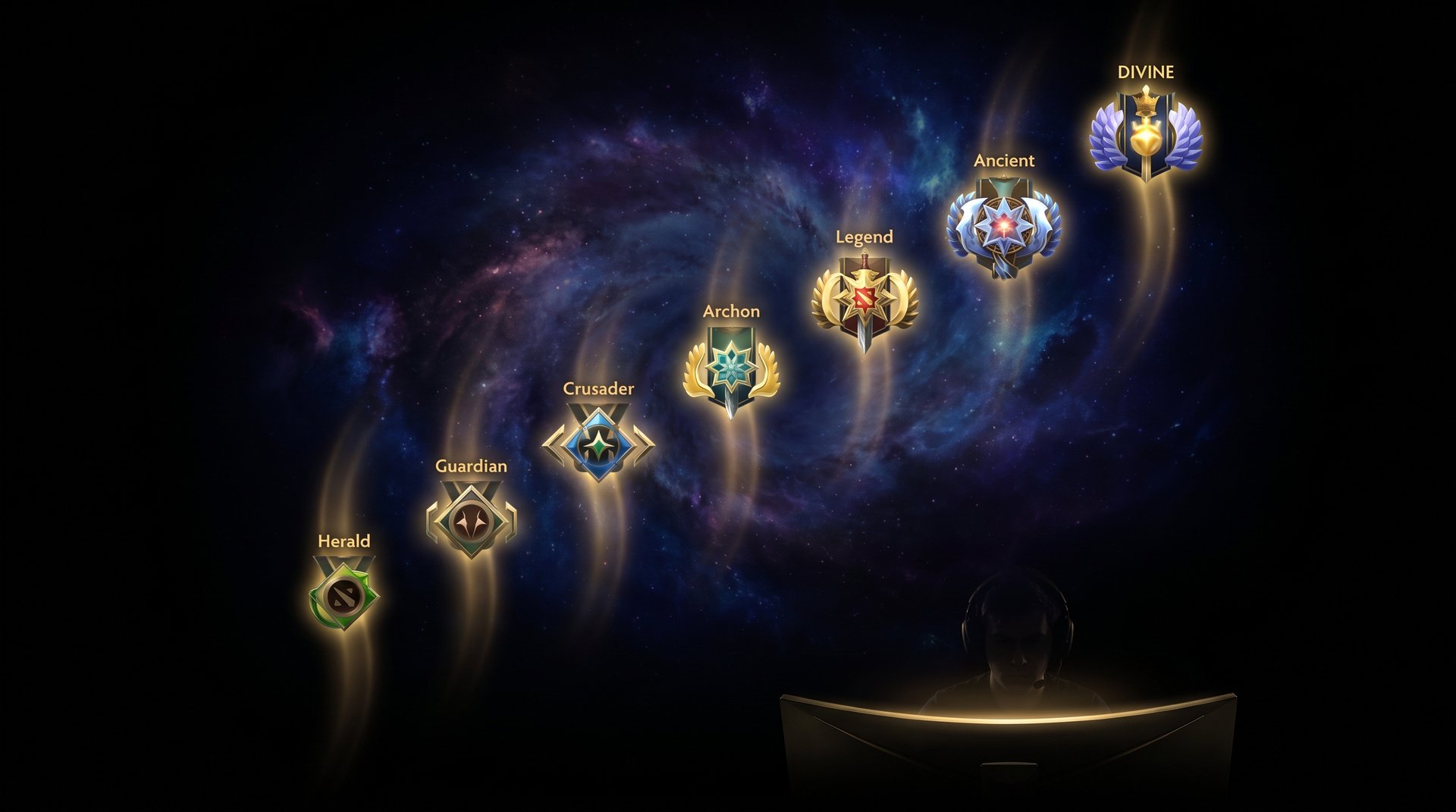
Herald and Guardian (0 — 1900 MMR)
In these brackets, the best low-APM pick is the one that wins the laning stage consistently on its own. Bristleback and Dragon Knight both pressure lanes aggressively, deny enemies from participating through sustained attrition, and scale into teamfights without needing team coordination. Wraith King is the safest carry option because Reincarnation buys time for teammates to rotate — which lower-bracket teams often fail to do, making the second life even more valuable as a surprise.
Crusader and Archon (1900 — 2900 MMR)
At this tier, enemies are beginning to draft with intent and occasionally itemize against dominant picks. Axe and Centaur become more valuable because their initiation is harder to simply right-click through. Mars starts to shine here as players begin grouping more intentionally around objectives. Omniknight is strongest in this bracket out of the support options — coordinated burst damage starts appearing and a well-timed Guardian Angel negates it entirely in fights your team otherwise loses.
Legend and Ancient (2900 — 4600 MMR)
Low-APM heroes still win games but require stronger game-reading to compensate for opponents who actively juke, draft against your pick, and apply pressure on your mechanical ceiling. Mars and Ancient Apparition scale best in this range — Mars because enemies start grouping in organized fight formations that reward precise Arena placement, and AA because healing-dependent cores are increasingly common and Ice Blast counters them categorically regardless of player skill level.
Divine and Immortal (4600+ MMR)
Most heroes on this list become difficult to pilot competitively at Divine and above. The exceptions are Mars (still impactful due to teamfight disruption) and Ancient Apparition (draft counter value does not diminish with MMR — countering Huskar or Ursa with Ice Blast works the same at 9k as it does at 3k). Everything else on the list either gets picked through at draft or requires mechanical refinement that closes the low-APM gap anyway. Players who are evaluating whether Dota 2 boosting is safe as a route to reaching a higher bracket before grinding the mechanical gap will find that question answered in detail on the safety page.
If you are stuck at the same bracket after 300+ hours on a low-APM hero, your mechanics are probably not the issue. Movement patterns during the laning phase, ward placement routines, and objective timing decisions account for a larger share of bracket stagnation than hero selection. These are exactly the habits our coaching sessions isolate and correct in replay review.
Common Mistakes Low-APM Players Make
Picking Low-APM Heroes Against Persistent Lockdown Lineups
Most low-APM heroes are physical-damage dependent and item-dependent to scale. Against a lineup of heroes with chain lockdown (Shadow Demon, Bane, Disruptor), a Wraith King or Dragon Knight will struggle to output damage through the stun chains even with Reincarnation or Dragon form active. Part of the skill of low-APM play is recognizing when the enemy draft makes your pick unplayable and switching to an alternative, even if that alternative has a slightly higher mechanical demand like Sven or Terrorblade.
Playing Too Passively While Waiting for a Perfect Engage
Tidehunter and Mars players are especially prone to this trap. Waiting for a perfect five-man Ravage or perfect Arena placement means spending 10 minutes of the game contributing nothing to the team’s objectives. A three-man Ravage that kills two priority targets is still a game-winning play. Learn to commit on a good opportunity instead of holding out for a theoretically perfect one that may never arrive.
Ignoring Hero Power Windows
Low-APM heroes compensate for mechanical simplicity by having strong window power — moments where they are disproportionately strong relative to the game clock. Dragon Knight at level 11 with Aghanim’s Scepter is one of the best Roshan heroes in the game. Axe with Blink Dagger at level 7 has a kill window that closes significantly at 25 minutes when enemies accumulate Black King Bars. Playing these windows deliberately — not reactively — is what separates climbers from players who plateau.
Not Redirecting the Freed Mental Budget
The cognitive budget you are not spending on APM needs to go somewhere productive. Players who pick low-APM heroes but still spend the whole game watching their own hero gain none of the decision-quality advantages these heroes are designed to provide. Practice scanning the minimap every 8-10 seconds during dead time in lane. Over 20 games, this single habit improves your map awareness more than any guide passage about map awareness can.
Want to Climb Faster on These Heroes?
A TeamSmurf coach watches your replays, identifies the specific decisions costing you MMR on your chosen hero, and builds a practice plan around your actual weaknesses — not generic advice. Low-APM players often have very fixable decision patterns that a single session can isolate and correct.


