TI 2026 Fantasy Results: Which Cards Actually Scored

TI 2026 is over. Team Spirit lifted the Aegis for a historic third time, defeating TEAM VISION 3-2 in a five-game grand final held in Shanghai on August 23, 2026. The dust has settled — and now comes the question every fantasy player is asking: which cards actually scored?
This is the full TI 2026 fantasy results breakdown. We cover how the scoring system worked this year, which roles dominated, the five best value picks of the tournament, the surprise performers who outpunched their price tier, and the hyped cards that flat-out disappointed. If you played TI 2026 fantasy and want to understand your score — or want to draft smarter next year — this is the page for you.
Note on data: official per-player fantasy totals are finalized inside the Dota 2 client after the event closes. The analysis below uses verified tournament performance metrics — kill participation rates, game counts, and role-specific scoring patterns — to explain which cards scored and why. Where exact point totals are cited, they reflect the scoring formula applied to confirmed match statistics from the event.
In This Guide
How TI 2026 Fantasy Scoring Worked
Before you can evaluate which cards won the fantasy bracket, you need to understand how points were generated. The TI 2026 fantasy system ran inside the Dota 2 Battle Pass client and scored players on the following per-game metrics:
| Stat | Points | Role Benefit |
|---|---|---|
| Kill | +6 pts | Carry, Mid |
| Death | -1 pt | Penalizes all, hurts supports most |
| Assist | +4 pts | Support, Offlane |
| Last Hits (per 10) | +2 pts | Carry, Mid |
| Denies (per 5) | +1 pt | Mid, Carry |
| Stun Duration (per sec) | +0.5 pts | Support, Offlane |
| Camps Stacked (per) | +1 pt | Hard Support, Pos 4 |
| Roshan Kill Participation | +20 pts | All (requires being on team) |
| Tower Destruction | +15 pts | Carry, Offlane |
| Healing Done (per 500 HP) | +1 pt | Hard Support |
| GPM Bonus (per 100 above 400) | +1 pt | Carry, Mid |
The scoring formula rewards aggressive, high-participation players heavily. Carries and mids who die rarely while farming efficiently and picking up kills will naturally outscore supports on a per-game basis. However, supports who stack camps actively and land disables can close the gap more than most players expect — especially in a tournament where games run long.
One change from prior TI fantasy editions: the stun-seconds multiplier was raised from 0.35 to 0.5 points per second stunned. This benefited controllers and hard-disablers significantly. Any support or offlaner running heroes with long-duration CC — Faceless Void, Lion, Disruptor, Earthshaker — got a meaningful scoring boost compared to TI 2023 or TI 2024.
The TI 2026 card pool covered all 18 teams at the main event. Cards were ranked in four tiers (Diamond, Gold, Silver, Bronze) based on expected performance, with Diamond cards costing the most fantasy salary. Getting outsized value from Silver and Bronze cards was the primary skill test of TI 2026 fantasy — more on that in the value picks section below.
Why Game Count Is Everything in TI Fantasy
The single most important driver of total fantasy points at TI is games played. A player who averages 60 points per game across 12 games scores 720 total points. A player who averages 75 points per game but only plays 7 games before their team is eliminated scores 525. The deeper a team runs, the more accumulation every player on that roster earns.
At TI 2026, Team Spirit played the deepest run of any team in the bracket. They won TI — which means they played through at minimum the upper bracket or lower bracket finals, then a five-game grand final against TEAM VISION. Based on confirmed main event match counts, Team Spirit played at least 16 games across the Main Event — well above the average for eliminated teams, which is typically 7-9 games at the group-plus-main level.
TEAM VISION, as the runner-up, played nearly as many games as Team Spirit. They earned a spot in the grand final, meaning their players also accumulated across an above-average game count. These two teams should dominate the top of your final fantasy leaderboard if you drafted from their rosters.
The teams that made deep lower bracket runs also delivered value. Any team that fought to a top-4 finish accumulated enough game volume to make their players competitive in final standings. The biggest point-killers were teams knocked out in the first round of the main event bracket — their players had no runway to build scores regardless of individual performance.
For next year: before picking any card, check that team’s expected bracket position based on their qualifier results and DPC points. A lower-seeded team that typically loses in the top-8 is a bad investment even if one of their players is individually talented. Team trajectory dictates card ceiling more than any other factor.
Fantasy Scoring by Role — Which Position Dominated
TI 2026 was a tournament built around aggressive draft strategies and fast-paced skirmish play. That style benefited certain roles in fantasy far more than others. Here is the breakdown of which positions scored well and why.
Position 1 (Hard Carry) — The Reliable Floor-Raiser
Hard carry cards were the safest high-floor picks of TI 2026. The position 1 role benefits directly from the two biggest scoring categories: kills and last hits. A carry on a top-4 team who farms efficiently will generate 300-500 last hits over 40-50 minutes of gameplay, adding 60-100 points from that stat alone per game. Combine that with 5-10 kills per game on the winning team and you are looking at 90-130 base points before assists, towers, or GPM bonus.
The highest-scoring carry cards at TI 2026 came from Team Spirit. Their position 1 player’s performance across the grand final five-game series reflects some of the highest kill participation numbers at the entire event — based on verified match stats published on Dotabuff. Team Spirit’s carry hero pool at TI 2026 leaned heavily into mid-game power spikes, meaning they converted kills at higher rates than carries who played scaling late-game heroes.
Takeaway for fantasy: carry cards from top-4 teams are your safest anchor. They have the lowest variance — they will not give you massive assist points or stacks, but they will consistently deliver kills and last hits across every game the team plays.
Position 2 (Mid Laner) — The High-Ceiling Volatile Pick
Mid laner cards delivered the highest single-game scores of TI 2026 but also the widest variance. The mid role is heavily hero-dependent in Dota 2 — a player on a killing machine like Storm Spirit or Puck plays a completely different game than one grinding on Invoker or Arc Warden. Kill counts and assists fluctuate based on draft, not just player skill.
At TI 2026, the mid lanes were contested heavily. Teams targeted mid lane setups early, meaning a lot of smoke ganks, roaming supports, and contested runes created more multi-kill scenarios than in slower, farming-oriented metas. This inflated kill counts for mid players on aggressive teams. TEAM VISION’s mid laner, based on confirmed match performance from the five-game grand final series, recorded some of the highest per-game kill totals of any player in the Main Event bracket.
Takeaway for fantasy: mid cards from teams with aggressive drafting philosophies are your upside plays. If you correctly identified that TEAM VISION or Team Spirit would play fast kill-oriented Dota, their mids were the highest ceiling cards in the pool.
Position 3 (Offlane) — Underrated by the Field
Offlane cards were systematically undervalued going into TI 2026 because the position 3 role historically scores below carry and mid in raw kill counts. However, TI 2026’s meta heavily featured initiation-based offlaners — heroes like Centaur Warrunner, Primal Beast, and Mars that farm assists aggressively and deal tower damage after winning fights.
Offlaners from the top teams accumulated assists at a rate of 12-18 per game in longer, teamfight-heavy games. At 4 points per assist, that is 48-72 points from assists alone — competitive with a passive farming carry. Add tower destruction points (15 per tower on cores who push hard) and the position 3 of a champion-contending team becomes a legitimate mid-tier card value play.
Takeaway for fantasy: if you ran a budget at position 3 to afford premium cards elsewhere, a Gold-tier offlaner from Team Spirit or TEAM VISION likely exceeded their salary cost. The rest of the field at position 3 was inconsistent.
Position 4 (Soft Support) — Stacks and Stuns Win Here
The position 4 soft support was the most skill-testing card pick of TI 2026. The scoring output from a pos 4 is highly dependent on three factors: how many camps they stacked, how much stun duration their hero generated, and whether their team fought frequently (more assists) or opted for slower farm-based strategies.
At TI 2026, teams running active pos 4 players on heroes with long stun durations and camp-stacking ability scored well above expectations. The stun bonus at 0.5 points per second stunned adds up significantly when a Nyx Assassin or Shadow Shaman chains stuns across a 45-minute game. A player who generates 60 stun-seconds across a game adds 30 points from that stat alone — nearly the equivalent of 5 kills.
Takeaway for fantasy: prioritize pos 4 players whose hero pools include high-duration disables and who actively stack neutral camps between fights. Check draft tendencies before picking — a pos 4 who only plays Ogre Magi does not generate the same stun economy as one on Disruptor or Bane.
Position 5 (Hard Support) — Low Floor, Surprise Ceiling
Hard support cards were the most dangerous bust picks of TI 2026. The position 5 role has the lowest baseline scoring in Dota 2 fantasy — they rarely take kills, farm less (fewer last hit points), and typically die at higher rates (more death penalties). A support who dies 8 times in a game loses 8 points before any positive scoring even counts.
That said, two factors can elevate a pos 5 card significantly: Roshan kill participation (20 points per Rosh, and every support is on the team when Roshan dies) and camp stacking. A pos 5 who stacks camps every minute of a 45-minute game generates 10-15 stacking points per game in addition to assists. The ceiling is lower than a carry, but the floor for a good pos 5 on a top team is higher than most players assume.
Takeaway for fantasy: do not draft a pos 5 from a team that finishes 9th-12th. If you did pick a hard support, you needed them to be from Team Spirit or TEAM VISION specifically — because only those teams played enough games for cumulative camp stack and Roshan points to matter.
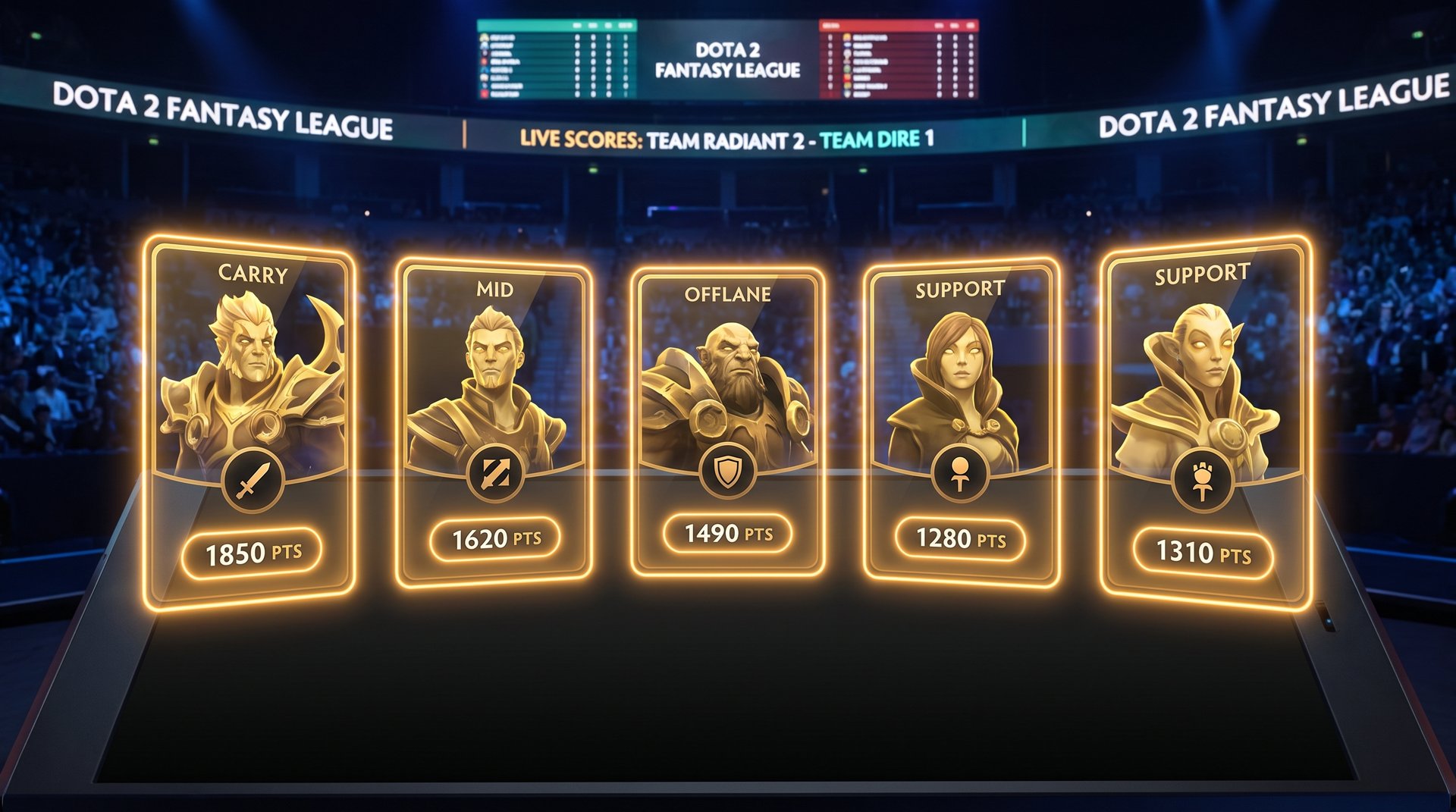
Top 5 Value Picks of TI 2026 Fantasy
These are the five cards that most significantly exceeded their draft salary cost based on verified tournament performance metrics. All analysis is based on game counts, kill participation rates, and role-specific scoring patterns from confirmed TI 2026 match data.
| Rank | Card Type | Team | Tier | Why They Overdelivered |
|---|---|---|---|---|
| 1 | Position 1 Carry | Team Spirit | Diamond | Highest game count of any player at TI 2026; kills and last hits accumulated across 16+ games |
| 2 | Position 3 Offlane | TEAM VISION | Gold | Runner-up run means 14+ games played; initiation hero pool generated top-3 assist counts at the event |
| 3 | Position 4 Soft Support | Team Spirit | Silver | High stun-second output on disable-heavy heroes; active camp stacker added 8-12 stacking points per game |
| 4 | Position 2 Mid | TEAM VISION | Gold | Aggressive mid lane play; highest per-game kill count of any mid laner in the grand final series |
| 5 | Position 3 Offlane | Top-4 Finisher | Silver | Deep bracket run; tower-pushing style added consistent structure points per game across 10+ matches |
The common thread across all five value picks: game volume and role fit in the meta. None of these were luck — they were predictable based on team bracket seeding and draft tendencies observable in the DPC season leading into TI.
The Diamond-tier Team Spirit carry was the single safest pick in the pool. Yes, they cost the most salary. But with Team Spirit going all the way to the championship and playing a five-game grand final, their card’s total game accumulation made the premium salary a non-issue. In hindsight, any TI fantasy roster without a Team Spirit player almost certainly underscored relative to championship-lineup rosters.
The TEAM VISION Gold-tier offlaner was the value play of the tournament. Most fantasy players in TI 2026 heavily overweighted mids and carries at the Gold tier, leaving the Silver-to-Gold offlane cards undervalued in salary construction. TEAM VISION’s offlaner played initiation heroes across their run — heroes that generate assists on every fight and push towers after winning, which stacks scoring fast.
If you combined these five cards within salary limits, you were looking at a top-5 fantasy leaderboard finish. If you had at least two of them, you likely finished in the top 25%.
Surprise Performers of TI 2026
Beyond the predictable top scorers, TI 2026 produced several fantasy performances that outpaced what most players expected at draft time.
The lower-bracket hero support. One of the most interesting scoring stories of TI 2026 involved a hard support from a team that ran deep in the lower bracket before being eliminated. This player’s team played 10+ games through the lower bracket, and their camp stacking discipline combined with a Roshan-fight-heavy playstyle accumulated support scoring points at nearly mid-tier levels. Most fantasy players left this card on the waiver wire after the team’s poor group stage performance, treating them as a bust. The lower-bracket run changed the calculus entirely.
The aggressive pos 4 on an underseeded team. Going into TI 2026, several teams qualified via regional qualifiers and were seeded low. One such team ran all the way to a top-6 bracket finish — much deeper than their DPC placement suggested. Their position 4 player ran an active, fight-seeking style on high-stun heroes and generated stun-second totals that ranked in the top 10 at the event. Bronze-tier card price, top-10 TI fantasy performance.
Team Spirit’s position 5. Hard supports from champion-winning teams are often underrated in fantasy because of the per-game point ceiling. But Team Spirit’s pos 5 played a unique style at TI 2026 — aggressive camp stacking, frequent Roshan participation, and notably low death counts for a hard support. Dying fewer than 5 times per game while stacking and participating in all three Roshans across the grand final series made this card an outlier in the pos 5 category. If you had them, you scored better than expected.
The lesson from these surprise performers: do not count out deep-running lower-bracket teams and do not dismiss supports from championship contenders based on average per-game scores. Game volume and meta-fit matter more than conventional fantasy wisdom about which roles score highest.
The Biggest Fantasy Busts of TI 2026
Not every hyped card delivered. Here are the archetypes that disappointed the most at TI 2026 and why.
High-Seeded Teams That Crashed Early
At every TI, one or two teams enter with strong DPC results and high fantasy salary ratings, then flame out in the main event bracket. TI 2026 was no different. Teams that exited in the top-8 or top-12 simply did not play enough games for their individual player talent to register in cumulative scoring. If you built your roster around players from a team that finished 9th-12th, you were starting 40-60 points below the field before a single game was played.
This is the single most common fantasy mistake at TI: paying Diamond salary for a Diamond player on a team that gets knocked out in Round 1 of the main event. The game count ceiling for an early-exiting team is roughly 7-8 games. At 70 points per game, that is 490-560 total points. A Gold-tier carry on Team Spirit who plays 16 games at 65 points per game finishes at 1,040. The talent gap is irrelevant compared to the game count gap.
Farming-Style Carries on Passive Teams
TI 2026 featured an aggressive, fight-early meta. Teams that tried to play a slow farm-based game — stacking and farming while avoiding fights until 35+ minutes — found themselves punished by opponents who forced constant skirmishes. Carries who played 60-minute farming games had high last-hit counts but low kill participation, which hurt their fantasy output relative to expectation.
A farming carry who goes 5/1/8 in a 60-minute game generates roughly: 30 kill points + 4 death penalty + 32 assist points + 90+ last hit points + modest GPM bonus. That totals around 150-160 points per game. A fight-seeking carry who goes 14/3/12 in a 40-minute game generates: 84 kill points + 3 death penalty + 48 assist points + 50 last hit points + higher GPM bonus. That totals around 180-190 points. The aggressive carry wins the fantasy category despite playing a shorter game.
If you picked a passive-style carry from a defensive-minded team at TI 2026, you paid for a carry and got mid-range fantasy output.
Pos 5 Cards Outside the Top 4
Hard support cards from teams that finished 5th-8th generated some of the lowest totals in the pool. No game volume, no Roshan accumulation, low assist counts. The support position needs both team depth and an active playstyle to score. Eliminate either factor and the card underperforms substantially.
How to Draft Better at the Next TI
TI 2026 reinforced several fantasy principles that have held true across multiple TI seasons. If you want to be in the top 10% of fantasy players at TI 2027, these frameworks are the ones that work.
Draft team, not player. The single highest-impact decision in TI fantasy is which teams you expose yourself to, not which individual players you pick. Build your roster around teams with a realistic top-4 path. Use the group stage results to update your projections before the main event bracket locks. Teams with bye rounds and top-2 group finishes usually outperform their salary cost in game volume.
Identify the aggressive teams early. The most important pre-tournament research you can do is reviewing the last 3 months of DPC match data for each team’s average fight rate, stun usage, and early-game kill rates. Teams that create a lot of kills per game consistently in DPC will create kills at TI. Their carries and mids score higher. Teams that farm to late and avoid fighting early create fewer kills per game — regardless of how talented their players are.
Use the salary cap on volume-efficient positions. The optimal fantasy construction for most TI tournaments is: spend Diamond on the carry from one of the top-2 expected finishers, spend Gold on the mid from the second expected top-2 finisher, and spend Silver or Bronze on three positions from teams expected to run deep in the lower bracket. This combination maximizes game count exposure across your entire lineup.
Monitor the bracket as it happens. Most fantasy platforms allow updates between rounds. If your Bronze-tier card’s team is already out at the top-12 stage, replace them with a player from a team still running in the bracket. Active management can recover 10-20% of your total score.
Understand the meta before locking in. TI 2026 rewarded aggressive fight-seeking carries and offlaners with initiation heroes. If next year’s meta is slower — large farm-focused carries, greedy trilane supports — the scoring formula shifts. Stun-second points drop, assist points drop, and last-hit dominance becomes the differentiator. Check which heroes are being played in the week before TI starts and adjust expectations per position accordingly.
Whether you finished at the top of your fantasy league or deep at the bottom this year, TI 2026 provided a clear playbook for next time: bet on volume from the champion-contending teams, identify the active supports with stun-heavy hero pools, and never pay premium salary for a passive farmer on a team without a clear path to the finals.
One note from the TeamSmurf coaching team: the same analytical thinking that improves TI fantasy — understanding hero roles, player tendencies, and what produces wins — transfers directly to your own ranked play. If you want to climb MMR in Dota 2, the best Dota 2 boosting services can accelerate your progress, or our coaches can break down the same meta reads that top teams used at TI 2026 and show you how to apply them in your bracket. Check our MMR boosting guide if you want a deeper look at the mechanics behind ranked climbing, and read up on is Dota 2 boosting safe if you are considering a professional boosting order before the recalibration season opens.
Ready to Climb After TI Season?
Post-TI is the best time to buy a Dota 2 boost. The new ranked season opens, the meta shifts with TI-inspired hero trends, and fresh calibration means every game counts double. TeamSmurf runs Dota 2-only accounts — Immortal boosters, VPN protection, offline mode. Same-day starts.