TI 2026 Grand Final Recap: How Team Spirit Won Their Third Aegis

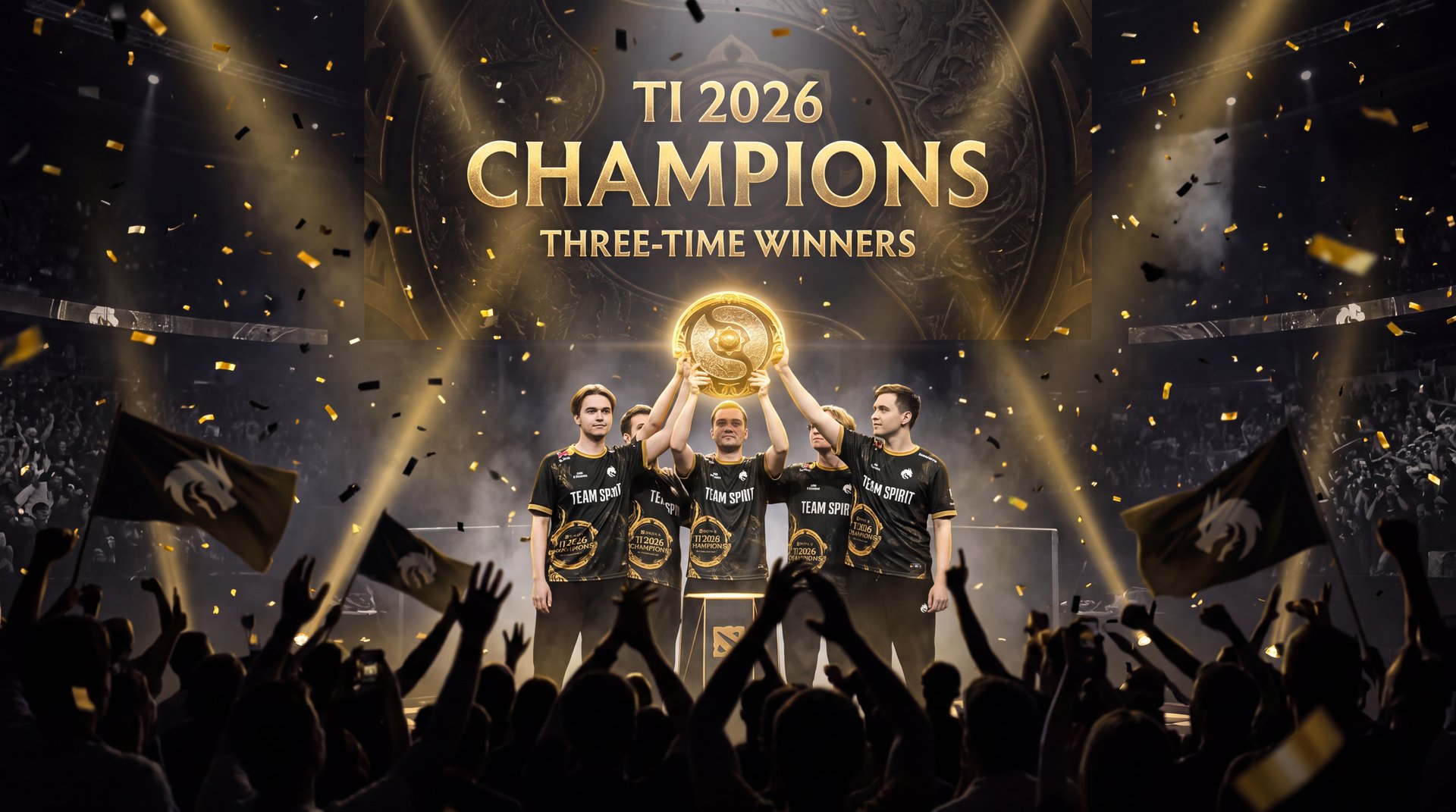
It took 64 minutes, five games, and one of the most dramatic comebacks in Dota 2 history — but Team Spirit have done it again. For the third time in their careers, Yatoro, Collapse, and coach Miposhka held the Aegis of Champions above their heads in Shanghai on August 23, 2026. Spirit defeated TEAM VISION (aka PARIVISION) 3-2 in the best-of-five grand final of The International 2026 to become the first-ever three-time TI world champions.
This recap breaks down every game of that series, Spirit’s full bracket run from the Elimination Stage to the throne, and the pivotal moments that separated the greatest squad in Dota 2 history from a VISION side that arrived in Shanghai as the overwhelming favourites.
In This Recap
- Spirit’s Path to the Grand Final
- Grand Final Series Overview
- Game 1: Spirit Strike First
- Game 2: VISION Levels It
- Game 3: The Pivotal Third Map
- Game 4: VISION Fires Back
- Game 5: 64-Minute Thriller
- Why Yatoro’s Performance Was Decisive
- Draft Strategy Lessons From the Series
- What Three Titles Actually Means
- What Pub Players Can Learn
Spirit’s Path to the Grand Final: The Hardest Road in Shanghai
TEAM VISION walked a highway to the grand finals. Spirit climbed a cliff face.
In the Group Stage, VISION went undefeated across five rounds — sweeping Team Resilience, Team Falcons, and BoomBoys (BetBoom Team) before putting Spirit away 2-0 in Round 4. That clean sheet earned them a direct spot in the Playoffs. Spirit, by contrast, had been rolling through their first three rounds (sweeping Xtreme Gaming, Aurora Gaming, and Team Liquid), only to be swept by VISION in Round 4, then suffer an upset 0-2 loss to Nigma Galaxy in Round 5. That double stumble forced Spirit into the Elimination Stage, where they had to beat Team Resilience in a three-game series just to earn their place in the Playoffs main event.
From the Elimination Stage onward, Spirit’s bracket run looked like this:
| Stage | Opponent | Result | Notes |
|---|---|---|---|
| Elimination Stage | Team Resilience | 2-1 Win | Scrappy three-game grind; earned the right to continue |
| Upper Bracket QF | Iron Wing (1w Team) | 2-0 Win | Clinical sweep; Spirit looked sharp and fast |
| Upper Bracket SF | TEAM VISION | 1-2 Loss | Closest meeting of TI 2026; Spirit dropped to LB |
| Lower Bracket QF | Team Liquid | 2-0 Win | Dominant — Spirit found their groove through the bracket |
| Lower Bracket SF | BoomBoys | 2-0 Win | Comfortable; drafts looked polished and purposeful |
| Lower Bracket Final | Team Yandex | 2-0 Win | Routed; Spirit peaked at exactly the right moment |
| Grand Final | TEAM VISION | 3-2 Win | 64-minute decider; third Aegis claimed |
The Lower Bracket run tells you everything about this Spirit squad. Where most teams tighten up under elimination pressure, Spirit found a different gear. By the time they walked out for the grand final, they had played — and won — more high-stakes games in seven days than any other team in the tournament. VISION, fresh off their Upper Bracket Finals win over Team Yandex, had rested for two days. Spirit had momentum. VISION had recovery time. The question was which advantage would matter more when the games actually started.
Grand Final Series Overview
Before we go game by game, here is the compressed read on how the series unfolded:
| Game | Winner | Character | Series Score After |
|---|---|---|---|
| Game 1 | Team Spirit | Spirit dominant from start to finish | Spirit 1-0 |
| Game 2 | TEAM VISION | VISION flipped a Spirit mid-game lead | Tied 1-1 |
| Game 3 | Team Spirit | Close affair; Spirit took it at the edge | Spirit 2-1 |
| Game 4 | TEAM VISION | VISION routed Spirit; forced game 5 | Tied 2-2 |
| Game 5 | Team Spirit | 64-minute thriller; Spirit from behind to champions | Spirit 3-2 — CHAMPIONS |
A 3-2 grand final at TI never goes exactly to form, but this one was wilder than most. Spirit dominated, got pegged back, surged ahead, got flattened, then had to dig deeper than any team should have to in a game 5. The 64-minute duration of the decider puts it among the longest TI grand final games in recent memory — and it was earned, not padded. Every minute meant something.
Game 1: Spirit Strike First
Spirit came out swinging in game 1 and it showed from the first few minutes of the game. The pace was dictated entirely by Collapse’s offlane pressure and Yatoro’s ability to hit power spikes faster than VISION’s draft could account for. Spirit’s preparation had clearly identified something specific in VISION’s tendencies, because their hero selections were purpose-built to counter the hand VISION showed.
Once Spirit established early control, they snowballed efficiently — never giving VISION the time or space to stabilise and pivot into their preferred late-game mode. By the midgame, Spirit’s net worth lead had extended to the point where individual fights were academic. VISION found no viable entry point into the game. Spirit closed it out without drama and without needing to do anything spectacular. This was the clean, composed performance Spirit’s fans had been waiting to see in the biggest match of the year.
Game 2: VISION Levels It Up
VISION’s coaching staff made significant adjustments heading into game 2. Puppey — a TI1 champion and now a four-time grand finals participant — is one of the most experienced support-captains in Dota 2 history, and that experience showed in how quickly VISION recalibrated after losing game 1.
Spirit actually built an early lead in game 2. Yatoro was farming efficiently, the support duo of not me and rue were making smart rotations, and it briefly looked like Spirit might replicate their game 1 control. Then VISION flipped it. In what the broadcast described as a pivotal momentum shift in the midgame, VISION found the fight they needed, converted kills into objectives, and dragged the game into their preferred territory. Once Spirit’s early advantage evaporated, VISION’s own cores began to outscale the contest. Spirit could not find a re-entry point and dropped game 2 to level the series at 1-1.
The turnaround in game 2 was a reminder of exactly why VISION had gone undefeated in the Group Stage. They do not need to win the early game. They just need to survive it long enough for their scaling composition to come online.
Game 3: The Pivotal Third Map
In a best-of-five, game 3 is almost always the series within the series. Win it and you have championship point with two safety nets. Lose it and momentum swings entirely to the other side. Both teams knew the psychological weight of this map. The crowd in Shanghai could feel it.
Game 3 was a close affair from beginning to end — neither team committed to anything definitive for long stretches, with the advantage shifting based on individual skirmishes rather than clean strategic execution. Spirit’s support play from not me and rue was highlighted by observers as a key stabilising factor. Both players were attending their first TI, and the fact that they were matching VISION’s veterans in a grandstand game 3 situation said something meaningful about the squad’s overall composition and preparation.
Spirit eventually found the edge they needed, converted it into a game 3 win, and took a 2-1 series lead. The Aegis was one game away.
Game 4: VISION Fires Back
VISION responded to their backs-against-the-wall situation the way great teams do: ruthlessly and without hesitation. Game 4 was not a close game. VISION routed Spirit — the broadcast used strong language about the dominance of VISION’s execution. Spirit, perhaps fractionally tightening up with the finish line in sight, could not execute at the level they needed to close out the series.
This is a pattern that appears in TI history: a team at match point in the grand final loses their composure by a fraction, and the opponent — with nothing left to lose — plays looser and better for it. VISION forced game 5, the crowd at Shanghai’s Oriental Sports Center collectively held its breath, and the psychological momentum swung fully back to VISION.
Puppey’s influence in game 4 was visible. VISION’s draft was sharp and coherent, their execution disciplined, and they denied Spirit the win with enough authority to reframe the narrative heading into the decider. A 3-2 instead of a 3-1 is a very different story. VISION made it 3-2.
Game 5: 64-Minute Thriller, Spirit Champions
Game 5 of a TI grand final is one of the rarest and most electric situations in competitive Dota 2. The crowd at the Oriental Sports Center was at maximum intensity. Both teams were running on adrenaline and five days of high-stakes competition. The prize pool, the Aegis, and an unprecedented third world title were all sitting at the end of one more game.
VISION came out with early aggression and established a lead in the opening phase, forcing Spirit to play from behind in the highest-stakes game of their lives. For most teams, a deficit in game 5 of a TI grand final would be an unrecoverable psychological blow. Spirit had been in equivalent positions before — in the Lower Bracket, multiple times, over the course of the week. They had a process.
The comeback was methodical rather than flashy. Spirit did not abandon their strategic structure and gamble on desperation plays — they held shape, waited for VISION to overextend, and picked their moments with the kind of discipline that only comes from teams who have practiced winning from behind. Over the course of what became a 64-minute marathon, Spirit gradually clawed back the deficit, converted fights when the windows appeared, and ran VISION down until there was nothing left to defend.
When the final throne fell, Yatoro, Collapse, Larl, not me, and rue gathered on stage in Shanghai. Miposhka — coaching the squad he had won TI 2021 and TI 2023 with as a player — joined the celebration. It was the first time in Dota 2 history that any individual or team had claimed three TI titles. The Aegis of Champions went to Team Spirit for the third time.
Why Yatoro’s Performance Was Decisive
Illya “Yatoro” Mulyarchuk is now a three-time TI world champion. He won TI 2021 as one of the youngest players ever to claim the title. He won TI 2023 as the consensus best carry in the world. And in 2026, with a target on his back, with VISION’s preparation specifically oriented around neutralising his impact, he delivered again when the series reached its critical moments.
Across the five-game series, Yatoro’s consistency under pressure separated Spirit from VISION at the moments that counted most. VISION’s core strategic identity — proven through their dominant Group Stage run — was built around neutralising enemy carries in the early-to-midgame and then out-scaling with their own cores in the late game. Against almost every team at TI 2026, that approach worked. Against Yatoro, it did not fully close out.
| Attribute | Why It Mattered in the Grand Final Series |
|---|---|
| Farm efficiency | Yatoro consistently hit power spikes faster than VISION’s draft timeline could account for |
| Fight timing | He converted available windows without overextending, even when Spirit were playing from behind |
| Positional discipline | VISION’s support duo struggled to find him at vulnerable moments in extended teamfights |
| Game 5 composure | Playing from behind in a 64-minute decider and converting the win requires a specific psychological makeup |
| Hero pool depth | Spirit could draft around VISION’s bans without meaningfully reducing Yatoro’s game impact |
Magomed “Collapse” Khalilov deserves equal billing in this analysis. As the offlaner, Collapse is responsible for creating the early-game conditions that allow Yatoro to farm efficiently and come online on schedule. The fact that the Yatoro-Collapse axis has produced three TI titles across a five-year window — in three different meta contexts, against three different sets of opponents — speaks to its durability at the highest level of the game. This is not a partnership that works by accident.
Draft Strategy Lessons From the TI 2026 Grand Final
The 3-2 scoreline is instructive for anyone who follows competitive Dota 2 — or who wants to improve their own understanding of hero selection and game shape.
The series swung on draft flexibility. VISION’s Group Stage dominance was built partly on the strength of a deep, coherent hero pool that allowed them to first-pick strong heroes and react from a position of strength. When they went undefeated through the Group Stage, it suggested that pool was deeper and more adaptable than anything they would face in the Playoffs.
Spirit’s counter was not to out-flex VISION in absolute pool depth — it was to make Yatoro’s carry role effectively unbannable by maintaining multiple heroes at championship level in that position. If VISION banned Hero A, Yatoro played Hero B with equivalent efficiency. This forced VISION into a reactive draft mode they were less comfortable in, because they could not solve the carry question by using the ban phase to take away Yatoro’s best option.
The games VISION won (2 and 4) were the ones where they successfully identified and restricted Spirit’s preferred game shape. The games Spirit won were the ones where their hero flexibility created a draft situation VISION could not fully neutralise before the game started.
Puppey’s support captain role is worth noting separately. As one of the most decorated players in Dota 2 history — TI1 champion in 2011, grand finalist in 2012, 2013, 2022, and now 2026 — Puppey’s draft decisions were consistently sophisticated and the VISION game plan was always coherent. Spirit just had the specific individual firepower to execute against it when the moments mattered most.
What Three Titles Actually Means: Spirit’s Place in Dota 2 History
Before August 23, 2026, no individual player — and no team — had won The International three times. OG (2018, 2019) were the benchmark: two consecutive titles, widely considered the greatest single achievement in competitive Dota 2 history. Spirit have now surpassed it, with titles spread across three different TI editions and in a roster configuration that evolved between each victory.
| Player | Role | TI Titles | Historical Significance |
|---|---|---|---|
| Yatoro | Carry | 3 (2021, 2023, 2026) | First three-time TI champion in Dota 2 history |
| Collapse | Offlaner | 3 (2021, 2023, 2026) | First three-time TI champion in Dota 2 history |
| Miposhka | Coach | 3 (2021, 2023 as player; 2026 as coach) | Only person to win TI as both player and head coach |
| Larl | Mid | 2 (2023, 2026) | 13th player to win TI twice |
| not me | Support | 1 (2026) | Won the Aegis in their first-ever TI appearance |
| rue | Support | 1 (2026) | First Aegis for a steadily-rising Eastern European pro |
The fact that Miposhka transitioned from player to coach without losing any championship-winning formula is genuinely unusual. Coaching elite Dota 2 requires a completely different skill set from playing it at the professional level. The results across two editions under his guidance suggest Spirit have built something systematic in their preparation approach — a structure around practice methodology, draft philosophy, and team culture that survives roster changes and produces results across meta shifts.
For VISION and Puppey, this result is a painful one. Puppey won TI1 in 2011 — the first world champion of Dota 2 — and has finished second four times since (2012, 2013, 2022, and now 2026). VISION’s undefeated Group Stage run had made this look like the most likely year for a Puppey victory. Spirit stood in the way one final time, and the third Aegis went to the team from Eastern Europe.
What Pub Players Can Learn From Team Spirit’s Grand Final Run
Watching a TI grand final is enjoyable on its own terms. But if you want to extract something that applies to your own ranked games, Spirit’s 2026 run is genuinely instructive. These are the most transferable principles:
1. Lower Bracket Runs Require a Different Mental Framework
Spirit had to win seven elimination-pressure series after being knocked into the lower bracket. In pub terms, this is every losing streak you have experienced — except Spirit had to convert every single game that actually mattered. The pattern that emerged across the week is that Spirit became more consistent under elimination pressure, not less. This is a skill you can develop in ranked: treat each game as important on its own terms, independent of your last five. Variance is normal. Consistent decision-making through it is the separator between players who climb and players who spike and drop.
2. Carry Pool Depth Beats Carry Pool Width
The grand final was decided partly by Spirit’s ability to play multiple carry heroes at championship level. In ranked play, the equivalent is maintaining two or three heroes you can genuinely perform on in each role rather than trying to master everything. Hero pools that are too narrow get exploited in draft. Hero pools that are too wide never reach the consistency required to climb. The competitive sweet spot is two to three truly mastered heroes per role — and this is exactly the standard a good Dota 2 coach will help you identify and build toward.
3. The Carry-Offlaner Axis Is the Spine of Your Team
Yatoro does not dominate without Collapse establishing the conditions that make it possible. The carry-offlaner relationship — in structural terms, the late-game scaling core paired with the early-pressure creator — is the spine of any functioning Dota 2 team. In pub games, you rarely get to coordinate directly with your offlaner before the match begins. But understanding the relationship helps: if you are a carry player, your job in the early game is to respond to what your offlaner is creating. If you are an offlaner, your job is to create the space that allows your carry to farm on schedule. When both players understand this, the coordination happens naturally even without voice communication.
4. Play the Current Game Situation, Not the Scoreboard
Spirit were behind in game 5. In ranked play, being down 5-10k gold at your MMR ceiling often triggers a shift to tilted decision-making — taking bad fights, chasing kills that are not available, abandoning the strategic approach that put you in a winnable position in the first place. Spirit did the opposite: they maintained structure, stayed patient, and waited for VISION to overextend before converting. The comeback came because they played the actual game situation rather than reacting to the fact that they were losing. This is one of the highest-leverage skills in ranked Dota 2, and it is directly learnable. Our MMR boosting guide covers the mindset elements that separate consistent climbers from players who are talented but volatile.
5. Coaching Makes the Intangibles Tangible
Miposhka’s contribution to Spirit’s 2026 victory cannot be quantified on a statistics page, but it was visible in the team’s preparation quality, their draft adaptations, and their ability to reset between games. In pub terms, a coaching session with a high-MMR player serves the same function: it externalises your blind spots, identifies the habits that are limiting your climb, and gives you a framework that holds up under pressure. If you want to apply what Spirit showed in the grand final, starting with a session from TeamSmurf’s coaching roster is the most direct path.
Apply TI-Level Strategy to Your Ranked Climb
Spirit’s run showed what happens when draft discipline, carry execution, and team structure work together under the highest possible pressure. If you want to climb MMR with a systematic approach rather than grinding it out alone, TeamSmurf’s immortal-tier boosters and coaches work within exactly this framework.
For everything you need to know about the boosting process before committing, our guide to the best Dota 2 boosting services covers the full landscape in 2026. For the mechanics of how MMR is calculated and what it takes to climb efficiently post-TI, the MMR boosting guide breaks it down clearly. And if you have concerns about account safety, is Dota 2 boosting safe addresses every common question with honest answers.