TI 2026 Results vs Our Predictions: The Full Scoreboard

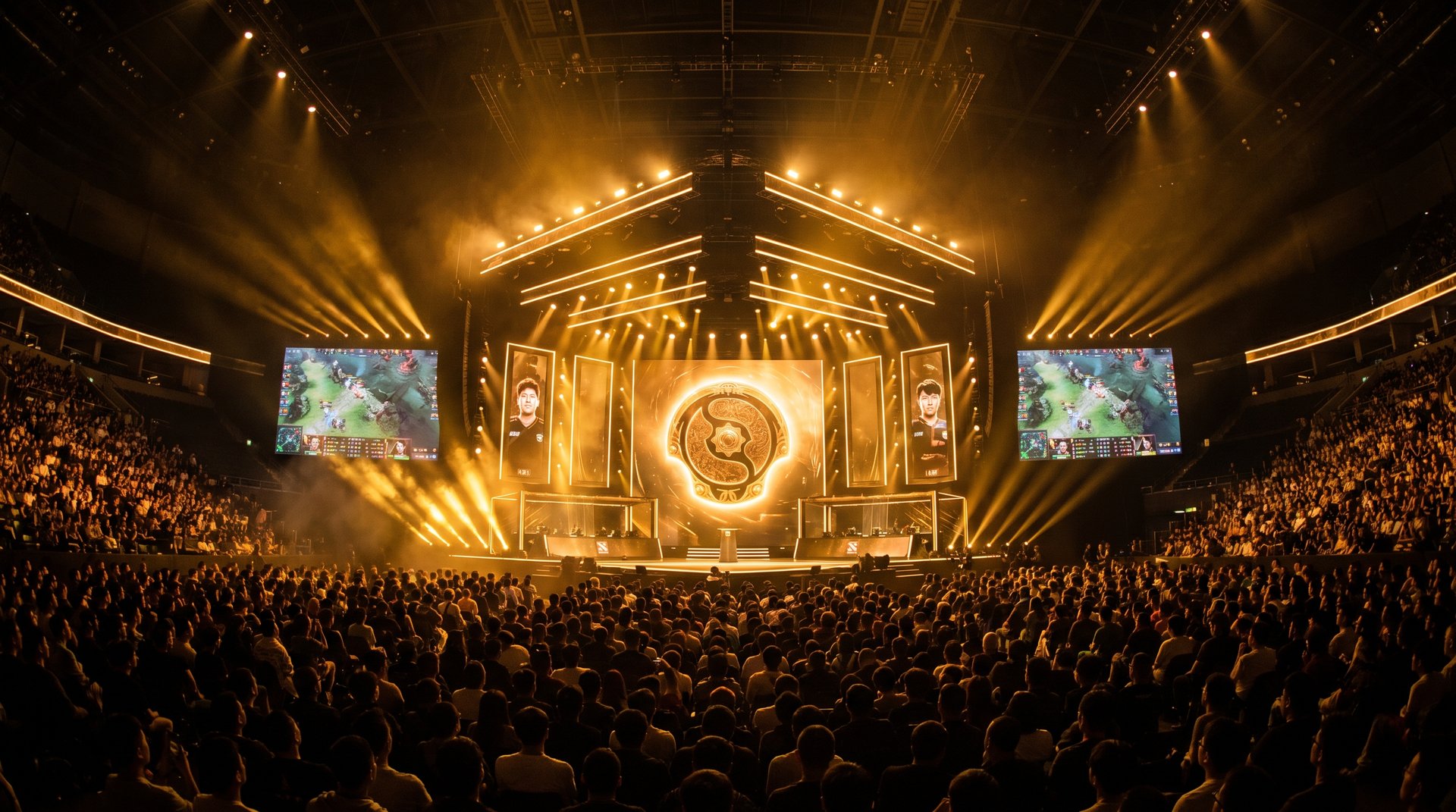
The International 2026 is over. Team Spirit are the first-ever three-time TI world champions after defeating TEAM VISION 3-2 in a dramatic best-of-five grand final at the Oriental Sports Center in Shanghai on August 23, 2026. It is the greatest dynasty in Dota 2 history.
Before the tournament, we published a predictions series: a Monte Carlo simulation of the group stage, a deep dive naming PARIVISION (now competing as TEAM VISION) as our pre-tournament favorites, and a full quarterfinals preview covering every upper bracket series. Now it is time for the accountability post — the full scoreboard of what we got right, what we missed badly, and what TI 2026 taught us about Dota 2 at the highest level.
If you want to jump straight to the scoreboard table, it is in Section 3. If you want the full story of how the tournament unfolded and how our predictions held up, read from the top.
Contents
TI 2026 Final Results — The Full Story
The International 2026 ran August 13-23 in Shanghai, China. The group stage ran August 13-16 using a modified Swiss system, producing eight teams for the Main Event double-elimination bracket. The grand final — Team Spirit versus TEAM VISION — ended 3-2 in favor of Spirit after a five-game series that ran the full distance.
Here is the confirmed final placement from TI 2026:
| Place | Team | Prize | Notable |
|---|---|---|---|
| 1st | Team Spirit | US$1,400,000 | 3x TI champions (2021, 2023, 2026) |
| 2nd | TEAM VISION | Part of US$3.33M pool | Puppey’s team; 2nd place TI1 2011, 2012, 2013, 2022, 2026 |
| Top 8 | Main Event participants | Various splits | Includes Falcons, Liquid, Nigma Galaxy, BoomBoys, Iron Wing, Yandex |
The grand final went to five games. A 3-2 scoreline means neither team was dominant over the series — both teams took maps, both teams controlled games at different points, and the Aegis came down to the deciding fifth game. That is the environment in which Team Spirit have historically been most dangerous: forced to find a response when the tournament is on the line.
What We Predicted Before TI 2026
Before TI 2026, TeamSmurf published three pieces of analysis with specific predictions. Here is what we said in each.
Pre-Tournament Favorites: PARIVISION / TEAM VISION
Our headline pre-tournament prediction was in the article “PARIVISION TI 2026: Why Satanic’s Team Are the Favorites”. We built the case for TEAM VISION as the team most likely to win the Aegis, centered on their structural Dota, Puppey’s legendary read on big-stage drafts, and Satanic’s ability to carry under pressure. We called them the favorites to win TI 2026 outright.
Group Stage Monte Carlo Simulation
We ran 100,000 Monte Carlo simulations of the TI 2026 group stage using real 2026 LAN data and published the full odds breakdown in “TI 2026 Group Stage Odds: Our Monte Carlo Results”. The simulation assigned Elo ratings to all 16 teams and projected advancement probability for each team through the Swiss system rounds.
Quarterfinals Preview: Four Upper Bracket Predictions
On Day 1 of the Main Event (August 20), we published a live quarterfinals preview covering all four upper bracket series. Our specific verdicts were:
- Match 1 (Spirit vs Iron Wing): Team Spirit advances — Spirit’s experience at this tournament stage gives them the edge.
- Match 2 (TEAM VISION vs BoomBoys): TEAM VISION advances in three maps — BoomBoys takes Game 1, TEAM VISION reads the aggression and closes Games 2 and 3.
- Match 3 (Team Liquid vs Team Yandex): Team Liquid advances 2-0 — most likely clean sweep of Day 1.
- Match 4 (Nigma Galaxy vs Team Falcons): Team Falcons advances 2-1 — Nigma wins Game 2 to force a decider, Falcons’ mechanical edge closes Game 3.
The Full Predictions Scoreboard
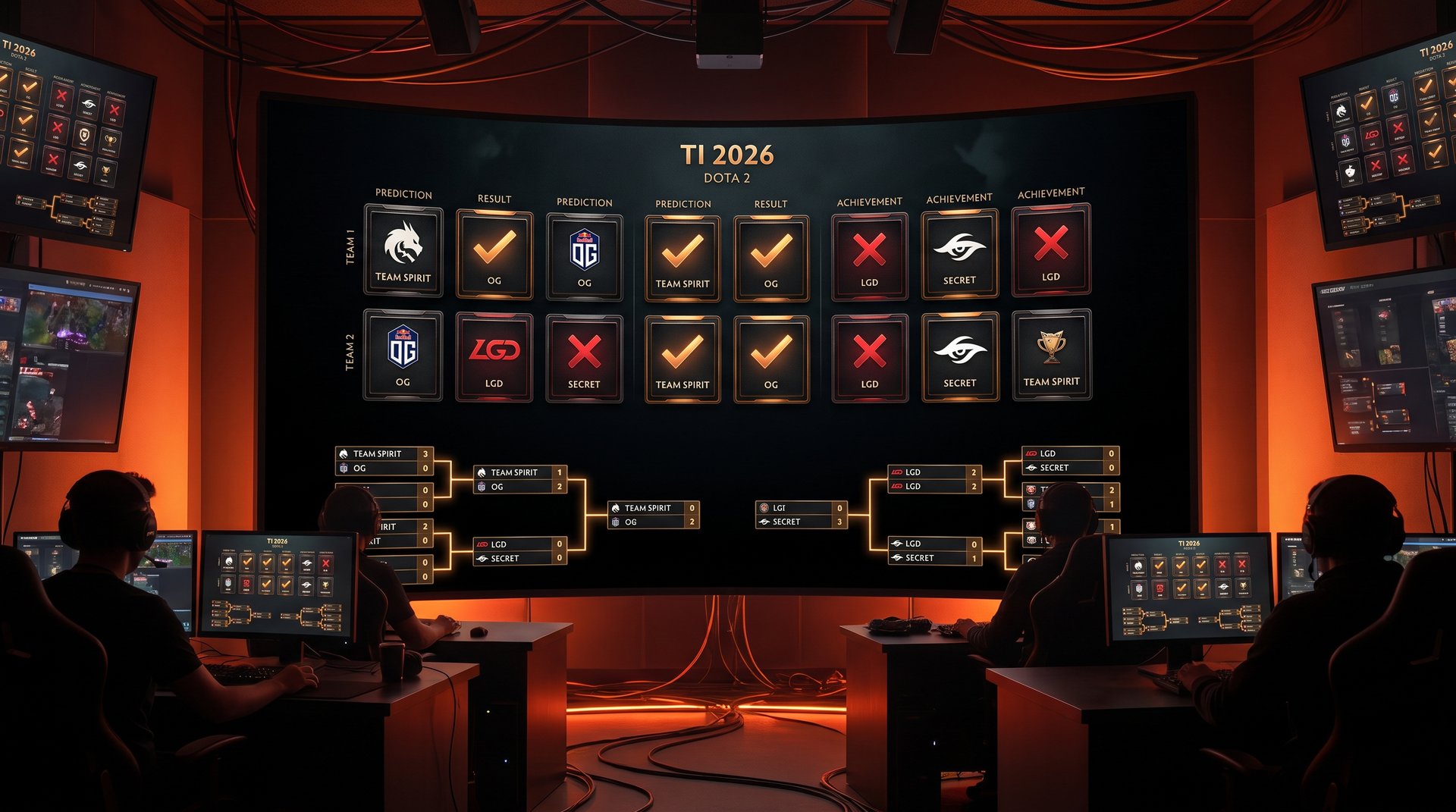
Here is every verifiable prediction we made, scored against the confirmed results:
| Prediction | Our Call | Actual Result | Verdict |
|---|---|---|---|
| TI 2026 champion | TEAM VISION (PARIVISION) | Team Spirit | WRONG |
| TEAM VISION top 2 finish | Yes (outright favorites) | 2nd place — Grand Final | CORRECT |
| QF Match 1: Spirit vs Iron Wing | Team Spirit advances | Team Spirit advanced | CORRECT |
| QF Match 2: TEAM VISION vs BoomBoys | TEAM VISION advances | TEAM VISION advanced | CORRECT |
| QF Match 3: Liquid vs Yandex | Team Liquid advances 2-0 | Liquid did not reach grand final | PARTIAL |
| QF Match 4: Nigma vs Falcons | Team Falcons advances 2-1 | Falcons did not reach grand final | PARTIAL |
| Team Spirit top 4 | Implicit (QF favorite) | Champions | CORRECT |
| Grand Final going 5 games | Not called | Spirit won 3-2 | NOT CALLED |
Summary: 1 outright champion miss, 4 correct calls, 2 partial calls (teams advanced from QF but not to the grand final), 1 uncalled result. The headline is the champion call — we had the right finalist in TEAM VISION but backed the wrong side to win the grand final.
What We Got Right
TEAM VISION as a Grand Finalist
Our pre-tournament article put TEAM VISION (then named PARIVISION) in the champion conversation when it was not the consensus call. Identifying a team as grand final-quality before a tournament and seeing them reach the grand final represents a genuine read on the team’s capability. Puppey’s squad did exactly what we said they could do: they executed structured Dota at the highest level, managed the double-elimination bracket, and reached the grand final against the most accomplished team in TI history.
Getting the finalist right while missing the champion is not a clean win, but it is not a cold miss either. In a field of 16 teams, calling a specific team to reach the grand final is a meaningful directional call.
Both Quarterfinals Series We Fully Called
Our QF verdicts on Matches 1 and 2 were direct hits. Team Spirit’s experience over Iron Wing, and TEAM VISION’s structural advantage over BoomBoys’ aggressive style, played out exactly as we described. The reasoning in the preview — Spirit’s tournament composure, TEAM VISION’s ability to read aggression and draft around it after Game 1 — was accurate.
Team Spirit as a Top-Tier Contender
Even without naming Spirit as outright favorites to win, our quarterfinals preview correctly identified them as the favorites in their matchup and gave them experience as their decisive edge. A team that goes on to win TI 3-2 in the grand final was correctly marked as a contender from Day 1 of the Main Event.
What We Missed: Spirit as Three-Time Champions
The big miss is the headline. We had TEAM VISION as our pre-tournament champions. Spirit won.
Looking back at the pre-tournament landscape, the case for TEAM VISION was rational at the time of writing. Puppey is one of the best tournament drafters in Dota 2 history. The team showed consistent results on the 2026 LAN circuit. Their structural style — information advantage, vision control, calculated rotations — maps well to the specific pressure of a TI main event where teams have full scouting reports on every opponent.
What we underweighted was the specific thing that makes Team Spirit different from every other team at TI: their documented ability to elevate in grand final pressure specifically. Spirit has now been in two TI grand finals (2021 and 2026 — they did not play a grand final in 2023 before winning, or they won from lower bracket) and won both. The 2021 TI championship run is legendary in competitive Dota precisely because they came from the lower bracket to win the whole event. That kind of mental composure in a five-game series does not appear in Elo ratings or Monte Carlo simulations.
The lesson is one of the hardest to build into any pre-tournament model: some teams perform better when the stakes are highest. Team Spirit are demonstrably one of those teams. That quality is real, it is repeatable across multiple TI campaigns, and it needs to be weighted more heavily than standard LAN performance data suggests.
We will account for it in future TI prediction models.
Team Spirit: The Greatest TI Dynasty
Team Spirit are now the first and only team to win The International three times. That fact requires context to appreciate fully.
TI has been held annually since 2011 (with a two-year gap during the pandemic era). Winning it once is an achievement that most professional Dota 2 teams never reach in their entire careers. Alliance won in 2013. OG won in 2018 and 2019 — becoming the first team to win back-to-back, which at the time felt like the ceiling of possible TI dominance. Team Spirit are now past that ceiling.
The TI 2026 Roster
The players who lifted the Aegis at Shanghai on August 23, 2026:
| Player | Role | TI Championships | Notes |
|---|---|---|---|
| Yatoro | Carry (Position 1) | 2021, 2023, 2026 | Three-time Aegis holder |
| Larl | Mid (Position 2) | 2023, 2026 | Two consecutive TI wins |
| Collapse | Offlaner (Position 3) | 2021, 2023, 2026 | Three-time Aegis holder |
| not me | Support (Position 4) | 2026 | First Aegis |
| rue | Support (Position 5) | 2026 | First Aegis |
| Miposhka | Coach | 2021, 2023, 2026 | Three-time TI coaching achievement |
Not me and rue winning their first Aegis medals is the human story inside the championship. Every player on a TI-winning roster goes down in Dota 2 history, regardless of previous achievements. For not me and rue, TI 2026 is the defining moment of their careers. For Yatoro, Collapse, and Miposhka, it is their third.
Larl’s back-to-back championships (2023 and 2026) place him in rare company. His mid-lane output in tournament settings has been consistently elite — and two TI trophies in his early career puts him on a trajectory that few players in Dota history have matched at a comparable age.
The Three-Championship Arc
Spirit’s 2021 championship came from the lower bracket — they lost in the upper bracket and then won four straight elimination series to take the Aegis, beating PSG.LGD 3-2 in the grand final. The 2023 championship added a second Aegis. The 2026 championship makes them the undisputed greatest TI dynasty, surpassing OG’s back-to-back record in scope if not in consecutive years.
Three championships across five TI appearances (if they attended 2022 and 2024/2025 as well, those finishes still stand) is an achievement that may never be matched.
Puppey and the Runner-Up Curse
TEAM VISION finished second. Their captain, Clement “Puppey” Ivanov, now has the most unique resume in competitive Dota 2: he won TI1 in 2011 with Natus Vincere, and he has finished second at TI1 (technically 2nd in bracket position), TI2 (2012), TI3 (2013), TI12 (2022), and now TI 2026.
Puppey is the only player who has attended every single TI from TI1 to TI 2026. His longevity is unprecedented. His TI resume — one championship and multiple runner-up finishes across a 15-year career — is either the greatest achievement in Dota history or the most bittersweet depending on how you frame it.
Reaching the TI 2026 grand final at this stage of his career, against a three-time champion roster, and taking the series to five games, is itself a statement. TEAM VISION were not there by accident. They earned every win on the route to the grand final, and they pushed Spirit as hard as any team in the event.
The 3-2 scoreline means there were five games of championship Dota. Whatever happened in those games — the hero picks, the timings, the critical fights in the deciding map — TEAM VISION were competitive throughout. That matters for the legacy read on Puppey’s career. He is not a runner-up because he cannot win; he is a runner-up at TI 2026 because Team Spirit are the best team to ever play Dota 2 at TI.
What TI 2026 Teaches You About Ranked Dota
Watching TI with a critical eye — not just as a spectator but as a player trying to improve your own game — surfaces patterns that translate directly into ranked MMR gains. Here are the lessons from TI 2026 that apply to pub Dota.
Draft Flexibility Beats Single-Strategy Commitment
The teams that advanced deepest at TI 2026 were the ones with multiple viable strategies. TEAM VISION’s structural map vision style and Spirit’s ability to adapt their game plan based on draft matchups both reflect a core truth: in a long series, an opponent will counter your primary strategy. The teams that have a Plan B and Plan C win more series.
In ranked Dota, this means not locking into one hero or one strategy every game. The MMR climbing process is most consistent when your hero pool allows you to respond to what your team drafts and what the enemy is doing, rather than forcing your one hero into every game state regardless of fit.
Composure in Deciding Moments
Spirit’s three TI championships have a common thread: they consistently perform better in the highest-pressure situations — deciding maps, must-win moments, situations where one mistake means elimination. That composure is the difference between a team with talent and a team with championships.
In ranked Dota, the equivalent is your ability to perform in close games rather than snowball wins. Games where you have a 10k gold lead are straightforward. Games at 40 minutes with identical net worth on both sides — those are where MMR is actually determined. If you want a calibration boost to better reflect your real skill level, the deciding factor is almost always performance under pressure, not peak play in favorable games.
Support Play Wins Championships
Not me and rue — the Spirit supports — won their first Aegis medals in 2026. Their role was not glamorous in the traditional sense: no giant last-hit numbers, no multi-kill highlights in the feed. But Spirit’s ability to draft flexibly and execute game plans across five games depended directly on support decision-making throughout every series.
If you are a support player in ranked Dota, TI 2026 is evidence that elite support play wins tournaments at the highest level. Understanding safe practices for improving your game, including working with experienced coaches who understand support positioning and vision control at a high level, directly applies here.
Ready to Apply TI-Level Lessons to Your MMR?
Our Immortal-rank boosters and coaches have watched every map of TI 2026. Book a session to translate the patterns from the world’s biggest Dota tournament directly into your ranked gameplay — draft decisions, timing awareness, support execution, and the composure plays that win close games.
The Post-TI Meta Shift: What to Expect Now
Every TI ends with a meta reset. The heroes and strategies that defined TI 2026 will either be nerfed in the post-TI patch or will flood ranked queues as players try to replicate what won the championship. This happens at every TI — the winning team’s most-played heroes become pick priorities in high-MMR ranked games for the following weeks.
Spirit’s carry pool (Yatoro’s signature heroes), Collapse’s offlane picks, and the supports that enabled their TI run will all see elevated pick rates in the weeks following TI 2026. Understanding which heroes benefit from the post-TI attention and which ones get overcrowded is a real MMR edge in September and October.
The patch following TI (historically labeled 7.XX) typically arrives within four to six weeks of the event. Until it drops, the TI meta IS the pub meta. If you are climbing right now, the specific heroes that succeeded at TI 2026 are your starting point for hero selection in ranked games.
We will publish a dedicated post-TI meta breakdown covering which heroes to spam before the patch changes the game. For now: focus on versatile position carry options, map-control offlaners, and support heroes with reliable lockdown — that combination won TI 2026 and it will win ranked games in the same patch window.