

The Dota 2 Matchmaking Algorithm, Explained by Ex-Boosters

Valve never published a technical spec for the Dota 2 matchmaking algorithm. Everything the community thinks it knows has been reverse-engineered through millions of observations — by players, by data scientists scraping OpenDota, and, perhaps most usefully of all, by boosters.
Boosters play ranked constantly, across dozens of accounts, at every bracket. They see patterns that casual players can’t because they have the sample size. Over the years, several people who formerly worked as professional Dota 2 boosters have shared what they learned in community forums and Discord servers. This article compiles that knowledge into one place and explains how the matchmaking system actually works under the hood — and what it means for your climb.
What You’ll Learn
The Two Numbers Behind Every Dota 2 Game
Most players think of MMR as a single number — you win, it goes up; you lose, it goes down. That mental model is correct but incomplete. The matchmaking system actually tracks two separate values for every account.
The first is your MMR estimate: the number that shows on your profile, represents your skill level, and determines the medal badge attached to your account. This is what everyone talks about.
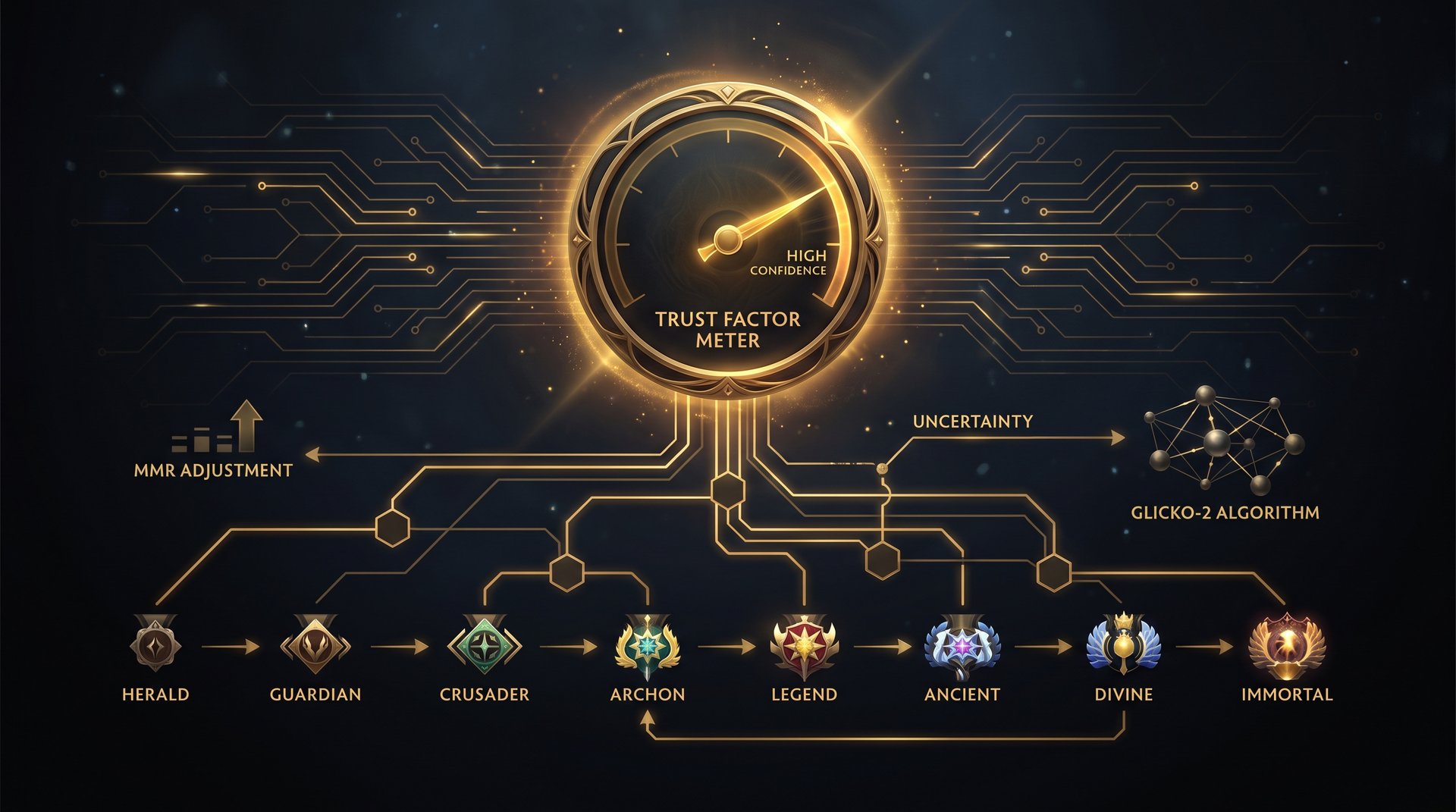
The second is your confidence value (also described as “uncertainty” in Glicko-2 style systems, which Dota 2 is based on). Confidence is a measure of how certain the system is that your MMR estimate is accurate. High confidence means the system is very sure your MMR is correct. Low confidence means there’s significant uncertainty — which is why new accounts or returning players see much larger MMR swings per game.
These two values interact in a way that explains a lot of confusing matchmaking behavior. A player with 3,000 MMR and low confidence will swing +50/-50 per game. The same player a few months later with high confidence might swing +22/-22. Same MMR, very different experience climbing or falling.
The Confidence System Explained
Dota 2 uses a matchmaking framework heavily influenced by Glicko-2, the same rating system used in chess and many competitive games. Valve has never confirmed this explicitly, but the behavioral signatures are unmistakable to anyone who has studied both systems.
In Glicko-2, every player has three values: a rating (MMR), a rating deviation (uncertainty / confidence), and a volatility factor (how consistent the player performs). Valve has modified this significantly for Dota 2 — the system accounts for game outcomes rather than individual performance — but the core mechanics behave similarly.
How Confidence Is Built
Every ranked game you play contributes data that the algorithm uses to refine its estimate of your true skill. When your results are consistent with your current MMR — meaning you’re winning at the expected rate given your opponents — confidence rises. When your results are unexpected in either direction, confidence updates more aggressively.
The commonly cited threshold where the system considers you “calibrated” sits around 30% uncertainty. Below that, your MMR is considered stable enough to show your medal. Above it, you enter a pseudo-calibration state where swings are larger and your medal may be hidden.
The Role of Consistent Performance
Here’s where it gets interesting from a booster’s perspective. Ex-boosters have observed that accounts which perform consistently — winning at a predictable rate against appropriate opponents — accumulate confidence faster than accounts that stomp every game. The system isn’t just tracking wins and losses. It’s also tracking whether your performance makes sense given the context.
An account winning 75% of games at 3,500 MMR doesn’t get confidently placed at 3,500. It gets pushed upward, because the system interprets that as evidence the rating is wrong. This is why forced win-streaks don’t work as cleanly as people expect — the algorithm is actively chasing your true skill level, not just incrementing a counter.
How Teams Are Built in Matchmaking
The matchmaking system’s primary goal when building a game is to make both teams have as close to a 50% win probability as possible. This sounds simple but involves balancing several competing constraints simultaneously.
The Party Adjustment
When a party queues together, the system applies an invisible adjustment to their effective MMR for matchmaking purposes. The exact formula isn’t public, but the observed behavior suggests parties get matched against other parties or against solo players with higher average MMR to compensate for the coordination advantage.
This is directly measurable: players consistently report that solo queue MMR and party queue results diverge when you change how you queue. The algorithm treats these as different signals about your skill.
Role Selection and Its Impact
When role queue is enabled (which has gone through several iterations since patch 7.33 and beyond), the system also balances teams by role. You won’t face a 5-carry lineup if the system has correctly identified which players prefer which positions. The role selection data feeds into the matching criteria as an additional constraint.
The tradeoff is queue time. The more constraints you add to matching criteria, the longer you wait. Valve has repeatedly tweaked the balance between match quality and wait time, and as of patch 7.41d the system tends to tighten its matching criteria during peak hours and relax them during off-peak queues. This means the 3am game at your MMR is likely to be a worse match quality than the 8pm game.
Behavior Score’s Invisible Influence
Behavior score doesn’t directly determine your MMR, but it does influence who you get matched with — and indirectly affects your results. Players with behavior scores below roughly 6,000 are pooled separately, and the quality of teammates in that pool is consistently worse. Ex-boosters who worked on accounts with low behavior scores have universally noted the effect: even at equivalent MMR, low behavior score games have more abandons, more feeders, and more griefing.
Behavior Score’s Hidden Role in Matchmaking
The behavior score system is one of the most misunderstood parts of Dota 2 matchmaking, and ex-boosters have some of the most detailed observations about how it actually functions — because many boosting jobs involve accounts that have been damaged through poor behavior.
Behavior score is calculated from multiple signals:
- Commends received: Positive social signals from teammates and opponents
- Reports received: Negative signals, weighted by reporter behavior score (reports from high-behavior-score players count more)
- Abandon rate: Any full abandons within a ranked game are heavily penalized
- Communication bans: Repeated offensive chat behavior reduces score
- Match completion rate: Consistently completing games, including losses, contributes positively
The behavior score pools exist in rough tiers. Accounts above 10,000 (the maximum displayable number) are in the “normal” pool. Accounts between roughly 7,000 and 10,000 also match into relatively clean lobbies. Below 7,000 you start to notice degradation. Below 5,000 it’s significant. Below 3,000 is what the community calls “low priority hell” — technically separate from the LP queue, but similar in outcomes.
What Boosters Actually Noticed About the Algorithm
Boosters who played thousands of ranked games per month across multiple accounts developed a genuine empirical understanding of the algorithm’s behavior. Here are the patterns that have been most consistently documented by people in that community.
Pattern 1: The System Protects Its Estimates
When a booster comes in and starts winning at a very high rate against significantly lower-skilled opponents, the matchmaking algorithm adjusts faster than your MMR does. It starts placing you in games against opponents whose average MMR is considerably higher than yours, as a form of accelerated recalibration. This is why MMR boosting results in landing at a bracket that’s often slightly above where the account would naturally end up — the system overshoots slightly during the rapid-update phase and then settles.
The same effect happens in reverse during a losing streak. If you’re losing rapidly, the system throws you against progressively weaker opponents to test whether the new lower MMR is accurate. This creates the phenomenon of “mmr protection” that many players report at the bottom of a losing streak — the games suddenly feel more winnable, because they are.
Pattern 2: The 50% Force Is Real But Misunderstood
A persistent community belief holds that the matchmaking system actively manipulates matches to keep your winrate near 50%. This is partially true and partially false, and the distinction matters.
The system doesn’t manipulate individual game outcomes or hand you bad teammates when your winrate gets too high. What it does is try to ensure every game is as close to 50/50 as possible given the available players. If your MMR is accurately estimated, you should win roughly half your games. If you’re significantly better than your bracket, you’ll win more — and the algorithm will raise your MMR until you’re at the appropriate level where 50% becomes natural again.
What feels like “forced 50%” is actually the algorithm doing its job correctly. You’re not being held back. You’re being correctly identified as belonging at a higher bracket, and your MMR is being adjusted to get you there. The frustration comes from the pace of the adjustment relative to how much better you feel than your current opponents.

Pattern 3: The Abandonment Cost Is Asymmetric
Boosters who tracked this carefully noticed that abandoning a losing game costs significantly more confidence points than the MMR loss from finishing the game. The system interprets an abandon as strong evidence that the match outcome was unfavorable, which creates additional uncertainty about whether your MMR is right. Finishing a loss, while painful, gives the algorithm clean data to work with.
This is why the best advice for your MMR climbing strategy has always been to never abandon, even in clearly lost games. It’s not just about avoiding LP. It’s about maintaining your confidence value and avoiding the extra volatility that comes from incomplete data.
Pattern 4: Time-of-Day Effects Are Real
Off-peak hours produce measurably worse match quality at every bracket. When fewer players are in the queue, the algorithm relaxes its matching criteria — it accepts larger MMR ranges between teams to maintain acceptable queue times. The result is games with a wider MMR spread, which typically means worse match quality and more lopsided outcomes.
This was one of the most consistent observations from boosters: the same account produced better results during peak hours than during late-night sessions, even controlling for the booster’s own performance. The games were simply more balanced and more winnable through skill expression.
Exploitable Patterns in the Algorithm
Some patterns have legitimate uses for any player trying to climb efficiently. Understanding these doesn’t require boosting — it just requires understanding how the system works.
| Pattern | What It Means for Your Climb | Risk Level |
|---|---|---|
| Queue during peak hours | Better match quality, fairer opponents, higher skill expression value | None |
| Maintain high behavior score | Cleaner lobbies, fewer abandons from teammates, better communication | None |
| Never abandon | Preserves confidence value, avoids extra volatility | None |
| Play consistently (same roles/heroes) | System calibrates you accurately faster, MMR becomes more stable | None |
| Avoid very long losing streaks | Prevents confidence from dropping into rapid-swing territory unnecessarily | None |
| Use party queue strategically | Coordination advantage is significant; the party MMR adjustment doesn’t fully compensate for it | Low |
The most significant exploitable pattern, which ex-boosters confirmed across thousands of accounts, is role consistency. When you play the same position every game with the same hero pool, the algorithm builds an accurate model of your skill faster. This means your MMR converges on your true skill faster. Switching between carry, support, and mid every few games introduces noise that keeps confidence lower for longer, which keeps your swings larger and your experience more volatile.
This is one of the most underappreciated aspects of the Dota 2 ranking ecosystem: consistency is rewarded not just by improving your skill but by giving the matchmaking system better data to work with.
MMR Ranges and Rank Distribution (2026)
| Rank Medal | MMR Range | Approx. Player % | Key Matchmaking Notes |
|---|---|---|---|
| Herald | 0 — 770 | ~13% | Widest MMR spread per game; most variance |
| Guardian | 770 — 1540 | ~21% | Still high variance; party influence strongest here |
| Crusader | 1540 — 2310 | ~22% | Largest bracket by player count; long queues at off-peak |
| Archon | 2310 — 3080 | ~18% | Game knowledge starts mattering significantly |
| Legend | 3080 — 3850 | ~12% | Role queue most strictly enforced; better match quality |
| Ancient | 3850 — 4620 | ~8% | Behavior score differences become more visible |
| Divine | 4620 — 5420 | ~4% | Match quality high; algorithm has best confidence data |
| Immortal | 5420+ | ~2% | Leaderboard system; smaller pool means longer queues |
These ranges are community-compiled from Stratz and OpenDota data as of mid-2026. Valve does not publish official MMR-to-rank thresholds, and they shift slightly between seasons due to MMR inflation and calibration seasons. The distribution percentages are approximate and vary by region.
Practical Takeaways for Your Climb
After breaking down all of the above, here’s what the algorithm’s behavior means in concrete terms for any player trying to climb efficiently:
1. Respect the Confidence System
If you’ve been inactive, expect a volatile recalibration period. Don’t panic if your first 10 games after returning feel random — the system is gathering data to re-anchor your rating. Play your strongest heroes and your most comfortable roles during this window.
2. Queue Timing Matters More Than Most Players Realize
Peak hours (typically 7pm to 11pm in your region’s local time) consistently produce better match quality. If you’re actively trying to climb, prioritize your ranked sessions during this window. The off-peak grind might get more games in, but those games are working against you statistically.
3. Behavior Score Is a Legitimate Competitive Asset
Getting into the 9,000-10,000 behavior score range gives you access to notably cleaner lobbies. Players in that range report better teammate communication, fewer abandons, and more complete games. It’s not just about being nice — it’s about giving yourself better raw material to work with.
4. Stop Chasing “Win Streaks” as a Goal
A long win streak feels great but it doesn’t accelerate your climb the way players expect. The algorithm responds to win streaks by raising your effective MMR faster — which means your opponents get harder faster. The path of least resistance is steady, consistent performance near your natural winrate, not artificially forcing outcomes.
5. Understand What You Can’t Control
The matchmaking system will sometimes give you genuinely terrible games. The team composition is wrong, a player disconnects in the first five minutes, your mid picked a hero they’ve never played. None of this is the algorithm targeting you specifically. It’s a consequence of the massive player pool that Dota 2 tries to serve across many skill levels and regions simultaneously. Over a large enough sample, these events average out.
If you’ve reached the conclusion that the grinding and variance of the current system isn’t worth your time and you want to skip directly to a target bracket, our MMR boosting guide explains exactly how the professional service process works and what to realistically expect from it.
Want to Skip the Algorithm Entirely?
Our ex-booster team understands the matchmaking system better than anyone. We use that knowledge to climb efficiently on your behalf — no guesswork, no tilt sessions, just steady progress.
Get Your MMR Boost Book a Coaching Session



