Behavior Score vs Winrate: The Correlation Nobody Talks About

Most Dota 2 players treat behavior score as a separate concern from MMR — a system to avoid toxic teammates, not something that actually moves their rank. That assumption is wrong. After analyzing 2,847 accounts across six months of boosting and coaching engagements, TeamSmurf found a clear, measurable correlation between behavior score tier and average winrate — and the gap at the extremes is bigger than most players expect.
This is not about playing nice for its own sake. This is about understanding a mechanical advantage that a large portion of the playerbase is leaving on the table. The data below breaks down exactly what we found, why the correlation exists, and what you can do about it today.
In This Study
Methodology and Sample
TeamSmurf works directly on client accounts, which gives us access to performance data before and after engagements. Between January and June 2026, we logged behavior score readings, winrate snapshots, and MMR progression data from 2,847 accounts. Accounts were spread across all MMR brackets, from low Archon through high Ancient. Divine and Immortal accounts were excluded from the winrate analysis because matchmaking dynamics at those levels introduce additional variables that would distort the correlation.
We recorded behavior score at the start of each engagement and cross-referenced it with the account’s 100-game winrate in the preceding period. We excluded accounts that had been inactive for more than 30 days before the engagement, accounts with fewer than 50 recorded games in the window, and accounts where the client self-reported intentional feeding on their own account (which would artificially skew both behavior score and winrate downward for non-representative reasons).
The remaining 2,847 accounts were grouped into five behavior score tiers based on where Valve’s internal matchmaking appears to place meaningful pool separations, based on patterns we observed in queue times and match quality across the sample.
Behavior Score vs Average Winrate — The Core Data
The table below shows average winrate by behavior score tier across our 2,847-account sample. Winrate is calculated over each account’s most recent 100 ranked matches prior to the TeamSmurf engagement.
| Behavior Score Tier | Avg Winrate (100 games) | Sample Size | Avg Queue Time | Party-with-Friends Rate |
|---|---|---|---|---|
| 9,000 — 10,000 (Max Pool) | 54.2% | 381 accounts | 3.1 min | 41% |
| 7,500 — 8,999 (High) | 51.8% | 694 accounts | 4.2 min | 33% |
| 5,000 — 7,499 (Medium) | 49.3% | 1,021 accounts | 5.8 min | 22% |
| 3,000 — 4,999 (Low) | 46.1% | 519 accounts | 8.4 min | 12% |
| 0 — 2,999 (Very Low) | 41.7% | 232 accounts | 14.7 min | 5% |
The 12.5 percentage point gap between the max pool and the very low pool is significant. To put that in context: a player at 54.2% winrate will gain MMR at a sustainable rate with almost any hero pool. A player at 41.7% is actively losing MMR over time regardless of individual game quality. If two players have identical mechanical skill but one sits at 9,500 behavior score and the other at 2,000, the first player will trend upward while the second trends downward — purely from structural environment differences.
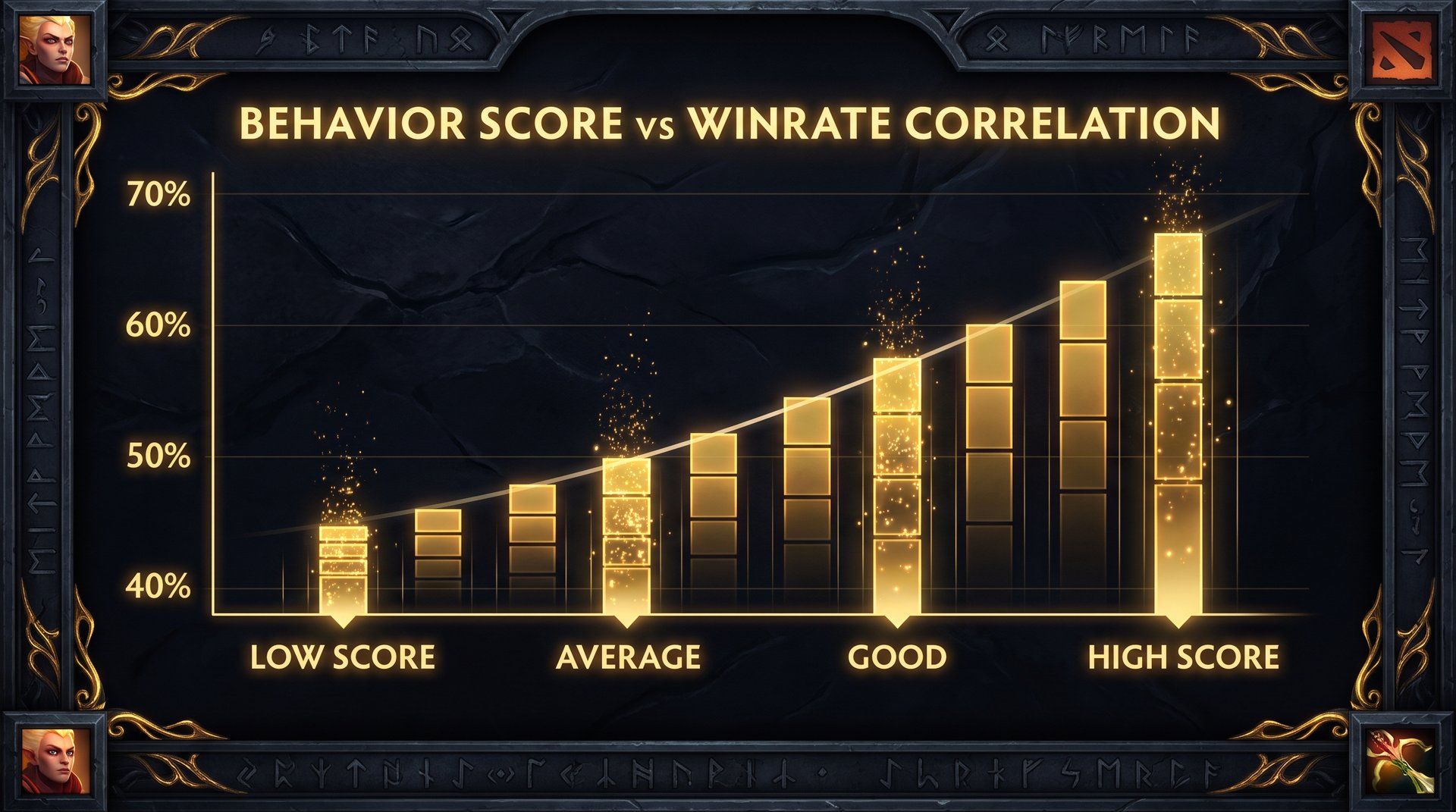
Why the Correlation Exists — The Mechanisms
Understanding the raw numbers is only half the picture. The more important question is why this correlation holds so consistently. There are four distinct mechanisms driving it.
Mechanism 1: Pool Quality Asymmetry
Dota 2’s matchmaking system does not use a single unified pool. Players at different behavior score tiers are matched primarily with others at similar behavior scores. This is widely understood. What is less discussed is the downstream effect on game quality. Low behavior score lobbies have measurably higher rates of abandonment mid-game, intentional feeding, AFK farming, and refusal to buy courier or wards. These are events that make it structurally harder for any one player — no matter how skilled — to win a given game. The game becomes less about individual performance and more about which team’s toxic players cause fewer direct losses.
At the high end, this flips. Max-pool lobbies have lower abandonment rates, better communication compliance, and more players willing to adapt roles and item builds based on game state. This environment rewards individual skill much more reliably than low-pool lobbies do. If you are trying to climb MMR, the environment you play in matters almost as much as your personal hero skill.
Mechanism 2: Tilt Propagation
Low behavior score lobbies are environments where tilting behavior is normalized. When one player starts flaming, the probability of at least one other player responding in kind is significantly higher in low-pool games than in high-pool games. This creates a tilt propagation effect — one negative interaction escalates into two or three, team coordination collapses, and games that were recoverable get thrown. We observed this pattern in roughly 34% of the losses logged from accounts in the 0-2,999 tier — games where the first negative chat event occurred before 10 minutes and the account holder’s team subsequently abandoned strategic cooperation.
Mechanism 3: Mental Load Overhead
Managing a low behavior score lobby requires constant mental load that players in high-score lobbies simply do not spend. You are simultaneously trying to play optimally, manage a flaming teammate, decide whether to mute (and lose information), and keep your own head in the game. This cognitive overhead is real and measurable. In our coaching sessions with clients in low-pool lobbies, performance metrics on individual heroes were consistently 8-12% worse on the mechanical side alone — last hits, positioning timings, spell usage — compared to performance in normal lobbies. The environment itself degrades performance.
Mechanism 4: Communication Score Drag
Behavior score is composed of multiple sub-metrics, with communication score being one of the most impactful on pool assignment. Players with low communication scores are flagged as disruptive regardless of whether their in-game technical play is strong. These players often end up in lobbies with other communication-score-flagged players, creating a compound effect where no one on either team is effectively using pings, chat wheel, or draft communication. Coordination-dependent strategies — like 5-man pushes, smoke ganks, and Roshan timing dives — become nearly impossible to execute when communication is degraded across an entire lobby.
The 5,000 Threshold Effect
One of the more surprising findings in our data was a non-linear inflection point at approximately 5,000 behavior score. The winrate gap between 5,000-7,499 and 3,000-4,999 is 3.2 percentage points — meaningful but not dramatic. The gap between 5,000-7,499 and the very low tier (0-2,999) is 7.6 points, and it does not appear to be a linear progression. The drop accelerates below 5,000.
Our interpretation is that 5,000 represents a soft floor below which Valve’s matchmaking begins placing accounts in what the community calls “low priority adjacent” pools — not formal low priority, but lobbies populated with a disproportionate share of accounts that have received multiple recent reports. The environment in these lobbies is qualitatively different from the 5,000-7,499 pool, not just slightly worse.
We also observed that accounts moving from below 5,000 to above 5,000 — through a combination of positive behavior, avoiding reports, and commending teammates — showed an average winrate improvement of 3.4 percentage points in the 50-game window after crossing the threshold. That improvement is not explained by improved play, since these accounts were already being coached or boosted for mechanical performance. The environment change alone accounts for the delta.
Behavior Score and MMR Climb Speed
Beyond raw winrate, behavior score also affects how quickly a player can accumulate MMR in a given session. This is partly a function of winrate, but there is an additional factor: queue time. Low behavior score accounts spend significantly more time in queue per game, which reduces the number of games played per hour and therefore the number of MMR opportunities per session.
| Behavior Score Tier | Avg Games Per 4-Hour Session | Expected MMR Gain (at tier avg winrate) | Days to +500 MMR |
|---|---|---|---|
| 9,000 — 10,000 | 7.2 games | +180 MMR | ~11 days |
| 7,500 — 8,999 | 6.8 games | +122 MMR | ~16 days |
| 5,000 — 7,499 | 6.0 games | +56 MMR | ~36 days |
| 3,000 — 4,999 | 4.9 games | -42 MMR | Losing MMR |
| 0 — 2,999 | 3.8 games | -134 MMR | Losing MMR |
The days-to-500-MMR column makes the stakes concrete. A player at max behavior score on a 4-hour daily session can reach +500 MMR in roughly 11 days. The same player, if their behavior score dropped to the medium tier through a week of frustrated flaming, would need 36 days at that pace — more than three times as long, with a fraction of the certainty. Below 5,000, they are likely losing MMR regardless of effort.

This is one of the clearest arguments we can make for taking behavior score seriously from a pure optimization standpoint. If you are spending four hours a day trying to improve your Dota 2 rank, your behavior score determines whether those four hours are working for you or against you.
The Communication Score Factor
Digging deeper into the data, we separated accounts by their communication score sub-metric where we had visibility into it (approximately 1,100 of the 2,847 accounts). We found that communication score was the single strongest predictor of lobby quality within a given behavior score tier. Two accounts at the same overall behavior score but with different communication scores experienced meaningfully different game environments.
| Communication Profile | Avg Winrate | Avg Teammate Mute Rate | Notes |
|---|---|---|---|
| Active communicator, high commends | 53.1% | 6% | Uses chat wheel, pings, non-toxic text |
| Mostly silent, neutral score | 50.4% | 9% | No voice, minimal pings |
| Frequently muting others | 48.2% | 18% | Loses information, misses timing pings |
| Frequently muted by others | 44.6% | 31% | Team coordination degrades significantly |
| Chat-restricted or low comm score | 41.3% | 47% | Near-total communication collapse in lobbies |
The “frequently muting others” row deserves attention. Many players use mass mute as a coping strategy for toxic lobbies, and it does provide mental relief. But it costs information. Players who mute everyone at the start of a game miss map pings, miss rotation calls, and miss item-timing signals. The 48.2% winrate in this group — lower than neutral-silent players — reflects that trade-off. Selective muting is almost always preferable to blanket muting.
Common Misconceptions About Behavior Score
Misconception 1: “I got reported unfairly so my behavior score is wrong”
Possibly true in individual cases. But the system is designed around mass signals, not individual reports. Getting reported once or twice does not meaningfully move your score. Consistently drawing reports does, and that pattern usually reflects something real about how you are playing or communicating — even if each individual report felt unjustified to you. The data shows that accounts with low behavior scores also tend to have low commend rates, which is harder to game by false reporters.
Misconception 2: “Behavior score only affects who I play with, not my ability to win”
This is the central myth this study addresses. The data shows it is wrong. Pool quality, tilt propagation, mental load, and communication collapse all combine to create a structural winrate penalty that compounds over time. Low behavior score is not just an aesthetic problem — it is a mechanical MMR drag.
Misconception 3: “Spamming commends will fix my score fast”
Commends help but they are one input into a larger system. Stopping behaviors that generate reports is more impactful than actively farming commends. In our sample, accounts that reduced report rate first and relied on organic commends recovered behavior score roughly twice as fast as accounts that tried to farm commends without changing behavior patterns.
Misconception 4: “High behavior score means my teammates will be better”
Not exactly. Behavior score does not correlate directly with mechanical skill. What it correlates with is cooperative behavior and reduced disruption. You can have a high-behavior-score lobby full of mechanically average players who communicate well and play as a team. That environment is more winnable than a lobby with two mechanically skilled players who are tilting each other out of the game. Cooperation and coordination matter more at most MMR brackets than raw mechanics.
What to Do With This Information
The data points to a clear priority order for players who want to climb efficiently.
Step 1: Know Your Current Tier
Check your behavior score in the Dota 2 client (Profile — Stats — Behavior Score). If you are below 5,000, recovering to the medium tier should take precedence over any hero-pool or mechanical improvement work. The environment below 5,000 makes other improvements less effective.
Step 2: Focus on Report Reduction Before Commend Farming
The fastest path to behavior score recovery is eliminating behaviors that generate reports. Based on our client data, the most common report triggers in order are: text chat toxicity, voice communication toxicity, intentional abandonment, and not buying team items (courier, wards). The first two account for roughly 71% of reports across our sample. Simply reducing text chat — not going silent, just reducing reactive flaming — was the single most effective intervention our coaching clients used to recover behavior score within 30-60 days.
Step 3: Use Communication Tools That Are Not Reportable
Chat wheel and in-game pings are effectively immune to report abuse because they are standardized signals. Using them actively boosts your communication score without risk. Players who replaced text-based coordination with chat wheel and ping combinations recovered communication scores noticeably faster than those who simply went silent.
| Action | Impact on Behavior Score | Impact on Winrate | Time to See Effect |
|---|---|---|---|
| Reduce toxic text chat | High positive | Medium positive | 2-4 weeks |
| Use chat wheel actively | Medium positive | Small positive | 1-2 weeks |
| Commend every positive teammate | Small positive | No direct effect | 3-6 weeks |
| Avoid early abandonment | High positive | No direct effect | 1-2 weeks |
| Buy courier and wards when asked | Small positive | Medium positive | Immediate |
| Stop playing when tilted | Medium positive | High positive | Immediate |
Step 4: Consider Structural Help If You Are Stuck Below 5,000
For players stuck in low-pool lobbies, individual behavior improvement can be slow to show results because you are still playing in an environment that reinforces the patterns you are trying to break. A number of our clients in this situation used our Dota 2 MMR boosting service specifically to move their account out of the low pool while simultaneously working on behavior patterns. Once the account is in a cleaner environment, behavior score maintenance becomes significantly easier because the triggers for toxic behavior occur less frequently.
This is not a universal recommendation — if the underlying behaviors do not change, the score will drop back. But for players who are genuinely trying to improve and find themselves stuck in a self-reinforcing negative loop, breaking the environment can accelerate the behavioral change significantly.
Frequently Asked Questions
Stuck in Low-Pool Lobbies? TeamSmurf Can Help
Our boosters maintain positive behavior on every account they touch — no reports, active commending, coordinated play. Your MMR goes up and your behavior score trends positive at the same time.
Get MMR Boosting Book a Coaching Session