What Your Dota 2 Account Is Worth (MMR Value Table)

If you have ever wondered what your Dota 2 account is actually worth in cash, you are not alone. Whether you are thinking about selling, considering buying a smurf, or just curious how the market prices rank — this guide gives you the honest breakdown.
The short answer: a clean account at the same MMR as a low-behavior-score account can be worth two to five times as much. MMR is the headline, but it is far from the whole story. Below you will find the full MMR value table, a breakdown of every factor that raises or lowers value, and an honest look at the risks buyers take on when they go the account-purchase route versus simply boosting what they already have.
Table of Contents
- The MMR Value Table (Herald to Immortal)
- Factor 1: Calibrated MMR
- Factor 2: Behavior Score
- Factor 3: Cosmetics and Rare Items
- Factor 4: Account Age and Steam Profile
- Factor 5: Win Rate and Recent Performance
- The Risk Side: What Buyers Need to Know
- Why Boosting Your Own Account Often Beats Buying
- Frequently Asked Questions
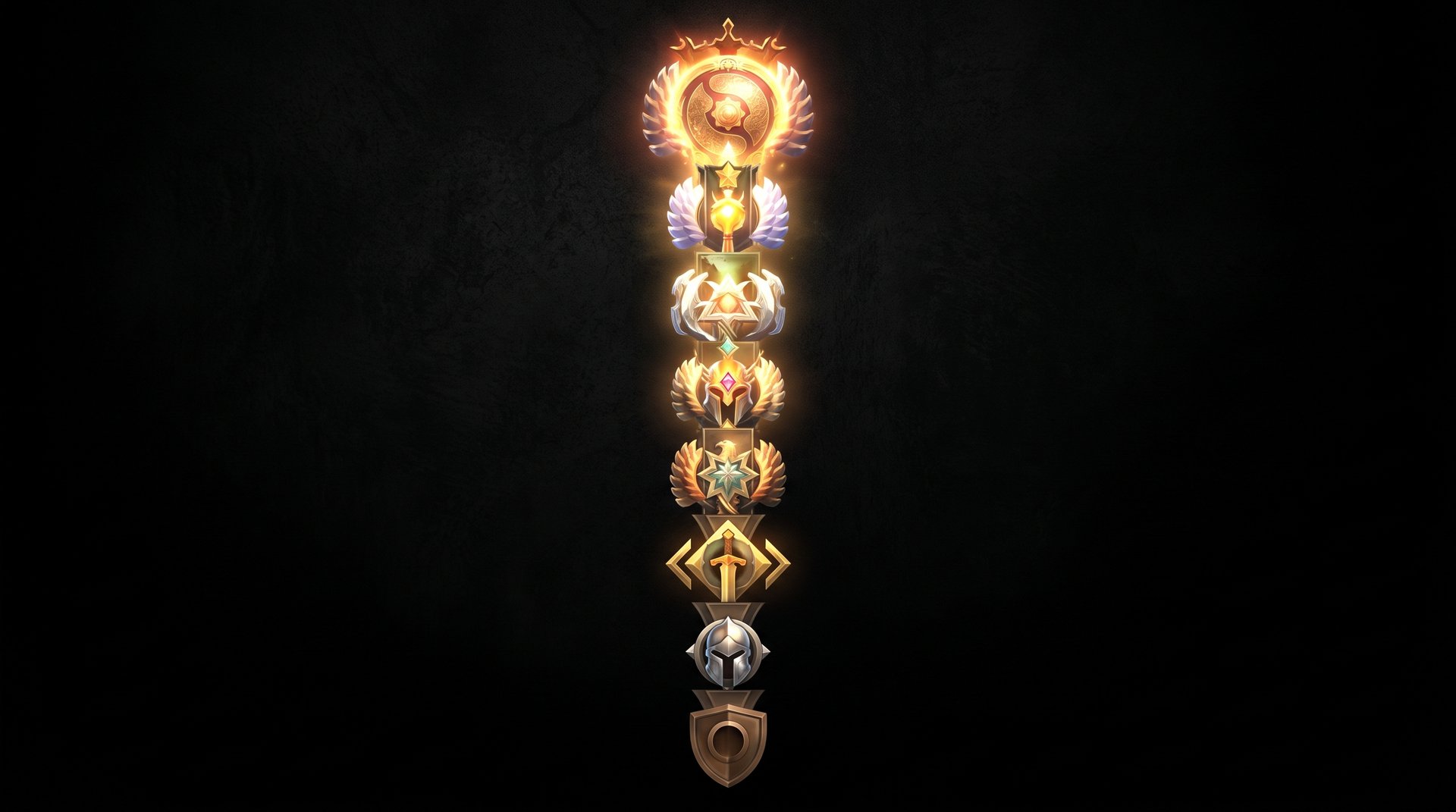
The MMR Value Table: Herald to Immortal
The table below reflects typical price ranges observed across Dota 2 account trading communities, marketplaces, and forums. These are not fixed prices — actual sale values depend on behavior score, cosmetics, account age, region, and current demand. Use this as a starting reference, not a guarantee.
| Rank | Typical MMR Range | Estimated Account Value | Market Tier |
|---|---|---|---|
| Herald | 0 — 769 | $10 — $35 | Entry-level / fresh calibration |
| Guardian | 770 — 1,539 | $20 — $55 | Low demand; mostly smurf buyers |
| Crusader | 1,540 — 2,309 | $35 — $90 | Growing interest from smurf buyers |
| Archon | 2,310 — 3,079 | $60 — $150 | Moderate demand; most popular buy bracket |
| Legend | 3,080 — 3,849 | $100 — $250 | High demand; strong buyer interest |
| Ancient | 3,850 — 4,619 | $200 — $500 | Premium tier; serious buyers only |
| Divine | 4,620 — 5,419 | $400 — $900 | High premium; rare on open market |
| Immortal | 5,420+ | $700 — $2,500+ | Elite tier; leaderboard rank adds substantial premium |
Each star within a medal adds incremental value. A Divine 3 account sits close to the floor of the Immortal market and often sells for significantly more than a fresh Divine 1. Within Immortal, leaderboard rank creates a second premium tier — top-1,000 accounts in a region can command prices well above the standard Immortal ceiling.
Factor 1: Calibrated MMR — The Headline Number
MMR is what buyers search for first. It determines the medal bracket and the general difficulty of the lobbies you will be placed in. A higher MMR account puts its owner into lobbies where teammates are more coordinated, decisions happen faster, and games are generally cleaner to play — which is exactly what most buyers want.
Why Calibrated Always Beats Uncalibrated
Uncalibrated accounts — fresh Steam profiles that have never completed ranked calibration — sell for a fraction of what calibrated accounts fetch. Buyers do not know what MMR they will receive after calibration, and the uncertainty depresses the price significantly. A calibrated account at 4,000 MMR is a known quantity. An uncalibrated account with 100 normal-mode wins might calibrate anywhere from 1,500 to 3,500, depending on performance during the placement games.
If you have an uncalibrated account and want to maximize its value, the single most impactful thing you can do is complete calibration and ideally boost it to a specific target bracket before selling. The price jump from uncalibrated to a confirmed 3,500 MMR calibration is often two to three times the pre-calibration value.
For more on how Dota 2 measures your underlying skill even before official calibration, read our guide on What Is Hidden MMR in Dota 2 and How Glicko Works.
The Calibration Star Effect Within Brackets
Buyers are not just looking at the medal — they are looking at how many stars you have within that medal. A Legend 5 account and a Legend 1 account both show the Legend badge in public-facing profiles, but the former is sitting at the edge of Ancient and commands noticeably more value. When evaluating your own account, count your stars, not just your medal.
Regional Variation
The same MMR does not carry the same market value across all regions. EU and NA accounts at Legend or Ancient typically sell at a premium compared to equivalent accounts from SEA or SA, primarily because the buyer market for Western server accounts is larger and there is stronger demand from buyers looking to maintain low ping on those servers. If your account is on EU or NA, add roughly 10 to 20 percent to the baseline estimates in the table above.
Factor 2: Behavior Score — The Hidden Multiplier That Most Sellers Ignore
Behavior score is probably the single most underestimated factor in account valuation, and it is the one that can either double or completely destroy what your MMR is worth on paper.
How Low Behavior Score Tanks Value
An account with 3,000 to 5,000 behavior score plays in a segregated low-priority pool where teammates abandon games, pause mid-fight, and communicate exclusively in all-caps profanity. Buyers who know what they are doing will not touch it — not at any price. Those who do not understand behavior score will discover the problem after purchase and immediately feel cheated. Low-behavior accounts become reputation problems on resale platforms, leading sellers to either deeply discount them or simply not disclose the score until after payment, which is its own kind of risk.
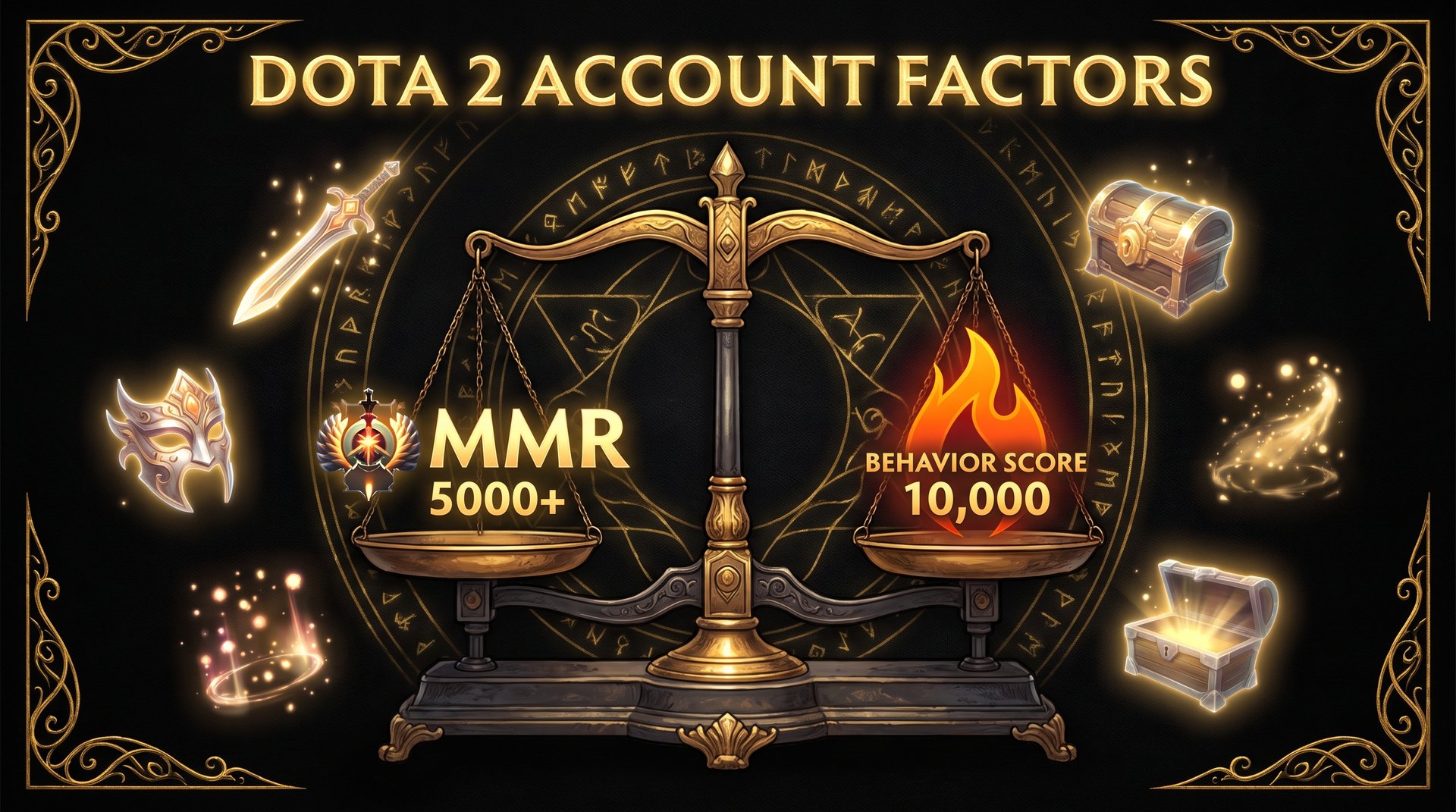
The market threshold is roughly 8,000. Below that, expect buyers to start applying discounts. Below 6,000, the account is essentially unsellable to any knowledgeable buyer without a very steep haircut. At or above 9,000, you are in premium territory and can command closer to the high end of the ranges in the table above.
To understand exactly how behavior score is calculated and how the Overwatch system impacts it, read our deep-dive: The Overwatch System in Dota 2: How Player Reviews Actually Work.
Behavior Score vs. MMR: Which Matters More?
In practical terms, a clean account at 3,500 MMR with 9,500 behavior score will often outsell a toxic account at 4,500 MMR with 4,000 behavior score. The playing experience at a higher MMR is ruined by low behavior score in ways that permanently undermine the point of buying a ranked account in the first place. Serious buyers know this. Casual buyers learn it quickly after their first purchase.
| Behavior Score Range | Market Impact | Effective Value Modifier |
|---|---|---|
| 9,500 — 12,000 | Premium — clean lobbies, high demand | Full price or slight premium |
| 8,000 — 9,499 | Good — mainstream buyer market | Standard range price |
| 6,000 — 7,999 | Below average — some buyer resistance | 10% — 30% discount typical |
| 3,000 — 5,999 | Poor — serious buyer avoidance | 40% — 70% discount or unsellable |
| Below 3,000 | Very low priority pool — nearly unsellable | Heavily discounted or no buyers |
Factor 3: Cosmetics and Rare Items — The Wildcard Multiplier
Cosmetics are where account valuation gets genuinely interesting. At high MMR brackets, a single rare Arcana set or a Collector’s Cache item from a discontinued treasure can be worth more than the MMR itself would command. An Immortal account with five or six high-value cosmetics is not just an Immortal account — it is a cosmetics portfolio that happens to come with a high-rank profile attached.
Items That Add the Most Value
The items that consistently add premium value to accounts include Arcana sets (which are limited-run cosmetics for specific heroes), Golden and Prismatic Immortal items from Collector’s Caches, early Battle Pass items that are no longer obtainable, and any cosmetic associated with a memorable TI moment or Compendium milestone. The rarer the item and the further back in history it comes from, the more it adds to the account’s asking price.
Items from the Steam Community Market can be checked for current prices to estimate the cosmetics value of an account. A reasonable approach is to add up the market value of the account’s five most valuable items and add that sum to the baseline MMR-based valuation. If the total cosmetics value exceeds the baseline MMR value, list the cosmetics as the primary selling point with the MMR as secondary.
The Account Age Interaction
Cosmetics become even more valuable on older accounts because some cosmetic types — particularly items from early TI Compendiums or special Valve giveaways — cannot be gifted or traded onto newer profiles without restrictions. An account that received a specific item as a drop in 2014 is a different category of product from an account that bought the same item on the secondary market. The original-owner history sometimes matters to serious collectors.
Factor 4: Account Age and Steam Profile — the Trust Layer
Older accounts carry more implicit trust on both the Dota 2 side and the Steam ecosystem side. A seven-year-old Steam account with 4,000 hours of Dota 2 and a long game history sends very different signals to both Valve’s anti-smurf detection and to potential buyers than a two-year-old account with 800 hours that was clearly created specifically for ranked purposes.
Steam Profile Age and the VAC Record
Account age on Steam matters primarily because it correlates with a clean VAC record. The longer an account has existed without any kind of restriction, ban, or note, the higher the confidence that it will not receive a retroactive action shortly after purchase. Buyers evaluating two accounts at the same MMR will typically pay more for the older one, all else being equal.
Accounts with any VAC bans, game bans, or restriction notes on their Steam profile see immediate and significant value loss. Even a note that appears unrelated to Dota 2 raises questions about the overall account history. The market treats “clean record” as a baseline requirement, not a bonus.
Hours Played in Dota 2
Hours played in Dota 2 serve as a proxy for legitimacy. Buyers looking at a 5,000-MMR account with 200 hours of Dota 2 will immediately recognize that the MMR was purchased or achieved through boosting. That is not automatically a dealbreaker — many buyers explicitly want boosted accounts — but it raises questions about what other things were purchased or manipulated on the profile. An account at the same MMR with 3,000 hours of genuine play history commands more trust and generally higher prices.
Public vs. Private Steam Profile
Accounts with private game history are harder to value and harder to sell. Buyers who cannot inspect hours played, win rates, and recent game history have no way to verify claims about the account’s condition. A public profile with visible stats is always easier to market and typically sells faster than an equivalent private profile. If you are considering selling, make the game details visible before listing.
Factor 5: Win Rate and Recent Performance — What the Numbers Signal
Sophisticated buyers will check Dotabuff or Stratz before finalizing any purchase above around $100. What they are looking for is not just that the current MMR is accurate — they want to understand how stable it is likely to be under normal play conditions.
Win Rate as a Stability Signal
An account with a 54% overall win rate at Ancient feels very different from an account with a 44% win rate at the same MMR. The 44% account arrived at its bracket through volume — it played enough games that its rare wins dragged the number up. The 54% account belongs there. Buyers who plan to actually play on the purchased account care deeply about this difference, because a 44% win rate account is likely to drop back toward its natural level within 50 to 100 games.
This dynamic also means that accounts where the MMR was recently boosted by a professional service are not automatically devalued — in fact, a booster’s win streak often leaves behind a win rate well above 50%, which is a positive signal. What matters is the trajectory and the gap between the account’s visible skill level and its rated MMR.
Hero Pool and Role Consistency
Buyers evaluating accounts for personal use will look at what heroes the account has played most, and whether those heroes match the roles the buyer wants to play. A carry main buying an Ancient account primarily built on a support hero pool knows they will face a steeper re-learning curve. This is not a major valuation factor, but it is something sellers can use as a differentiating point when two accounts are otherwise similar — a diverse hero pool or a deep specialization in a popular meta hero adds appeal.
The Risk Side: What Every Account Buyer Needs to Know
No account value discussion is complete without addressing the risks, because they are real and they affect the effective value of what you are buying or selling.
Valve’s Terms of Service on Account Sharing and Transfer
Valve’s subscriber agreement prohibits account sharing and account sales. This is not a grey area — it is a direct rule. The practical enforcement varies, but accounts can be permanently banned if Valve detects unusual login patterns, suspicious behavior changes, or if the account is flagged through other means. An account worth $400 can become worth $0 if Valve acts on it.
This risk is non-zero and buyers should price it into their decisions. It is one of the key reasons that our full guide on whether you can get banned for buying a Dota 2 account is one of our most-read pieces — the community wants clarity on this, and the honest answer is that it depends on how visible the account activity is after the sale.
The Value Destruction After a Ban
Any permanent ban on a purchased account eliminates its value entirely. There is no recourse. Valve does not reverse Dota 2 bans for account-sale reasons, and Steam support will not discuss account ownership disputes between buyers and sellers. The full financial risk of a post-purchase ban sits with the buyer — sellers have already been paid and are not liable under any marketplace terms that govern these transactions.
Red Flags When Buying an Account
- Seller cannot provide Steam login history or refuses to show recent gameplay
- Price is significantly below market rate for the stated MMR (often means behavior issues or ban risk)
- Account was “calibrated last week” on a three-year-old Steam profile (suggests account sharing history)
- Seller insists on payment before account credentials are verified
- No behavior score disclosed — always ask and always verify independently
What Happens to the Seller
Sellers face their own risk: if Valve links the sold account back to the original owner through login history or Steam Guard recovery attempts, the original account can be affected as well. Sellers who have other high-value accounts on the same email domain or Steam Guard device need to understand this exposure before completing a sale.
Why Boosting Your Own Account Is Often Smarter Than Buying
Here is the part where we are honest about the alternative: for most players, investing in Dota 2 MMR boosting on their existing account produces better outcomes than buying a new one.
When you boost your main account, you avoid all of the account-sharing risks while building on a profile that already has your playtime, achievements, friends list, and cosmetic investments. The boosted MMR is yours to keep. You are in familiar hero pools. And the investment is typically significantly lower than what a new account at the same bracket would cost on the secondary market.
The Math Comparison
Compare: a clean Ancient 1 account might cost $200 to $400 on the secondary market, plus the risk of a Valve ban, plus the adjustment period playing on an unfamiliar account. Alternatively, boosting an Archon 3 account to Ancient 1 through a professional service like TeamSmurf’s MMR boosting typically costs a fraction of that — and the result is your main account, elevated to the rank you wanted, with zero platform risk and zero adjustment period.
This is not just a theoretical comparison. Our boosters work on main accounts every day for clients who started exactly this calculation and concluded the same thing. The purchase market for accounts exists and serves a real purpose — but it is not the right answer for every player, and for most players it is not the most cost-effective path.
When Buying Makes Sense
There are scenarios where buying is the right move. If you want a completely separate smurf account to play without impacting your main, and you want it to start at a specific calibration rather than going through the calibration process, purchasing is faster. If you want an account that comes with specific cosmetics that you cannot otherwise access, buying can make sense as a combined cosmetics-plus-rank acquisition. But for improving your main rank — the goal most players actually have — boosting your existing account is the better play in the majority of situations.
You can learn more about whether boosting is right for your situation in our guide: Is Dota 2 Boosting Safe? What You Need to Know in 2026.
Ready to Increase Your Account’s Value?
Instead of navigating the risky account marketplace, boost your existing Dota 2 account to your target MMR with TeamSmurf — the Dota 2-only specialist. Clean, professional, and confidential.
View MMR Boost Prices Compare Our ServicesFinal Thoughts: What Your Account Is Really Worth
Your Dota 2 account is not a single number — it is a combination of MMR, behavior score, cosmetics, age, and play history, each of which pulls the market value up or down independently. A high-MMR account with poor behavior score and a fresh Steam profile may genuinely be worth less than a moderate-MMR account that has been kept clean for five years with a solid cosmetics collection.
The most important levers if you want to maximize your account’s actual value: maintain behavior score above 9,000, never share account credentials before sale (as shared accounts often carry login-pattern flags), let the account age naturally, and if you want to sell at a higher price bracket, invest in boosting to a higher MMR first — the per-dollar return on boosting an account from Legend to Ancient, then selling at the Ancient price, is typically higher than the direct cost of the boost itself.
And if selling is not your goal but playing at a higher MMR is — that is exactly what we do at TeamSmurf. Skip the secondary market entirely and let a Dota 2-only specialist boost the account you already have.