What Is Hidden MMR in Dota 2? Glicko Explained Simply

Every Dota 2 player has a visible MMR number next to their name. But behind that number sits a second rating system — one Valve never shows you directly. Players call it “hidden MMR,” and it runs on a mathematical framework called Glicko-2. Understanding how it works explains almost every frustrating MMR experience you have had: the unequal gains and losses, the brutal calibration result, the smurf who gets detected surprisingly fast, and the returning player whose rank collapses the moment they queue again.
This guide breaks down the Glicko-2 system in plain language. No math degree required. By the end you will know exactly what hidden MMR is, how it influences your visible rank, and what you can actually do about it.
Table of Contents
What MMR Actually Is in Dota 2
MMR stands for Matchmaking Rating. In Dota 2, it is a numerical value that Valve uses to estimate your skill level and match you against players of roughly equivalent ability. Win a ranked game and your MMR goes up. Lose one and it goes down. The visible number on your profile — the one your friends can see, the one that grants you your medal — is a simplified window into something far more complex running underneath.
Most players think of MMR as a straightforward counter. Win: +25. Lose: -25. But that simplicity is a front end. The actual engine making decisions about where you belong is statistical, and it uses a system designed by a university professor to rate chess players with much greater accuracy than the older Elo system could manage.
Your visible MMR is Valve’s best public-facing estimate of your skill. The hidden system is where that estimate is actually computed — updated continuously based on your recent performance, your uncertainty level, and your consistency over time.
What Is Hidden MMR?
The Visible Number vs the Engine Behind It
Hidden MMR is not a separate number you are hiding from yourself. It is more accurate to think of it as a collection of internal parameters that Valve uses to decide how much your visible MMR should change after each game — and how confident the system is in your current rating.
Your visible MMR changes by roughly the same amount each game once you are a seasoned player. But in the background, the system tracks two additional values for every account: how uncertain it is about your true skill level, and how consistently you perform. These values determine the magnitude of future updates and guide major events like calibration and smurf detection.
When players say “hidden MMR,” they usually mean one of two things. First, the internal Glicko-2 confidence interval around your real skill estimate. Second, for new or fresh accounts, the estimated starting skill value that the system will try to land on during calibration. Both concepts are real, and both influence your experience every time you queue.
Why Does Hidden MMR Exist?
A simpler system could just move MMR up or down by a fixed amount after every game. Some older games did exactly that. The problem is that a fixed-increment system is wildly inefficient at placing new players and wildly slow at responding when someone gets genuinely better or worse.
If every game is worth 25 MMR, a Herald-level player joining a new account needs to play dozens of games before landing at their true bracket — causing misery for every teammate along the way. A confidence-based system can move a highly uncertain account by 100+ MMR in a single game, placing them much faster at their real skill level.
Hidden MMR also gives Valve a way to catch smurfs without relying purely on reporting. A player who is statistically dominant versus opponents far below their expected skill level looks anomalous in the Glicko-2 framework — and the system can respond by accelerating their climb or flagging the account.
The Glicko-2 Rating System Explained
Who Invented Glicko?
The Glicko rating system was created by Mark Glickman, a statistician at Harvard University, in 1995. He extended and improved it in the early 2000s to create Glicko-2. The original system was designed for chess but has since been adopted by competitive games and leagues around the world — including Dota 2, Counter-Strike, various MOBAs, and many others.
Glickman’s key insight was that the old Elo system, while elegant, did not track how confident it was in a player’s rating. Two players could have the same Elo number but wildly different levels of certainty about that number. A player who has played 500 games at 3000 Elo is almost certainly a 3000-rated player. A player who played five games to arrive at 3000 Elo might really be anywhere from 1500 to 4500. Elo treated both identically. Glicko does not.
Three Numbers That Run Your Dota 2 Rank
Under Glicko-2, every player account has three internal values rather than one:
- Rating (r): The actual estimated skill level. This is the closest thing to what players call “hidden MMR.” It is updated after every rating period.
- Rating Deviation (RD): How uncertain the system is about the Rating. A high RD means the system is not confident in your current rating. A low RD means the system has seen enough of your play to be fairly sure where you belong.
- Volatility (sigma): How erratically your performance swings. A player who consistently performs at a similar level has low volatility. A player whose performance fluctuates wildly — great games followed by terrible games — has higher volatility.
All three values update together after each set of games, and they interact with each other. High volatility means RD decays more slowly. Low RD means individual game results have less impact on the Rating. The system is built to balance speed of adjustment with accuracy of estimate.
Rating Deviation — The “Confidence” Number
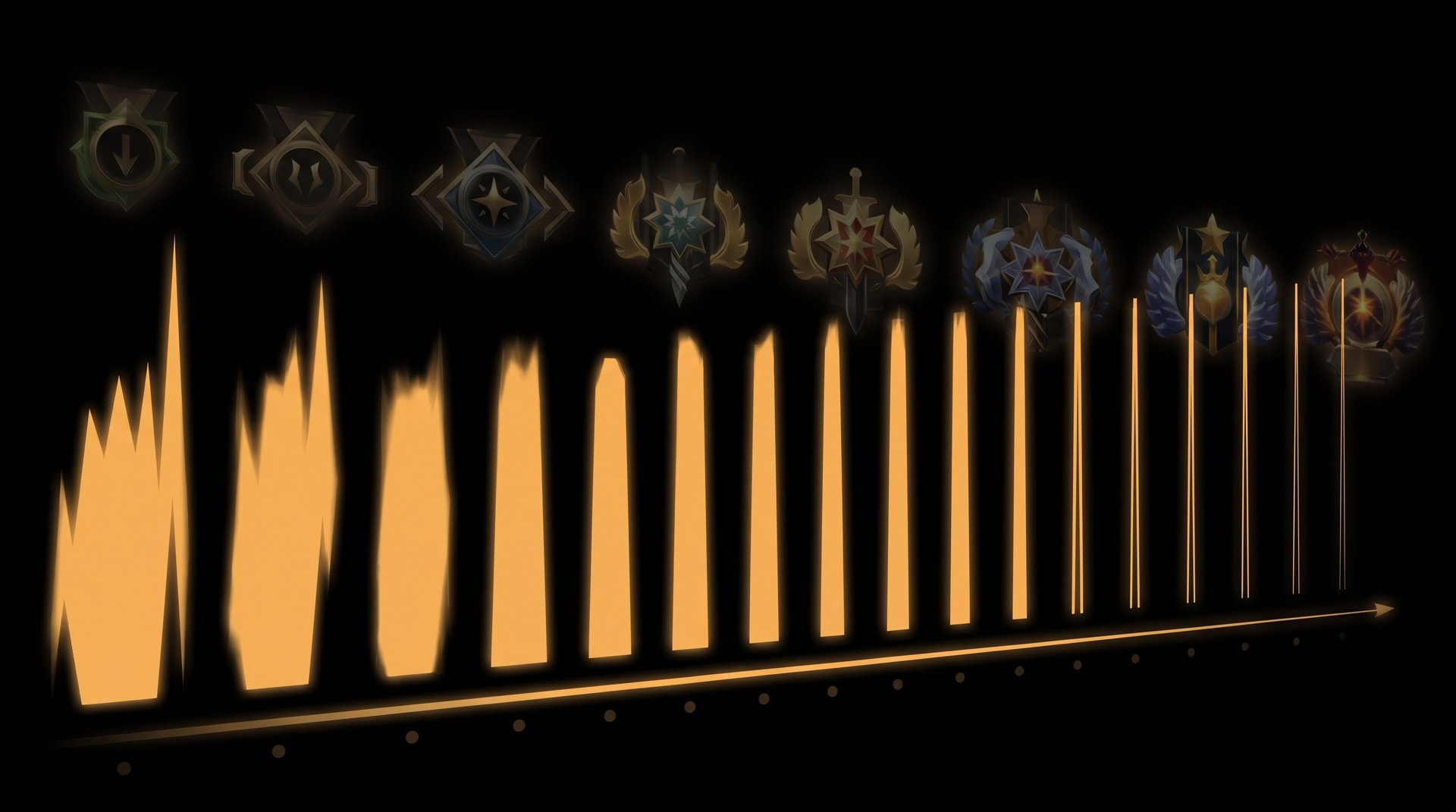
Rating Deviation is the most important concept in hidden MMR discussions, and it is the one most players never encounter explicitly. Think of it as a confidence interval. If your Rating is 3500 and your RD is 300, the system is saying: “We think this player is around 3500, but we would not be surprised if their true skill is anywhere between 3200 and 3800.”
When RD is high (a new account, a returning player, or someone who just played very inconsistently), each game result moves your Rating more. The system is trying to gather information fast. When RD is low (an active, consistent player), each game result has a smaller effect on your Rating — the system is fairly confident in its estimate and is only making minor adjustments.
This explains one of the most common complaints about Dota 2 MMR: “I gained 28 MMR for that win but only lost 22 for the next game” or the opposite. The size of the gain/loss is not random. It reflects the current RD state, your opponent’s RD state, and the Volatility parameter — all hidden from the player but doing math on every game.
Volatility — How Consistent Are You?
Volatility tracks whether your win/loss outcomes are predictable or chaotic. If you win 60% of your games consistently over a long period, you have low volatility. If you sometimes go on 15-game winning streaks followed by 15-game losing streaks, your performance is volatile — and the system treats your rating with less certainty as a result.
High volatility accounts need more games to settle at a stable MMR because each game carries more noise. Low volatility accounts lock in faster because their results are statistically interpretable. This is part of why some players feel like they can never escape a bracket — not because the matchmaker is rigged, but because their volatile performance makes it hard for the system to confidently place them at a higher tier and keep them there.
How Your Hidden MMR Changes
New Accounts: High Uncertainty from the Start
When a fresh account plays its first calibration games, it starts with an extremely high RD. The system has almost no information about this player. As a result, the Rating update from each of those early games is massive — potentially hundreds of hidden MMR points per game. This is why a good player on a new account can jump several brackets in their calibration games while a bad player drops hard.
The starting Rating for a new account is not zero or a universal baseline. Valve uses behavioral signals from the account’s very first games — performance relative to opponents, communication patterns, hero choices — to build an early estimate before the calibration sequence even begins. This is the “hidden MMR” that leaks into calibration and causes the non-linear results that confuse new players.
By the end of calibration, RD has dropped significantly. The account now has a more stable visible MMR, and future games move that MMR by smaller amounts as the system converges on its best estimate of true skill.
Calibration Games and RD Collapse
Dota 2 uses a calibration period at the start of each season or for new accounts. During calibration, the RD is typically at its highest, which is why calibration results can seem dramatic. Winning 8 out of 10 calibration games might place you 600 MMR above where you started. Losing 7 might drop you 500 MMR. The swings feel extreme because the system is in “high uncertainty” mode and making aggressive updates to converge quickly.
After calibration, RD stabilizes at a lower level and your visible MMR begins moving in the smaller, more familiar increments most players are used to. The calibration phase is Glicko-2 doing its most important work — collecting enough data to become confident, fast.
The Math Behind Unequal Gains
Under standard Glicko-2, the amount you gain from beating a player depends on three things: your current Rating relative to theirs, your RD, and their RD. Beating someone rated far below you earns almost nothing because an upset victory against a weak opponent provides little information about your true skill. Beating someone rated far above you earns a lot because it is strong evidence you belong higher.
This is why stomping low-MMR players is inefficient at climbing. If the system already expects you to win those games, winning them tells it almost nothing new. It is the close games — those between evenly matched players — where results provide the most information and where gains/losses are most meaningful.
| Scenario | RD State | MMR Change per Game | What It Feels Like |
|---|---|---|---|
| New account (calibration) | Very High | +/- 80-150 hidden pts | Wild swings, bracket jumps |
| Returning player (6+ months off) | High | +/- 40-80 visible pts | Fast gains OR fast drops on return |
| Active consistent grinder | Low | +/- 20-30 visible pts | Slow, stable movement |
| Inconsistent active player | Medium (elevated volatility) | +/- 25-50 visible pts | Momentum feels exaggerated |
| Smurf (high skill, low account age) | Very High | +/- 100+ on early games | Rapid acceleration through brackets |
What Hidden MMR Feels Like in Practice
Streak Games and the Slingshot Effect
One of the most discussed Dota 2 phenomena is the “win streak boost” — a sense that after several consecutive wins, the system suddenly gives you easier matchups or the gains become larger. This is not entirely a myth, but the explanation is more mundane than players assume.
When you go on a winning streak, your Rating is increasing while your RD has not yet caught up to reflect confidence in the new higher value. You are in a zone where the system is still “discovering” whether you truly belong at the new level. During this phase, wins earn more because your high RD means each result is still strongly informative. Once you settle at a new plateau, RD drops and the gains normalize.
The inverse is also true. During a losing streak, your RD temporarily rises (the system becomes less certain about your rating), which means losses hurt more and wins during recovery earn more. This creates the rubber-band feeling many players describe — where losses are brutal but a good recovery streak can claw back MMR surprisingly fast.
Returning Players and the Decay Problem
If you stop playing for several months and return to Dota 2, your RD has increased during your absence. The system no longer knows if you are still the same player you were when you left. You might have dramatically improved or dramatically regressed. As a result, your first games back move your MMR more aggressively in whichever direction your results indicate.
This catches many returning players off guard. They come back after a break, lose the first three games because they are rusty, and suddenly find themselves 100+ MMR down from where they left. The system is not being punitive. It is responding to high uncertainty with large updates — exactly what Glicko-2 is designed to do. The good news is that a few strong performances can recover that ground quickly for the same reason.
The practical implication: when returning after a long break, warm up in unranked before queuing ranked. Your hidden RD is elevated and any losses will hurt disproportionately compared to when you were actively playing.
Smurfs — Glicko Catches Them Faster Than You Think
A common belief is that smurfing is easy to hide. It is not — at least not from Valve’s systems. When a high-MMR player creates a new account and starts performing far above what the current low-bracket opponents should be able to stop, the performance data creates statistical anomalies in the Glicko-2 model.
The smurf’s actual results versus what the expected win probability model predicts are wildly divergent. An account that should win about 50% against its opponents but is winning 80-90% is not operating normally. The system responds by elevating its uncertainty upward — essentially acknowledging that the low RD starting point was wrong and correcting it. The account rockets through brackets much faster than a genuine player at that MMR level would.
Combined with behavioral signals (behavior score patterns, hero performance metrics, average denies, last hits relative to bracket norms), Valve can flag these accounts relatively quickly. This is why smurfing is both harder and less impactful than it used to be — the matchmaker is designed to end it fast.

Can You Manipulate Your Hidden MMR?
Players often ask whether there are tricks to artificially inflate hidden MMR — queuing at specific times, playing certain heroes, or deliberately losing games to reset into a fresh calibration. The honest answer is: there is no reliable manipulation of hidden MMR that works the way these theories suggest.
Deliberately losing games (“MMR resetting”) increases your Volatility, which can lead to larger swings in both directions on your next run. But there is no guarantee those swings will be upward. You are as likely to crater further as you are to spike higher. Players who “tank” their MMR hoping to recalibrate higher generally find the system accurately places them back where their skill level actually is.
Playing heroes with high win rates in your bracket can absolutely improve your visible MMR over time — but that is because you are genuinely winning more, not because you are tricking the hidden system. The rating model does not care which heroes you pick. It cares whether you win or lose and how expected those outcomes were based on your and your opponents’ rating states.
Where manipulation does play a role is in account selection. An account with lower current visible MMR but a history of strong performances (low RD, decent Volatility) will respond better to a skilled player than an account with matching visible MMR but high RD and turbulent history. This is relevant for players who purchase Dota 2 accounts, as the hidden history of the account matters — not just the visible number stamped on it.
Hidden MMR and Calibration Seasons
Dota 2 runs ranked seasons, and at the start of each season there is a calibration phase. This is when the Glicko-2 uncertainty is intentionally partially “reset” — meaning RD is partially elevated to allow the new season to correct for any skill changes that occurred since the previous season ended.
The key word is “partially.” Valve does not fully reset your hidden MMR history at the start of a new season. Your established Rating carries over with modified parameters. This means that players who inflated their MMR through a boost or lucky run in the previous season will often find they regress toward their true level relatively quickly during the new season’s recalibration — the system still knows roughly where they belong and converges back there as the uncertainty resolves.
It also explains why some players feel “soft reset” seasons are actually harder than playing without a reset. Going into a season with elevated RD means your early losses hurt more. If your skill genuinely improved during the off-season, your early wins will also carry you higher faster. The calibration system is designed to be accurate — which means it will find your correct level whether you want it to or not.
Players preparing for a new season should focus on form rather than superstition. The calibration system rewards genuine performance, not rituals. If you are performing at a higher level than your previous peak, the elevated RD of a new season is your friend — it means you can reach a higher stable point faster. If you are performing at the same level, you will end up roughly where you were before.
How This Affects Boosting and Rank Recovery
Understanding Glicko-2 changes how you should think about professional boosting services. When you order a boost from a service like TeamSmurf, you are not just temporarily changing your visible MMR number. The booster’s consistent performance on your account — high win rates, hero mastery, decisive game impact — is also influencing the hidden parameters that govern how your account behaves after the boost.
A booster playing at Divine or Immortal level on a Legend account generates performance data that looks similar to an account rated higher than where it currently sits. Over the course of the boost, this can actually recalibrate the account’s internal profile toward that higher level — making the boosted rank more stable than it would be if you just bought an inflated account with a hollow history.
This is one reason why high-quality boosting services produce better retention rates than cheap alternatives. When a top-rated booster carries the account with genuine skill and dominant performance, the Glicko-2 model starts to “believe” the higher MMR is accurate. The post-boost experience is smoother because the rating system has been updated to reflect an account performing at a higher level.
For the full picture on how reputable boosting works and what to look for in a provider, see our comprehensive guide to the best Dota 2 boosting services. If you are specifically interested in how the MMR system interacts with different types of boosts, our MMR boosting guide covers the mechanics in detail. And if you have concerns about account safety during the process, is Dota 2 boosting safe addresses every risk factor you should know about.
One important nuance: buying an already-boosted account from a third-party seller is riskier than having a service boost your own account. A purchased account with a history of inconsistent performance (high Volatility) or a hidden MMR that diverges significantly from the visible number will regress — potentially dramatically — once you start playing it. The system’s estimates of where you belong will correct themselves over time regardless of what number is painted on the account.
The Difference Between Solo and Party Hidden MMR
Dota 2 maintains separate MMR tracks for solo queue and party queue. This separation extends to the hidden parameters as well. Your hidden RD and Volatility in solo games can diverge from those in party games because the context is different — party games involve coordination variables that individual skill metrics alone cannot fully explain.
This is why players who primarily play in a stack often find their solo calibration surprisingly low. Their party MMR may be accurate for their coordinated performance, but the hidden parameters for their solo queue track reflect a player with less consistent solo carry ability. The system is not wrong — it is measuring different things accurately.
Players looking to maximize solo MMR should invest the majority of their games in solo queue, not party queue. Each track has its own independent Glicko-2 state, and grinding one does little to improve your hidden standing in the other.
Common Misconceptions About Hidden MMR
Several persistent myths about hidden MMR circulate in the Dota 2 community. Let’s address the most damaging ones directly.
Myth: Valve intentionally keeps you at 50% winrate by adjusting your hidden MMR. This is one of the most popular conspiracy theories in competitive Dota 2, and it is incorrect. The matchmaker tries to pair you with and against players of similar rating, which naturally produces close-to-50% outcomes for most players at their true level. This is not manipulation — it is accurate matchmaking. Players significantly below their true skill win more than 50%. Players above their true skill win less.
Myth: You can tell what your hidden MMR is from your calibration result. Calibration gives you a snapshot based on your RD state at the time of calibration, your recent match history, and the current season’s parameters. It is an estimate, not a precise measurement of your hidden internal rating.
Myth: Behavior score affects hidden MMR. Your behavior score influences your matchmaking pool (low behavior score players are queued with other low behavior score players), but it does not directly adjust your Glicko-2 rating parameters. Behavior score and MMR are parallel systems that occasionally interact at the matchmaking level but are not the same thing.
Myth: Hidden MMR resets fully between seasons. It does not. The recalibration process elevates RD to allow for some correction, but your established rating history carries significant weight into the new season. Players who dramatically inflated their MMR through boosting or lucky runs often find they regress to a point much closer to their actual prior performance baseline.
Reading the Signs — What Your Recent Games Tell You
Even without access to your internal Glicko-2 parameters, your recent game history gives you clues about your current hidden MMR state.
If your gains and losses have been unusually large recently — say, +35 or -35 instead of the usual +22 — your RD has likely elevated. This can happen after a long break, a very inconsistent recent stretch, or a seasonal soft reset. The system is recollecting information about you.
If your gains and losses are very consistent and small (within 2-3 MMR of each other every game), your RD is low. The system is confident in your rating. Climbing from here requires sustained performance improvement, not just streaks.
If you are gaining slightly more than you lose on average, your hidden Rating is above your visible MMR and the system is slowly moving the visible number upward. This “correction phase” is the most common experience for players who have recently improved significantly.
Understanding these signals lets you set more realistic expectations for your MMR climb. The system is designed to find your true level efficiently. If you are performing above your bracket, it will acknowledge that. If you are performing at bracket level, your visible MMR will stabilize. The hidden math is almost always working correctly, even when it feels unfair.
Ready to Close the Gap Between Hidden and Visible MMR?
Understanding the system is the first step. But if you want results faster, TeamSmurf’s professional boosters operate at Immortal rank — every game they play on your account generates performance data that moves your hidden rating in the right direction. No cheap services, no VPN failures, no bots.