


What Is Dota 2? The Game Explained for People Who’ve Never Played

You have heard the name. Maybe a friend plays it, maybe it keeps appearing in Steam charts, or maybe you stumbled across a highlight clip of something that looked impossibly complex. Whatever brought you here, the question is simple: what exactly is Dota 2, and should you care?
This page answers that question without assuming you already know anything. No jargon, no assumed knowledge. By the end, you will know what kind of game Dota 2 is, how it works, why millions of people play it, and whether it is something you might enjoy.
If you already know what it is and want to start playing, jump straight to our first-game guide for new players. If you are wondering about cost, see our page on whether Dota 2 is free.
Table of Contents
The Short Answer
Dota 2 is a multiplayer online battle arena (MOBA) game developed and published by Valve Corporation. Two teams of five players compete on a single map, each trying to destroy the other team’s main structure — called the Ancient — before their own is destroyed. It is free to play on Steam and has been running since 2013.
That single sentence tells you almost nothing useful, though. Dota 2 is one of the most complex video games ever made, and it earned that reputation over more than a decade because the space between “two teams trying to destroy each other’s base” and “what actually happens in a match” is vast. The rest of this page fills that space.
The short version that actually means something: you pick one hero from a roster of over 120. You spend 25-50 minutes fighting the other team across a large map with three lanes connecting the two bases. Your goal is to push through their defenses and destroy the final structure at the back of their base before they do the same to yours. Every hero is different. Every match is different. The same team composition almost never plays out the same way twice.
What Kind of Game Is It?
Dota 2 belongs to the MOBA genre — short for Multiplayer Online Battle Arena. The genre grew out of a custom map in Warcraft III called “Defense of the Ancients” (DotA), created by a modder who went by Icefrog. That map became so popular that Valve hired Icefrog to create a commercial sequel. That sequel is Dota 2.
A MOBA sits at the intersection of real-time strategy and action RPG. You control a single powerful character in real time, but you are also making decisions about movement, economy, and positioning across a shared map with four teammates. You do not build bases or manage armies — but you do make strategic decisions that operate at a team level every minute of the match.
Compared to other popular MOBAs, Dota 2 is the genre’s most mechanically dense entry. It retains several systems that competing games simplified or removed — including turn rates, denial mechanics (you can kill your own creeps to deny the enemy gold and XP), and vision penalties when attacking from lower ground. These layers make Dota 2 harder to learn but give it a higher ceiling of depth for players willing to invest.
Unlike a first-person shooter, you do not aim projectiles manually — most abilities are point-and-click or targeted at a unit. Unlike a strategy game, you only control one unit. Unlike an action RPG, there is no campaign and no persistent character progress — every match starts fresh at the same baseline for all ten players.
The Core Objective
Every Dota 2 match has one win condition: destroy the enemy Ancient. The Ancient is a large structure deep inside the enemy base, protected by towers, barracks, and the opposing team. Your team’s Ancient is also deep in your own base, and the enemy team is trying to destroy it.
Neither team can simply walk to the enemy Ancient at the start of the game. The path is blocked by several layers of defense:
- Towers — large defensive structures that deal enormous damage to anything that enters their range without nearby friendly creeps to absorb the first hit. You need to “tank” a tower with your creep wave before attacking it safely.
- Barracks — structures that, when destroyed, upgrade your team’s creep waves permanently for the rest of the match, making them far more powerful.
- Creeps — AI-controlled soldiers that spawn every 30 seconds from each team’s base and march down the three lanes, fighting the other team’s creeps. Creeps provide the primary source of gold when killed and act as the constant pressure that keeps the game moving.
- The opposing team — five players actively contesting every centimeter of the map, defending objectives, and looking for kills.
Most of the match is spent contesting ground: winning your lane in the early game, fighting over neutral objectives like Roshan and outposts in the mid-game, and then coordinating a final push to break the enemy base in the late game. The Ancient only falls once all the outer defenses are gone or the enemy team is dead long enough for your creep waves to reach it.
There is also a secondary consideration: the gold and experience economy. Killing enemy creeps, neutral monsters, and enemy heroes all generate resources. Those resources buy items and level up abilities, which determines the power of each hero at any given moment. A team that controls more of the map controls more of the economy — which is why lane assignments and jungle control matter so much even in the early game when no towers have fallen yet.
The Map and the Lanes
All Dota 2 matches take place on the same map (with occasional seasonal adjustments). The map is a large square with two bases in opposite corners — Radiant in the bottom-left, Dire in the top-right. Three lanes run between the bases, each a path that creep waves follow automatically:
- Safe lane (bottom for Radiant, top for Dire) — the lane with the best defensive positioning for the team that owns it. The carry hero farms here, protected by the hard support.
- Mid lane — the direct center path. It is the shortest lane and played solo by a hero with strong early-game tempo potential.
- Off lane (top for Radiant, bottom for Dire) — the lane closest to the enemy high ground. It is the most dangerous lane to farm in, and the heroes who play here are built to survive pressure and disrupt the enemy carry.
Between the lanes is the jungle — a network of neutral monster camps that spawn on a timer. Supports use the jungle to stack camps for carries to farm. Carries use the jungle to extend their farming when their lane runs out of creeps. Certain heroes are designed to jungle efficiently as a primary playstyle.
The map also contains several recurring neutral objectives:
- Roshan — a powerful boss that respawns periodically. Killing him drops the Aegis of the Immortal (a one-time death prevention) and other items that scale in power as the game goes on. Roshan control is often the deciding factor in close games.
- Outposts — structures in the jungle that provide bonus experience over time to the team that controls them. They also allow teleporting directly to them once per match.
- Lotus pools — periodic spawn points for healing consumables that any hero can pick up.
- Runes — powerup items that spawn at fixed intervals near the river. Bounty runes provide gold; power runes provide temporary combat advantages.
Understanding the map — where enemies might be, which areas are warded (observed with invisible sentries), and which paths are safe to travel — is one of the most important skills in the game. A player who knows the map controls their own movement and creates opportunities. A player who ignores the minimap dies to ganks they could have predicted.
Heroes: Who You Play As
Dota 2 currently has over 120 playable heroes, with new ones added roughly once or twice a year. Before each match, teams go through a draft phase in which players take turns banning heroes from the available pool and picking the heroes they want to play. No two players on the same team can use the same hero, and the banning phase ensures the opponent cannot easily counter-pick your strategy.
Every hero has four abilities: three normal abilities and one ultimate. Abilities are leveled up as the hero gains experience. At certain level thresholds, heroes also unlock talent choices — upgrades that allow you to customize your hero’s stats or ability values in ways that match the specific game situation.
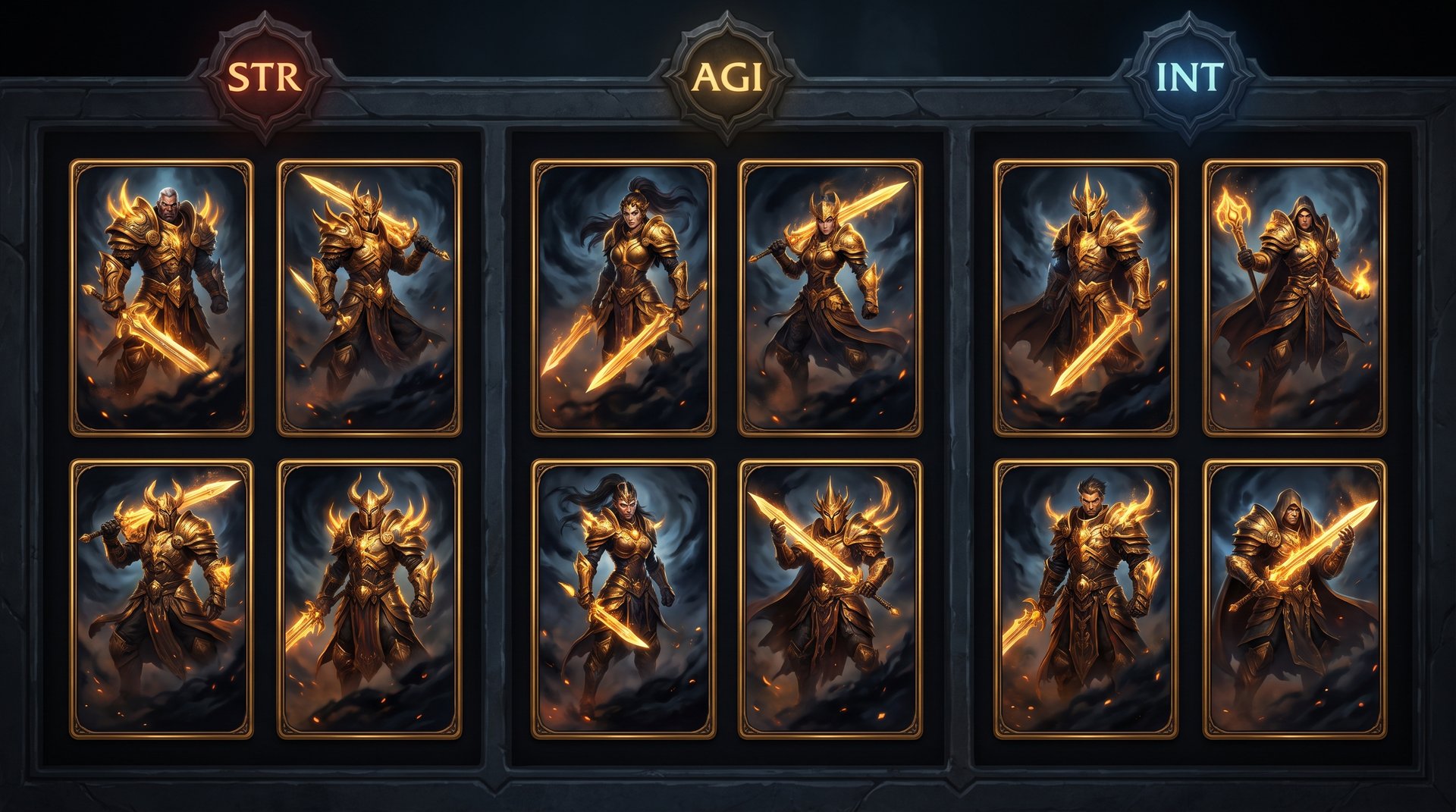
Heroes are categorized by primary attribute:
- Strength heroes — naturally durable, with high health pools. They include initiation tanks, brawlers, and support heroes who can take punishment. Examples: Axe, Dragon Knight, Tidehunter.
- Agility heroes — high attack speed and damage that scales with items. Most carry heroes fall into this category. Examples: Phantom Assassin, Juggernaut, Anti-Mage.
- Intelligence heroes — high mana pools and powerful spells. Typically played as supports, mid-laners, or utility heroes. Examples: Crystal Maiden, Invoker, Shadow Shaman.
- Universal heroes — a newer category that gains stats from all three attributes equally, making them more flexible in different roles. Examples: Marci, Primal Beast.
The variety is intentional and central to the game’s longevity. Valve patches Dota 2 every few weeks, adjusting hero values, item stats, and map details. A hero that dominated last month might be weak this month. This constant evolution keeps even players with thousands of hours finding new things to learn and experiment with.
For newcomers, there is a recommended pool of simpler heroes specifically chosen to teach core mechanics without punishing small errors. You do not need to learn all 120+ heroes before you can play well. Most experienced players specialize in a pool of 5-10 heroes and develop deep expertise in their preferred roles.
The Five Roles
Each player on a team fills one of five positions, numbered 1 through 5. The numbering reflects the hero’s expected farm priority — how much of the team’s gold and experience that hero needs to reach their peak effectiveness:
| Position | Name | Farm Priority | Core Responsibility |
|---|---|---|---|
| Pos 1 | Carry | Highest | Farm the safe lane and become the strongest hero on the map by late game |
| Pos 2 | Mid | High | Win the solo mid duel and create tempo pressure across the map |
| Pos 3 | Offlaner | Medium | Survive the dangerous off lane, initiate team fights, absorb damage |
| Pos 4 | Soft Support | Low | Roam early, create kills, provide ward coverage and team utility |
| Pos 5 | Hard Support | Lowest | Protect the carry, buy consumables and wards, enable team survival |
The carry (pos 1) is intentionally weak early in the game. They spend the laning phase farming creeps rather than fighting, slowly building toward items that will make them nearly unstoppable in the late game. The hard support (pos 5) spends their gold on wards, smokes, and consumables rather than personal power items — sacrificing their own hero’s strength so the carry can farm safely.
This asymmetry between roles is one of Dota 2’s most distinctive design features. In many games, every player tries to be as individually powerful as possible. In Dota 2, the optimal play for a pos 5 support is often to die so their carry does not — to buy time, absorb damage, and create space. Understanding that this is not a failure state but a design intention takes new players a long time to internalize.
Items and Builds
Unlike many games where characters unlock abilities through level-ups alone, Dota 2 heroes buy items with gold earned during the match. Items modify stats and grant additional active or passive abilities — and some of the most impactful moments in any game come from item purchases rather than hero abilities.
Items are built by combining smaller component parts at the shop. A Black King Bar — which grants a period of magic immunity during fights — is assembled from two smaller items that are useful on their own. Blink Dagger must be purchased all at once. A Bottle starts as a basic item but gains power when filled with runes. Different heroes have completely different optimal build paths depending on what the enemy team has picked and how the game is playing out.
The item system is one of the largest sources of Dota 2’s learning curve. The questions are not just “what does this item do” but:
- Which items does my hero need to function in this specific game?
- Should I build tank items because the enemy has a lot of physical damage, or damage items because I need to kill them before they kill me?
- What order should I build my items in — which components do I finish first?
- When should I deviate from the standard build for my hero?
There are over 100 items in the game, spread across Basic items (bought at the main shop), Recipe items (assembled from components), and Neutral items (dropped by jungle camps at timed intervals throughout the match, random from a tiered pool). Knowing which items apply to your situation is a significant part of what separates low-skill-bracket players from high-skill ones.
Item knowledge also feeds directly into your understanding of threats. If you know an enemy support just bought a Glimmer Cape (which grants invisibility and magic resistance to allies), you know they will use it to save their carry in team fights. If you know the enemy carry has a Battle Fury, you know they have been farming efficiently and are becoming dangerous. The MMR guide goes deeper into why item knowledge is one of the biggest skill separators between brackets.
Why People Play Dota 2
The honest question is not just “what is this game” but why anyone would choose a game with this level of complexity when there are thousands of simpler alternatives. The answer is different for different players, but a few themes come up consistently:
Depth that has no ceiling
Most games have a ceiling where you run out of things to learn. Players master the mechanics, reach the top rank, and either keep grinding or move on. Dota 2 does not have a visible ceiling for most players. Every match at every skill level contains decisions that could have been made better. Veterans with 5,000+ hours are still finding new hero interactions, item timing windows, and situational choices they had not considered before. The complexity is a feature to the people who love it — the game is never fully solved.
Team wins that feel different from anything else
Winning a close Dota 2 match — especially one where your team was losing for 40 minutes and clawed back — produces a sense of collective achievement that solo games cannot replicate. The coordination required at high levels approaches small-unit tactics. Even at casual skill brackets, there is a specific satisfaction to executing a plan with four other people that actually works, where every player’s contribution was necessary for the outcome.
Free to play with no pay-to-win
Every hero and every item is available to every player at no cost. The paid portion of Dota 2 is entirely cosmetic: custom hero models, couriers, visual effects, and seasonal content. You cannot buy in-game power. This is a meaningful distinction from many free-to-play games, and it is part of why the game has retained serious competitive players who care about the integrity of the ranked experience. See the full breakdown in our page on whether Dota 2 is free.
An active professional esports scene
The International (TI) is Dota 2’s annual world championship. Its prize pool has historically been among the largest in esports, funded partially through in-game cosmetic sales. The scene provides a shared cultural layer for the community — professional play shapes which heroes and strategies become popular in public match-making, and watching high-level games gives new players a sense of what mastery actually looks like.
How Hard Is It to Learn?
Directly: Dota 2 is one of the hardest video games to learn from scratch. This is not a selling point or a warning — it is context so your expectations are calibrated correctly.
The honest breakdown of what makes it hard for newcomers:
- 120+ heroes, each unique. No two heroes play the same way. Learning your first hero means understanding abilities that do not exist elsewhere in the game.
- 100+ items with different optimal buy orders for different situations.
- Map mechanics that do not exist in other genres — denial, high-ground vision penalties, stacking, pulling, fog of war interactions.
- Economy decisions — when to farm versus when to fight, which items to prioritize, how to allocate resources across five players with different farm needs.
- Positioning — where to be on the map at every point of the game, which changes every minute based on the score, the heroes, and the items in play.
- Communication — coordinating five players without a structured command interface in a game where a single missed call can lose a fight.
New players typically need 100-200 hours before they start to understand what is happening in their own matches — not to play well, but to comprehend the cause-and-effect of what they are seeing. The first 20-50 hours often involve dying to things you did not see coming, losing fights you did not understand, and making purchases that your team cannot use.
That early period is a shared experience for nearly every Dota 2 player alive. The game does not ease you into it. Our first-game guide is designed to get you through those early hours with the right priorities — what to focus on, what to ignore, and which habits to build early before they become hard to break.
If you want to compress the learning curve once you have the basics, one-on-one coaching with an Immortal-rank analyst can identify the specific habits holding you back at your bracket faster than solo grinding usually manages.
Dota 2 as an Esport
The International (TI) is Valve’s annual world championship, first held in 2011. Teams qualify through a combination of DPC (Dota Pro Circuit) points earned at regional majors and direct invitations. The format varies by year but typically involves a group stage followed by a double-elimination bracket at the main event, held in a large venue in front of a live audience.
Below the TI level, the Dota Pro Circuit structures the year into regional leagues (where teams compete domestically for DPC points) and international majors (where the top teams from each region meet). The structure is not as stable as some other esports, with Valve periodically adjusting how points, invitations, and the DPC season work.
Even if you never watch a professional match, the esports scene shapes the game you will play. Heroes that work at TI typically become popular in public matchmaking within days. The patch cycles partially align with the competitive calendar. And the community’s shared knowledge — which heroes are strong, which items are valued, which strategies are effective — flows substantially from professional play being analyzed, discussed, and copied at every level of the game.
Is Dota 2 Free?
Yes. Dota 2 is free to download and play on Steam. Every hero is available from the moment you create an account. No heroes are locked behind a paywall. No items are locked behind a paywall. Ranked matchmaking is available once you have met the minimum playtime requirement.
What you can optionally pay for: cosmetic items (custom hero models, couriers, visual effects, voice line packs), Dota Plus (a subscription that provides in-game hero tips, a stats tracker, and some cosmetic rewards), and seasonal battle passes when they are available. None of this gives you any gameplay advantage over a player who spent nothing.
For a full breakdown of the monetization model and what is worth buying, see our dedicated page: Is Dota 2 Free? What Costs Money in 2026.
What a Typical Match Looks Like
Here is a simplified timeline of a 35-minute Dota 2 match, to give you a feel for how the game flows from start to finish:
- 0:00 — Creep spawn. Waves of AI soldiers begin marching from both bases down all three lanes. Heroes buy starting items and head to their assigned lane or jungle position.
- Minutes 0-8 (Laning phase). Carries last-hit creeps for gold while supports try to secure kills or deny the enemy carry resources. Mid heroes duel one-on-one for lane dominance. The first few towers may fall if one team dramatically outplays the other.
- Minutes 8-20 (Mid-game). Rotation begins. Ganks happen across the map. Outpost control and rune timings become relevant. Both teams start grouping for objectives. Roshan becomes contestable around the 10-minute mark.
- Minutes 20-35 (Late game). Team fights happen frequently. Roshan is highly contested — the Aegis can swing a fight. Carries with full item builds become extremely dangerous. Both teams are looking for the decisive engagement that lets them breach the enemy base.
- Minutes 35+ (The push). One team has found an advantage. They push into the base, threaten or destroy the barracks (creating mega creeps), and attack the Ancient. The other team either defends and claws back into the game, or the Ancient falls and the GG screen appears.
That timeline is not fixed — some games end in 20 minutes when one team stomps completely. Others run 60+ minutes when both teams are evenly matched and neither can break the other’s base. The arc varies every game, which is part of why players can log thousands of hours without feeling like they have seen it all.
Frequently Asked Questions
Ready to Start Playing?
Dota 2 is free to download on Steam. Once you are in, the beginner guide walks you through your first real match and tells you exactly what to focus on — without drowning you in information you cannot use yet.
Already past the basics and looking to climb your rank? TeamSmurf offers Immortal-rank coaching sessions tailored to identifying exactly what is holding you back at your bracket.
Read the Beginner Guide Book a Coaching Session



