How to Master Tusk in Dota 2: The Ultimate Guide for Every Rank (2026)

Tusk is one of Dota 2’s most satisfying heroes to play — a brawling, snowballing menace who can single-handedly turn a losing lane into a bloodbath. Whether you are rolling into fights with Snowball, trapping enemies behind Ice Shards, or launching them into orbit with Walrus PUNCH, Tusk offers a unique blend of initiation, burst damage, and playmaking potential that few heroes can match.
In patch 7.38, Tusk sits at a 51.2% winrate across all ranks with an 8.5% pick rate, making him one of the most consistently viable position 3 and position 4 heroes in the game. Pro teams like Team Falcons and Tundra Esports have been flexing Tusk between offlane and soft support to devastating effect, and his kit scales beautifully whether you are ganking at minute 5 or punching buildings at minute 40.
This guide breaks down everything you need to master Tusk — from hidden ability interactions that even Divine players miss, to the exact item timings that separate good Tusk players from great ones. Whether you are a Herald learning the basics or an Immortal refining your execution, you will find actionable advice to climb MMR with one of Dota’s most fun heroes.
Table of Contents
Why Tusk Is Dota’s Ultimate Brawler
Tusk is a melee strength hero most commonly played as position 3 (offlane) or position 4 (soft support). He brings something rare to Dota 2 — a hero who is equally dangerous as a damage dealer and as a setup artist. His entire kit revolves around closing gaps, isolating targets, and punishing enemies who dare to stand still.
What makes Tusk special is his versatility. Unlike most offlaners who need farm to function, Tusk can dominate with just a Blink Dagger and levels. His Snowball provides BKB-piercing save potential for allies, Ice Shards creates terrain that rivals Earthshaker’s Fissure for game-changing plays, and Walrus PUNCH delivers one of the highest burst damage instances in the game on a laughably short cooldown.
According to Dotabuff, Tusk’s winrate spikes to 53.8% in Divine and Immortal brackets, which tells you everything you need to know — this is a hero that rewards skill, game sense, and creativity. The better you get at Dota, the more terrifying Tusk becomes in your hands.

Abilities Deep Dive
Understanding Tusk’s abilities at a granular level is what separates a mediocre Tusk from a game-winning one. Every spell has hidden mechanics and interactions that dramatically change how you should use them.
Ice Shards (Q)
Damage: 75/150/225/300 | Shard Duration: 7 seconds | Cooldown: 18/16/14/12 | Mana Cost: 100/105/110/115
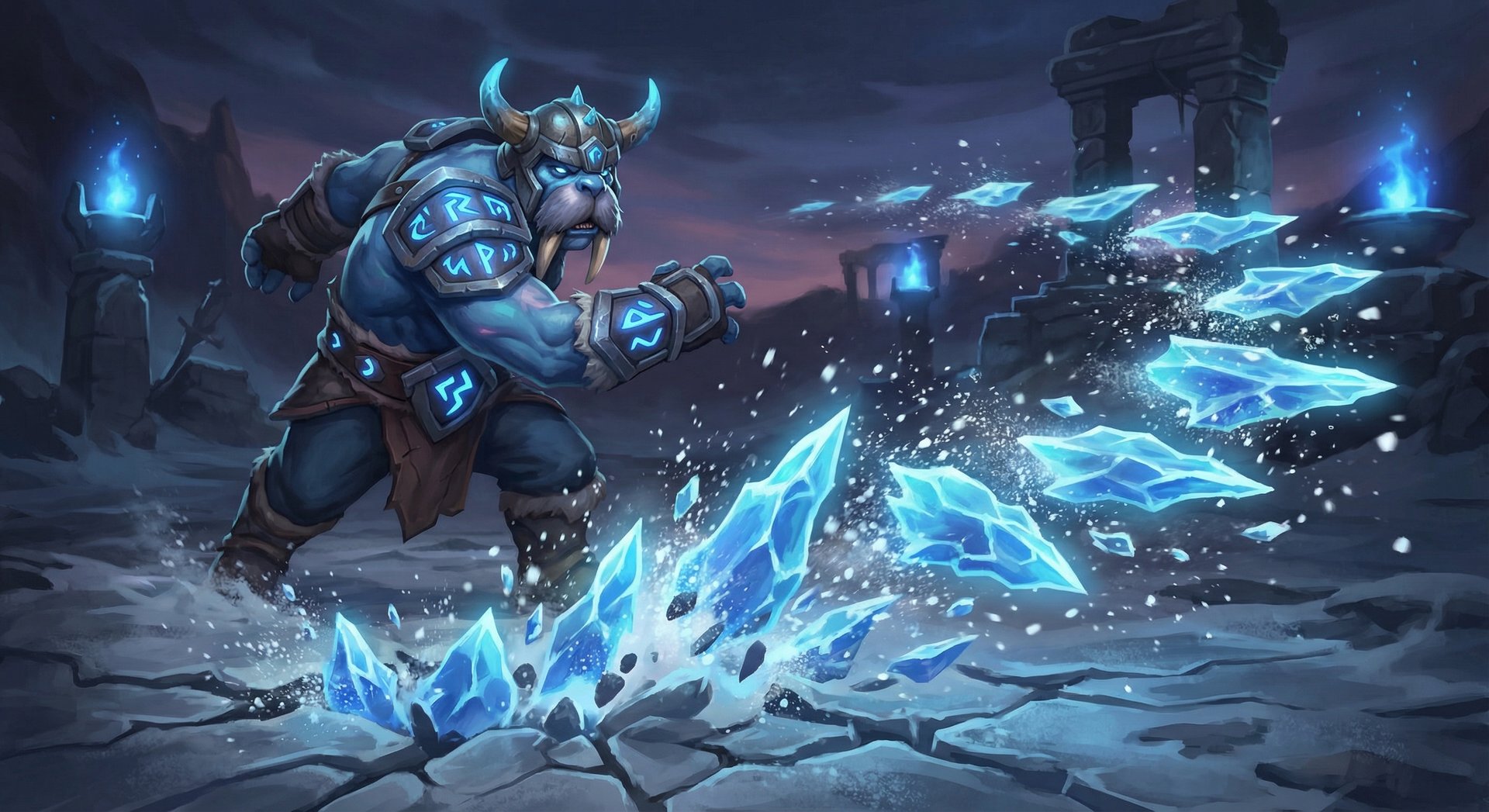
Ice Shards is Tusk’s signature utility spell — a line of ice that damages enemies and creates an impassable arc of terrain. The shards form in a crescent shape behind the first enemy hero hit, which means positioning relative to your target determines whether you trap them or waste the spell.
Hidden mechanics most players miss:
- The shard arc always forms behind the target relative to the projectile direction. Aim so the arc pushes enemies toward your team, not away.
- Shards provide vision in their area for the full 7-second duration — use this to scout Roshan, high ground, or fog.
- The projectile travels 1800 range even though the cast range is only 1100. Enemies can be hit well beyond the cast indicator.
- Shards block pathing for allies too. Careless shard placement in team fights can trap your own carry.
- Force Staff and Blink can escape the arc, but heroes without mobility items are completely stuck for 7 seconds — an eternity in Dota.
Skill build note: Max Ice Shards first in 90% of games. The damage scaling from 75 to 300 is enormous for early fights, and the cooldown reduction from 18 to 12 seconds lets you use it multiple times in extended engagements.
Snowball (W)
Damage: 80/120/160/200 | Stun: 0.5/0.75/1.0/1.25s | Cooldown: 21/18/15/12 | Mana Cost: 75
Snowball is what makes Tusk, Tusk. You roll into a massive snowball, gathering allies along the way, becoming invulnerable during the roll, and stunning enemies on impact. This single ability functions as initiation, escape, save, and disable all in one.
Critical interactions:
- You and all gathered allies are invulnerable during the roll. This means you can dodge projectiles like Sniper’s Assassinate, Sven’s Storm Hammer, and even Lina’s Laguna Blade if you time it right.
- Right-click allies while rolling to absorb them. You have a 3-second window before the snowball launches. Use this to save a teammate who is about to die — click them, and they become invulnerable inside the ball.
- The snowball deals bonus damage for each ally inside (40 damage per hero gathered). Rolling with 3 allies adds 120 extra damage on top of the base.
- You can cancel Snowball with Stop (S key) during the 3-second gather phase. If you start rolling and the situation changes, press S before launch to cancel.
- Snowball grants flying vision along its path, which is valuable for chasing into tree lines or uphill.
Tag Team (E)
Bonus Damage: 30/60/90/120 per attack | Slow: 75% | Duration: 5 seconds | Cooldown: 15 | Mana Cost: 70/80/90/100
Tag Team is Tusk’s steroid ability and one of the most underrated spells in Dota 2. When activated, Tusk and nearby allied heroes deal bonus physical damage on every attack against enemy heroes in the radius, while also applying a massive 75% movement speed slow.
Why this ability is broken:
- The bonus damage applies to EVERY allied hero attack. In a team fight with 3 right-clicking allies, Tag Team adds 360 bonus physical damage per second at max level.
- The 75% slow is one of the strongest slows in the game, and it stacks with other slows. Combined with Ice Shards terrain, nobody escapes.
- Tag Team works on Roshan. Pop it during Rosh attempts for significantly faster kills.
- The aura persists for the full duration even if Tusk dies. If you know you are going down, activate Tag Team first.

Walrus PUNCH! (R) — Ultimate
Critical Damage: 350% | Air Time: 0.8/1.0/1.2s | Slow After Landing: 40% for 2/3/4s | Cooldown: 20/16/12 | Mana Cost: 75/100/125
Walrus PUNCH is the most satisfying ultimate in Dota 2. Tusk’s next attack launches the target into the air with a 350% critical strike, followed by a movement slow on landing. At level 3, the 12-second cooldown means you can Walrus PUNCH multiple times in a single team fight.
Advanced mechanics:
- Walrus PUNCH applies before the attack connects, meaning it works with attack modifiers like Desolator and Orb of Corrosion. The armor reduction applies on the same hit as the crit.
- The critical multiplier applies to ALL of your attack damage, including bonus damage from items. A Tusk with Desolator and Daedalus can one-shot most support heroes.
- Targets are invulnerable during air time. Do not use Walrus PUNCH when your team is trying to chain-stun a target — the air time gives them a brief reprieve.
- Walrus PUNCH goes through BKB. The damage, the launch, and the slow all pierce spell immunity. This makes Tusk relevant even against BKB-heavy lineups.
- You can Walrus PUNCH buildings. The crit damage applies to towers and barracks, making Tusk a legitimate split-push threat with the right items.
Aghanim’s Scepter: Walrus Kick
Aghanim’s Scepter grants Tusk a new ability — Walrus Kick. Tusk kicks the target 1400 units in the direction he is facing, dealing 350 damage and applying a 4-second slow. This is a massive displacement tool that can kick enemies back into your team, kick them off cliffs for extended stuns, or kick dangerous heroes out of team fights.
Aghanim’s Shard upgrades Tag Team to also affect Tusk’s Snowball, making the snowball deal Tag Team bonus damage and slow on impact. This is a strong farming and fighting upgrade that significantly increases Tusk’s burst combo potential.
Recommended Skill Build
| Level | 1 | 2 | 3 | 4 | 5 | 6 | 7 | 8 | 9 | 10 |
|---|---|---|---|---|---|---|---|---|---|---|
| Standard (Pos 3) | Q | W | E | Q | Q | R | Q | E | E | E |
| Ganking (Pos 4) | W | Q | Q | E | Q | R | Q | W | W | W |
| Fighting Early | E | Q | W | Q | Q | R | Q | E | E | E |
Item Builds by Rank Bracket
Tusk’s item build varies significantly depending on your rank bracket, role, and game state. Lower-rank players should focus on reliable items that work even without perfect execution, while higher-rank players can leverage timing-dependent builds that require precise game sense.

| Rank | Starting | Early Game | Core Items | Late Game |
|---|---|---|---|---|
| Herald – Crusader | Tango, Quelling Blade, Gauntlets x2, Branch | Phase Boots, Orb of Corrosion, Magic Wand | Blink Dagger, Desolator, BKB | Assault Cuirass, Daedalus |
| Archon – Legend | Tango, Orb of Venom, Gauntlets, Branch x2 | Phase Boots, Orb of Corrosion, Urn of Shadows | Blink Dagger, Desolator, Aghanim’s Shard | BKB, Assault Cuirass, Nullifier |
| Ancient – Divine | Tango, Orb of Venom, Circlet, Branch x2 | Phase Boots, Orb of Corrosion, Magic Wand | Blink Dagger, Aghanim’s Shard, Desolator | BKB, Aghanim’s Scepter, Overwhelming Blink |
| Immortal | Tango, Orb of Venom, Circlet, Faerie Fire | Phase Boots, Orb of Corrosion, Bracer | Blink Dagger, Aghanim’s Shard, Solar Crest | Aghanim’s Scepter, BKB, Overwhelming Blink |
Why Item Builds Differ by Rank
Herald to Crusader: At lower ranks, fights are chaotic and long. Building raw damage items like Desolator and Daedalus is effective because enemies rarely have the coordination to kite or focus you down. BKB is essential because lower-rank players tend to dump all their spells on whoever is closest.
Archon to Legend: Players at this bracket start understanding target priority. Urn of Shadows becomes valuable because you are constantly fighting and need sustain between ganks. Aghanim’s Shard timing around minute 15 gives your combo a massive power spike when coordinated pushes start happening.
Ancient to Divine: At this level, Tusk transitions from damage dealer to playmaker. Aghanim’s Shard rush accelerates your farming and fighting. The Desolator timing needs to hit before 20 minutes to remain impactful, and Overwhelming Blink in the late game turns you into an AoE initiation monster.
Immortal: Top-level Tusk players prioritize utility and tempo over raw damage. Solar Crest gives your carry a huge advantage in fights while also letting you Roshan faster. Aghanim’s Scepter (Walrus Kick) is the biggest late-game item because the displacement lets you remove a key hero from every fight. Immortal Tusk players know their job is not to deal the most damage — it is to create the most chaos.
Situational Items
- Lotus Orb: Against heavy single-target lineups (Doom, Batrider). The dispel is also clutch for removing silences.
- Heaven’s Halberd: Against right-click cores like PA, Troll, Ursa. The disarm is devastating and it gives you evasion and status resistance.
- Nullifier: Against Ghost Scepter, Glimmer Cape, Ethereal Blade carriers. Combine with Walrus PUNCH for guaranteed kills on slippery supports.
- Silver Edge: Against passive-dependent heroes like Bristleback, PA, Spectre. The break plus crit from Walrus PUNCH is brutal.
Laning Phase Masterclass
Tusk’s laning phase is where you set the tone for the entire game. Played correctly, you will have kill potential from level 2 onwards and can zone most carry heroes out of the lane entirely. Played poorly, you will feed first blood and lose the game before it starts.

Offlane Tusk (Position 3)
Level 1-2 aggression: Start with Orb of Venom and immediately contest the pull camp. At level 2 with Ice Shards and Snowball, you have a guaranteed kill setup if your support has any kind of disable or slow. The combo is simple: Ice Shards behind the enemy, then Snowball into them while they are trapped. The burst damage from Shards (75) plus Snowball (80) plus right-clicks with Orb of Venom is enough to kill most heroes from 70% HP.
Creep aggro manipulation: As a melee offlaner, you need to use creep aggro tricks to last hit safely. Click an enemy hero from 500+ range to draw creeps toward you, then last hit them closer to your tower. Tusk’s base damage of 52-56 is average, but his attack animation is smooth enough for reliable last hits.
When to abandon the lane: If the enemy trilanes you or the lane is unwinnable (Ursa + Shaman, for example), leave at level 3-4 and rotate mid for a kill. Tusk’s gank potential with Ice Shards and Snowball is so high that a single mid kill can recover a lost lane’s worth of gold and experience.
Soft Support Tusk (Position 4)
Lane partner synergies: Tusk works best with offlaners who have follow-up stuns or damage. The strongest combos include:
- Tusk + Mars: Snowball into Arena of Blood is nearly inescapable. Mars can ride inside the Snowball for an instant Arena setup.
- Tusk + Axe: Snowball delivers Axe directly onto enemy heroes for Berserker’s Call. The 75% Tag Team slow guarantees Counter Helix procs.
- Tusk + Clockwerk: Ice Shards and Power Cogs create a double-terrain prison. Nobody walks out of this combination alive.
- Tusk + Legion Commander: Snowball into Duel is a guaranteed setup, and Tag Team bonus damage applies during Duel for absurd kill speed.
Laning Phase Power Spikes
| Level | Timing | Power Spike |
|---|---|---|
| Level 2 | ~1:30 | First kill potential with Q + W combo |
| Level 3 | ~2:30 | Tag Team makes trades devastating with lane partner |
| Level 5 | ~4:00 | Max Ice Shards base damage — 225 nuke every 14s |
| Level 6 | ~5:30 | Walrus PUNCH adds 350% crit to kill combo |
Mid and Late Game Transitions
Tusk’s mid game (minutes 15-30) is his absolute peak. With Blink Dagger and maxed abilities, you can delete supports in under 2 seconds and create fight-winning initiations every 60 seconds. Your job in the mid game is not to farm — it is to force fights on favorable terms and snowball (pun intended) your team’s advantage.

The Tusk Combo Sequence
The full Tusk burst combo that kills most supports from full HP:
- Blink in next to the target
- Walrus PUNCH (R) — the 350% crit hits immediately
- Tag Team (E) during the air time — this ensures your follow-up attacks have bonus damage
- Ice Shards (Q) behind the target as they land — they are slowed and cannot escape
- Right-click with Tag Team active — the slow and bonus damage finish the kill
- Snowball (W) to chase if needed, or save as an escape
This combo deals approximately 1,200-1,500 physical damage at level 12 with Phase Boots and Desolator, which is enough to kill any support hero and most mid heroes who have not built survivability items.
Team Fight Positioning
In team fights, Tusk plays as a flanking initiator. You do not want to be the first hero to walk in — you want to Blink from fog onto a high-value target while the fight is already happening. Your ideal targets in this priority order:
- Squishy supports with key spells (Warlock before Golem, Oracle before Save, Dazzle before Grave)
- Backline damage dealers (Sniper, Zeus, Drow Ranger)
- Cores without BKB active
When Tusk Falls Off (and How to Stay Relevant)
Tusk’s damage starts falling off around minute 35-40 when enemy cores have multiple defensive items. When this happens, shift your role from damage dealer to utility player:
- Save allies with Snowball. A well-timed Snowball that absorbs your carry during a Chrono or Black Hole wins the late game.
- Use Ice Shards defensively to cut off enemy chase paths or protect high ground.
- Walrus Kick (Aghs) removes key heroes from fights. Kicking an enemy carry 1400 units away from the team fight is often better than trying to kill them.
- Tag Team scales with allies’ attack speed. Late-game Tag Team on a 6-slotted carry is adding hundreds of bonus damage per second.
BKB Timing
BKB on Tusk is a third or fourth item, not a rush. You need Blink and at least one damage item before BKB makes sense. The exception is if the enemy team has instant disables that prevent your combo entirely (Hex, Doom, Dismember). In those games, consider BKB second after Blink.
Counters: Heroes That Destroy Tusk
Even the best Tusk players struggle against these five heroes. Understanding why they counter you is the first step to playing around them.

1. Oracle
Oracle is Tusk’s worst nightmare. Fate’s Edict grants 100% magic resistance and disarms, but more importantly, False Promise makes Tusk’s entire burst combo irrelevant. You Walrus PUNCH someone, drop your full combo, and Oracle just presses R and undoes all of it. Oracle’s Purifying Flames also dispels the Tag Team slow, making it impossible to lock down Oracle’s save target.
How to play around Oracle: Focus Oracle first. He has 500 HP and no escape. Blink-Punch Oracle before he can False Promise anyone, and your team fight becomes 5v4 with no save on the enemy side. If Oracle has Aeon Disk, bait it with Ice Shards, then re-engage after the 2.5-second window.
2. Abaddon
Aphotic Shield absorbs Tusk’s burst and dispels the Tag Team slow. Borrowed Time makes killing Abaddon’s core targets nearly impossible because he will just pop it and heal through your damage. Abaddon also naturally builds into Pipe and Crimson Guard, which reduce Tusk’s AoE team fight damage.
How to play around Abaddon: Ignore him. Abaddon is a low-priority target. Ice Shards to isolate him from his carry, then Snowball past him to reach the backline. If he Aphotic Shields a target, wait the 2 seconds for it to expire before committing your full combo.
3. Lifestealer
Rage grants spell immunity, which means Lifestealer can walk through Ice Shards (they still block pathing, but Rage prevents the stun from Snowball). Lifestealer’s built-in lifesteal also means he can sustain through Tag Team harassment in lane. The matchup is miserable at every stage of the game.
How to play around Lifestealer: Never Snowball into an active Rage — you will waste your cooldown and take free damage. Wait for Rage to expire, then initiate. Build Heaven’s Halberd to disarm him during the Rage downtime. Alternatively, ignore Lifestealer entirely and delete his supports instead.
4. Omniknight
Heavenly Grace provides status resistance and strength, making it harder to burst targets. Guardian Angel grants physical damage immunity to Omniknight’s entire team, which completely nullifies Tusk’s physical damage output. Since almost all of Tusk’s damage is physical (Walrus PUNCH, Tag Team, right-clicks, Desolator), Guardian Angel is a hard counter.
How to play around Omniknight: Build Nullifier to purge Guardian Angel from single targets, or time your engagement after Guardian Angel expires. Diffusal Blade also purges GA and can be a cost-effective option.
5. Vengeful Spirit
Nether Swap can save any ally you initiate on, trading positions and making your Blink-Punch combo a 1-for-0 trade instead of a kill. Vengeful Spirit’s Wave of Terror reduces your armor, making you squishier in fights. Her aura also boosts nearby allied damage, turning trade-heavy lanes against Tusk.
How to play around Vengeful Spirit: Kill Venge first, or bait the Swap and then re-engage. If you Snowball into a target and Venge Swaps them, you can redirect onto Venge instead — she is often the squishier target anyway.
Heroes Tusk Destroys
Tusk is not just a versatile hero — he is a hard counter to specific hero archetypes. If you see these heroes on the enemy team, Tusk should be one of your first picks.
1. Sniper
Sniper has zero mobility and relies entirely on range to survive. Tusk’s Snowball closes the gap instantly from 1000+ range, and Ice Shards behind Sniper means he cannot run. One Walrus PUNCH crit at any point in the game kills or forces buyback on Sniper. This matchup is so one-sided that pro Sniper players will ban Tusk rather than deal with it.
2. Drow Ranger
Drow’s Marksmanship passive is disabled when a melee hero is within 400 range. Tusk’s entire kit is about getting into melee range. Snowball into Drow disables her main damage source, and the burst from Walrus PUNCH kills her before she can Gust you away. Ice Shards also blocks Drow’s kiting path, removing her main defensive strategy.
3. Crystal Maiden
CM is slow, fragile, and has no escape. Tusk can kill Crystal Maiden from full HP at level 6 with just Phase Boots. Snowball interrupts her Freezing Field channel, and Ice Shards prevents her from retreating to safety. If CM is the enemy position 5, every fight is a 5v4 because Tusk deletes her in the first 2 seconds.
4. Zeus
Zeus relies on staying at max range and spamming abilities. Tusk’s Snowball closes the distance instantly and makes your team invulnerable to Zeus’s damage during the roll. Walrus PUNCH one-shots Zeus at most stages of the game, and Zeus has no way to stop the initiation without a pre-emptive Eul’s or BKB.
5. Shadow Fiend
Shadow Fiend loses all his souls on death, making Tusk’s burst damage doubly punishing. A single Blink-Punch kill on SF not only removes him from the fight but also resets his damage to near zero. In lane, Tusk’s aggression prevents SF from collecting last hits for souls, crippling his scaling from minute zero.
How Pros Play Tusk in the Current Patch
Tusk has been a consistent presence in professional Dota 2 throughout 2025-2026, with a 15% pick/ban rate in tier 1 tournaments. Pro teams value Tusk for his flexibility — he can be drafted early without revealing the team’s strategy, as he works equally well as position 3 or position 4.
Recent Pro Performances
Collapse (Team Spirit) demonstrated the offlane Tusk at DreamLeague Season 24, going 8-2-15 in a dominant Game 3 against Gaimin Gladiators. His build prioritized Blink Dagger into Aghanim’s Shard, using the Walrus Kick upgrade to displace enemy cores out of fights while Tag Team provided massive damage amplification for YATORO’s carry.
Cr1t- (OG) has been one of the standout position 4 Tusk players this season. In ESL One Birmingham 2025, Cr1t- showcased a Solar Crest rush build that focused entirely on enabling his carry rather than dealing damage. His timing was impeccable — Solar Crest completed at minute 14 in every game, turning his Ursa or Troll Warlord into unstoppable lane dominators during the critical mid-game window.
iceiceice (various teams) has historically been the benchmark for creative Tusk plays. His use of Snowball to dodge key abilities — saving himself and allies from Ravage, Black Hole, and Chrono in the same tournament — demonstrates the ceiling of what Tusk can do in the hands of a master. His positioning before fights, always on the flank with Blink ready, is something every Tusk player should study.
Pro Build Trends
- Aghanim’s Shard at minute 15 is almost universal in pro play. The value of the enhanced Snowball in both farming and fighting is too good to skip.
- Solar Crest over Desolator when playing position 4. Pros recognize that amplifying carry damage is more valuable than personal damage.
- Overwhelming Blink as the luxury upgrade. The AoE slow and damage on Blink-in synergizes perfectly with Tusk’s initiation pattern.
- Aghanim’s Scepter in games that go late. Walrus Kick provides displacement that wins fights even when Tusk’s damage has fallen off.
Rank-Specific Climbing Guide
Tusk plays differently at every rank bracket. What works in Herald will get you killed in Immortal, and what Immortal players do would be wasted on Herald opponents. Here is exactly how to adjust your Tusk play for your current rank.

Herald to Guardian: Foundation Basics
At this rank, mechanical execution matters more than strategy. Focus on these fundamentals:
- Land Ice Shards consistently. Practice in demo mode until you can trap enemies behind the arc 8 out of 10 times. At Herald, most players will not have Force Staff or mobility to escape your shards.
- Do not Snowball into 5 heroes. The most common Herald Tusk mistake is rolling into the entire enemy team and dying instantly. Only Snowball when you have a clear target and an escape plan.
- Build Phase Boots first, always. The movement speed and armor help you survive lane trades and chase kills.
- Use Walrus PUNCH on cooldown in fights. At this rank, do not overthink timing — just punch the nearest enemy hero whenever it is available. The 350% crit will carry you through chaotic Herald team fights.
- Buy Blink Dagger before anything else after boots. Blink Tusk is 10 times more effective than no-Blink Tusk. Skip every other item until you have Blink.
Crusader to Archon: Adding Game Sense
At this bracket, enemies start grouping and buying basic items. Adjust your approach:
- Start ganking at level 6, not before. Walrus PUNCH provides the burst damage that guarantees kills. Pre-6 ganks often fail at this rank because follow-up damage is inconsistent.
- Smoke of Deceit with your mid laner. A Smoke gank from Tusk at minute 8-10 has an absurd kill rate because Crusader-Archon players rarely expect it. Smoke, Blink, Punch, kill.
- Learn to Ice Shard from fog. Throw shards from trees or uphill so enemies cannot see the projectile coming. This removes their reaction time entirely.
- Communicate before Snowball. Ping your target before rolling so your team knows to follow up. At this rank, allies will not instinctively react to your initiation.
- Build Orb of Corrosion early. The armor reduction and slow stack with Tag Team, making lane kills much easier with minimal gold investment.
Legend to Ancient: The Macro Leap
This is where Tusk transforms from a pub stomper to a strategic asset:
- Play around Roshan timers. Tusk’s Tag Team accelerates Roshan significantly, and your Ice Shards can zone enemies away from the pit entrance. Push for Rosh immediately after winning a fight.
- Counter-initiate instead of initiating. At Legend+, enemies bait initiations. Let the enemy team commit their spells first, then Snowball in to clean up. Reactive Tusk is often better than proactive Tusk.
- Carry a TP scroll and a Smoke at all times. Tusk’s rotational speed is his biggest asset. If you see an enemy dive your mid tower, TP in, Snowball the diver, and turn the fight.
- Deward aggressively. Tusk’s ability to safely check wards (Snowball in, check, Ice Shards escape path) makes him one of the best dewarding heroes in the game.
- Target selection becomes everything. At Legend+, killing the enemy position 4 first is often more valuable than killing the carry. Remove the save hero (Oracle, Dazzle, Omni) before committing to the core.
Divine to Immortal: What Separates the Top 1%
At the highest ranks, Tusk is about information and timing:
- Snowball dodge timings. Immortal Tusk players use Snowball invulnerability to dodge specific abilities with frame-perfect timing. Practice dodging Finger of Death, Laguna Blade, and Assassinate in demo mode until it becomes muscle memory.
- Ice Shard geometry. The arc placement of shards is a skill with infinite depth. Learn to place shards so the arc pushes enemies INTO your team (throw from behind the target) rather than trapping them in place.
- Ally Snowball saves. The best Tusk players in the world use Snowball more as a save than as initiation. Absorbing your carry into Snowball during Chronosphere, Black Hole, or Ravage wins games that nothing else can.
- Map pressure through vision. Place aggressive wards before fights and use Ice Shards for scouting. Tusk with superior vision wins; Tusk without vision feeds.
- Itemize for the game, not the build guide. At Immortal, every game demands a unique build. Pipe of Insight on Tusk against heavy magic damage, Lotus Orb against Doom, Heaven’s Halberd against physical carries — adapt or die.
Tips and Tricks
These are the Tusk techniques that separate average players from carry-banning nightmares. Some of these take hundreds of games to master, but knowing they exist is the first step.

Animation Cancels and Hidden Interactions
- Walrus PUNCH animation cancel: After pressing R, immediately issue a move command to cancel the backswing animation. This lets you get an extra right-click in before the target lands from the air, increasing your burst damage by 15-20%.
- Ice Shards + Snowball instant combo: Cast Ice Shards, then immediately Snowball to the same target. The shards will arrive and trap the enemy just as your Snowball connects, giving them zero time to react. This requires casting shards BEFORE snowball because the shard projectile is slower.
- Snowball direction change: While gathering allies in the 3-second window, you can re-target the Snowball to a different enemy hero. Use this to fake initiation on one target, then redirect to the real target after the enemy team reacts.
- Tag Team + Roshan speed kill: Activate Tag Team inside the Rosh pit. Every allied hero attacking Roshan deals bonus physical damage per hit. With a Troll Warlord or Ursa, this can cut Roshan kill time by 30%.
Common Mistakes to Avoid
- Snowballing without a plan. Every Snowball should have a clear purpose — initiation, save, or dodge. Rolling randomly into fights is the fastest way to feed on Tusk.
- Ice Shards trapping allies. Always check where your teammates are before throwing shards. A poorly placed shard arc that blocks your carry’s escape path can cost the entire team fight.
- Using Walrus PUNCH while allies are chain-stunning. The target is invulnerable during air time. If your Earthshaker just Fissured and your Lion is about to Hex, hold your punch until the stun chain ends.
- Ignoring Aghanim’s Shard timing. Shard at minute 15 is one of the strongest power spikes in the game for Tusk. Delaying it past 18 minutes significantly reduces its impact.
- Not carrying Smoke. Tusk is one of the best Smoke carriers in Dota. Buy one every time you have a spare 50 gold. Smoke ganks with Tusk have an absurdly high kill rate at every rank.
Advanced Techniques Only High-MMR Players Know
- Shard scouting: Throw Ice Shards into Roshan pit, fog areas, or behind trees to check for enemies. The vision provided by the shards lasts 7 seconds — more than enough to confirm a gank setup or Rosh attempt.
- Snowball body-block: After Snowball connects and stuns, immediately position yourself between the enemy and their escape path. The 0.5-1.25 second stun gives you time to set up a body-block that keeps them in range for Tag Team follow-up.
- Walrus Kick cliff trapping: With Aghanim’s Scepter, kick enemies onto ward cliffs or other elevated terrain they cannot walk off. This effectively removes them from the fight for the TP scroll cooldown duration — a 60-80 second “stun” in the mid game.
- Snowball courier snipe: If you spot an enemy courier passing nearby, you can Snowball to it for a guaranteed kill. The courier counts as a valid target and cannot dodge.
- Phase Boots + Snowball speed stack: Activate Phase Boots before launching Snowball. The movement speed bonus increases your Snowball roll speed, giving enemies less time to react.
Frequently Asked Questions
Both work, but position 3 gives Tusk the farm priority he needs for Blink Dagger and Desolator timings. Position 4 Tusk is viable when your team already has a greedy offlaner and needs a roaming playmaker. In pub games below Divine, position 3 is generally stronger because you control your own farm and do not rely on kills for gold.
Pick Tusk when the enemy has squishy backline heroes (Sniper, Drow, Zeus, CM), when your team needs initiation, or when you need a flexible hero that can be drafted early. Avoid Tusk when the enemy has strong saves (Oracle, Abaddon), heavy AOE lockdown (Enigma + Magnus), or when your team already has enough initiation and needs a frontline tank instead.
Aim for Blink Dagger by minute 14-16 as position 3, or minute 16-18 as position 4. If you get Blink before 14 minutes, you are ahead of schedule. If it takes past 20 minutes, the item’s impact drops significantly because enemies will have enough HP and items to survive your combo.
Yes. Walrus PUNCH pierces spell immunity completely — the damage, the launch, and the post-landing slow all go through BKB. This is one of Tusk’s biggest strengths in the late game, as most other physical burst heroes are countered by BKB timing.
Go into demo mode with bots. Initiate a fight, then practice clicking allies into your Snowball during the 3-second gather phase. The key is to press W on an enemy to start the roll, then immediately right-click the ally you want to save before launching. In real games, start by saving allies from obvious ultimates like Chronosphere and Black Hole — these have long durations that give you time to react.
Aghanim’s Scepter (Walrus Kick) is a situational luxury item that becomes essential in games that go past 35 minutes. If you are ahead and the game is ending, skip it. If the game is going late and you need displacement utility, Aghanim’s Scepter is one of the strongest items in the game on Tusk. Kicking an enemy carry out of a team fight is worth more than any amount of personal damage.
Level 10: Take the Ice Shards damage talent in most games for better burst. Level 15: Tag Team damage is almost always correct — it scales with your team’s attack speed. Level 20: Snowball speed is excellent for initiation range. Level 25: Walrus PUNCH cooldown reduction turns you into a machine gun of crits in late-game fights. Adjust based on whether you are playing damage (take damage talents) or utility (take survivability and Tag Team talents).
Ready to Snowball Your Way to Immortal
Mastering Tusk takes hundreds of games, but you do not have to grind alone. Our Immortal-rank coaches can review your replays, identify your biggest mistakes, and accelerate your climb. Or skip the grind entirely with our professional MMR boosting service.