TI 2026 Shanghai: Complete Guide – Teams, Format, Dates, Tickets

The International 2026 is coming to Shanghai. For the first time since TI9 shattered every esports record in 2019, Dota 2’s biggest stage returns to the SPD Bank Oriental Sports Center in Pudong — and 16 of the world’s best teams are about to compete for the title of world champion.
This guide covers everything you need to know: the full team list and how they qualified, the Swiss-system group stage format, the double-elimination main event bracket, exact dates and schedule, how to get tickets, and where to watch every game live. We have also verified every key fact against official Valve announcements and reporting from established esports outlets, so you can read this without second-guessing the details.
Whether you are flying to Shanghai, watching from home at 3am, or just trying to understand why the Dota 2 community goes completely silent for two weeks in August, this is your starting point.
What Is in This Guide
TI 2026 at a Glance
Before we go deep, here is every key detail in one place. If you already know TI and just need the fast facts, this table is what you are looking for.
| Detail | Info |
|---|---|
| Official Name | The International 2026 (TI15) |
| Organizer | Valve Corporation + PerfectWorld |
| Location | SPD Bank Oriental Sports Center, Shanghai, China |
| Group Stage | August 13-16, 2026 |
| Main Event | August 20-23, 2026 |
| Teams Competing | 16 (7 direct invites + 9 qualifier winners) |
| Group Stage Format | Swiss system, all matches best-of-three |
| Main Event Format | Double-elimination bracket, grand final best-of-five |
| Base Prize Pool | USD 1,600,000 |
| Total Prize Pool | Growing via 30% of supporter bundle sales |
| Tickets | Single-day or two-day bundles, assigned seating only |
| Domestic Ticket Platforms | Perfect World Esports app, Damai |
| International Ticket Platform | Trip.com |
Venue: SPD Bank Oriental Sports Center
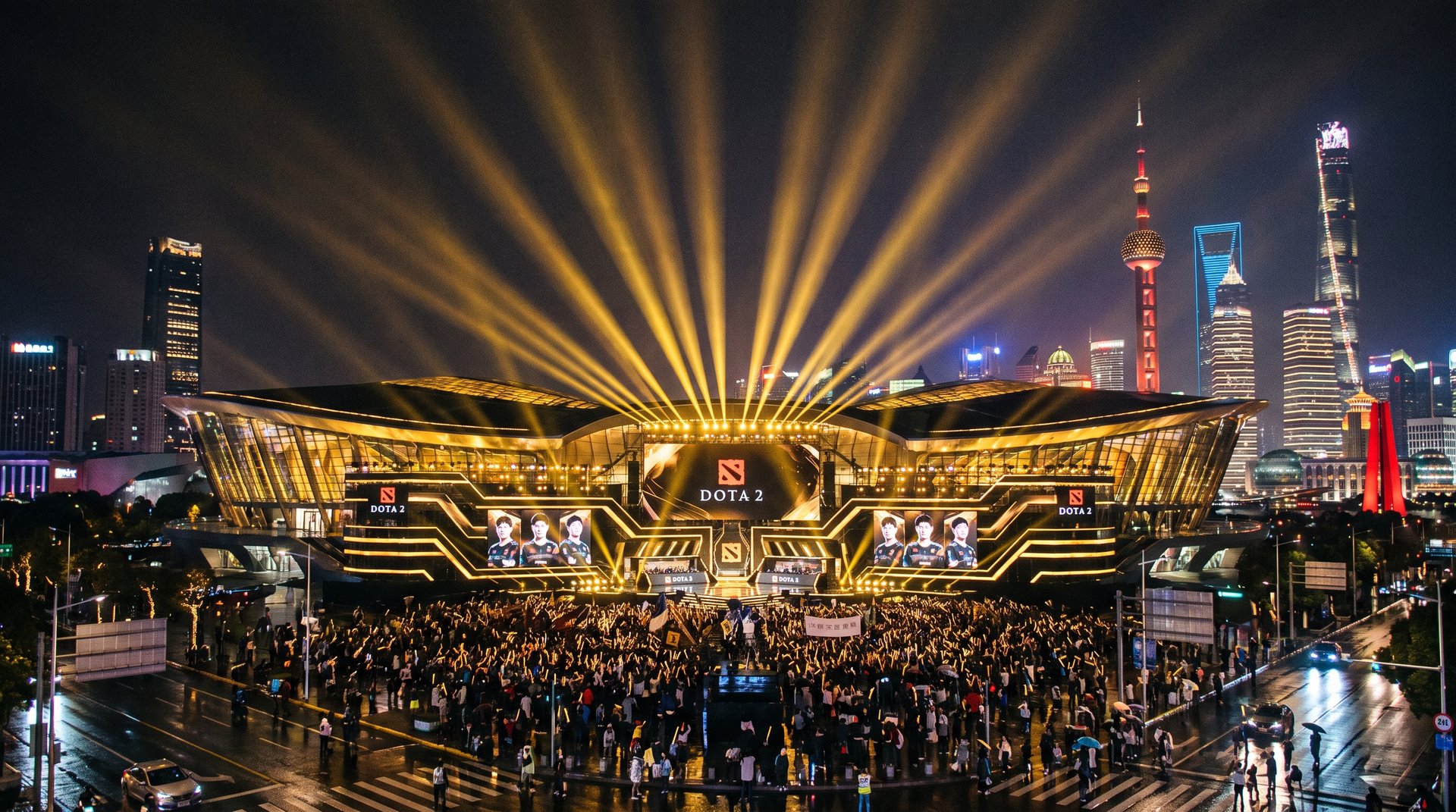
The SPD Bank Oriental Sports Center — commonly shortened to Oriental Sports Center or OSC — sits in the Pudong district of Shanghai. This is the same arena that hosted TI9 in 2019, which remains one of the most watched esports events in history. The venue has a capacity that comfortably seats tens of thousands for major events, and Valve made the deliberate choice to return here knowing exactly how loud and electric the environment gets when a Chinese team is on the main stage.
Pudong is the financial and commercial heartbeat of modern Shanghai. The venue is well connected by Shanghai’s Metro Line 6, with Changshanhu Station a short walk away. For international attendees staying near the Bund or in central Puxi, the journey takes around 30 to 40 minutes by metro, which is both cheap and faster than any taxi during peak hours around event days.
The arena itself is a multi-purpose venue used for concerts and sporting events throughout the year, but when TI rolls in, it transforms. Valve and PerfectWorld take over the space for weeks before the event, installing the custom stage, production rigs, LED display arrays, and the broadcast infrastructure needed to deliver the kind of production quality that TI is known for. Attendees who were at TI9 describe the scale of the setup as nothing like a typical esports event — it sits in a completely different category from regional tournaments held in hotel ballrooms or smaller convention halls.
Getting to the Venue
If you are traveling to Shanghai specifically for TI 2026, here is what you need to know logistically. The two major international airports serving Shanghai are Pudong International Airport (PVG) and Hongqiao International Airport (SHA). PVG is physically closer to the venue — both are in Pudong — and is the better option for most international flights. From PVG, the metro journey to the venue takes around 50 to 60 minutes on Line 2 followed by a transfer, or roughly 40 minutes by taxi in reasonable traffic.
Accommodation near the venue in Pudong tends to be more expensive and business-focused. Many TI attendees prefer staying near the Bund or in Xuhui for a better overall Shanghai experience, accepting the slightly longer transit time. Book accommodation well in advance — TI 2026 ticket holders are arriving from dozens of countries, and hotels in central Shanghai fill up for the main event weekend.
Full Schedule and Dates
The full TI 2026 calendar runs from August 13 to August 23. The event is split into two distinct phases: the Road to The International (the group stage) and The International itself (the main event). There are rest days between the two phases to allow for travel, setup adjustments, and player recovery.
| Phase | Dates | Format | Location |
|---|---|---|---|
| Road to TI — Group Stage | August 13-16, 2026 | Swiss system, all 16 teams | Shanghai (venue TBD for group stage) |
| Rest / Break Days | August 17-19, 2026 | No matches | — |
| Main Event — Playoffs | August 20-23, 2026 | Double elimination, 8 teams | SPD Bank Oriental Sports Center |
For time zone reference: all times during TI 2026 are typically listed in China Standard Time (CST, UTC+8). If you are watching from North America, EST is 12 hours behind CST, meaning an 11am Shanghai start becomes 11pm the previous night in New York. European viewers in CET (UTC+1) are 7 hours behind, making morning Shanghai matches land in the early evening. Australians in AEST (UTC+10) have the best scheduling luck, with matches often falling in reasonable afternoon slots.
Tournament Format Explained
TI 2026 uses a two-phase format that Valve has refined over multiple years. Understanding how it works makes the stakes of each match much clearer when you are watching.
Phase 1: Road to The International (Group Stage)
The group stage runs August 13-16 and uses a Swiss system format with all 16 teams. In a Swiss system, teams are paired based on their current record rather than predetermined seedings — teams with the same number of wins face each other each round. This creates increasingly meaningful matches as the group stage progresses, since every game from round 2 onward pits teams with identical records against each other.
All group stage matches are best-of-three. A best-of-two format (which some TIs used in the past) is not in use this year, which means there are no draw results — every series has a winner and a loser. This matters for seeding and for the quality of play, since teams cannot settle for a split result and must push for the full series win.
Advancement from the group stage works as follows:
- Top 3 teams — direct advancement to the main event playoff bracket
- Teams 4 through 13 — enter a tiebreaker or elimination round to determine the remaining 5 playoff spots
- Teams 14 through 16 — eliminated from TI 2026
This means that at least 8 teams and at most 13 teams will be alive heading into the break days. The exact format of the tiebreaker/elimination round between teams 4 and 13 follows standard Valve playoff procedure, with the final playoff field of 8 teams confirmed before the main event begins on August 20.
Phase 2: The International Main Event (Playoff Bracket)
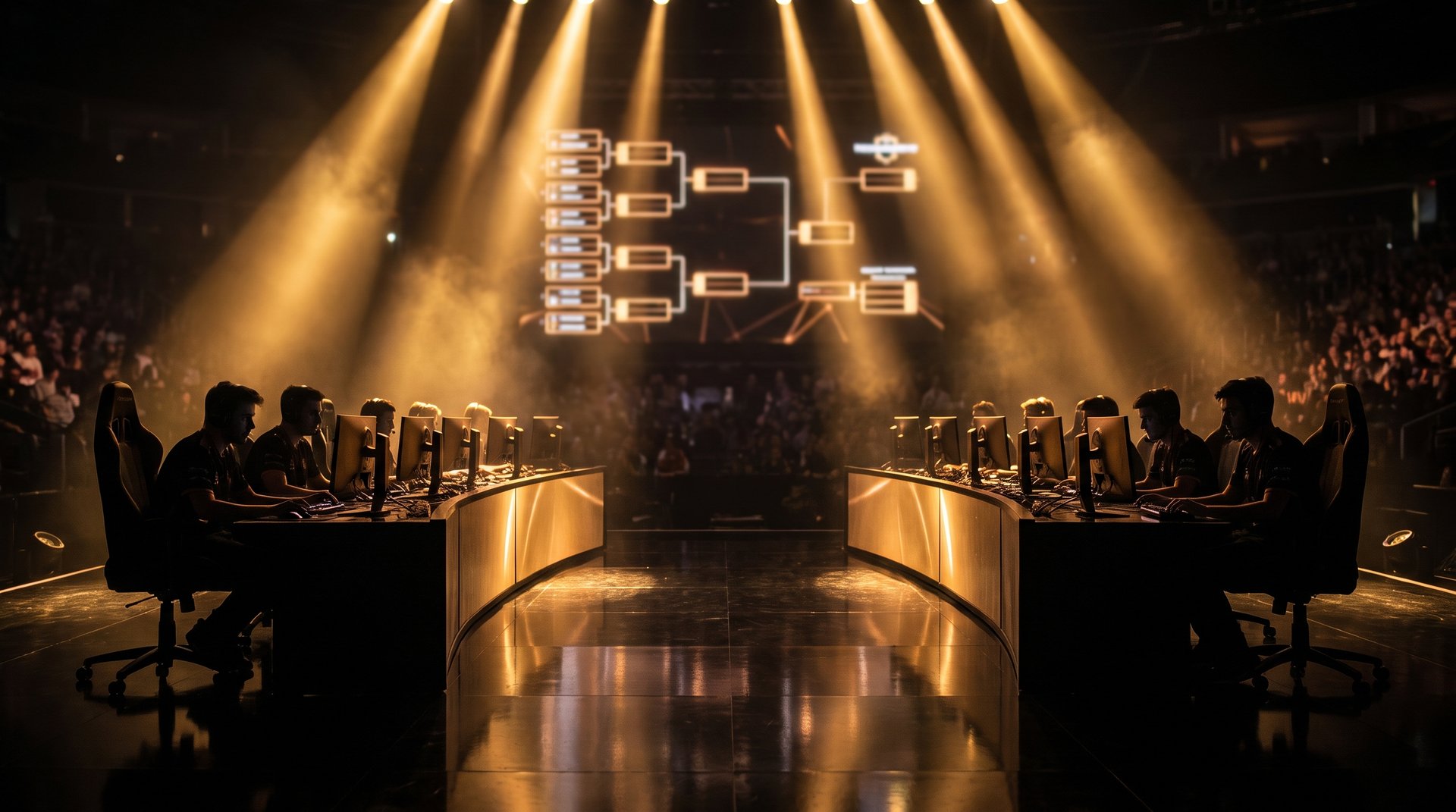
The main event runs August 20-23 at the SPD Bank Oriental Sports Center with 8 surviving teams in a double-elimination bracket. Double elimination means teams are not knocked out after one loss — they fall to the lower bracket and still have a path to the grand final. Only two consecutive lower bracket losses end a team’s run at TI 2026.
The grand final is played as a best-of-five series, giving both teams maximum room to demonstrate adaptability and depth. Lower bracket finalists enter the grand final at a disadvantage — they need to win 3 maps, while the upper bracket finalist only needs to win 2 out of 3 if it comes to a lower bracket final first. The exact bracket advantage rules follow the standard TI format Valve has used in recent editions.
All 16 Teams at TI 2026
Sixteen teams will compete at TI 2026. Seven received direct invitations from Valve based on DPC performance and circuit results. Nine more qualified through regional qualifiers across five regions: Europe, China, Southeast Asia, South America, and North America.
Direct Invites (7 Teams)
Direct invitations to TI 2026 went to the following organizations:
| Team | Region | Notable |
|---|---|---|
| Team Falcons | Middle East / International | Defending TI champions |
| Team Liquid | Western Europe | Multiple TI finals appearances |
| Tundra Esports | Western Europe | Previous TI champions |
| Aurora Gaming | Eastern Europe | Tier-1 event winners this cycle |
| Team Yandex | Eastern Europe | Consistent DPC performers |
| BetBoom Team | Eastern Europe | Strong circuit results |
| Xtreme Gaming | China | Top Chinese lineup this season |
Team Falcons headline the direct invite list as the defending champions, arriving at TI 2026 with a target on their back. Team Liquid and Tundra Esports represent the Western European contingent that has produced TI champions in back-to-back years. Aurora Gaming and Team Yandex round out what has been a genuinely strong Eastern European scene this cycle. Xtreme Gaming carry the hopes of the massive Chinese fanbase that will pack the Oriental Sports Center.
Regional Qualifier Teams (9 Teams)
The remaining nine spots were fought for across regional qualifiers that concluded in July 2026. Here is who came through from each region:
| Region | Slots | Qualifier Winners |
|---|---|---|
| Europe | 4 | Team Spirit, TEAM VISION, HULIGANI, Nigma Galaxy |
| China | 2 | Team Resilience, Vici Gaming |
| Southeast Asia | 1 | OG |
| South America | 1 | LGD Gaming |
| North America | 1 | GamerLegion |
Teams to Watch
Beyond the defending champions, several qualifier teams arrive at TI 2026 with compelling storylines.
OG — The all-Filipino roster returned to TI for the first time since 2022 under the storied OG banner, the organization that won back-to-back TIs in 2018 and 2019. This is a new roster carrying historic colors, and the crowd in Shanghai will recognize the name even if the players are different from those legendary squads.
Nigma Galaxy — The return of SumaiL (Syed Sumail Hassan) and the addition of Artem “Lorenof” Melnick revitalized a team that claimed the fourth and final European qualifier spot. SumaiL was one of the defining players of Dota 2’s golden era and his return to TI adds significant narrative weight.
Team Spirit — The Eastern European squad claimed the first EU qualifier slot and arrives as a known quantity at TI, having won TI10 with a legendary lower bracket run in 2021. They know how to win the whole thing.
GamerLegion — The North American qualifier winner enters TI 2026 as one of the region’s top hopes in a competitive context where NA has historically struggled to translate qualifier wins into deep TI runs. Every TI they prove the region wrong a little more.
LGD Gaming — The South American qualifier was taken by the former HEROIC roster now competing under LGD Gaming. LGD is one of the most recognizable names in Chinese Dota 2 history, and the squad’s dominant qualifier performance suggests they are not coming to Shanghai as tourists.
Vici Gaming — Another organization with a rich TI history, Vici Gaming qualified through the Chinese regional and adds to what could be a genuinely interesting home crowd experience if both Chinese teams make deep runs.
Prize Pool Breakdown
The base prize pool for TI 2026 is USD 1,600,000 — a Valve-funded baseline that existed before any fan contributions. On top of that, 30 percent of revenue from in-game supporter bundle sales is added to the pool throughout the qualifying period and up to the event.
Supporter bundles for TI 2026 include cosmetic items, in-game achievements, and TI-specific content, similar to the old Battle Pass model but restructured under the newer supporter campaign framework Valve introduced after the Battle Pass ran its course. The crowd-funded portion means the final prize pool is genuinely unknown until purchases close — it has historically been the factor that pushed TI prize pools far above any other esports tournament in the world.
For context: TI9 in 2019, at this same venue, reached a total prize pool of over USD 34.3 million. The last several TIs have seen lower pools as the Battle Pass model wound down, with the base pool now being more transparent. Whether TI 2026 approaches historical highs depends entirely on how many players buy supporter bundles before and during the event.
| Component | Amount |
|---|---|
| Valve base contribution | USD 1,600,000 |
| Supporter bundle revenue share | 30% of total bundle sales added |
| Final pool | Determined when sales close |
Prize distribution across the 16 teams historically follows a steep curve, with first place taking a disproportionately large share. At TI9, first place alone took over USD 15 million. At more modest prize pools, the spread is tighter but the winner still walks away with a life-changing sum regardless of the overall pool size.
Tickets: How to Buy Your Way Into Shanghai
Getting tickets to TI 2026 in person requires planning. Valve and PerfectWorld opened sales on June 10, 2026 at 2pm China Standard Time, and all seating at this year’s event is assigned — there is no general admission standing room.
Ticket Options
Two ticket types are available for the main event (August 20-23):
- Single-day tickets — valid for one specific day of the main event
- Two-day bundle tickets — Thursday/Friday (August 20-21) or Saturday/Sunday (August 22-23)
There are no full-event passes covering all four main event days in a single purchase. If you want to attend every day, you need to buy two separate two-day bundles. Single-day tickets are the most flexible option and also the highest-demand items, so they tend to sell out first for the weekend days.
Where to Buy
Ticket purchase options differ based on whether you are buying from within China or internationally:
| Buyer Location | Platform |
|---|---|
| China (domestic) | Perfect World Esports app |
| China (domestic) | Damai.cn ticketing platform |
| International | Trip.com |
International buyers who have not used Trip.com before should create an account in advance and verify payment methods work before ticket drops go live. The platform supports major international credit cards and some regional payment systems, but having your preferred payment already set up prevents losing a ticket in the queue while entering card details.
Resale and Scalping Warning
TI tickets are among the hottest resale items in esports. Once official tickets sell out, they appear on secondary markets at significant markups. Be careful about buying through unofficial channels — counterfeit TI tickets have appeared at previous events, and showing up to the venue with a fake ticket on a day with 20,000 other attendees is not a position you want to be in. Stick to the official platforms above wherever possible.
How to Watch TI 2026
For the large majority of the Dota 2 community that will not be physically present at the Oriental Sports Center, watching online is the experience. TI coverage is some of the most comprehensive in esports, with multiple official broadcast options and third-party casts covering every match.
Official Streams
Valve’s official Dota 2 broadcasts are available on Twitch at the official Dota 2 channel and on YouTube via the official Dota 2 YouTube channel. Both platforms provide simultaneous coverage of all main stage matches, with English commentary from the world’s best Dota 2 broadcast talent. The main channel focuses on the featured match of the day, while secondary channels broadcast concurrent games during the group stage.
Third-Party Language Broadcasts
TI is one of the only esports events where fans in dozens of languages get full professional coverage. Russian, Chinese Mandarin, Spanish, Portuguese, Korean, and numerous other language broadcasts run simultaneously with the English main feed. These casts are typically organized by third-party broadcast partners working with Valve’s permission, and they often attract larger regional audiences than the English broadcast in their respective markets.
Watching in the Dota 2 Client
Valve’s in-game watching feature allows you to spectate TI matches with an 8-minute delay directly through the Dota 2 client. This does not require a third-party platform and gives you full control over the camera, which is genuinely useful for studying pro play during the event. You can switch between any player’s perspective, check the full minimap, or just let the game play out however you choose.
The in-game watch experience also includes access to the dedicated TI 2026 hub in the client, where match results, brackets, and team information are updated live throughout the tournament.
Shanghai’s Dota 2 Legacy: Why This Venue Matters
When Valve announced Shanghai as the TI 2026 host, the reaction from the Dota 2 community was immediate recognition: this is where TI9 happened. For those who followed esports in 2019, TI9 was the moment when crowd-funded prize pools became a mainstream conversation topic. The $34.3 million pool dwarfed anything that had come before it, the sold-out arena created the loudest crowd atmosphere in the game’s history, and OG’s back-to-back championship run became the defining storyline of competitive Dota 2 in the 2010s.
Seven years is a long time in esports. The game has changed substantially since 2019 — several major patches have reworked fundamental mechanics, the roster landscape looks completely different, and Valve’s approach to the competitive ecosystem has shifted. But returning to the same physical venue connects TI 2026 to that moment in a way that an entirely new location would not.
For Chinese fans specifically, this is a home event in the deepest sense. Xtreme Gaming and Vici Gaming represent their region on a stage that Chinese audiences have historically packed to the rafters. The energy differential when a Chinese team wins a game at an event hosted in China is something that broadcast audio alone cannot fully convey — you have to be in the building.
TI Season and Your MMR: What This All Means for Pub Players
Here is the part that is specific to players who spend most of their Dota 2 time in ranked matchmaking rather than watching tournaments. TI season has consistent, documented effects on the pub game environment, and understanding them helps you plan your ranked sessions better.
The Meta Stabilizes
Valve does not push major patches immediately before TI. The patch used at TI 2026 will have been live for several weeks before the tournament begins, giving it time to settle. This is good for pub players because the meta is at its most solved and predictable heading into the event — theorycrafting from the competitive scene has had time to filter down to the mid-level brackets, and you can watch qualifier and TI matches to identify exactly what the top heroes are doing.
Pro Strats Transfer Better Than You Think
A common mistake pub players make is assuming that TI gameplay has nothing to offer them strategically. In practice, the fundamentals — draft priorities, laning setups, timing attacks, and objective focus — that win at TI are the same ones that win at 4k MMR. The execution differs, but the decision-making logic is the same. Watching a few TI matches with deliberate attention to when teams take Roshan, when they force fights, and how they allocate resources is genuinely useful study for anyone trying to climb.
Getting to Your True Rank Before TI
If there is a time of year to take your MMR seriously, the weeks leading into TI are it. The meta is at its most stable, pub game quality at higher brackets is elevated because players are watching pro matches and applying lessons in real time, and the post-TI period brings a new season with recalibration that resets much of the work you did previously.
Players who want to climb to a rank that reflects their actual skill level before TI 2026 have roughly the same options they always have: grind ranked games with focused improvement, or accelerate the process with a professional Dota 2 boosting service that places you at the rank you belong at.
If you are unsure whether boosting is the right move for your situation, our MMR boosting guide covers the full decision framework — when it makes sense, what to look for in a service, and how to protect your account. And if your concern is account safety, we address that directly in our breakdown of whether Dota 2 boosting is safe in 2026.
The honest reality is that TI season brings a window where being at the right MMR matters more than usual. You will get better games, face opponents who are also engaged with the competitive scene, and have a more rewarding experience in the weeks surrounding the tournament. Whether you grind there yourself or use a service, the goal is the same: be playing where your actual skill belongs when TI is happening.
The Road to TI 2026: Qualifier Recap
The nine qualifier teams did not arrive at TI 2026 by accident. The regional qualifier rounds ran across two weeks in July 2026, with fierce elimination matches in every region. Here is a brief recap of how the nine qualifier spots were decided.
In Europe, the competition was exceptionally tight across four spots. Team Spirit claimed the first EU berth, TEAM VISION and HULIGANI fought through to take the next two, and Nigma Galaxy — revitalized with the return of SumaiL — secured the fourth spot in a 2-1 win over Yellow Submarine in the final series. Four different European teams, four different playstyles, and a region that has been among the strongest in the world for several years running.
The Chinese qualifier produced two qualifiers to join Xtreme Gaming as the region’s direct invite. Team Resilience secured the first China qualifier spot, and Vici Gaming edged past Yakutou Brothers in a closely contested lower bracket series to claim the second. With three Chinese teams at TI 2026, the Shanghai crowd will have home favorites to cheer for regardless of how the bracket sets up.
Southeast Asia’s single spot went to OG, the all-Filipino roster that cruised through the qualifier and secured the organization’s first TI appearance since 2022. The OG name carries immense weight in Dota 2 — two consecutive TI championships in 2018 and 2019 earned the organization a permanent place in the game’s history. A new roster returning under that banner, qualifying through SEA, is exactly the kind of redemption arc storyline that makes TI interesting beyond just the gameplay.
South America’s qualifier was won by LGD Gaming, carrying the former HEROIC roster. Their performance in the South American bracket was dominant from the start, making the result feel inevitable even as other regional qualifiers went down to the wire. LGD Gaming’s historical association with Chinese Dota 2 adds an interesting dimension to their appearance at a Shanghai-hosted TI.
North America’s single qualifier spot was won by GamerLegion in a competitive qualifier that ran June 24-26. NA has consistently punched below its weight at TI relative to Europe and China in terms of tournament wins, but the region has shown signs of improvement in roster depth and team quality over recent seasons.
What TI 2026 Means for Dota 2 Overall
Beyond the specifics of who qualified and who is favored, TI 2026 landing in Shanghai sends a broader message about where Dota 2 sits in 2026. The game is no longer the casual gamer’s pick — it lost that audience to games with faster onboarding cycles long ago. What it retained and deepened is a dedicated global competitive community that tracks every roster move, analyzes every patch note, and treats TI like the Super Bowl of their sport.
Returning to Shanghai signals confidence. The venue can hold a crowd, the infrastructure for international travel exists, and the local fanbase in China is one of the most invested Dota 2 communities on the planet. The last several TIs held in Western locations — Seattle, Stockholm, Bali — attracted strong global audiences but a different in-venue energy. Shanghai brings back the atmosphere of a home crowd invested in specific teams, which makes for better television and a better in-person experience regardless of your regional allegiance.
For the competitive scene, TI 2026 also represents a period of genuine uncertainty at the top. Team Falcons arrive as defending champions and direct invites, but the qualifier field includes multiple teams with TI champion pedigree of their own. Team Spirit’s TI10 run, OG’s two-peat, Vici Gaming’s historical near-misses — the narrative threads at this year’s event are richer than a simple favorites-versus-qualifiers storyline would suggest.
Frequently Asked Questions
Ready for TI 2026? Get Your MMR Right First
TI season is the best time of year to play Dota 2 at your actual skill level. The meta is stable, the competition is sharper, and being stuck two brackets below where you belong is the most frustrating way to watch the world’s best players compete.
TeamSmurf’s professional boosters will place you at the rank your skill deserves — quickly, safely, and with full offline mode so your account stays private. Most orders complete in 2 to 5 days.