The Rarest Dota 2 Ranks: How Many Players Are Actually Immortal?

Dota 2 has one of the most demanding ranking ladders in competitive gaming. With over 7.6 million monthly active players and 91 million registered accounts on Steam, the gap between the average player and the game’s elite is staggering. But just how rare is Immortal — and how do the numbers look across every rank tier? This guide breaks down the real Dota 2 rank distribution with community-tracked data, explains what each bracket actually means in practice, and shows you exactly how far above average an Immortal player really is.
Whether you are trying to figure out where you stand, plotting your climb from Divine to Immortal, or just curious how many players share your medal — the data below gives you an honest picture of where the player base is concentrated and how thin the air gets at the top.
Table of Contents
How Dota 2 Ranks Work
Dota 2 uses a hidden MMR (Matchmaking Rating) number to determine your skill level, and this MMR maps onto a visible medal system that most players see as their “rank.” The medal system has eight main tiers — Herald, Guardian, Crusader, Archon, Legend, Ancient, Divine, and Immortal — and each tier (except Immortal) is divided into five stars numbered 1 through 5. Climbing from Herald 1 to Immortal means progressing through 35 intermediate star thresholds before you even reach the top medal.
The MMR thresholds for each rank shift slightly each season as Valve recalibrates the ladder, but the approximate current ranges (Season 6 / 2026) are well-documented by community trackers. Herald starts near zero MMR for brand new accounts and extends to roughly 770 MMR. From there, each subsequent bracket adds roughly another 770 MMR per tier. Divine 5 tops out around 5,420 MMR, after which there is no hard ceiling — Immortal stretches from that point indefinitely, with the world’s best players sitting above 12,000 MMR.
What makes the system interesting is that Valve does not publish a real-time rank distribution report. Unlike League of Legends, which posts official season data, Dota 2’s distribution numbers come entirely from community-operated tracking tools like Stratz, OpenDota, and sites like Dotabuff. These tools analyze millions of matches and accounts, so the data is directionally accurate — but exact percentages vary between sources and shift throughout a season as players recalibrate or abandon their accounts. All figures in this article are approximate, drawn from community data published in 2025-2026, and should be treated as ranges rather than precise headcounts.
Full Dota 2 Rank Distribution Table (2026)
The table below compiles rank distribution data from community sources including Stratz (7+ million players analyzed), Esports Tales, and the TeamSmurf internal dataset. Where different sources disagree, the range is noted. This is a snapshot of the current season — the numbers shift modestly between seasons but the overall shape of the distribution is very stable year to year.
| Rank Tier | Approx. % of Players | Est. Player Count (7.6M MAU) | Approx. MMR Range | Percentile (Bottom of Tier) |
|---|---|---|---|---|
| Herald (1-5) | ~5-7% | 380,000 – 530,000 | 0 – 769 MMR | 0th |
| Guardian (1-5) | ~12-16% | 910,000 – 1,210,000 | 770 – 1,539 MMR | ~7th |
| Crusader (1-5) | ~20-23% | 1,520,000 – 1,750,000 | 1,540 – 2,309 MMR | ~21st |
| Archon (1-5) | ~22-23% | 1,670,000 – 1,750,000 | 2,310 – 3,079 MMR | ~43rd |
| Legend (1-5) | ~16-20% | 1,210,000 – 1,520,000 | 3,080 – 3,849 MMR | ~65th |
| Ancient (1-5) | ~9-15% | 680,000 – 1,140,000 | 3,850 – 4,619 MMR | ~82nd |
| Divine (1-5) | ~4-8% | 300,000 – 610,000 | 4,620 – 5,419 MMR | ~92nd |
| Immortal | ~2-4% | 150,000 – 300,000 | 5,420+ MMR | ~96th+ |
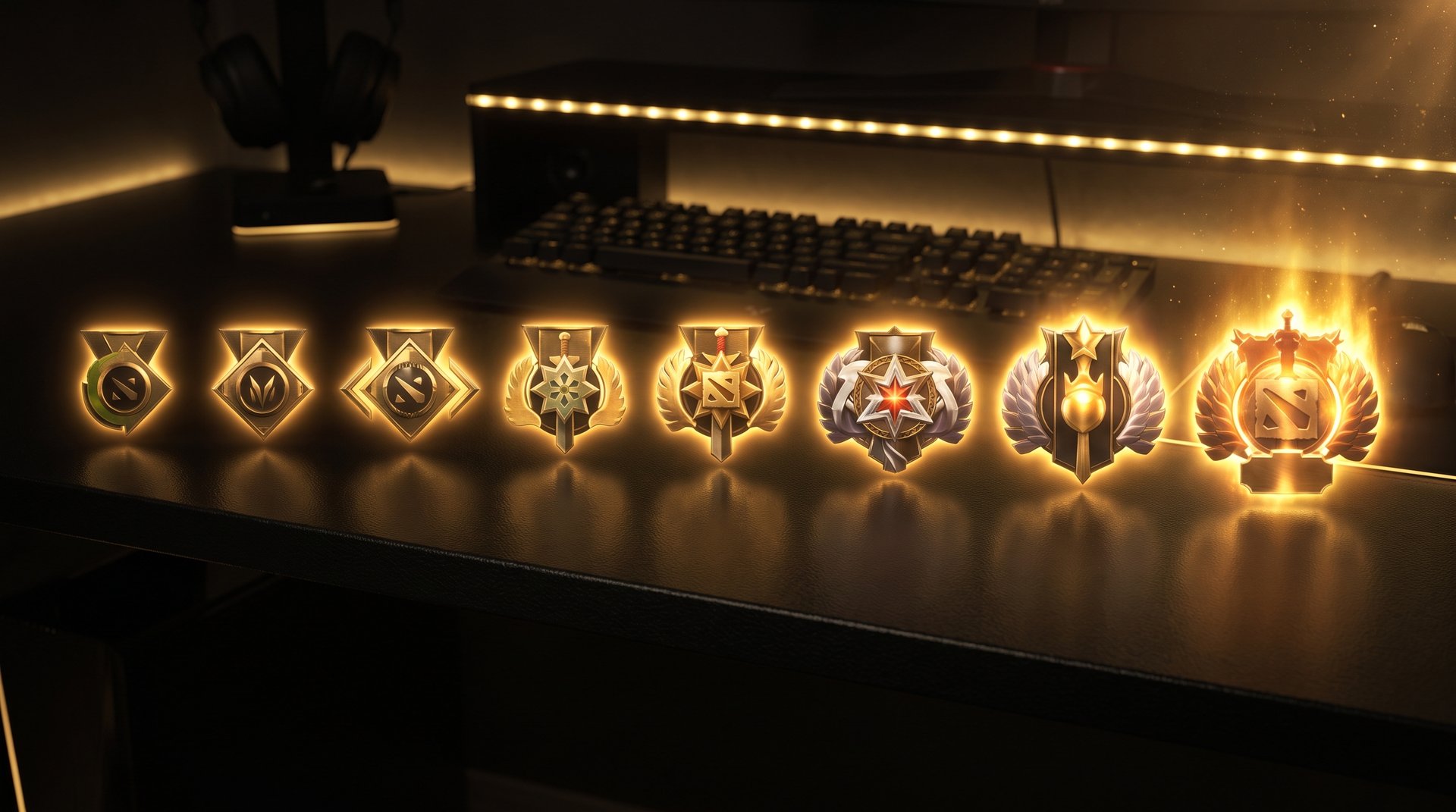
A few things stand out immediately. First, the distribution is shaped roughly like a bell curve that is shifted slightly toward the lower end — the bulk of players cluster in Crusader, Archon, and Legend, which together account for somewhere between 58% and 66% of the entire ranked population. Second, everything above Legend gets progressively rarer very fast. Ancient represents roughly the top 18% of players, Divine the top 10-12%, and Immortal sits somewhere in the top 2-4%.
The spread in estimates — for example, Immortal ranging from 2% to 4% — reflects real methodological differences. A tracker that only counts accounts that have played a ranked game in the current season will show a higher Immortal percentage than one that includes all accounts with a medal on record, since inactive or casual players are more concentrated in the lower brackets. The “true” current-season Immortal share of active ranked participants is generally closer to the higher end (3-4%), while lifetime-account-based samples push it lower.
How Rare Is Immortal? Breaking Down the Numbers
To understand what it means to be Immortal, you need to feel the scale. Dota 2 reports roughly 7.6 million monthly active users. If Immortal represents 2-4% of the ranked player base, that works out to somewhere between 150,000 and 300,000 players worldwide holding an active Immortal medal at any given time. That sounds like a lot — until you put it next to 7.6 million.
For every Immortal player, there are roughly 25 to 50 players at some other rank. The typical player you queue against in an Archon or Legend game is not just “below Immortal” in some vague sense — they are separated from Immortal by hundreds or thousands of matches worth of skill gap. Reaching Immortal means being better at Dota 2 than somewhere between 96% and 98% of everyone who has ever queued a ranked match.
Put another way: if you gathered every Dota 2 ranked player in a stadium and ranked them by skill from front to back, the Immortal players would fill only the last few rows. Everyone else — tens of millions of people — would be sitting in front of them.
The Immortal Threshold Over Time
The MMR floor for Immortal has been a moving target across Dota 2’s history. In the early days of the medal system, the threshold was significantly lower, which meant a larger fraction of the community held the medal. As the game matured, Valve periodically recalibrated MMR, and the community-wide average shifted. Today, the generally accepted entry point for Immortal sits around 5,420 MMR, though this also varies by region because different server pools have different skill ceilings.
Southeast Asia (SEA) and China servers tend to have a denser concentration of high-MMR players, meaning the MMR required to land on the regional leaderboard is higher there than it is in less competitive regions like South America or parts of Europe. A player who would be a comfortable leaderboard Immortal in South America might be a non-leaderboard Immortal in SEA at the same MMR.
Immortal Sub-Tiers: Leaderboard vs. Non-Leaderboard
Unlike every other rank in Dota 2, Immortal is not divided into numbered stars. Instead, it splits into two informal categories that the community refers to constantly: leaderboard Immortal and non-leaderboard Immortal.
Non-Leaderboard Immortal
When you first cross the Immortal threshold, you receive the Immortal medal but you do not automatically appear on any public leaderboard. Your Immortal medal shows a number — your rank position within the global Immortal pool — but this is only visible to you and is not part of the tracked public leaderboard. The vast majority of Immortal players fall into this category. These are players who have clearly proven they belong in the top few percent, but who have not climbed far enough above the entry point to crack the regional leaderboard.
Leaderboard Immortal
Regional leaderboards track the top players in each major region: North America, South America, Europe, Southeast Asia, China, and several others. The exact cutoff for leaderboard inclusion varies by region and season — in competitive regions it can take several thousand leaderboard-eligible games to crack the top 5,000 spots — but once you are there, your rank number is public and updated in near real-time.
The top positions on the leaderboard are the closest thing Dota 2 has to a title for the best players in the world. Rank 1 in your region is a genuine achievement that very few players ever hold, and the competition among the top 100 players in a region is intense enough that professional players and aspiring pros fight for those spots throughout the season.
High Immortal and the Immortal Draft Cutoff
There is a third informal tier within Immortal that carries serious gameplay implications. As of a March 2025 update, players above approximately 8,500 MMR trigger Immortal Draft rules in their games. Immortal Draft replaces the standard pick/ban phase with a different drafting system designed to handle lobbies where every player is among the best in the world. As of mid-2026, 8,500 MMR represents roughly the top 0.5% of all ranked accounts — an extraordinarily small group even within the already-rare Immortal bracket.
| Immortal Sub-Tier | Approx. MMR | Est. Players (Global) | Notes |
|---|---|---|---|
| Entry Immortal | 5,420 – 6,000 MMR | ~100,000 – 150,000 | Immortal medal, no leaderboard spot |
| Mid Immortal | 6,000 – 7,500 MMR | ~40,000 – 80,000 | Leaderboard eligible in most regions |
| High Immortal | 7,500 – 8,499 MMR | ~10,000 – 20,000 | Top leaderboard positions |
| Immortal Draft Tier | 8,500+ MMR | ~2,000 – 5,000 | Immortal Draft matchmaking rules apply |
These sub-tier estimates are rough — community data at these MMR levels is thinner because the sample sizes are smaller and fewer accounts choose to make their profiles public. But the direction is accurate: the higher you climb within Immortal, the fewer players share that space with you, and the exponential difficulty increase is very real.
Why Immortal Is So Hard to Reach
The rarity of Immortal is not just a statistical curiosity — it reflects a genuine and steep skill wall. To understand why most players never make it, it helps to look at what separates each bracket from the one above it.
The Skill Curve Is Not Linear
The most important thing to understand about Dota 2’s ranking system is that the MMR required to move up is equal at every step (you gain and lose the same amount per win and loss), but the skill difference between brackets is not equal. Going from Herald to Guardian looks similar numerically to going from Divine to Immortal — but the actual gap in game knowledge, mechanical execution, decision-making speed, and macro awareness between those two transitions is completely different.
Herald and Guardian players are still learning the basics of last-hitting, item timing, and not dying to towers. Divine and Immortal players are executing hero rotations at a split-second level, reading the enemy drafter’s gameplan from the first pick, and making map movements based on tracking invisible heroes through ward patterns and timing windows. The skills are not just “more of the same” — they are qualitatively different and much harder to develop.
Time Investment
Reaching Immortal typically requires somewhere between 3,000 and 8,000+ hours of Dota 2, depending on your learning rate, coaching history, and natural aptitude. The average player who starts the game today and puts in 20 hours per week will take years to reach the skill level that Immortal demands — assuming consistent active improvement rather than passive play. Many players with several thousand hours still plateau in the Archon or Legend range because they are repeating comfortable habits rather than studying and breaking bad ones.
Mental Fortitude
Dota 2’s ranked mode is notorious for its psychological difficulty. Games can last 60+ minutes, and a single mistake in the late game can end a run that was ahead for most of the match. Tilting, loss streaks, and poor mental performance are genuine obstacles that prevent otherwise skilled players from converting their game knowledge into MMR gains. Maintaining a consistent performance across hundreds of ranked games is a separate skill from knowing what to do in any given situation, and it is one that many players underestimate.
If you want to climb efficiently without grinding thousands of games on a slow trajectory, many players look at professional Dota 2 coaching as a shortcut to the knowledge gap and a way to fix systemic mistakes that solo play will not reveal. Targeted coaching sessions with Immortal-level players can compress years of self-discovery into a much shorter feedback loop.
What Each Bracket Looks Like From the Inside
Numbers alone do not capture what it feels like to play at each rank. Here is a realistic breakdown of what you should expect from your games at each tier.
Herald and Guardian (Bottom ~20-22%)
These brackets are dominated by brand new players, casual players who do not invest much time in improving, and occasionally returning players whose skills have faded. Games are unpredictable and can swing wildly. Heroes are often played off-role or without regard to item timing. Map awareness is minimal — many players will walk into clearly dangerous areas without vision or map context. If you are in Herald or Guardian, your fastest path out is learning one or two heroes deeply rather than playing the full roster.
Crusader and Archon (The Majority — ~43-46%)
This is where most Dota 2 players live. Crusader through Archon represents the largest slice of the ranked population, and it is a bracket with highly variable game quality. Some players here have genuine skill floors — decent last-hitting, rough understanding of objectives, basic hero matchup awareness — but consistent execution is lacking. The Archon bracket is particularly wide in skill because it sits right at the median, meaning players entering from below and players who have stalled from above are mixed together.
Breaking through the top of Archon into Legend is the first real climbing wall that many players encounter. At this point, knowing what to do is no longer enough — you need to start doing it consistently and under pressure. This is also where understanding the Dota 2 MMR system and how wins and losses are weighted can help you think more strategically about your climb.
Legend (Top ~35%)
Legend players have meaningful game knowledge. They understand the broad strokes of draft synergy, they have a sense of when to take Roshan and when to push, and they have mechanics that are solid if not impressive. The gap between Legend 1 and Legend 5 is significant — a Legend 5 player is approaching Ancient territory in raw skill and could be close to breaking through with a few targeted improvements.
Ancient (Top ~18%)
Ancient is the first bracket where players genuinely understand Dota 2 at a strategic level. Item builds are situational rather than templated. Support players are buying the right utility items at the right times. Carries are making decisions about when to farm versus when to fight based on the state of the game rather than just when they feel ready. The Ancient bracket is also where players start talking about Dota 2 in the language of the game’s depth — creep equilibrium, neutral item optimization, vision control. If you are in Ancient, you are already better at Dota 2 than the vast majority of the player base.
Divine (Top ~8-10%)
Divine players are skilled enough that most casual fans watching their games would not be able to spot obvious mistakes. The errors at this level are subtle — slightly suboptimal hero movements, small timing windows missed on item usage, draft decisions that are defensible but not optimal. Divine is both a genuinely elite rank and a brutal psychological grind because you can see Immortal from here but the gap still feels enormous. Many players spend months or years in Divine 4 and 5 unable to convert game quality into consistent wins against Immortal-adjacent opponents.
The Divine Gap — Almost There, Not Quite
The Divine-to-Immortal transition is widely regarded as the hardest single rank climb in Dota 2. The reason is not mechanical — most Divine 5 players are already executing hero mechanics at a very high level. The gap is about decision consistency under pressure, drafting sophistication, and the mental game of performing at your ceiling across every game regardless of teammates.
At Divine 5, you are above the 92nd percentile of the entire Dota 2 ranked population. At Immortal, you cross into the top 2-4%. That gap — roughly 8 to 10 additional percentile points — requires a disproportionate amount of improvement compared to every previous transition. It is the difference between a very good amateur and a professional, and it is a gap that many talented players never close regardless of hours invested.
The players who do make the jump consistently from Divine to Immortal share some common traits: they have identified a small hero pool that they can execute optimally in any game state; they have eliminated the mental patterns that cause them to play worse when behind; and they have developed a genuine understanding of what information they are acting on versus what they are guessing about. If you are stuck in Divine and want to accelerate this process, dedicated guidance on the Divine-to-Immortal push can identify the specific gaps holding you back.
How to Actually Climb to Immortal
Understanding the rank distribution is one thing — using it to inform your climb is another. Here are the highest-leverage actions for each stage of the ladder.
From Herald/Guardian: Build a Foundation
The single most effective thing you can do below Guardian 3 is pick one carry or midlaner you genuinely enjoy and play it until the basics are automatic. Last-hitting, denying, staying alive, and buying core items on time — these habits compound over hundreds of games and move you through the low brackets faster than hero diversity. Resist the urge to copy patch trends at this stage. Mastery beats meta at this MMR.
From Crusader/Archon: Fix the Fundamentals
Players stuck in Crusader and Archon almost always have one of the same three problems: they die too often in situations they should recognize as dangerous; they spend too much time not farming or fighting (just walking around the map without a purpose); or they play heroes inconsistently because they keep switching between roles. Identifying which of these applies to you and grinding to fix it will unlock steady progress. Recording your games and watching them back — even just the first 15 minutes — is the most efficient feedback tool available.
From Legend/Ancient: Study the Game
At this level, mechanical floor is no longer your primary limiter — game knowledge is. Study professional replays and focus not on what heroes they play but on where they stand on the map at each minute mark. Study your lane opponent in draft, think about what they are going to build, and consider how that changes your item priorities. Learn to track the enemy support and jungler through process of elimination rather than relying on wards alone. Every improvement at this stage is a conceptual one more than a mechanical one.
From Divine: Eliminate Losing Patterns
Review your loss history specifically and look for patterns. Do you lose more often on certain hero matchups? Are your losses clustered around specific game lengths? Do you perform differently when you are ahead versus when you fall behind early? Divine players often have identifiable “losing patterns” that they repeat across dozens of games — specific situations where their decision-making degrades under pressure. Cutting these patterns is more valuable than adding new skills. The path to a boosted Dota 2 account at Immortal level can also reveal what high-MMR gameplay looks like in practice, giving you a target to aim for.
The Shortcut: Coaching and Boosting
For players who want to accelerate their climb without spending thousands of additional hours on self-directed improvement, professional coaching from Immortal and top-leaderboard players offers a structured path. A skilled coach can identify your specific limiting factor within a few game reviews and give you a targeted improvement plan that would otherwise take months to discover through solo play.
For players who want to experience Immortal lobbies directly — either to study the game at that level or to see how elite players approach drafts and fights — Dota 2 MMR boosting is an option that many players explore. Understanding the risk profile and choosing a specialist service is key to doing this safely.
Ready to Reach Immortal?
TeamSmurf is a Dota 2-only boosting and coaching service built by players who have navigated every bracket of this game. Whether you want to skip the Divine grind, experience Immortal lobbies, or work with an elite coach to fix the specific habits holding you back — we have the right service for your goal.