Talent Tree Priorities: The Picks Most Players Get Wrong

Talent trees are one of the most impactful decision points in Dota 2 — four choices across an entire game that can swing fights, enable combos, or waste stat budget on things you already have enough of. The problem is that the game never tells you which pick is wrong. Both options look reasonable. Both get you something. And most players default to whichever choice sounds bigger without thinking through how it interacts with their hero’s job, their item build, or the game state.
This guide covers the talent tree mistakes that show up repeatedly across all brackets: the specific picks at levels 10, 15, 20, and 25 that players get backwards, hero by hero, role by role. If you have been picking the same talent for years without questioning it, you will want to read this before your next game.
What This Guide Covers
How to Evaluate Any Talent Tree Choice
Before going hero-specific, the framework matters. Every talent decision comes down to three questions: Does this stat have diminishing returns in my current build? Does this talent unlock something my kit cannot do otherwise? Does this choice matter earlier than level 25?
Most talent mistakes fall into one of four categories: choosing raw stats that your item build already covers, taking an active-enhancing talent when your active is situational, prioritizing a large number that sounds impressive but applies infrequently, or taking a support-oriented talent on a hero whose primary job is to deal damage.
The evaluation order we use at TeamSmurf: (1) Does it enable a new behavior? (2) Does it multiply existing damage or utility? (3) Does it patch a weakness you cannot cover through items? (4) Does it simply add flat stats? In that order, top-rated options almost always outperform bottom-rated ones even when the number looks smaller.
Talent timing also matters. A level 10 talent you take at 14 minutes because the lane went well is different from one you take at 22 minutes because the game dragged on. Some talents are more impactful in the midgame than at 40 minutes when heroes are item-complete — this mostly affects carries and semi-carries whose timing windows you are trying to exploit.
Level 10 Talents: Where Most Games Start Going Wrong
Level 10 is where the first talent decision happens, and it is also where the most formulaic thinking sets in. Players learn a talent “from a guide” and stick with it regardless of context. The reality is that several popular level 10 defaults are wrong in specific item builds and game states.
The +Stats Trap at Level 10
At level 10, most heroes are not yet item-complete. This means a flat stat talent — +15 agility, +200 health, +15 damage — often has a high effective value because the hero has very few items buffing that stat naturally. This is the opposite of the situation at level 25, where heroes have five or six major items and flat stats lose value rapidly.
The mistake players make is assuming this means “always take the big stat.” That is only true when the alternative is a niche cooldown reduction or a spell that does not fit the current game. When the alternative is something that changes how a fight plays out — a mana talent on a hero running dry in every fight, a cast range talent that lets a support rotate from a safer position — it almost always wins.
Phantom Assassin: The Level 10 Crit vs Spell Shield Debate
Phantom Assassin’s level 10 choice is a classic example of contextual decision-making. The Blur/spell immunity chance talent extends her escape window against casters. The damage talent accelerates her kill timing. The correct pick depends entirely on what the enemy team looks like at that point. Against a lineup of three or more magical burst sources who can kill her through Blur, the dodge chance extension has real value. Against a physical lineup, it does almost nothing and the damage talent is correct every time.
The mistake is always defaulting to the crit-related damage talent without looking at the enemy lineup. Against a Storm Spirit, a Lina, and a Lion on the opposing team, running the version that gives your Blur more dodge coverage is clearly correct. Against a Drow Ranger, a Juggernaut, and a Dragon Knight, it is close to worthless.
Anti-Mage: Mana Burn vs Attack Speed
Anti-Mage’s level 10 mana burn damage talent is widely taken as the default. And it is strong. But there is a scenario where it loses value faster than players expect: when the enemy team’s key heroes are low-mana heroes or have already burned their mana pool before AM gets to them. In those cases, the attack speed talent starts to look more attractive because it adds consistent right-click output that does not depend on enemy mana levels.
The correct answer for most games is still the mana burn talent because AM’s entire identity is exploiting mana-dependent carries and supports. But against lineups with a lot of tankiness and low mana dependence — Underlord, Dragon Knight, Centaur — the attack speed talent is worth considering at level 10 instead of being dismissed automatically.
Crystal Maiden: Mana Regen vs Cast Range
Crystal Maiden’s level 10 talent is one of the most misunderstood in the game at lower brackets. The mana regen aura already scales the team’s mana recovery. The cast range talent extends CM’s effective engagement distance. A lot of players instinctively take cast range because it sounds like it improves gameplay more obviously. But if CM’s team has mana-hungry heroes who are constantly limited by mana — Timbersaw, Keeper of the Light — the aura improvement returns far more team-level value than a personal cast range increase. Cast range is a personal benefit. Mana regen is a team multiplier. In a game with mana-hungry cores, take the aura.
Level 15 Talents: Role Divergence Becomes Critical
By level 15, roles have diverged significantly. Supports have different item builds and different needs from cores. This is the level where taking the wrong talent costs you the most because the game is usually in a critical midgame phase — Roshan fights, high-ground pressure, team compositions coming online.
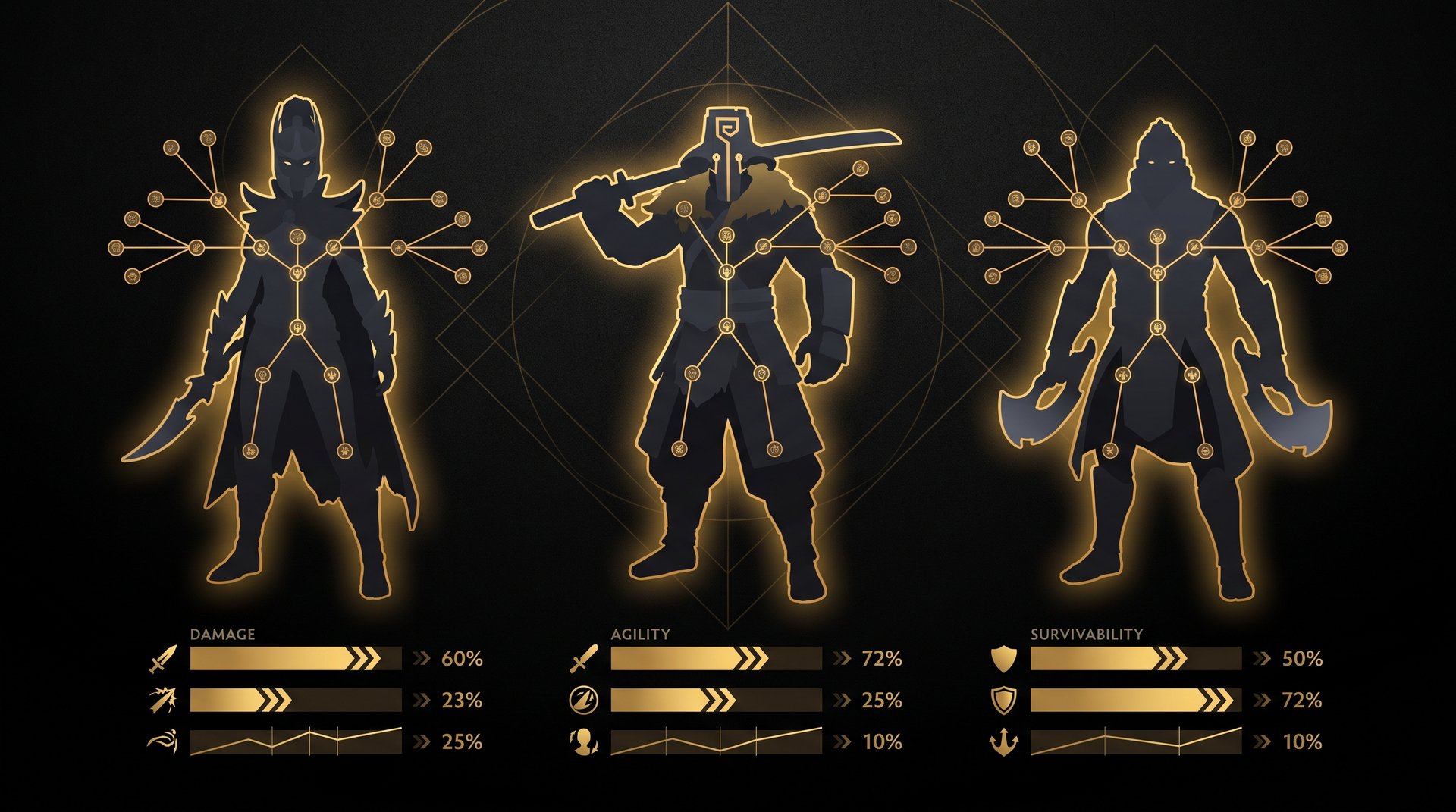
Juggernaut: Healing Ward vs Blade Fury Duration
Juggernaut’s level 15 talent is a good example of how game context should override theory. The standard advice is to take the Healing Ward movement speed talent because it makes the ward harder to kill in fights. That is correct in most scenarios. But in games where Juggernaut is playing a more aggressive split-push style or where the team has dedicated healing from another source, the Blade Fury cooldown reduction changes his rotation timing significantly. A 4-second reduction on Blade Fury lets Jugg use it more aggressively in skirmishes without overcooking the cooldown on Omnislash timing.
The mistake is treating the Healing Ward talent as always better because it has higher raw numbers. If your Healing Ward is being walked out of, killed instantly by enemy AoE, or the game does not have the team-fighting duration to use it, its value drops hard. Evaluate what you are actually using each game.
Lion: Mana vs Gold on Kill
Lion’s level 15 talent is one of the most context-dependent choices in the support category. The gold-on-kill talent rewards aggressive Lion play — constantly rotating for kills, snowballing a lead. The mana talent is a sustain choice that lets Lion spam Hex and Finger of Death more freely in long siege scenarios. Most low-bracket players take the gold talent because gold sounds good. Most high-bracket players take whichever one fits the game pace. If Lion is ahead and killing, gold talent accelerates snowball. If Lion is behind or the game is dragging into a siege, mana talent lets you participate in every fight without running dry.
Tidehunter: Kraken Shell Passive vs Flat Damage
Tidehunter is picked as an offlaner or a team-fight anchor. His level 15 talent for Kraken Shell (passive damage block) improvement is almost always correct for the offlane role because it significantly increases how much punishment he can absorb while Ravage is on cooldown. The flat damage talent looks appealing but does very little when Tidehunter’s job is to take hits and reset fights with Ravage rather than right-click damage. This is a role-context mistake — Tidehunter is not a right-clicker, and buffing his right-click does less than making his natural tankiness even harder to cut through.
Invoker: Spell Amp vs Mana Regen
Invoker’s talent tree decisions depend almost entirely on which build and spell rotation the player is running in the current patch. In a Quas-Wex EMP build, the mana regen talent is often secondary because the point of the build is to drain enemy mana rather than sustain your own. In a Quas-Exort Sunstrike build where Invoker is playing more as a nuke caster, spell amp returns significantly more kill threat than mana regen. Players often run one Invoker build but take talents optimized for a different one. Identify which rotation you are actually using and match the talent to that.
Level 20 Talents: Active vs Passive — The Biggest Decision
Level 20 is where the active-vs-passive tension is sharpest. One side of many level 20 choices adds a meaningful mechanic to an active ability. The other side provides a passive stat that works every game automatically. Passive talents are safer. Active talents have a higher ceiling when you land the fight correctly.
Faceless Void: Attack Speed vs Mana
Faceless Void’s level 20 attack speed talent is the pick for players who are closing fights inside Chronosphere reliably. The idea is that faster attacks inside Chrono means more DPS on locked targets during the one window when they cannot respond. This is correct when the team is coordinating around Chrono. But in pub games where Void’s Chrono is often triggered without perfect team follow-up, the mana talent sometimes keeps him in longer fights without needing a Bottle or Arcane Boots crutch. The error is assuming attack speed is always the “carry” talent — it only fully pays off when the Chrono usage rate is high and fights are ending cleanly inside the dome.
Warlock: Upheaval Duration vs Golem HP
Warlock’s level 20 choice between extending Upheaval duration and increasing Golem HP is one of the most debated in the support category. In fights where Upheaval has time to stack up — defensive posture, long base sieges — the duration extension snowballs the slow into an enormous movement speed debuff. But Golems that survive longer contribute to pushing power and buyback scenarios. The correct choice depends on whether the enemy team can immediately dispel or force Warlock to cancel Upheaval, and whether your push timing is constrained to one Golem’s lifespan or multiple waves.
Windranger: Windrun vs Shackleshot
Windranger’s level 20 talent is a case where players over-index on Shackleshot enhancement. The cooldown reduction on Shackleshot or the extend on its effect sounds powerful. But Shackleshot requires precise positioning to get a second unit to bounce off of, and in pubs that alignment rarely happens consistently. The Windrun talent that extends her dodge window is consistently valuable every game regardless of opponent positioning and is often the better pub pick precisely because it does not require specific setup.
Level 25 Talents: Game-Changers That Rarely Get Reached
Level 25 talents are powerful enough that some heroes scale dramatically from them — but they only matter if the game reaches that point. In pub games, level 25 happens in a minority of matches. This does not mean you should ignore the choices, but it does mean you should understand which heroes genuinely scale into level 25 as a win condition vs which ones close games before getting there.
Drow Ranger: Frost Arrows vs Marksmanship
Drow Ranger’s level 25 talent enhancing her Frost Arrows is often overlooked in favor of the Marksmanship-adjacent options because Marksmanship is the talent players have been building toward since the hero was designed. But in the current patch, Drow’s Frost Arrows talent has genuine utility as a catch tool in late games where enemies are constantly attempting to escape her attack range. The mistake is auto-selecting the Marksmanship path purely by reputation. Check what the enemy carries are building — if they are stacking escape items, the Frost Arrows slow talent has real situational value.
Dragon Knight: Dragon Blood vs Elder Dragon Form
Dragon Knight’s level 25 choices relate to survivability versus raw dragon form power. Players consistently undervalue the Dragon Blood regeneration talent at level 25 because Dragon form sounds more exciting. The regen talent makes DK into an extremely difficult hero to burst between Roshan fights and racks up in extended sieges. But the Elder Dragon Form talent multiplies his actual damage output in teamfights significantly. The correct pick is almost always the Elder Dragon Form enhancement for carry DK in current game states, but the regen talent has genuine value in defensive setups where DK is the last hero standing buyback pivot.
Role-Specific Talent Tree Priorities
| Role | Level 10 Priority | Level 15 Priority | Level 20 Priority | Level 25 Priority |
|---|---|---|---|---|
| Hard Carry | Damage or attack speed (avoid mana if items cover it) | Damage multiplier or cooldown reduction on core skill | Active-enhancing talent if skill usage is high | Highest damage ceiling — close games fast |
| Midlaner | Spell damage or movement (sustain independence) | Cooldown reduction or spell amplifier | Skill-empowering — mid timing windows matter | Context-dependent — evaluate remaining game length |
| Offlaner | HP or tankiness — survive early harassment | Passive survivability over flat damage | Team utility or initiation cooldown | AoE or control enhancement for late-game teamfights |
| Soft Support (pos 4) | Cast range or mana — enable rotations | Team utility — move speed, ward damage, aura | Team-level benefit over self-benefit | Rarely reached — prioritize impact at 20 |
| Hard Support (pos 5) | Mana sustain or aura — enable team | Global aura talent > personal stat every time | Disable duration, heal amplification, team utility | Rarely reached — best level 25 supports are late-game teamfight heroes |
The table above is a starting framework, not a rule. Every hero in every role has talents that break the category pattern. What matters is that you are thinking about whether the talent serves you or serves the team. Hard supports in particular tend to lose the most value from self-stat talents at level 10 because their budget should go toward the abilities that enable the team, not their own right-click.
Improving your MMR starts with decisions like these. If you want a faster path to a higher rank while your talent tree knowledge catches up, the best Dota 2 boosting services work by placing you in games at your target rank so you can study what high-MMR players actually pick in their talent trees by watching and playing alongside them.
Stats vs Active Effects: How to Think About It
The most common question about talent trees is when to take a passive stat vs when to take an active-enhancing talent. Here is a concrete framework based on how often you actually use each ability in a game.
If a skill is on a 20-second or longer cooldown and you use it every time it comes up, a talent that reduces that cooldown or increases its effect multiplies its total game value. If a skill is short-cooldown or spammable, flat stat improvements often return more consistent value because the skill is already being used optimally.
For carry heroes, the active-enhancing talents at level 20 and 25 almost always win because carry heroes are built around their core abilities — Phantom Assassin’s crit, Faceless Void’s Chronosphere, Anti-Mage’s Blink. Enhancing the core mechanic multiplies every fight. For supports, passive auras and flat ability improvements often win because supports do not have item builds that compress individual ability usage into short windows.
A useful self-check before level-up: in the last five teamfights, how many times did you use the ability this talent would enhance? If the answer is “every fight, multiple times,” the talent is worth taking. If the answer is “once or twice,” the passive stat probably returns more value over a full game.
This kind of decision-making is exactly what separates Herald MMR from Archon MMR. Our complete MMR boosting guide breaks down where most bracket-specific habits are holding players back, talent decisions included.
Hero-by-Hero Talent Tree Breakdown
Witch Doctor: Maledict vs Voodoo Restoration
Witch Doctor’s level 10 is one of the highest-stakes early talent decisions for a hard support. Maledict enhancement amplifies kill threat in fights but requires correct ability timing and a cooperating carry. Voodoo Restoration mana reduction lets WD heal more aggressively in the lane without depleting mana as fast. In a lane where the carry is capable of following up on debuffs, Maledict is correct. In a lane where WD is playing defensive — healing through harass, keeping the carry alive — the Voodoo Restoration talent pays for itself in sustained lane presence. Most players pick Maledict by default because it sounds offensive, but many WD games are played defensively in the current patch.
Sniper: Headshot vs Attack Speed at Level 10
Sniper’s level 10 talent for increased Headshot proc chance vs flat attack speed is widely misunderstood. Headshot procs deal pure damage and mini-stun — they are extremely strong against targets trying to use active items. The attack speed talent gives consistent right-click output but does not add the disruption. Against heroes who rely on channeled abilities or item actives — Pugna’s Nether Ward, Wraith King’s Wraithfire Blast — the Headshot talent actively shuts them down. Against a tanky lineup that builds pure HP, attack speed gives more sustained damage. Check what you actually need to interrupt before clicking.
Keeper of the Light: Chakra vs Illuminate
Keeper of the Light’s level 15 talent is a case where the “right” choice swings dramatically based on team composition. Illuminate enhancement is tempting because it is the ability everyone sees and associates with KOTL. But the Chakra magic talent that gives KOTL a free Chakra use is often more team-impactful when the team has mana-hungry cores — an Invoker, a Lina, an Exort build that runs out of mana every fight. A free Chakra every N seconds means a core hero can cast more freely without itemizing for mana. That team-level value frequently exceeds the personal Illuminate damage increase that only KOTL directly benefits from.
Viper: Nethertoxin vs Corrosive Skin
Viper’s talent tree is one of the cleanest examples of role-context choices. The Corrosive Skin talent is correct for an offlane Viper whose job is to be difficult to kill and to apply persistent slow. The Nethertoxin talent is correct for a mid Viper who is trying to shut down enemy item actives and win the fight before BKB comes online. In both cases, picking the wrong one means the talent is working against the role’s job. Offlane Viper with Nethertoxin does less slowing, less tanking. Mid Viper with Corrosive Skin does less offensive disruption. Know your role.
Zeus: Static Field vs Lightning Bolt at Level 15
Zeus’s level 15 talent between Static Field range extension and Lightning Bolt improvements is a debate in high-bracket play. Static Field at longer range extends Zeus’s area of threat and allows percentage-damage application from farther back, which matters in fights where Zeus cannot safely walk in. The Lightning Bolt talent improves a spell with a much shorter cast range anyway, which means the range benefit is limited. In most patch states, the Static Field range talent wins because it multiplies his most reliable and lowest-interaction spell. But if Lightning Bolt is the primary tool for True Sight reveal in the current game, the Bolt talent has situational value that players should not dismiss automatically.
Rubick: Spell Steal vs Telekinesis
Rubick’s talent tree is entirely dependent on which stolen spell he expects to be using. The Telekinesis talent at level 10 is almost universally correct because Rubick will always have Telekinesis — it is not stolen, it is native. Improving Telekinesis flight time or range gives Rubick guaranteed value every fight regardless of what spells are available to steal. The temptation to take spell-stealing enhancement talents earlier than necessary is a mistake because stolen spells are unpredictable, while native abilities are the guaranteed floor of Rubick’s toolkit.
How Talent Mistakes Compound Into MMR Loss
A single wrong talent choice does not lose a game by itself. But talent mistakes compound in two ways: they reduce your effectiveness in the critical window of the game where the choice is most relevant, and they represent a decision made without thinking, which usually means the rest of your decision-making in the same game is similarly automatic rather than analytical.
High-MMR players are often not faster or mechanically superior to players two or three brackets below them — they are more frequently making the right contextual choices at each decision point. Talents are a concrete place to practice that habit: each level-up is a forced pause where you can actively evaluate rather than click by memory. Safe boosting services that place high-MMR players on your account operate this way — the boosters are not just mechanically better, they are making correct contextual decisions at every decision point including talent trees.
If you want a structured path to improve without waiting for the game to slowly teach you through losses, our Dota 2 coaching service includes talent tree review as part of the replay analysis. Seeing where your choices differed from an Immortal player in the same game state is one of the fastest ways to internalize the correct patterns.
The Quick Reference: Most Commonly Wrong Talents by Hero
| Hero | Level | Commonly Wrong Pick | Correct in Most Games | When to Flip |
|---|---|---|---|---|
| Phantom Assassin | 10 | Always taking damage | Context — vs magic heavy: dodge, vs physical: damage | Enemy has 3+ nukers |
| Anti-Mage | 10 | Attack speed vs low-mana teams | Mana burn vs most lineups | Enemy cores are low-mana heroes |
| Crystal Maiden | 10 | Cast range when team is mana-hungry | Aura improvement with mana-hungry cores | Team is mana-independent |
| Juggernaut | 15 | Always taking Ward speed | Ward speed vs most teamfight games | Ward gets killed instantly; solo pressure game |
| Lion | 15 | Gold when game is slow | Gold when killing; mana when sieging | Siege or long games |
| Tidehunter | 15 | Damage talent | Kraken Shell enhancement almost always | Almost never flip |
| Witch Doctor | 10 | Always Maledict | Maledict when killing; VR when healing | Defensive lane, carry farming |
| Rubick | 10 | Steal-enhancing talent | Telekinesis native improvement | Rarely — Tele is always there |
| Sniper | 10 | Always attack speed | Headshot vs active-item heavy teams | Enemy relies on channeling or item actives |
| Zeus | 15 | Lightning Bolt improvement | Static Field range extension | True Sight is primary need |
Understanding talent trees is one layer of the broader game knowledge stack. If you are also working on MMR and want to understand where your rank sits relative to where your skill level should be, the MMR boosting guide breaks down the bracket system and common gaps between actual and apparent skill.
Patch Context Matters — Do Not Copy Old Guides Blindly
Talent tree recommendations change when base stats, spell interactions, or item synergies change in a patch. A talent that was mandatory last patch can become secondary if the spell it enhances was nerfed or if a new item covers the same role more efficiently. In the current patch, check each hero’s talent notes on the official Dota 2 wiki or community resources like Dotabuff’s meta reports before locking in a build for the season.
Hero talent trees also get reworked periodically. If you are coming back after a break or playing a hero you have not touched in six months, verify that the talent you remember is still there and that the numbers have not changed. Several popular talent defaults from earlier patches have been replaced with different mechanics entirely, and playing on memory for a reworked hero is a fast way to throw a game at the level-up screen.
Want to Climb Faster While Your Game Knowledge Catches Up?
Our Immortal boosters make the correct talent choices by default — because they have played every hero at the highest level in the current patch. Let us carry your account while you study, or book a coaching session and have an Immortal player review your actual talent decisions in your recent replays.