Region Choice for Boosting: EU/SEA/NA Differences That Matter

Region selection is the most commonly overlooked variable in MMR boosting decisions. Most clients ask “how fast” and “how much” — almost none ask “which server?” Yet the region choice affects booster availability, average game quality, the speed of the boost, the hero pool the booster uses, and the behavioral risk profile of the service. Getting the region wrong means slower results, higher prices, or a service experience that does not match what you paid for.
This guide covers the specific differences between EU, SEA, and NA server boosting in 2026: average booster MMR distributions, queue time differences, meta variations that affect gameplay and boost speed, pricing differences, and practical guidance for choosing the right region for your situation.
Table of Contents
- Why Region Matters More Than Most Clients Realize
- EU Server Breakdown
- SEA Server Breakdown
- NA Server Breakdown
- Head-to-Head Comparison: Key Differences
- How to Choose Your Region
- Multi-Region Accounts: Special Considerations
- Other Regions: SA, OCE, and Russia
- Questions to Ask Your Provider About Region
- Frequently Asked Questions
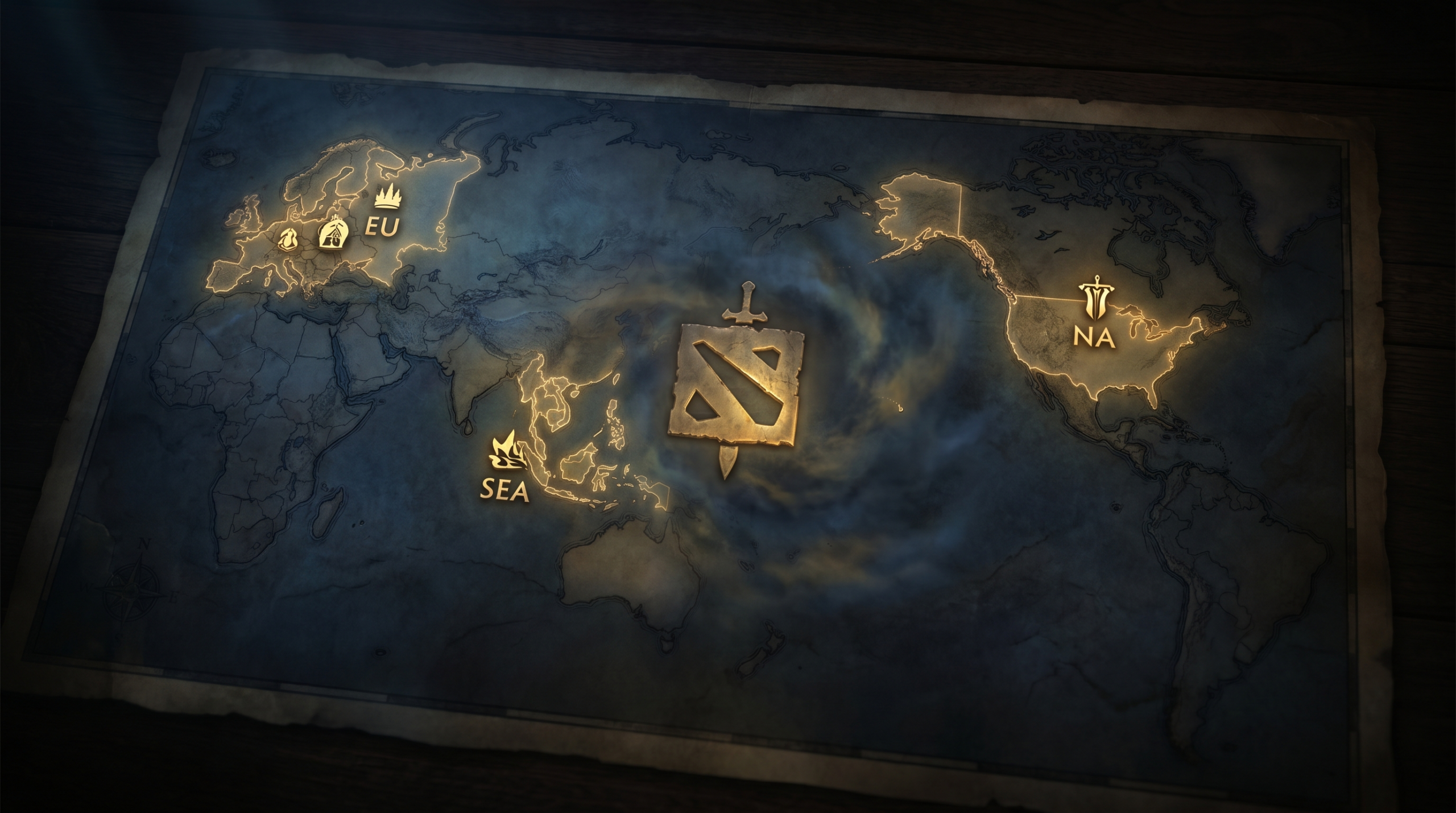
Why Region Matters More Than Most Clients Realize
The Dota 2 matchmaking system assigns MMR on a per-region basis. EU MMR and SEA MMR are separate values in different pools. A 4,500 MMR player on EU is not necessarily equivalent to a 4,500 MMR player on SEA — the player pools have different average skill distributions, different meta preferences, and different queue populations that affect the difficulty of winning games at any given MMR band.
For boosting, this means: the “hardness” of gaining 500 MMR varies by region. In NA at 3,500-4,000 MMR, the game quality is lower than at the same MMR band on EU West or SEA. This affects how fast a booster can work and — indirectly — how much the service costs.
Beyond game difficulty, region affects booster availability. Most boosting services are staffed by boosters in specific geographic locations. A service based primarily in Eastern Europe has a deep EU booster bench and a thinner SEA bench. If you queue in SEA, your booster may be less specialized in SEA hero metas, SEA ping conditions, or SEA player patterns. For maximum service quality, match your region to the service provider’s primary operational region.
EU Server Breakdown
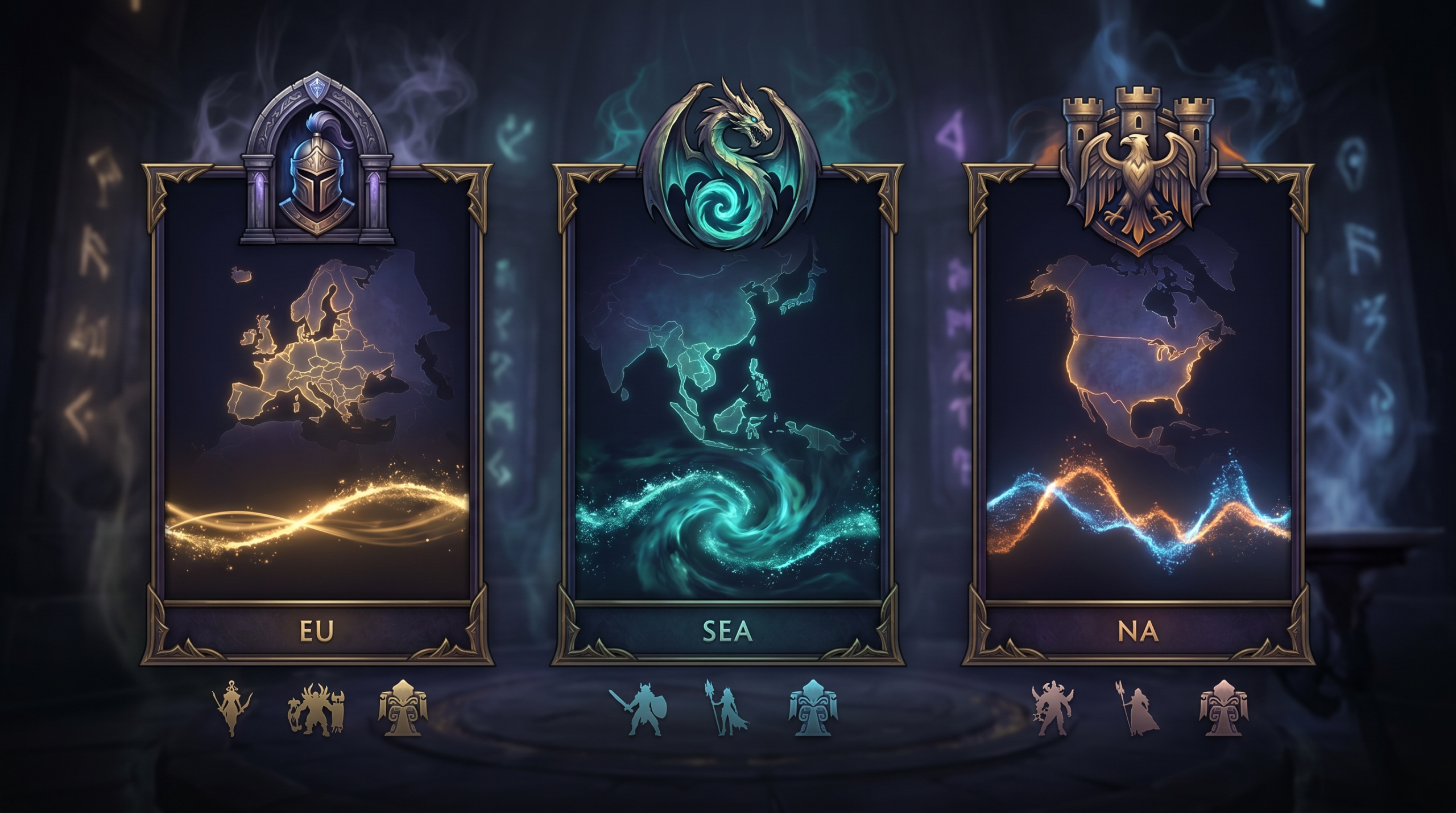
European servers split into EU West (Frankfurt, Luxembourg) and EU East (Stockholm, Vienna, depending on Valve routing). For boosting purposes, EU West is the higher-quality pool with more active high-MMR players.
EU MMR distribution and difficulty
EU has the highest average game quality of the three major regions at equivalent MMR bands. The Ancient/Divine bracket on EU West plays differently from the same bracket on NA or SEA. Games are more macro-focused, teamfight execution is more consistent, and drafting is more structured. For boosters, this means EU games at 4,000-5,000 MMR require higher personal skill to win reliably than equivalent MMR on other servers. The booster’s individual skill must be proportionally higher to maintain a strong win rate.
EU queue times
EU has the largest Dota 2 ranked population in the West. Queue times at peak hours (18:00-23:00 CET) are typically 2-5 minutes for brackets below Immortal. Above 6,000 MMR, queue times extend to 10-20 minutes. For boosting services, this means EU boosts execute games efficiently during peak hours and can be slower outside peak windows.
EU meta characteristics
EU trends toward structured lane compositions, strong mid-game transition timings, and teamfight-centric drafts at mid-tier brackets. Supports on EU tend to be more ward-active than NA equivalents at the same MMR. Boosters familiar with EU meta can exploit consistent patterns in how EU players respond to tempo plays — specifically, EU players at non-Immortal brackets tend to over-commit to fights when they should be farming, creating kill opportunity windows that experienced boosters exploit reliably.
EU booster availability
The highest booster availability of any region. Most Tier 1 boosting services have 5-10+ active EU boosters at Immortal rank. EU is the most competitive booster market, which means pricing is the most competitive and quality vetting is most rigorous among providers who want to maintain reputation in a crowded market.
SEA Server Breakdown
Southeast Asian servers (Singapore primary, with overflow to Dubai and Korean routing depending on client location) are the highest-volume Dota 2 servers globally. SEA has the largest total player population and the fastest queue times at almost all brackets.
SEA MMR distribution and difficulty
SEA is unique because the MMR distribution is compressed at the lower end and has an extremely high ceiling at the top. The gap between a 3,000 MMR SEA player and a 3,000 MMR EU player is significant — SEA 3,000 is generally harder to achieve than EU 3,000 because the player pool is larger and the game has been more deeply embedded in SEA gaming culture for longer. The average mechanical skill at equivalent MMR bands on SEA is often higher than on NA.
However, SEA games at non-Immortal brackets have higher variance in team coordination. Solo-queue communication is less consistent on SEA than on EU. A skilled booster can exploit this variance effectively — winning individual lanes and converting kills faster in games where the opposing team has lower coordination.
SEA queue times
Fastest queue times of any region. 1-3 minutes at virtually all brackets below Immortal, even at off-peak hours. This makes SEA the fastest region for boosting by total game count per day. A booster on SEA can execute 8-10 games in a standard 6-hour session; EU might yield 6-8 games in the same window due to slightly longer queues and slightly longer games.
SEA meta characteristics
SEA brackets below Divine tend to favor aggressive laning over macro play. Early-game kill pressure is higher than on EU or NA equivalents. Roshan attempts are more frequent. The meta on SEA tends to trail the professional meta by a smaller margin than NA, meaning mid-tier SEA players adopt Valve patch meta shifts faster.
For boosters, SEA games reward aggressive early-game heroes — Bristleback, Nyx Assassin support, Batrider, Slark, and other kill-threat heroes that capitalize on opponent coordination gaps. A booster who specializes in these heroes will work faster on SEA than a farm-pattern specialist.
SEA booster availability
Strong availability from Filipino, Thai, Indonesian, and Malaysian boosters. SEA boosters are often the most mechanically skilled relative to their listed MMR because the higher competition level in SEA means a 6,000 MMR SEA booster is a more impressive credential than a 6,000 MMR NA booster. Specialized SEA services are available from providers with regional offices in Southeast Asia.
NA Server Breakdown
North American servers (US East and US West) have the smallest competitive Dota 2 population of the three major regions. This has significant implications for boost speed, booster availability, and price.
NA MMR distribution and difficulty
NA is the easiest region to gain MMR in at equivalent brackets, primarily because the game quality at non-Immortal brackets is lower than EU or SEA. Games at 3,000-4,500 MMR on NA have more varied skill distribution, less structured team play, and higher individual carry-dependency. A skilled booster on NA will win a higher percentage of games than an equivalent booster on EU at the same MMR range because the opponent quality is lower.
This means NA boosts complete faster (higher win rate = more net MMR per game), which partially compensates for the slower queue times.
NA queue times
NA has the longest queue times of the three regions, particularly for high-MMR accounts. At 5,000-6,000 MMR on NA, queue times of 15-25 minutes are common during off-peak hours. This significantly slows boost execution and is the primary reason NA boosts are often priced higher per MMR point despite easier game difficulty — the booster’s time is consumed by queuing, not just playing.
NA meta characteristics
NA at non-Immortal brackets has the highest variance in game outcomes driven by individual carry performance. The meta is less structured than EU, and drafting quality is lower at equivalent MMR bands. Boosters on NA frequently exploit the lack of structured teamfight coordination by playing high-impact solo heroes — Sniper, Windranger, Bristleback — that can win games independently of teammate contribution.
NA booster availability
Limited compared to EU and SEA. Most top-tier boosters are based in EU or SEA and will boost NA accounts via VPN, but the ping disadvantage (100-180ms from EU to NA East) can reduce their effectiveness on mechanically demanding heroes. Services that specialize in NA boosting typically have US or Canadian-based boosters with lower-latency connections.
Head-to-Head Comparison: Key Differences
| Factor | EU West | SEA | NA |
|---|---|---|---|
| Game difficulty at 4,000 MMR | High | Medium-High | Medium |
| Queue times (peak hours) | 2-5 min | 1-3 min | 4-10 min |
| Booster availability | Highest | High | Limited |
| Boost speed (games/day) | 6-8 | 8-10 | 4-6 |
| Average price per 100 MMR | Moderate | Moderate-Low | Moderate-High |
| Meta structure at mid-tier | High | Medium | Low |
| Best booster hero style | Tempo/coordination | Aggressive early-game | Solo carry |
How to Choose Your Region
Choose EU if:
Your account primarily plays on EU. You want the highest quality of service in terms of booster skill and meta knowledge. You are not price-sensitive and want the most reliable execution. Your target MMR is in the 4,500-6,000 range where EU booster depth is a meaningful advantage.
Choose SEA if:
Your account primarily plays on SEA. You want the fastest completion time (most games per day). You are price-sensitive — SEA boosts are typically 10-20% cheaper than EU for equivalent MMR gains. You play at a bracket where the larger player pool provides consistent game availability.
Choose NA if:
Your account is NA-primary with no SEA or EU history. You understand that NA-specific boosters provide better service than EU boosters playing through 150ms ping. You have accepted that NA boosting will be slower and potentially more expensive per MMR point than the alternatives.
When your account spans multiple regions:
If you actively play on both SEA and EU (common for players in the Middle East and South Asia who have accounts on both), choose the region where you want to raise MMR and confirm with the provider that they have boosters specialized for that region. Do not accept a “we boost all regions” statement at face value — ask specifically about booster availability and win rate for your target MMR band on your target server.
Multi-Region Accounts: Special Considerations
Dota 2 accounts maintain separate MMR values for each region. If you play on both EU and SEA and want to boost one region, the boost only affects the target region’s MMR. Your other region’s MMR is unaffected.
Multi-region accounts are common among players who started on one server and switched regions due to ping improvement, friend group migration, or quality-of-life preferences. These accounts sometimes have MMR mismatches — 4,000 on SEA from historical grinding, 3,200 on EU from casual games — and boosting the lower region to match is a legitimate use case.
For multi-region accounts, confirm with the provider that their VPN infrastructure supports the correct regional endpoint. A booster connecting to your EU account must connect through EU endpoints to match your EU play history. A booster connecting through SEA endpoints to play EU games creates the IP-mismatch anomaly discussed in detail in our account sharing risks guide.
Other Regions: SA, OCE, and Russia
Beyond the three major regions, Dota 2 has active ranked populations in South America (Brazil-primary), Oceania (Australia-primary), and Russia/CIS (separate from EU servers despite geographic proximity). These regions have unique characteristics for boosting clients who play on them.
South America (SA)
SA servers are primarily Brazil-based, with significant populations in Argentina, Chile, and Peru. Game quality at non-Immortal brackets is lower than EU or SEA, comparable to NA. Queue times are moderate — 3-8 minutes at most brackets. The SA player population is passionate about Dota 2 but has historically had less access to high-quality coaching and meta analysis, which creates exploitable patterns for skilled boosters. SA booster availability through most services is limited — confirm SA-specific booster assignment rather than accepting an EU or NA booster connecting through a Brazilian VPN endpoint, which will produce higher latency than a locally-based booster.
Oceania (OCE)
Australian and New Zealand servers have the smallest competitive ranked population of any Valve-supported region. Queue times at higher MMR bands (5,000+) can extend to 20-30 minutes, and the server population is thin enough that high-MMR players frequently play each other in consecutive games. This “small pool” dynamic means boosters on OCE may face the same opponents repeatedly, which creates consistency of play but also potential recognition of boosting patterns. OCE boosting is a specialized niche; verify that your provider has specific OCE experience rather than treating it as an extension of their NA or SEA offerings.
Russia / CIS
Russian servers are technically separate from EU East despite geographic overlap. The CIS region has a historically strong Dota 2 competitive culture — many professional players emerged from CIS, and the non-Immortal ranked population reflects this with higher mechanical skill at equivalent MMR bands compared to NA. CIS boosters are often Eastern European-based with server expertise in both EU and CIS. If your account plays on Russian servers, confirm CIS-specific booster assignment; EU-specialized boosters may not have optimized hero pool knowledge for CIS meta tendencies, which differ from EU West in specific ways (CIS tends to favor more aggressive, teamfight-heavy styles at mid brackets).
Questions to Ask Your Provider About Region
Before finalizing any boosting order, the following questions clarify whether the provider has genuine regional expertise or is making generic claims. A quality provider answers these specifically; a low-quality provider gives vague or evasive responses.
Booster credentials
Ask: “Can you provide the Dotabuff profile of the booster who will handle my account, and confirm their recent game history is on my target server?” This question filters out providers who use one booster pool for all regions, connecting through VPNs rather than having local or regionally-specialized boosters. A booster’s Dotabuff should show the majority of their recent games on the region they claim to specialize in.
VPN endpoint specifics
Ask: “Which specific VPN provider and endpoint will you use for my region, and can you confirm it matches my historical play location?” A sophisticated provider knows their VPN infrastructure and can answer this specifically. A provider who says “we use VPN” without specifics may not have region-matched infrastructure.
Hero pool matching
Ask: “I play [hero list] — do you have a booster who plays these heroes at the required MMR on my server?” This confirms whether the booster assignment process is hero-pool-aware or whether boosters are assigned by availability only. A hero-pool match is important not only for safety (behavioral fingerprint consistency) but for performance — a booster playing heroes outside their expertise is less likely to maintain a strong win rate.
Peak hour scheduling
Ask: “What time windows do you schedule EU/SEA/NA boosts, and do they align with peak queue hours for my region?” This reveals whether the service understands regional queue time dynamics or whether they schedule boosts in off-peak hours that produce longer queues and slower completion. EU peak hours are 18:00-23:00 CET. SEA peak hours are 18:00-24:00 SGT. NA peak hours are 18:00-23:00 EST.
Ready to Skip the Grind?
Team Smurf has specialized boosters for EU, SEA, and NA — matched to your region, your hero pool, and your target MMR.
Get Your Boost Now Talk to Our TeamOnce you have picked your region, our Dota 2 MMR boost runs on servers that match your account so the games look exactly like your normal queue.