How Dota 2 Ranked Has Changed Over the Years: A Complete History

Dota 2’s ranked matchmaking system has undergone more transformations than perhaps any other competitive game’s ranking system. From the raw MMR numbers of 2013 to the medal system, role queue, Glicko-2 integration, and seasonal resets of the 2020s, the journey has been marked by constant iteration, community controversy, and Valve’s ongoing quest to create a system that accurately measures skill while remaining fair and motivating.
This comprehensive history covers every major change to Dota 2’s ranked system from its inception in December 2013 through 2026. Whether you’re a veteran who lived through these changes or a newer player curious about how the system evolved, this timeline tells the complete story of competitive matchmaking in Dota 2.
Understanding the ranked system’s history also helps contextualize services like our MMR Boost and Calibration services–the way MMR works today is the product of over a decade of evolution.
Table of Contents
- Before Ranked: The Early Days (2011-2013)
- The Birth of Ranked Matchmaking (December 2013)
- The Raw MMR Era (2014-2017)
- The Medal System Revolution (November 2017)
- Role Queue and Ranked Roles (2018-2019)
- Phone Number Requirements and Smurf Detection
- The Seasonal Reset Experiment
- Glicko-2 and Uncertainty (2023-2024)
- Modern Ranked: 2025-2026
- The Complete Timeline
- How Each Change Affected Players
- The Future of Dota 2 Ranked
- FAQ
Before Ranked: The Early Days (2011-2013)
Dota 2 entered closed beta in 2011 and open beta in 2012, but for the first two years of the game’s life, there was no ranked matchmaking at all. Players queued into “normal” matchmaking, which used a hidden MMR (matchmaking rating) to create balanced games, but this number was never shown to players.
Hidden MMR System
Even without visible ranked play, Valve’s matchmaking algorithm was working behind the scenes from day one. The system used a variant of the Elo rating system (later confirmed to be more complex than simple Elo) to track each player’s skill level. Key characteristics of the hidden MMR era:
- No visible number: Players had no idea what their rating was
- Matchmaking based on hidden skill: Games were still matched by skill level, they just weren’t labeled “ranked”
- Win/loss was the primary factor: Your hidden MMR went up when you won and down when you lost
- Party and solo were mixed: No distinction between solo and party queue
The lack of a visible rank created a unique environment. Without a number to obsess over, many players focused more on enjoying the game and improving organically. But it also created frustration–players had no way to measure their progress, compare themselves to others, or set concrete improvement goals.
The Community Demands Ranked
By 2013, the community’s demand for a ranked mode was overwhelming. Other games (League of Legends in particular) had visible ranking systems that gave players a sense of progression and accomplishment. The Dota 2 community wanted the same. Forums, Reddit, and community sites were filled with requests–and complaints–about the lack of competitive matchmaking.
Valve, characteristically, said very little publicly about their plans. Then, in December 2013, they dropped ranked matchmaking with minimal fanfare.
The Birth of Ranked Matchmaking (December 2013)
On December 6, 2013, Valve released the Ranked Matchmaking update. It was, at the time, one of the biggest updates Dota 2 had ever received–not in terms of content, but in terms of impact on the community.
How It Worked
The initial ranked system was refreshingly simple:
- MMR as a number: Every player had a visible MMR (matchmaking rating), starting from their calibration. There were no medals, no leagues, no divisions–just a number.
- Calibration: To access ranked, players needed to reach experience level 13 (later changed). They then played 10 calibration matches, after which they received an initial MMR.
- Two separate MMRs: Solo MMR and Party MMR were tracked independently.
- Gain/loss per game: Approximately +25 MMR for a win and -25 MMR for a loss, with slight variations based on the MMR difference between teams.
- No rank decay: Your MMR stayed the same whether you played daily or took a year off.
- No seasonal resets: Your MMR was permanent unless you recalibrated (which wasn’t an option initially).
The Calibration System
Initial calibration was based on a combination of your hidden MMR from unranked play and your performance in the 10 calibration games. This meant that players who had been playing Dota 2 since beta started ranked at roughly their actual skill level, while new accounts needed to build up their hidden MMR through unranked games first.
The calibration cap was initially set at approximately 4,500 MMR–even if you won all 10 calibration games with incredible performance, you couldn’t calibrate higher than this. This prevented smurf accounts from immediately calibrating at the top of the ladder.
Community Reaction
The initial reaction was electric. Players finally had a number to track, goals to set, and a ladder to climb. The first weeks of ranked play saw enormous engagement as millions of players calibrated and began their ranked journey.
But problems emerged quickly:
- Calibration anxiety: Players who calibrated “too low” felt stuck and blamed the system
- Boosting emerged immediately: Services offering to play on your account to raise your MMR appeared within weeks
- Toxicity increased: With MMR on the line, players became more hostile during games
- Solo vs. Party disparity: Party MMR was widely seen as less meaningful because you could be carried by better friends
The Raw MMR Era (2014-2017)
For nearly four years, Dota 2’s ranked system remained remarkably unchanged. This era was defined by the raw MMR number–no medals, no seasons, just pure numerical ranking.
Key Events During the Raw MMR Era
2014: The MMR Arms Race
The community became obsessed with MMR milestones. Reaching 5K, 6K, 7K, and eventually 8K MMR became major achievements celebrated on Reddit and social media. The first players to reach 7K and then 8K MMR became mini-celebrities. Pro players’ MMRs were tracked and compared, creating an unofficial leaderboard.
2015: Leaderboards Added
Valve added official regional leaderboards showing the top 200 players in each region. This formalized the high-MMR competition and gave aspiring professional players a visible goal. The leaderboards also became a scouting tool for professional teams looking for new talent.
2015-2016: MMR Inflation
Over time, the average MMR of the top players kept increasing. Where 6K was elite in 2014, 7K became the new elite by 2016, and players began pushing toward 9K and beyond. This “MMR inflation” was a natural consequence of the system: as better players won more, the top of the ladder kept expanding.
2016: Account Buying and Boosting Crisis
By 2016, MMR boosting and account buying had become a significant problem. Services (including early predecessors of modern boosting) would raise accounts to high MMR, then sell them to players who wanted to play in high-skill games they hadn’t earned. This created terrible game quality at higher brackets, as purchased accounts would lose badly and ruin the experience for teammates.
Valve responded with stricter detection methods and occasional ban waves, but the problem persisted throughout this era.
MMR Distribution (Raw Number Era)
| MMR Range | Approximate Percentile | Common Label |
|---|---|---|
| 0-1,000 | Bottom 5% | “Trench” |
| 1,000-2,000 | 5-25% | Below Average |
| 2,000-3,000 | 25-55% | Average |
| 3,000-4,000 | 55-80% | Above Average |
| 4,000-5,000 | 80-95% | High Skill |
| 5,000-6,000 | 95-99% | Very High Skill |
| 6,000+ | Top 1% | Elite / Pro-level |
These numbers are approximate and shifted over time due to inflation. The key insight is that the “average” Dota 2 player was around 2,000-2,500 MMR during this era–far lower than many players assumed.
The Medal System Revolution (November 2017)
On November 22, 2017, Valve introduced the most significant change to Dota 2’s ranked system since its creation: the Medal System. This update replaced the visible MMR number with a medal-based ranking system.
The Medal Tiers
The original medal system introduced 7 tiers, each with 5 sub-tiers (stars):
| Medal | Stars | Approximate MMR Range (at launch) |
|---|---|---|
| Herald | 1-5 | 0 – 770 |
| Guardian | 1-5 | 770 – 1,540 |
| Crusader | 1-5 | 1,540 – 2,310 |
| Archon | 1-5 | 2,310 – 3,080 |
| Legend | 1-5 | 3,080 – 3,850 |
| Ancient | 1-5 | 3,850 – 4,620 |
| Divine | 1-5 | 4,620 – 5,420+ |
Immortal was added later as a tier above Divine, reserved for the top players on each regional leaderboard.
Key Design Decisions
Medals only go up (initially): In the original implementation, your medal would never decrease during a season. If you reached Ancient 3, you’d keep that badge even if you lost 500 MMR. Only your underlying (hidden) MMR changed. This was designed to reduce anxiety and encourage players to keep playing without fear of losing their rank.
MMR became hidden: Initially, Valve hid the specific MMR number, showing only the medal. This was controversial–many players wanted to see the exact number. Valve eventually re-exposed MMR as a visible number alongside the medal.
Seasonal medals: The medal system introduced seasons (approximately 6 months each). At the end of each season, medals reset and players recalibrated. This was Dota 2’s first experience with seasonal resets.
Community Reaction
The medal system was polarizing:
Positive reactions:
- Medals felt more rewarding and tangible than raw numbers
- The visual progression (Herald to Immortal) gave players clearer goals
- Medals were easier to understand and communicate (“I’m Legend 3” vs. “I’m 3,500 MMR”)
- The one-way medal system reduced anxiety about losing rank
Negative reactions:
- Hiding MMR felt like a step backward–players wanted to see their exact number
- The one-way medal system meant medals didn’t accurately reflect current skill (a player could be Ancient medal but playing at Crusader level)
- Seasonal resets felt unnecessary and forced players to re-earn ranks they’d already achieved
- The medal system made boosting more visible (and arguably more desirable) because medals were displayed on profiles
Role Queue and Ranked Roles (2018-2019)
One of the most demanded features in Dota 2’s history, Role Queue fundamentally changed how ranked games were played.
The Problem
Before role queue, ranked games in Dota 2 were a free-for-all during the draft phase. Five strangers would load into a game and immediately argue about who plays which role. The stereotypical scenario: three players all wanting to play mid, nobody wanting to play support, and the resulting team composition being a disaster before the game even started.
This “role conflict” was the number one source of toxicity in ranked Dota 2. It led to:
- Last-pick fights where two players both locked carry heroes
- Passive-aggressive gameplay where forced supports would buy no wards and farm jungle
- Unbalanced lineups with 4 cores and 1 reluctant support
- Pre-game tilting that carried into the actual match
Ranked Roles (Dota Plus – 2018)
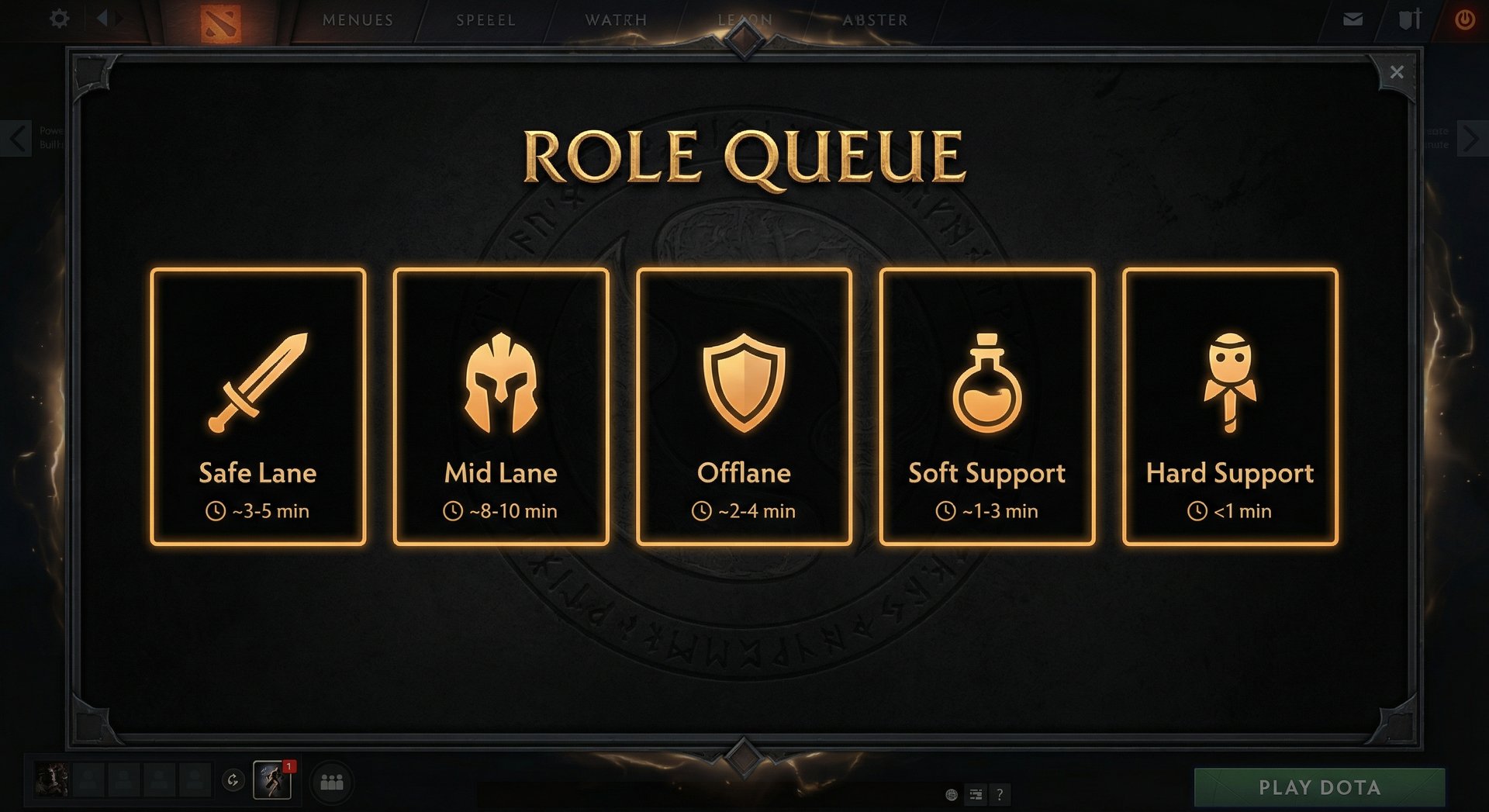
Valve first introduced “Ranked Roles” as a Dota Plus exclusive feature in 2018. Players could select their preferred role (Safe Lane, Mid Lane, Off Lane, Soft Support, Hard Support) before queuing, and matchmaking would assemble a team with one player per role.
This was initially locked behind the Dota Plus subscription ($3.99/month), which generated significant backlash. The community argued that a fundamental matchmaking improvement shouldn’t be paywalled.
Free Role Queue for Everyone (2019)
In August 2019, Valve made role queue free for all ranked players. This was one of the single best changes in Dota 2 history, according to community sentiment. Key features:
- All five roles selectable: Safe Lane (Carry), Mid Lane, Off Lane, Soft Support, Hard Support
- Separate MMR per role: Initially experimented with but eventually simplified to a single MMR
- Role queue tokens: To incentivize support play (which was always in higher demand), players earned “role queue games” by playing support. This ensured queue times remained reasonable for core roles.
- Role performance tracking: Players who consistently performed poorly in their selected role could be flagged
Impact of Role Queue
Role queue’s impact on game quality was immediate and dramatic:
- Pre-game toxicity dropped significantly: No more fighting over roles
- Team compositions improved: Every team had a proper 1-2-3-4-5 lineup
- Support players felt valued: No more being “the person who didn’t get a core role”
- Queue times increased slightly: Especially for mid and carry, since those roles were more popular
- Role abuse became a new problem: Some players would queue as support to get shorter queue times, then play like a core
Role queue remains one of the most impactful changes in Dota 2’s history and is virtually universally supported by the community in 2026.
Phone Number Requirements and Smurf Detection
Phone Number Verification (2017-2019)
In April 2017, Valve introduced a requirement that ranked accounts must have a unique phone number linked to their Steam account. This was part of Valve’s escalating war against smurfs and boosted accounts.
The phone number requirement:
- Each phone number could only be linked to one Dota 2 ranked account at a time
- Changing numbers had a cooldown period
- Online/VOIP numbers were blocked (initially; workarounds appeared quickly)
- Significantly reduced casual smurfing but didn’t eliminate dedicated smurfs
Smurf Detection Algorithm (2019-2024)
Valve developed and continuously refined an algorithmic smurf detection system. The system used behavioral analysis, performance metrics, and hardware fingerprinting to identify accounts likely being used by higher-skilled players. Detected smurfs received:
- Accelerated MMR gains: +100 MMR or more per win, rapidly pushing them to their actual bracket
- Account bans: In severe or repeat cases, accounts were permanently banned from ranked play
- Matchmaking pool separation: Suspected smurfs were matched against each other rather than against legitimate players
For a detailed look at how smurf detection works and how to deal with smurfs in your games, see our Complete Guide to Countering Smurfs.
New Player Experience Requirements
Over the years, Valve increased the barriers to accessing ranked matchmaking:
| Year | Requirement to Play Ranked | Purpose |
|---|---|---|
| 2013 | Experience Level 13 | Basic game familiarity |
| 2017 | Level 20 + phone number | Increased barrier, identity verification |
| 2019 | 100 hours of play + phone number | Significant time investment before ranked |
| 2021+ | 100 hours + phone + tutorial completion | Ensure basic game knowledge |
Each increase in requirements made smurf account creation more time-consuming, though determined smurfs and boosting services adapted by maintaining pre-leveled accounts.
The Seasonal Reset Experiment
Seasonal resets–where all players’ medals reset and require recalibration at the start of a new season–have been one of the most debated features of Dota 2’s ranked system.
How Seasonal Resets Work
At the end of each ranked season (typically every 6 months), players’ medals are reset. When the new season begins, players play 10 calibration games, and their medal is reassigned based on their calibration performance combined with their previous season’s MMR.
Crucially, recalibration doesn’t start from scratch. Your previous MMR serves as the starting point, and calibration games adjust it up or down (usually by 100-300 MMR at most). This prevents dramatic rank swings but allows for some correction.
The Arguments For Seasonal Resets
- Accounts recover from boosting/buying: Boosted accounts gradually fall back to their real MMR through recalibration
- Returning players recalibrate: Players who took a long break aren’t stuck at an outdated MMR
- Sense of renewal: Each season feels fresh, giving players motivation to climb again
- Meta adaptation: Recalibration can account for players who improved (or declined) with meta shifts
The Arguments Against Seasonal Resets
- Calibration game quality: The first week of each season is chaotic, with Immortal players matching with Ancients
- Losing earned rank: Players who worked hard to reach a milestone dislike having it reset
- Calibration variance: 10 games is a small sample size for determining rank–unlucky streaks can drop you significantly
- Boosting incentive: Seasonal resets create recurring demand for calibration services since players need to re-rank every season
Our Calibration service exists in part because of seasonal resets. Players who don’t have time to grind through calibration or who want to ensure their placement matches go well can have experienced players handle the calibration process.
Glicko-2 and Uncertainty (2023-2024)
One of the most technically significant changes to Dota 2’s ranked system was the adoption of Glicko-2 rating principles, which Valve implemented in phases between 2023 and 2024.
What Is Glicko-2
The Glicko-2 rating system was developed by Professor Mark Glickman as an improvement over the Elo rating system. While Elo tracks only a single number (your rating), Glicko-2 tracks three values:
- Rating (µ): Your estimated skill level (equivalent to MMR)
- Rating Deviation (RD): How confident the system is in your rating. Low RD means high confidence; high RD means uncertain.
- Volatility (σ): How consistent your performance is. High volatility means your performance varies a lot between games.
How Glicko-2 Changed Dota 2
The practical implications of Glicko-2 for Dota 2 players:
New accounts calibrate faster: New accounts have high uncertainty (RD), so the system adjusts their rating dramatically in early games–gaining or losing 75+ MMR per game instead of 25. This means new accounts (and smurfs) reach their actual rating much faster.
Inactive players have increased uncertainty: If you don’t play for months, your uncertainty increases. When you return, the system adjusts your rating more aggressively in your first few games to quickly determine if your skill has changed.
Consistent players have stable ratings: If you play regularly and your performance is consistent, your uncertainty decreases and your rating becomes very stable. You might gain/lose only 20 MMR per game.
Performance streaks are handled better: Under old Elo-style systems, a 10-game win streak and a 10-game loss streak would perfectly cancel out. Under Glicko-2, the system recognizes that streaks might indicate a genuine skill change and adjusts the uncertainty accordingly, allowing for faster correction.
Confidence Intervals and Display
Valve didn’t expose all Glicko-2 variables to players–you still see a single MMR number and a medal. But the underlying system uses the full Glicko-2 framework to determine matchmaking and MMR gains/losses. Some players noticed variable MMR gains (getting +30 in one game and +20 in the next) which was the system’s uncertainty manifesting.
| Player Situation | Uncertainty Level | MMR Change Per Game | Effect |
|---|---|---|---|
| New account (first 50 games) | Very High | ±50-100+ | Fast calibration to actual skill |
| Returning after long break | High | ±30-50 | Quick recalibration |
| Regular active player | Low | ±20-25 | Stable, gradual changes |
| Player on a win/loss streak | Increasing | ±25-35 | System suspects skill change, adjusts faster |
Impact on the Ranked Experience
Glicko-2 was largely a behind-the-scenes improvement that most players didn’t notice directly. However, its effects were significant:
- Smurf accounts reached their real MMR much faster (in 20-30 games instead of 100+)
- Returning players had a smoother transition back into ranked play
- Match quality improved overall as the system became better at estimating true skill
- The “MMR hell” feeling decreased because the system was more responsive to genuine improvement
Modern Ranked: 2025-2026
The ranked system in 2025-2026 represents the culmination of over a decade of iteration. Here’s what the current system looks like:
Current Ranked Structure
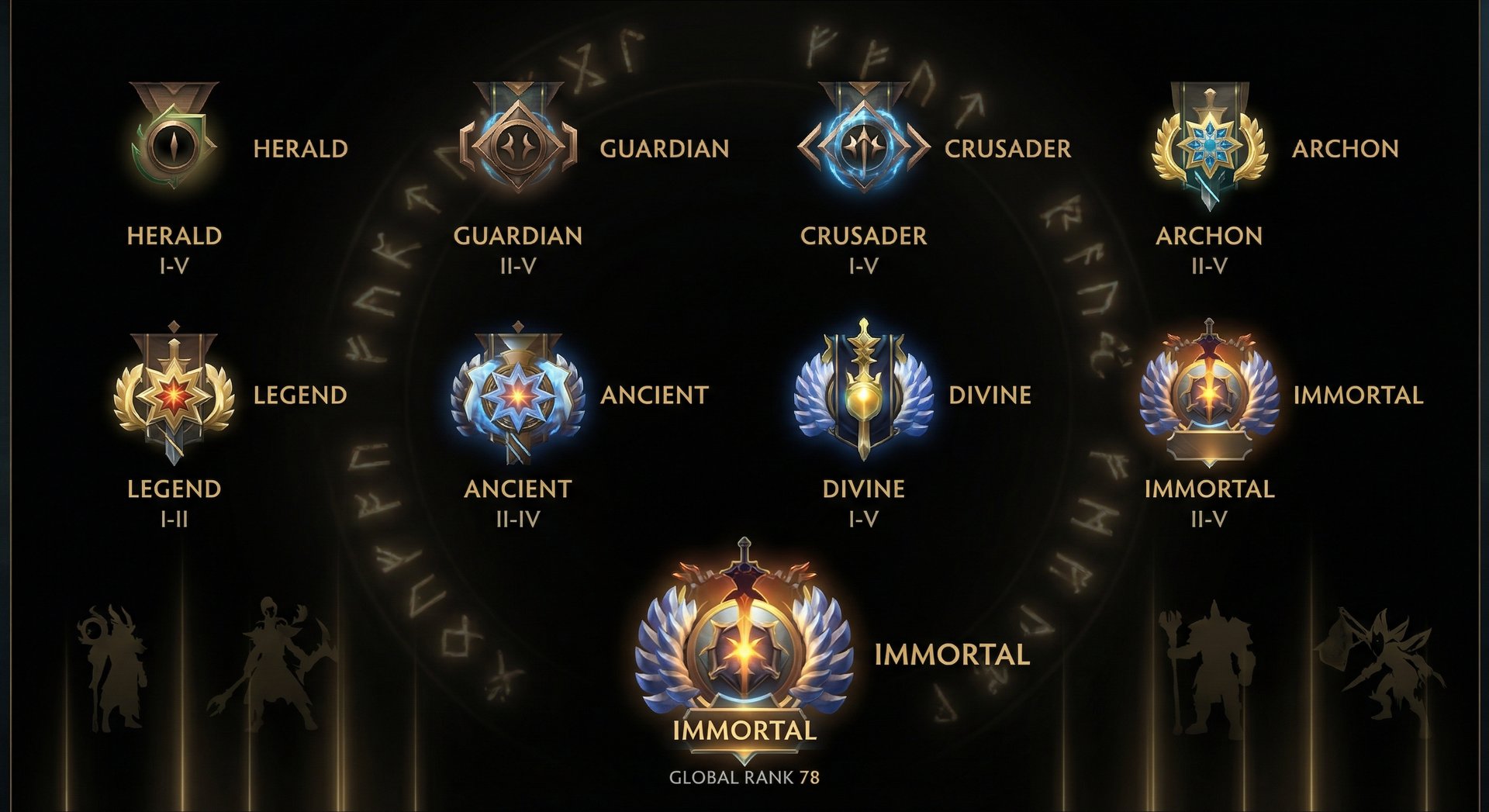
8 Medal Tiers: Herald, Guardian, Crusader, Archon, Legend, Ancient, Divine, Immortal. Each (except Immortal) has 5 stars.
Single MMR: After experimenting with role-specific MMR, Dota 2 returned to a single MMR number that applies regardless of role played.
Role Queue: All ranked games use role queue. Players select their role before searching.
Seasonal Resets: Medals reset approximately every 6 months, with 10 calibration games to re-establish rank.
Glicko-2 Backend: The matchmaking system uses Glicko-2 principles for rating calculation and uncertainty management.
Anti-Smurf Measures: Phone verification, behavioral analysis, accelerated MMR for detected smurfs, and periodic ban waves.
Overwatch System: Community-driven review of reported players, including suspected smurfs and account buyers.
Current MMR to Medal Mapping (Approximate, 2026)
| Medal | MMR Range (Approximate) | Percentile (Approximate) |
|---|---|---|
| Herald 1-5 | 0 – 770 | Bottom 5% |
| Guardian 1-5 | 770 – 1,540 | 5-15% |
| Crusader 1-5 | 1,540 – 2,310 | 15-35% |
| Archon 1-5 | 2,310 – 3,080 | 35-55% |
| Legend 1-5 | 3,080 – 3,850 | 55-75% |
| Ancient 1-5 | 3,850 – 4,620 | 75-90% |
| Divine 1-5 | 4,620 – 5,620 | 90-98% |
| Immortal | 5,620+ | Top 2% |
| Immortal (Leaderboard) | ~6,500+ | Top 0.1% |
Note: These numbers fluctuate between seasons and regions. They are approximate based on community data.
Current Issues and Community Feedback (2026)
Even after a decade of refinement, the ranked system still faces ongoing challenges:
- Queue time disparity: Mid lane and carry roles have significantly longer queue times than support roles
- Smurf persistence: Despite detection improvements, smurfs remain a frustration in Archon-Ancient brackets
- Regional imbalance: Some regions have smaller player pools, leading to wider skill disparities in matches
- Calibration anxiety: Seasonal resets continue to generate stress, particularly for players near medal boundaries
- The “grinding” feeling: At ±20-25 MMR per game, climbing feels slow, especially for players who feel they’ve improved significantly
The Complete Timeline
Here’s every major change to Dota 2’s ranked system in chronological order:
| Date | Change | Impact |
|---|---|---|
| 2011-2013 | Hidden MMR only, no ranked mode | Players can’t see their rating |
| Dec 2013 | Ranked Matchmaking launched | Visible MMR, Solo/Party split, calibration introduced |
| 2014 | Leaderboards announced for top players | High-MMR players gain visibility |
| 2015 | Regional leaderboards formalized (top 200 per region) | Pro player scouting tool, community goals |
| Apr 2017 | Phone number required for ranked | First major anti-smurf measure |
| Nov 2017 | Medal System introduced (Herald-Divine) | Visual ranks replace raw numbers; seasons introduced |
| 2018 | Immortal tier added above Divine | Top players get distinct recognition |
| 2018 | Ranked Roles (Dota Plus exclusive) | Role queue behind paywall–controversial |
| Aug 2019 | Free Role Queue for all players | Massive quality-of-life improvement; role-based matchmaking |
| 2019 | 100-hour requirement for new ranked accounts | Increased smurf barrier |
| 2019-2020 | Smurf detection algorithm deployed | Accelerated MMR for detected smurfs |
| 2020 | Overwatch system launched | Community-driven review of cheaters and smurfs |
| 2021 | Ranked reset experiments / frequent seasons | More frequent recalibration periods |
| 2023-2024 | Glicko-2 rating system adopted | Variable MMR gains, uncertainty tracking, faster calibration |
| 2024 | Solo/Party MMR merged into single MMR | Simplified system, party queue impacts main rank |
| 2025 | Enhanced smurf detection + ban waves | Thousands of accounts banned per wave |
| 2026 | Current system stabilized | Medals + Glicko-2 + Role Queue + Anti-smurf = modern ranked |
How Each Change Affected Players
The Carry Player’s Perspective
For carry players, the biggest changes were role queue (no more fighting for safelane) and the various matchmaking adjustments. Before role queue, carry players had to compete with 2-3 other core players for farm. After role queue, they were guaranteed their role but faced longer queue times.
Glicko-2 helped carry players who improved significantly–the system’s uncertainty tracking meant that a carry player who suddenly started performing at a much higher level would see their MMR adjust faster than under the old flat +25 system.
The Support Player’s Perspective
Support players have been perhaps the biggest beneficiaries of ranked system changes. Role queue gave them dignity (no more “you’re last pick, you support”), shorter queue times (support is always in demand), and role queue tokens that let them occasionally play core. The medal system also made support climbing feel more rewarding–seeing your medal upgrade is more motivating than watching a number tick up by 25.
The Smurf/Booster’s Perspective
Each anti-smurf measure–phone verification, 100-hour requirements, smurf detection, Glicko-2’s fast calibration–made smurfing progressively harder and less rewarding. Modern smurfs reach their actual MMR much faster, spend fewer games in lower brackets, and face higher risk of account bans. This has improved the experience for legitimate players in lower brackets.
At TeamSmurf, we’ve adapted our MMR Boost service and our broader services to work within the modern system, ensuring our clients’ accounts remain safe while delivering results.
The Returning Player’s Perspective
Players who take breaks from Dota 2 have benefited from Glicko-2’s uncertainty tracking and seasonal resets. Previously, a player who quit for a year would return to the same MMR and struggle because the meta had changed and their skills had rusted. Now, the system quickly adjusts returning players to their current skill level through increased uncertainty and recalibration.
The Future of Dota 2 Ranked
While we can’t know Valve’s exact plans, community discussions and industry trends suggest several potential future developments:
Potential Future Changes
- More transparent Glicko-2 data: Showing players their uncertainty and volatility values, not just MMR
- Improved role queue with flex roles: Allowing players to select 2-3 roles with priority weighting
- Behavior-based matchmaking improvements: Separate pools for toxic and positive players (partially implemented via behavior score)
- AI-driven smurf detection: Machine learning models that can identify smurfs with even higher accuracy
- Regional MMR normalization: Adjusting MMR values across regions so that “5000 MMR” means the same skill level worldwide
- Tournament integration: Connecting ranked performance to in-client tournament qualification
Community Wishlist
The most-requested features from the Dota 2 community in 2026:
- Visible MMR gains/losses shown post-game (currently you have to check your profile)
- Stricter role queue enforcement (penalizing players who don’t play their selected role)
- Faster smurf detection (catching smurfs within 5-10 games instead of 20-30)
- Team-based ranked mode (for 5-stacks competing against other 5-stacks)
- More frequent seasonal rewards for reaching certain ranks
FAQ
Ready to Climb Start Your Boost Today
Team Smurf is the #1 rated Dota 2 boosting service. Immortal-rank boosters, maximum safety, competitive pricing, 24/7 support.
Conclusion
The history of Dota 2’s ranked system is a story of continuous evolution. From the simplicity of raw MMR numbers in 2013 to the sophisticated Glicko-2-powered, role-queued, smurf-detected medal system of 2026, Valve has iteratively refined how competitive Dota 2 works. Every change was driven by a combination of community feedback, competitive integrity concerns, and the inherent challenge of measuring skill in a complex, team-based game.
Understanding this history gives you context for why the system works the way it does today. The +25 MMR per game isn’t arbitrary–it’s a product of Glicko-2’s uncertainty calculations. The seasonal resets aren’t punitive–they’re designed to keep rankings fresh and accurate. The medal system isn’t superficial–it’s a psychological framework built on a decade of player behavior data.
Whether you’re a Herald working toward Guardian or a Divine pushing for Immortal, the ranked system is designed to reward consistent improvement over time. And if you want help navigating the system–whether through MMR Boosting, Calibration, or Coaching–TeamSmurf has been evolving alongside the ranked system since the beginning.
The one thing that hasn’t changed since 2013 The climb feels amazing. Good luck out there.