

Pro Players’ MMR in 2026: Where TI Stars Sit on the Leaderboard

Every Dota 2 player has wondered how their MMR stacks up against the pros competing on the biggest stage in the game. The International 2026 brings together the best players in the world, and their public leaderboard MMR numbers tell a striking story. When you see a TI star with 12,500 MMR on the EU leaderboard, it puts your own bracket into sharp perspective — and helps you understand exactly what separates elite pub play from professional performance.
This guide breaks down where active TI 2026 participants actually sit on the public MMR leaderboard, what MMR brackets those numbers represent, how regional servers affect leaderboard thresholds, and what it genuinely takes to push into the tier where pro players compete. You will also find out how pro players MMR dota 2 2026 data should inform your own climb — and where a TeamSmurf boost or coaching session can realistically get you.
In This Guide
- What Is the Dota 2 Leaderboard?
- TI 2026 Stars and Their Approximate MMR
- Inside the Top 200
- Regional Leaderboard Thresholds by Server
- How Pro MMR Compares to Pub Brackets
- The Gap Between Immortal and Pro
- What MMR Do You Need for the Leaderboard?
- How TI Stars Maintain High MMR While on Tour
- Lessons for Pub Players From Pro MMR Data
- Frequently Asked Questions
What Is the Dota 2 Leaderboard?
The Dota 2 leaderboard is a server-specific ranking that shows the top 200 players by MMR on each regional matchmaking server. Unlike the visible rank medals (Herald through Immortal), the leaderboard does not show a bracket — it shows a raw MMR number and a position from 1 to 200. To appear on the leaderboard at all, a player must be inside the top 200 on their server and have played a calibration match within the past 21 days to keep their position active.
This system exists separately from ranked medal display. A player can be Immortal in terms of medal without appearing on the leaderboard if they fall outside the top 200 on their server. Conversely, the number 1 leaderboard player on the SEA server typically has a different MMR than the number 1 player on EU West — because server populations and average MMR ceilings differ substantially between regions.
For pro players, the leaderboard is both a badge of pride and a practical necessity. Teams, tournament organizers, and fans use leaderboard positions as a live signal of a player’s current form. A player who dropped from leaderboard top 10 to outside the top 50 over a patch cycle is often cited as a form concern heading into a major or TI qualifier. The leaderboard is the closest thing Dota 2 has to a public performance tracker for active pros.
TI 2026 Stars and Their Approximate MMR
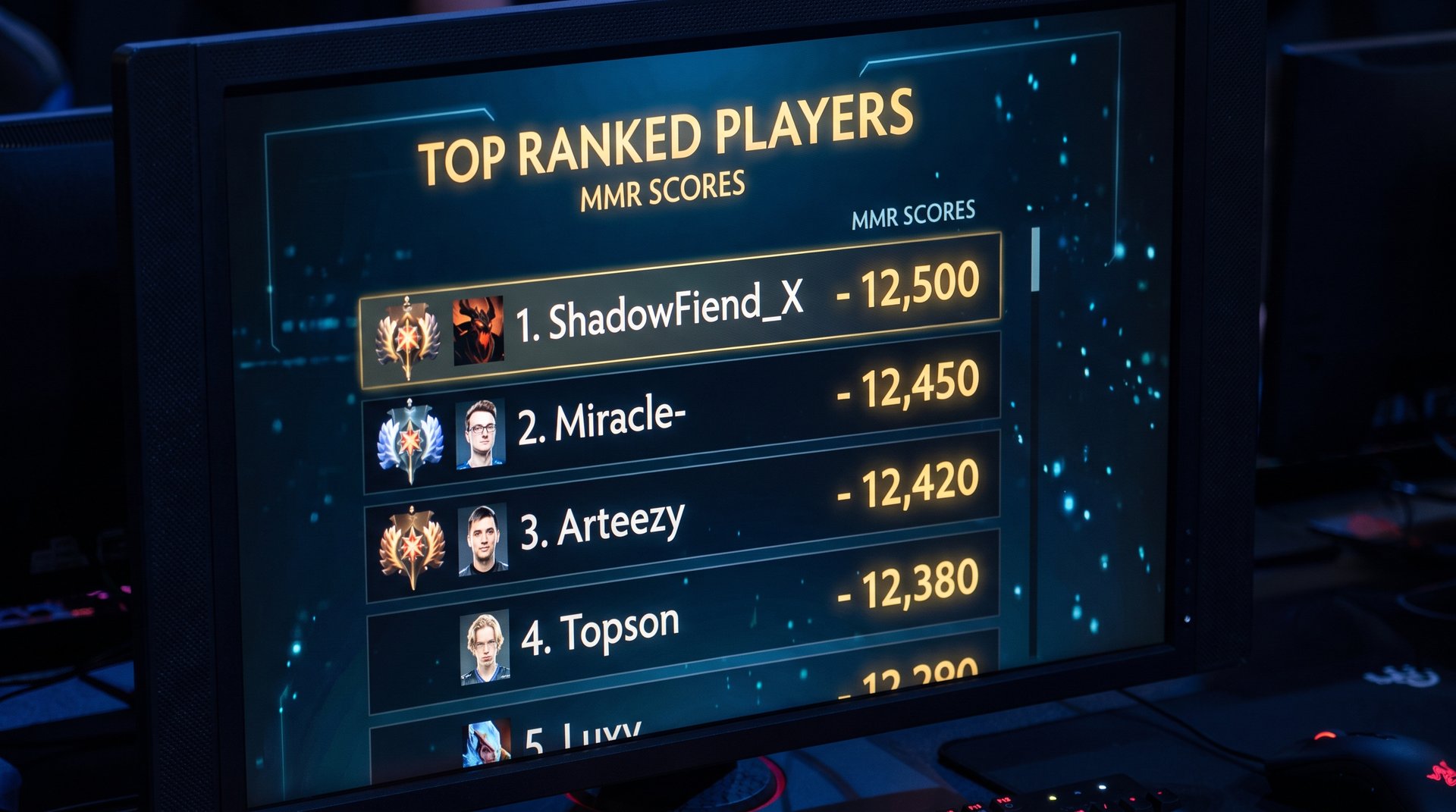
The best place to ground any discussion of pro players MMR dota 2 2026 is with the players themselves. TI 2026 brings together the highest-performing teams from each regional qualifier — and the players on those rosters are among the most decorated in Dota 2 history. Here is a breakdown of the key names and their approximate public leaderboard MMR.
These figures are compiled from Dotabuff and OpenDota community tracking data. MMR is not a static number: pros gain and lose MMR in pub games between tournaments, take breaks that temporarily freeze their rank, or play on smurfs and secondary accounts. The figures below represent their primary account peak and active ranges over the 2026 season.
| Player | Approx. Active MMR (2026) | Primary Server | Role | Leaderboard Position Range |
|---|---|---|---|---|
| Yatoro | 12,400 — 12,900 | EU West | Carry (Pos 1) | Top 10 |
| Collapse | 11,800 — 12,500 | EU West | Offlaner (Pos 3) | Top 30 |
| Miracle- | 12,500 — 13,200 | EU West / SEA | Mid (Pos 2) | Top 5 |
| SumaiL | 11,900 — 12,800 | NA / EU West | Mid (Pos 2) | Top 20 |
| 23savage | 12,200 — 13,000 | SEA | Carry (Pos 1) | Top 5 SEA |
| Arteezy | 11,200 — 12,000 | NA / EU West | Carry (Pos 1) | Top 50 EU |
| Quinn | 9,200 — 10,000 | NA | Support (Pos 4/5) | Top 10 NA |
| Miposhka | 10,200 — 11,000 | EU West | Support (Pos 5) | Top 80 EU |
A few things stand out immediately from this data. First, the carry and mid positions — the highest kill-participation roles — tend to hold the highest MMR. Yatoro and Miracle- are consistently near the top of the EU leaderboard, while 23savage dominates the SEA server. Second, support players generally carry slightly lower MMR, not because they are worse players, but because the role’s value is harder to express in solo queue where carrying games through individual performance is faster. Quinn’s NA MMR looks lower than EU counterparts, but on the NA server he sits inside the top 10 — a leaderboard position equivalent to the prestige of top 30 in EU by sheer difficulty of competition.
Third, notice that all of these players are inside what Dota 2 would classify as “Immortal” bracket — but they are at the extreme top end, thousands of MMR above where the Immortal medal itself is awarded. The highest MMR ever recorded in Dota 2 history was set at over 14,000 by a handful of players in previous seasons, which puts even the current active pro range in context.
Understanding the Top 200 Cutoff
To appear on the Dota 2 leaderboard at all, you need to crack the top 200 on your regional server. This threshold is not a fixed MMR number — it shifts with the season, the server population, and how active the top players are. On EU West, one of the most competitive servers in the world, the cutoff to reach position 200 has historically sat between 9,200 and 10,000 MMR. On NA, it can be as low as 7,500-8,500 due to a smaller high-MMR population.
This is why pro players who primarily play on EU tend to have higher raw MMR numbers — they are competing against the densest pool of elite pub players in the world. When Yatoro sits at position 8 on EU West, he has climbed past approximately 192 other players who would all qualify as exceptional by any pub standard.
Regional Leaderboard Thresholds by Server
One of the most common misconceptions among pub players is treating all leaderboard positions as equivalent. A rank 200 on SEA and a rank 200 on EU West are separated by potentially thousands of MMR points. Understanding regional thresholds is essential for accurately reading pro player MMR data.
| Server Region | Approx. Leaderboard #200 MMR | Approx. Leaderboard #1 MMR | Estimated Active High-MMR Pool |
|---|---|---|---|
| EU West | 9,200 — 10,200 | 12,500 — 13,500 | Very large (most competitive) |
| EU East | 8,800 — 9,800 | 12,000 — 13,000 | Large |
| SEA | 8,500 — 9,500 | 12,000 — 13,500 | Very large (strong CN overflow) |
| NA | 7,500 — 8,800 | 11,000 — 12,000 | Moderate (smaller pool) |
| SA | 7,200 — 8,500 | 10,500 — 12,000 | Moderate |
| Australia | 6,800 — 8,000 | 9,500 — 11,000 | Small (low population) |
These numbers are estimates derived from community data aggregators (Dotabuff, OpenDota, Stratz) over the 2025-2026 season. They shift between major patches and at the start and end of ranked seasons when many players recalibrate.
The practical implication: if a Chinese or SEA pro plays on EU servers during a bootcamp, their MMR on that server starts lower than their “home” rating and takes time to climb. You will sometimes see a player listed at 9,500 EU West who is actually ranked inside the top 20 on CN servers. Server-jumping is common at the pro level, especially for TI bootcamps held in Europe.
How Pro MMR Compares to Pub Brackets
Dota 2’s rank distribution places the average player around 2,500-3,000 MMR, in the Crusader-Archon range. The Dota 2 ranked system as a whole follows a rough bell curve where the majority of players cluster in the 2,000-4,000 range. The jump from there to where TI players operate is not a gap — it is a chasm.
Herald/Guardian: 0-1,500 MMR — approx. 20% of players
Crusader: 1,500-2,500 MMR — approx. 25% of players
Archon: 2,500-3,500 MMR — approx. 22% of players
Legend: 3,500-4,500 MMR — approx. 17% of players
Ancient: 4,500-5,500 MMR — approx. 10% of players
Divine: 5,500-6,500 MMR — approx. 5% of players
Immortal (non-leaderboard): 6,500-9,000 MMR — approx. 1% of players
Leaderboard Immortal: 9,000+ — top 200 per server
Consider what this means. A player who climbs from 3,500 (Archon 5) to 7,000 (Immortal) would already be in the top 1-2% of all Dota 2 players — and they would still be roughly 5,000 MMR below Yatoro. The pro level does not sit just above the average pub player’s aspiration ceiling. It exists in an entirely separate tier that requires years of full-time practice, professional coaching, and tournament-tested mental conditioning to reach.
This is also why understanding your MMR boosting options through a legitimate service matters for players trying to reach new brackets. The difference between 4,500 MMR and 6,500 MMR is genuinely life-changing in terms of matchmaking quality and what you learn from your teammates. Getting into the upper Immortal bracket requires a shift in how you approach the game — and coaching from players who have operated at 9,000+ is one of the most direct paths there.
The Gap Between Immortal and Pro
The data makes clear that reaching the Immortal medal — around 6,500 MMR on most servers — still leaves a player roughly 5,000 MMR below where TI stars like Yatoro or Miracle- operate. That gap represents thousands of hours of professional practice. But the interesting insight from pro player MMR data is not about how far the gap is — it is about where the game starts to look fundamentally different.
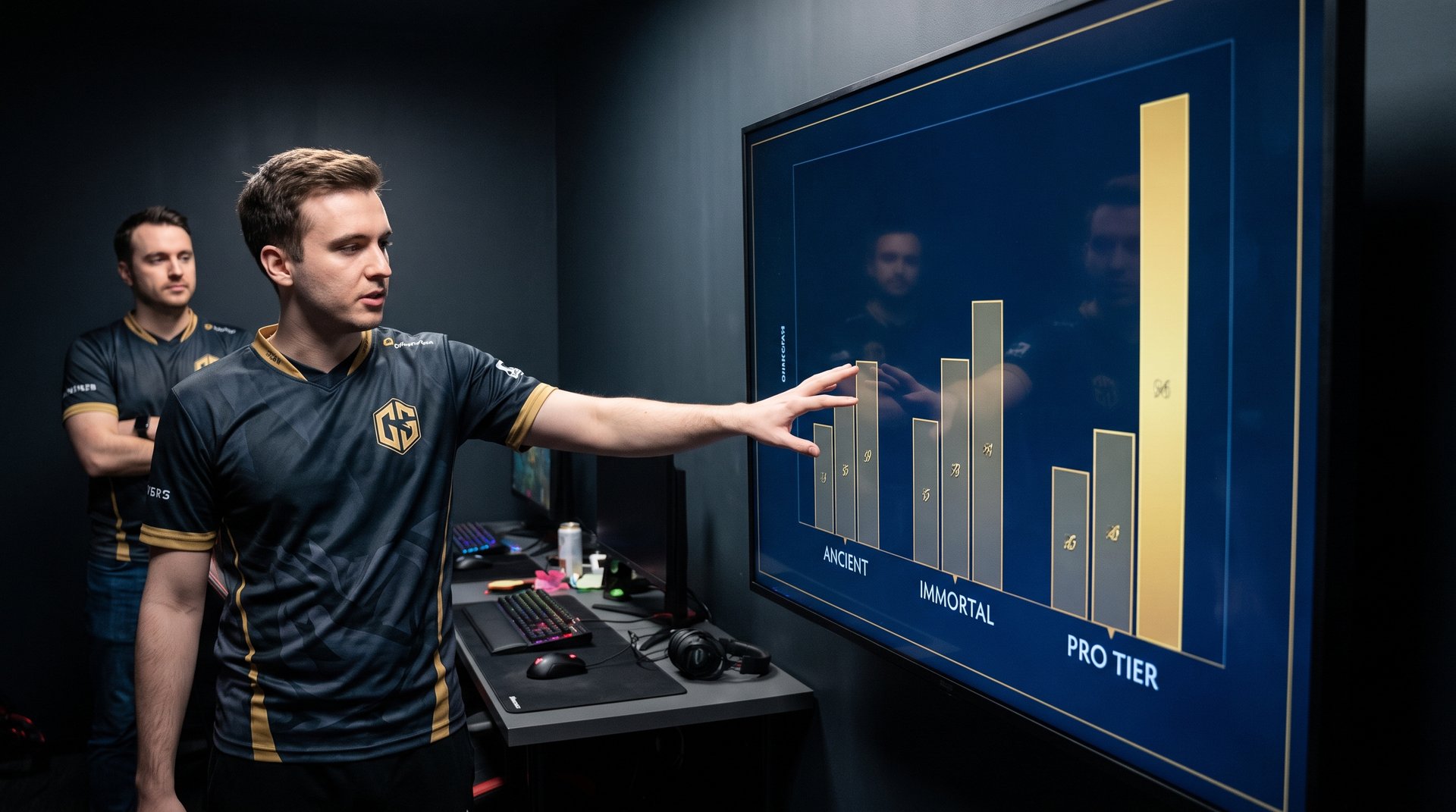
At around 7,000-8,000 MMR, pub games start to resemble professional Dota in meaningful ways. Players at this level understand movement timing, farming efficiency, draft counter-play, and coordination at a level that is qualitatively different from the 4,000-5,000 bracket. This is the tier where players who aspire to qualify for regional leagues typically grind. TI 2026 hopefuls who were not already in professional organizations spent much of 2025-2026 in this zone.
Pro players themselves do not worry much about their MMR relative to other pros — their primary competition is on LAN. But the leaderboard position serves as a signal of readiness. A player who drops from rank 15 to rank 100 over a bootcamp period is often dealing with hero pool stress, jetlag, or a patch transition that has disrupted their game sense. Coaches and managers track these signals.
What MMR Do You Need for the Leaderboard?
The most direct answer, as of mid-2026: you need to be inside the top 200 of your server, which on EU West currently requires approximately 9,200-10,200 MMR depending on season activity. On NA you can crack the leaderboard at a lower number — historically 7,500-8,500 has been the entry threshold.
But “getting to the leaderboard” as a pub player is less useful as a goal than understanding what you need to reach each milestone below it. Here is a realistic ladder for the serious grinder:
- Ancient bracket (4,500+ MMR): Top 15% of players. You understand core concepts like lane equilibrium, basic rotations, and the importance of timing. Games feel like real Dota.
- Divine bracket (5,500+ MMR): Top 6%. You can read opponents, adapt your item build mid-game, and your mechanical execution is solid. This is where natural talent starts to differentiate players significantly.
- Immortal badge (6,500+ MMR): Top 1-2%. You are functionally playing a different game than the average player. Drafting, communication, and hero mastery are all operating at a high level.
- High Immortal (8,000+ MMR): Top fraction of a percent. Most players at this level are either semi-professional or have played at a serious competitive level in the past.
- Leaderboard (9,000-10,000+ EU West): You are in the top 200 of one of the most competitive servers in the world. At this point you genuinely belong in the same pub lobbies as TI participants.
If you want to accelerate your climb from Ancient or Divine toward the Immortal milestone, a professional MMR boost from TeamSmurf can close hundreds of MMR quickly, placing you in better lobbies where you can actually learn from higher-level players rather than ceiling-ing out against the same opponents every game. And if you want to understand WHY the pros make the decisions they make at 12,000 MMR, our one-on-one coaching connects you with boosters who play at the leaderboard level.
How TI Stars Maintain High MMR While on Tour
One of the underappreciated facts about pro players MMR dota 2 2026 is how difficult it is to stay on the leaderboard during tournament season. TI qualifiers, major events, and team boot camps consume enormous amounts of time — and ranked pub games simply do not happen during those windows. The 21-day activity requirement on the leaderboard means that a pro player at TI who has not played a ranked pub game in three weeks will see their position disappear until they return to playing.
This is why you will occasionally see TI competitors drop off the leaderboard during the event itself, then rapidly reclaim a top-20 position within days of returning to pub play. Their mechanical skill has not declined — they simply lost the administrative requirement to maintain the leaderboard slot.
The other factor is hero pool management. During a tournament patch, pro players spend most of their practice time on the specific hero pool relevant to their team’s strategy. A player who has mastered six heroes for TI might return to pub play after the event and find themselves struggling on picks they have not touched in two months. MMR swings of 200-400 during these readjustment windows are common even for top-10 leaderboard players.
Lessons for Pub Players From Pro MMR Data
Studying where TI players sit on the leaderboard is not just about awe at the numbers — it is a useful diagnostic for your own climb. Here are the most practical takeaways:
1. Role Specialization Accelerates Climbing
Notice that almost every TI player on the leaderboard is primarily associated with one role. Yatoro is a position 1 carry specialist. Collapse is a position 3 offlaner. Even versatile players like Miracle- anchor to mid. The highest-MMR players in the world are not five-role specialists — they are elite at one or two positions. If you are stuck in the 4,000-6,000 range playing a different role every game, this data is telling you something.
2. Hero Pool Depth Matters More Than Width
TI competitors typically bring 10-15 heroes to a tournament, but their highest-MMR pub sessions are often concentrated on 3-5 core picks per role. Miracle- is famous for dominating pub games on mid heroes he has played for thousands of hours. Playing 40 different heroes across a season is a learning exercise; climbing MMR fast means narrowing to your best heroes and grinding them to mastery.
3. The Gap Is Real But Not Magical
12,000 MMR looks impossibly far from 4,500 MMR. But every increment of that gap was crossed by a specific decision — spending more time in the practice client, watching VODs from higher-level players, working with a coach who identified mechanical mistakes. The gap between your current bracket and the next one is always bridgeable. Learning from experienced boosters through a legitimate service is one of the most efficient ways to understand what higher-level decision-making actually looks like in real game time.
4. MMR Is a Lagging Indicator
Pro players do not obsess over their day-to-day MMR during tournament season. They obsess over their form, their mechanics, and their team coordination. MMR follows from those inputs — it is a trailing measurement, not a direct objective. The same applies to pub players: when you focus on making better decisions each game, MMR follows. When you chase the number itself by playing tilted or hero-queuing unfavorable matchups, it stagnates. Finding the best Dota 2 boosting service can short-circuit this trap by getting you to a MMR tier where your game quality can grow faster.
5. Server Choice Affects Your Reference Class
If you are a 7,000 MMR player on NA, you are a top-10 leaderboard contender on that server. The same MMR on EU West puts you well outside the top 200. This is not a cheat — NA pros compete in the same TI qualifiers and are just as world-class as EU players. But it does mean that the meaning of any specific MMR number depends on your regional context. Cross-referencing Dotabuff leaderboard data for your server is always more informative than raw MMR comparisons across regions.
Frequently Asked Questions
Close the Gap With TeamSmurf
You now know exactly where TI 2026 stars sit on the leaderboard — and what separates their bracket from yours. Whether you want to break into Divine, push past the Immortal threshold, or understand what 10,000 MMR play actually looks like, TeamSmurf’s professional boosters and coaches have the answers.
Our boosters are active Immortal and leaderboard-level players who play the same lobbies as the pros you just read about. Every boost is played on your account by a human expert — no bots, no sharing, no risk.



