

Movement Speed in Dota 2: Caps, Slows, Bonuses and Why 550 Matters

Movement speed in Dota 2 looks simple on the surface — a number next to your hero portrait — but underneath sits a surprisingly intricate system of caps, formulas, and stacking rules that every player above Herald should understand. The 550 maximum is not just a stat ceiling; it shapes how ganks work, which boots to buy, and why some heroes become impossible to catch with the right items.
This guide covers the complete mechanics: the hard floor at 100, the hard cap at 550, how flat and percentage bonuses combine, how multiple slows interact, and a full breakdown of every relevant boot and Yasha-family item. All values verified for patch 7.41f.
Contents
The 100 Floor and the 550 Ceiling
Every movement speed calculation in Dota 2 is bounded by two hard limits. No combination of slows, debuffs, or modifiers can reduce a unit below 100 movement speed. No combination of bonuses, buffs, or abilities can push a unit above 550 movement speed. These are not soft targets or diminishing-return thresholds — they are hard clamps applied after all other calculations complete.
The 100 floor matters for supports and tanky heroes who get caught in multiple slows. Even if an enemy hits you with a 60% slow from Skywrath Mage’s Mystic Flare, a 25% slow from Crystal Nova, and a 20% slow from a Diffusal Blade purge simultaneously, your speed cannot drop below 100. In practice, 100 MS is barely faster than walking — most heroes at base speed are around 295 to 315 — but the floor prevents some ability combos from being literally immobilizing outside of hard stuns and roots.
The 550 ceiling shapes item build decisions at the opposite extreme. Once you calculate that your hero reaches 550 with your current item set, additional movement speed investments give you nothing. Understanding when you have hit or are approaching 550 — and when you realistically cannot reach it — prevents wasted gold on items that provide zero mobility value.
Base Movement Speed by Role and Hero Type
Hero base movement speeds span a roughly 50-point range. Most heroes cluster between 290 and 315 at the start of the game with no items equipped. Understanding where your hero sits in that range tells you how much of a boost you need from items and abilities to reach efficient movement thresholds.
| Speed Tier | Range | Typical Hero Types | Representative Heroes |
|---|---|---|---|
| Slow | 270-285 | Heavy strength cores, some supports | Ogre Magi (280), Dragon Knight (280), Bristleback (285) |
| Below average | 285-295 | Tanky supports, some offlane heroes | Tidehunter (285), Centaur Warrunner (290), Timbersaw (290) |
| Average | 295-310 | Most carry and support heroes | Invoker (295), Lina (300), Anti-Mage (310) |
| Above average | 310-320 | Agility carries, mobile cores | Lifestealer (310), Slark (310), Puck (315) |
| Fast | 320-330 | Roaming heroes, high-mobility cores | Witch Doctor (315), Night Stalker (320), Luna (330) |
| Exceptional | 330+ | Heroes with speed-oriented kits | Clinkz (330), Spirit Breaker (330 base) |
These base values tell you how much work items need to do. A hero with 280 base MS needs 40 points of flat bonus just to match what a 320 base hero gets for free. This is one reason high-MS heroes like Luna and Spirit Breaker can afford to skip certain boots upgrades that slower heroes cannot — their baseline already puts them in an efficient zone for rotation speed.
For heroes climbing ranked solo queue, understanding your base speed gap is important for timing decisions. A 280 MS hero trying to rotate before a fight at minute 8 with only Boots of Speed is moving at 330 MS — slow enough that enemies with Phase Boots active are already at 430+ and can dictate engagement distance before you arrive. Players using our MMR boosting guide often report that rotation timing is one of the first mechanical gaps that widens between brackets, and movement speed math is a core reason why.
How Movement Speed Bonuses Actually Stack
The stacking formula is the piece of movement speed knowledge most players get wrong. There are two categories of bonus: flat bonuses and percentage bonuses. They work differently and apply in a specific order.
Flat Bonuses
Flat movement speed bonuses add directly to your hero’s base movement speed before any multiplication occurs. Every boot in the game provides a flat bonus. Yasha-family items also include a small flat component. These bonuses are simply summed: if you have Boots of Travel (+95 MS flat) and Yasha (+10 MS flat), you add both to your base speed.
Percentage Bonuses
Percentage movement speed bonuses — from Phase Boots’ active, Yasha-family items’ passive, certain hero abilities, and some auras — multiply the combined total of base plus flat bonuses. The critical mechanic here is that all percentage bonuses are additive with each other. They are not multiplicative against each other. You add them all together into one multiplier, then apply that single multiplier once.
The Full Formula
The formula applied every frame is:
Final MS = (Base MS + Sum of all flat bonuses) x (1 + Sum of all percentage bonuses)
The result is then clamped between 100 and 550.
Worked example — Lifestealer with Phase Boots, Sange and Yasha, Phase active:
- Base MS: 310
- Flat bonuses: Phase Boots +45, S&Y +12 = +57 flat
- Combined base + flat: 310 + 57 = 367
- Percentage bonuses: Phase active +16%, S&Y passive +16% = +32% total
- Final: 367 x 1.32 = 484 MS
Now the same hero adds a Yasha component by upgrading S&Y to Manta Style (+10% MS instead of S&Y’s +16%, but let’s say they stack Yasha plus S&Y briefly as a thought experiment). The point is that the two percentage bonuses add together — you do not get 1.16 x 1.16 = 1.35 multiplier, you get 1.16 + 0.16 = 1.32 multiplier. This is why stacking multiple Yasha-type items gives less than intuition suggests.
Slow Mechanics — How Multiple Slows Interact
Movement speed slows in Dota 2 apply as multiplicative reductions from different sources, but there are important rules about how slows from the same source stack (they do not refresh multiplicatively — re-applying the same ability just resets the duration). Understanding the distinction is essential for coordinating crowd control effectively in ranked games.
Multiplicative Stacking from Different Sources
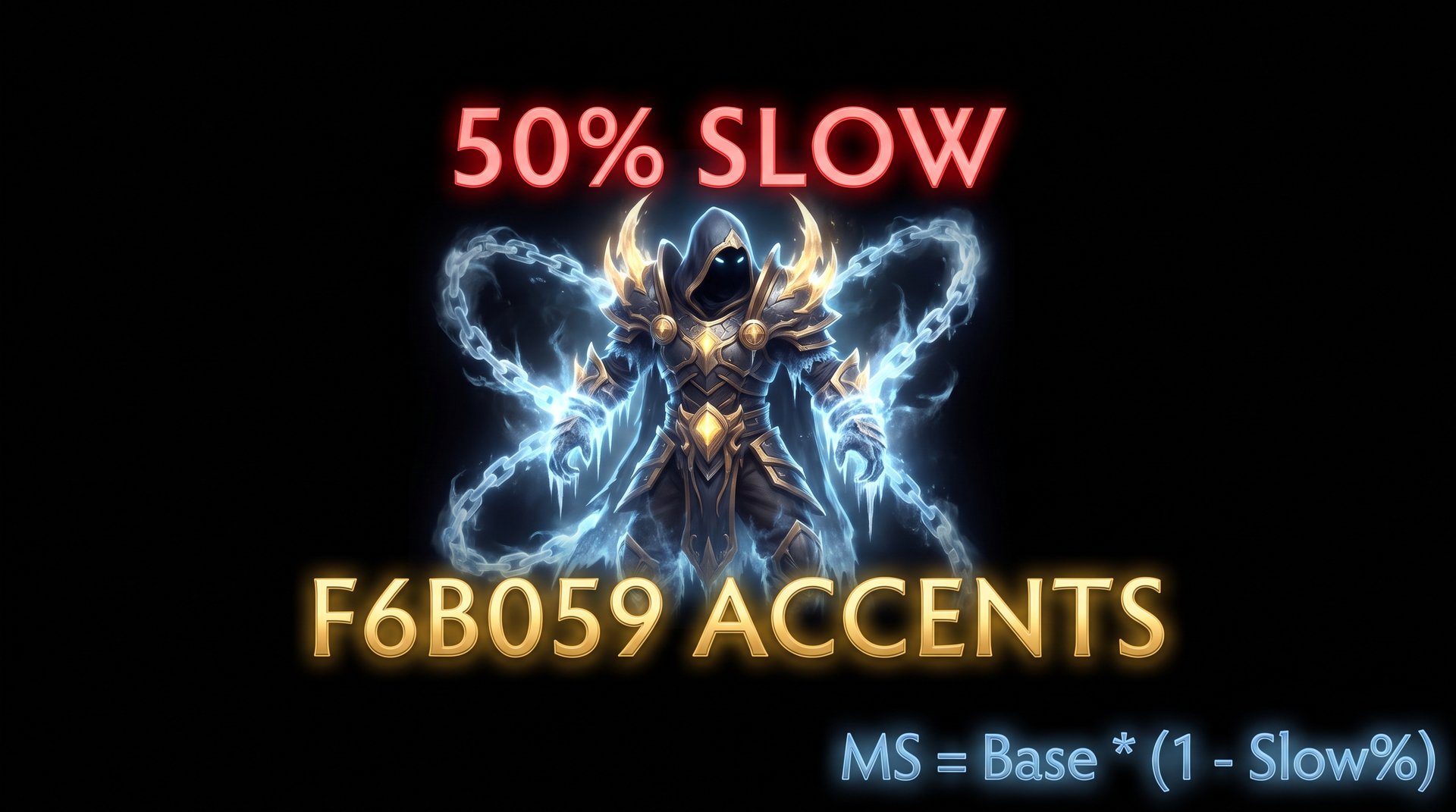
When a target is hit by slows from two different abilities or items, each slow multiplies against the remaining speed after the previous slow was applied. A 30% slow from Crystal Nova and a 20% slow from a Skywrath Mage ability combine like this:
- Starting speed: 300 MS
- After 30% slow: 300 x 0.70 = 210 MS
- After additional 20% slow: 210 x 0.80 = 168 MS
- Combined effective reduction: 44% (not 50%)
This is multiplicative — each slow reduces from the remaining speed, not from the original base. Two 30% slows from different sources do not give a 60% total slow. They give 0.70 x 0.70 = 0.49, or a 51% reduction. The math favors deeper individual slows over stacking many weak ones.
Same-Source Refresh
Re-applying the same ability or item effect to a target does not stack a second multiplicative layer — it simply resets the duration of the existing slow. Crystal Nova applied twice in quick succession gives one 30% slow for the full duration, not a 51% combined slow. Building two items with the same unique slow aura (such as two sources of the same debuff type) follows this rule as well.
The 100 MS Floor in Slow Scenarios
No matter how many slow layers are applied, the target cannot drop below 100 MS. In a worst-case scenario with four simultaneous major slows, the floor kicks in and the target moves at 100. This is still a severe mobility penalty — at 100 MS you are moving at roughly one-third of a well-itemized carry’s speed — but it prevents some theoretical ability combinations from becoming purely immobilizing outside of roots and stuns.
| Scenario | Starting MS | Slow 1 | Slow 2 | Result |
|---|---|---|---|---|
| One 30% slow | 300 | 30% | — | 210 MS |
| Two different 30% slows | 300 | 30% | 30% | 147 MS |
| 30% + 50% from different sources | 300 | 30% | 50% | 105 MS |
| 60% + 60% from different sources | 300 | 60% | 60% | 100 MS (floor) |
| Any combination on 100 MS base | 100 | any | any | 100 MS (floor) |
For players trying to catch or escape enemies: if you need to guarantee a target cannot run, applying two 30% slows from different sources is close to a root in practical terms. A hero moving at 147 MS covers roughly the same ground as a fast-running hero covers in 2.5x the time. Coordinating a second slow source — even a weak one from a teammate — dramatically extends the window to land follow-up abilities.
Boots Deep Dive — Every Boot’s Movement Speed Contribution
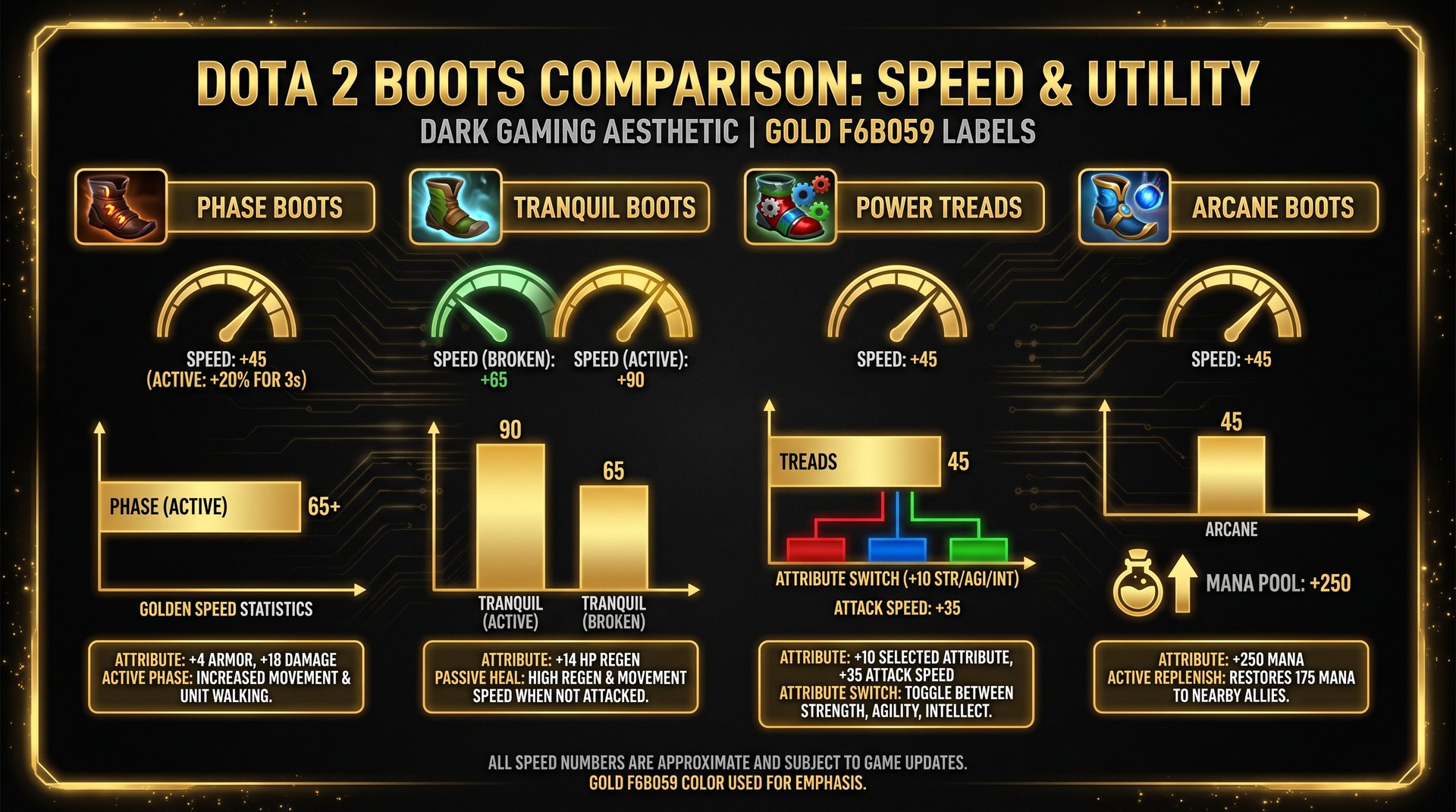
Boots of Speed (500 gold, +45 MS) is the base item. Every upgraded boot uses it as a component and defines its MS contribution as a flat bonus on top of whatever else it provides. Here is the complete breakdown for patch 7.41f.
Phase Boots
Phase Boots provide +45 MS as a passive flat bonus, plus a toggleable active (Phase) that grants an additional +16% movement speed bonus for 4 seconds. While Phase is active, the hero can move through units — other heroes, creeps, trees (not structures). The active is particularly strong for melee heroes who need to close distance on kiting ranged opponents, and for aggressive cores who want to maintain consistent pressure during an engagement window.
The key insight with Phase Boots is that the 16% is a percentage bonus that stacks additively with all your other percentage bonuses. If you also have a Yasha providing 12% MS, then Phase active gives you 16% on top of the existing 12%, for 28% total multiplier. At 350 combined flat MS, that is 350 x 1.28 = 448 MS while active. Phase Boots are the single highest burst movement speed boot in the game when their active is running.
Power Treads
Power Treads give +45 MS flat (identical to Phase Boots in the flat category), plus +25 attack speed and +10 to a switchable attribute (Strength, Agility, or Intelligence). They have no movement speed active. Their value is sustained fight stats, not burst mobility. Treads are optimal for heroes who do not need to close gaps through units but benefit heavily from the attribute switching — Strength for survivability, Intelligence for mana, Agility for attack speed during damage windows.
Because Treads offer 0% movement bonus (only flat), they fall behind Phase Boots in raw mobility for heroes who frequently need to chase or disengage. The gap is largest in the Phase active window: a Phase Boots hero at +16% moves noticeably faster than a Treads hero despite identical flat MS contributions.
Tranquil Boots
Tranquil Boots are the highest flat MS boot in the game at +65 MS passive — 20 more than Phase or Treads. They also provide +14 HP regeneration per second. The tradeoff: Tranquil Boots “break” when you attack, disabling the movement speed and regen bonuses for 8 seconds. During the break, you move at standard Boots of Speed speed (445 flat MS minus the 20 extra = your base + only 45 flat equivalent).
For supports who avoid attacking in most rotations — Witch Doctor, Crystal Maiden, Warlock — Tranquil Boots are strictly better than Phase or Treads in movement speed while roaming. The 65 flat MS against a typical 285 support base gives 350 MS without any percentage bonuses, which is strong early rotation speed. The regen also provides meaningful sustain between engagements. If you play a support and you are not attacking to last-hit or zone, Tranquil Boots are often the correct choice for raw map presence.
Arcane Boots
Arcane Boots match Phase and Treads at +45 MS flat and add +250 maximum mana plus a powerful AoE mana replenishment active (175 mana to all allied heroes in 1200 AoE, 55s cooldown). They disassemble into Boots of Speed and Energy Booster, allowing you to convert them into Boots of Travel later. Arcane Boots are the MS boot of choice for mana-hungry supports (Ogre Magi, Lion, Shadow Demon) who need the mana to function, with the future BoT upgrade as a natural second-phase item.
Boots of Travel
Boots of Travel (BoT) exist in two tiers. The first purchase (2500 gold over Arcane Boots or directly) gives +95 MS flat — 50 more than Phase/Treads — and a 75-second cooldown teleport to any allied building. The second BoT purchase upgrades to +115 MS flat and reduces the teleport cooldown to 40 seconds while also enabling TP to allied heroes. Both tiers are the strongest flat MS boots in the game, but their gold cost and dependency on Arcane Boots (or direct 2500g spend) means they typically arrive after minute 25 on most heroes.
The jump from Phase/Treads (+45 flat) to BoT Tier 1 (+95 flat) is +50 MS — a significant upgrade. At 310 base + 50 extra from BoT = 360 combined flat with no items, then multiplied by whatever % bonuses you have. For a carry at minute 30 with BoT + S&Y (12% + flat), you can expect sustained 450+ MS without any active required.
| Boot | Flat MS Bonus | % MS Bonus (active) | Peak MS at 310 base | Cost (gold) |
|---|---|---|---|---|
| Boots of Speed | +45 | 0% | 355 MS | 500 |
| Phase Boots (active on) | +45 | +16% | 411 MS | 1500 |
| Power Treads | +45 | 0% | 355 MS | 1400 |
| Tranquil Boots | +65 | 0% | 375 MS | 975 |
| Arcane Boots | +45 | 0% | 355 MS | 1325 |
| Boots of Travel 1 | +95 | 0% | 405 MS | 2500 |
| Boots of Travel 2 | +115 | 0% | 425 MS | 5500 |
All values reflect patch 7.41f. Base hero used in calculation is 310 MS (a common carry base). Actual MS varies by hero base speed.
Yasha-Family Items and Other Notable Movement Speed Sources
Yasha is the primary movement speed scaling item in Dota 2. Every item in its family provides both a flat and a percentage bonus, making it the most efficient MS-per-gold investment for heroes who can use the other stats.
The Yasha Family
| Item | Flat MS | % MS (passive) | Combined Effect at 310 + 45 flat | Notable Use |
|---|---|---|---|---|
| Yasha (standalone) | +10 | +12% | (365) x 1.12 = 409 MS | Component / efficiency buy |
| Manta Style | +10 | +12% | (365) x 1.12 = 409 MS | Agility carries, dispel tool |
| Sange & Yasha | +12 | +16% | (367) x 1.16 = 426 MS | Strength/melee cores, HP buffer |
| Yasha & Kaya | +10 | +12% | (365) x 1.12 = 409 MS | Int casters with mobility need |
Sange and Yasha is the movement speed champion of the family due to its higher flat (+12 vs +10) and higher percentage (+16% vs +12%). For pure mobility investment, S&Y gives you the most speed per gold in the Yasha family. However, the other items often provide better value through their secondary effects: Manta Style’s illusions are powerful for farming and dispelling debuffs, and Yasha and Kaya serves intelligence-based heroes who need mobility without the str-focused stats of S&Y.
Other Significant MS Sources
Several non-boot, non-Yasha items and abilities provide movement speed worth knowing:
- Windwaker: +20 flat MS, plus the active removes the owner from the game briefly for repositioning. The 20 flat is a minor bonus but stacks like any other flat modifier.
- Disperser (former Diffusal Blade): Purge from Disperser applies a powerful slow that reduces target speed significantly per application — useful for ensuring a target cannot escape after they have used all escape items.
- Aghanim’s Scepter / Aghanim’s Blessing: No inherent MS bonus, but some heroes gain movement speed through Aghs upgrades to their abilities (context-dependent per hero).
- Octarine Core: No MS bonus directly, but reduced cooldowns on Phase Boots active and other MS abilities extend the effective uptime of speed bonuses.
- Alchemist’s Berserk Potion (Alchemy): Grants a large temporary movement speed bonus to an allied hero — significant if you are playing against or alongside Alchemist.
Hero Abilities That Grant Significant MS
Movement speed is also affected by hero abilities, not just items. Some of the strongest ability-based speed bonuses in 7.41f:
- Spirit Breaker — Charge of Darkness: Passive bonus to movement speed that increases over the charge duration, allowing Spirit Breaker to accelerate from 330+ base to exceptional speeds while targeting an enemy.
- Bloodseeker — Thirst: Grants movement speed based on how low enemy heroes are below 50% HP. At maximum stacks with multiple low-HP enemies, Bloodseeker can approach extremely high MS numbers — the 550 cap becomes relevant here.
- Night Stalker — Dark Ascension: Grants substantial movement speed at night, pushing Night Stalker’s already above-average base speed to threatening levels during nighttime.
- Io — Overcharge: Temporarily grants Io and its tethered ally +20% movement speed, plus attack speed and damage reduction. The MS component is a true percentage bonus stacking additively with all other bonuses.
- Broodmother — Spin Web: Inside her webs, Broodmother gains a passive movement speed bonus that scales with web level. Combined with good boots, she can reach 500+ MS on her webs, making her almost impossible to chase within her territory.
For supports trying to position their team, understanding that certain cores have ability-based MS that does not come from items means that itemizing to slow them — rather than itemizing to out-speed them — is often the more practical response.
Why 550 Matters — The Hard Cap in Context
The 550 cap is not an abstract design fact. It has real consequences for how games play out and which item builds reach diminishing returns.
The Speed at Which Games Are Decided
A hero at 550 MS moves across the map roughly 83% faster than a hero at 300 MS. In real terms, this means covering a full lane in less than two-thirds the time. At high MMR, that difference determines whether a rotation catches a fight before it resolves or arrives two abilities too late. The 550 cap defines the maximum possible gap between the fastest and most mobile hero on the map and the slowest, heavily slowed target.
Heroes That Approach 550
Most heroes with full items in a normal game operate in the 400-480 range. Getting to 500+ requires specific conditions:
- Spirit Breaker: During Charge of Darkness, Spirit Breaker regularly hits the 550 cap, especially after acquiring movement speed items. The charge bonus, combined with S&Y or Boots of Travel, frequently triggers the hard cap and is clamped.
- Bloodseeker: With multiple low-HP heroes on the map simultaneously, Thirst stacks push Bloodseeker toward the cap. This is the most extreme ability-based MS bonus in the game against the right enemy composition.
- Broodmother: In her webs, with Aghs or web-level bonuses, she can reach very high numbers that approach or hit the cap in favorable geometry.
- Any hero with BoT 2 + S&Y + Phase active: (310 base + 115 + 12) x (1 + 0.16 + 0.16) = 437 x 1.32 = ~576, clamped to 550. This three-item combination on a 310 MS hero already caps out — meaning further MS investment is completely wasted. Identifying this threshold for your hero is how you know when to stop buying speed and start buying other stats.
Why Chasing 550 Is Usually Wrong
Players who optimize for reaching 550 MS are often making a mistake unless their hero has a kill-oriented engage kit that explicitly benefits from maximum closing speed (Spirit Breaker being the clearest case). For most carry and support heroes:
- 400-450 MS is sufficient to rotate efficiently and maintain position in most team fights.
- Gold spent getting from 480 to 550 is gold not spent on damage, armor, magic resistance, or utility.
- The 550 cap means that the last 50 MS of investment (the most expensive portion) gives you 0 benefit against any target with positive MS, since you are already chasing at your theoretical maximum.
The correct framing is: invest enough MS to do your job at full efficiency, then spend remaining gold on items that improve your damage output or survivability. In most cases, one boot upgrade plus one Yasha-family item gets you to the 420-460 range that is genuinely sufficient for farm-and-fight gameplay. High-MMR coaching services consistently identify over-investment in movement speed as a pattern in mid-bracket (3k-5k MMR) players who feel they need to “always be able to catch” enemies, when in fact targeted ability damage and correct positioning matter more than raw speed.
Practical Applications in Ranked Games
Understanding movement speed mechanics translates directly into ranked game decisions. Here are the most common scenarios where this knowledge matters:
Ganking and Rotation Windows
When planning a gank, the MS of your hero relative to the target determines whether you can arrive within a useful window and whether the target can disengage before your disabling abilities land. A hero at 420 MS ganking a target at 350 MS with no escape items closes at 70 MS net speed — meaning every second you are visible, the target gains time to react. A 480 MS closer targeting a 300 MS support (with one slow applied, at 210 MS) has a completely different math — the chase is nearly guaranteed once the slow lands.
The slow-first principle: landing any slow on a retreating target immediately shifts the MS math drastically. A single 30% slow on a 350 MS support brings them to 245 MS, turning a 70 MS advantage into a 175 MS advantage. This is why slow-on-kill items like Diffusal Blade’s predecessor effects and Desolator builds around slowing supports have been historically strong — they convert a difficult chase into a guaranteed kill.
Escape Routes and Disengage
For supports and low-MS heroes trying to disengage, understanding the slow floor means knowing when a fight is truly lost versus when movement can still save you. If you are at 100 MS from multiple slows, you have roughly 3-4 seconds before a 480 MS chaser covers the typical fight-to-safety distance. That window — small as it is — is often enough for a Blink Dagger, Force Staff, or allied save ability to complete. Do not give up movement when you are slowed; the 100 MS floor is not zero.
Itemizing Against High-MS Heroes
When facing a lineup with Spirit Breaker, Bloodseeker, or a high-MS carry, the correct response is rarely to out-speed them. Instead, you need items that slow them, root them, or prevent them from building maximum speed (status resistance items reduce slow duration, not slow magnitude — a different mechanic covered in the status resistance guide). Cyclone (Eul’s Scepter), Hex, and Scythe of Vyse stop movement entirely regardless of MS. Force Staff repositions you independently of your movement speed. These tools are more efficient against high-MS threats than trying to match their speed with items.
For players looking to climb efficiently, understanding when movement speed investment is correct and when it is a gold drain is the difference between a focused build and a scattered one. Players who use MMR boost services to reach higher brackets consistently report that itemization clarity — knowing exactly what stats your hero needs and in what order — is the main thing separating their coached games from their pub games. Movement speed is one of the earliest tests of that clarity.
Vision of the Movement Speed Budget
Think of your movement speed budget as: boot upgrade decides your flat MS tier, Yasha-family item decides your percentage tier. If your flat + percentage combination is already approaching 500 MS, stop there and redirect gold. If you are only at 380 MS and your hero needs speed to execute its role (a ganking mid, a roaming support), a second mobility investment is justified. If you are playing a passive farming carry that wins by outfarming, 400 MS is usually enough — the games where you need 480+ to win are games where you are already behind enough that itemization order matters more than raw speed.
Frequently Asked Questions
Climb Faster With Expert Dota 2 Support
Understanding mechanics is half the battle. The other half is consistent execution under pressure. If you are stuck in a bracket where enemies exploit movement speed advantages that you are still working to understand, TeamSmurf’s coaching sessions pair you with high-MMR players who have made these calls thousands of times. Or use our MMR boost to move past bracket walls so you can focus on improving in better games.



