How Many Games Until Your MMR Is “Real”? The Statistics

You finish calibration. Your MMR lands somewhere unexpected — maybe 500 lower than you thought you deserved, maybe surprisingly high. A friend tells you “calibration MMR means nothing, play 100 more games first.” Someone on Reddit says 50 games is enough. Someone else insists your rating is not real until you hit 300 games.
Who is right? The answer is grounded in the mathematics behind Valve’s rating system, and it is more precise than you might think. This article breaks down the actual statistics — how Glicko-based uncertainty works, what the numbers say about convergence, and what you should actually be doing while your MMR is still finding its level.
In This Article
How Valve’s Rating System Actually Works
Dota 2 does not use a simple Elo system like chess used in the 1960s. It uses a variant of Glicko-2, a rating algorithm developed by statistician Mark Glickman that adds two critical components to the basic win/loss equation: Rating Deviation (RD) and Volatility.
Here is how the three parts interact:
- Rating (R): Your actual MMR number. The number everyone sees.
- Rating Deviation (RD): The system’s confidence in that number. High RD means the system is uncertain about you. Low RD means it has a reliable read.
- Volatility: How much your performance swings from game to game. A player who sometimes wins 10 in a row and sometimes loses 10 in a row has higher volatility than one who alternates steadily.
Valve has never published the exact parameters they use, but the mechanics of Glicko-2 are well-documented in Glickman’s original 2001 paper and the algorithm’s behavior is observable through tools like Dotabuff and Stratz.
The key insight for this article is this: your MMR number is always an estimate with uncertainty attached. When RD is high, the system is making guesses. When RD is low, the system has enough data to be confident. The question “how many games until my MMR is real?” is really the question “how many games until my RD drops enough to stop making large corrections?”
Valve does publish one piece of information: the system distinguishes between new accounts and established accounts, and it applies larger adjustments when it has less data. This is the calibration mechanic everyone experiences in their first hundred games — but calibration-style uncertainty does not stop at game 100. It just slows down significantly.
What Rating Deviation Means in Practice
The higher your RD, the larger the MMR swing per game. In standard Glicko-2, if RD is very high, a single game can move your rating by 50-150 points. As RD falls, that swing compresses toward the 20-30 range you typically see in established accounts.
Here is what different RD phases look like in terms of practical game experience:
| Phase | Approx. Games | Estimated RD Level | MMR Swing Per Game | Reliability |
|---|---|---|---|---|
| Early calibration | 1-20 | Very high (200+) | 80-150+ MMR | Low — treat as noise |
| Active calibration | 20-50 | High (150-200) | 50-100 MMR | Directionally useful |
| Settling phase | 50-100 | Moderate (100-150) | 30-60 MMR | Starting to signal |
| Convergence zone | 100-200 | Lower (60-100) | 25-35 MMR | Increasingly reliable |
| Stable MMR | 200+ | Low (<60) | 20-30 MMR | Reliable representation |
These ranges are based on standard Glicko-2 mathematics and community-observed behavior patterns reported across Dotabuff discussion threads and high-MMR player communities. Valve does not publish precise RD values, so the exact numbers are estimates consistent with the algorithm’s design — not claimed as Valve-official figures.
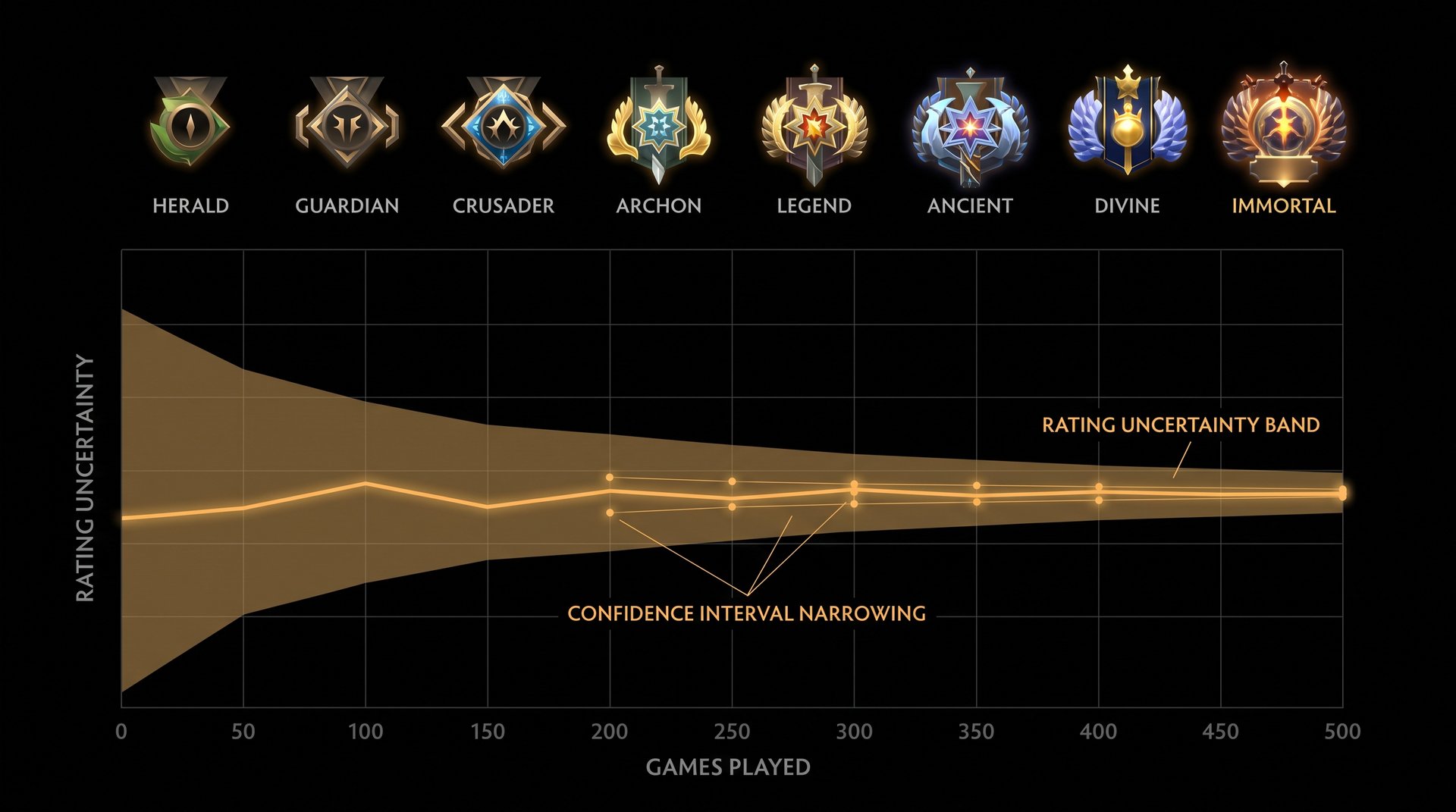
The Math: How Many Games to Converge
In Glickman’s original Glicko-2 formulation, RD decreases with each rated game and increases slightly when a player goes inactive. The rate of decrease slows as you play more games — it follows a curve, not a straight line. This means:
- The first 50 games reduce RD dramatically.
- Games 50-150 reduce RD at a moderate pace.
- Beyond 150 games, RD reduction slows to a near-plateau (though it never fully stops).
In theoretical Glicko-2 with typical parameters, a brand-new player reaches the “stable zone” (RD below the threshold where swings become consistent) after roughly 100-200 rated periods. In Dota 2’s implementation, where one game effectively equals one rating period for most purposes, this translates to approximately 100-200 games for the bulk of stabilization.
However, there is a complication: volatility. If your actual skill has genuinely shifted — you improved significantly, or your performance is highly inconsistent — volatility stays elevated and RD reduction slows. The system interprets inconsistent results as “this player’s skill is uncertain,” which is mathematically correct but frustrating to experience.
The Confidence Interval Concept
A useful way to think about it: imagine your “true” MMR has a confidence interval around it. After 10 games, that interval might be plus or minus 400 MMR. After 50 games, plus or minus 200. After 150 games, plus or minus 80. After 300+ games, plus or minus 30-40.
When people say “my MMR isn’t real yet,” they mean the interval is still wide — the system cannot yet confidently place them within a narrow skill band. When the interval shrinks to plus or minus 30-40 MMR, that is the definition of “real” in statistical terms. The system’s best estimate is now precise enough to matter for matchmaking.
The community consensus from high-MMR players and Dota coaching communities generally lands at 150-200 games as the practical “real MMR” threshold — the point past which most players agree their rating reflects their actual level rather than calibration noise.
What Community Data Shows
While Valve does not release raw RD data, the Dota 2 community has generated substantial observational data through Dotabuff, Stratz, and OpenDota tracking tools. Several patterns emerge consistently:
New Account MMR Instability
New accounts — including returning players who took long breaks — show dramatically larger win/loss swings in their first 30-50 games compared to accounts with 200+ ranked games. This is directly observable on Dotabuff MMR progression charts: the early zigzag pattern smooths significantly around games 50-100.
The Glicko vs Elo distinction is covered in depth in a companion article. The short version relevant here: Elo assumes constant skill and makes uniform adjustments. Glicko explicitly models uncertainty and makes larger adjustments when uncertain, smaller adjustments when confident. That is why new Dota 2 accounts swing so dramatically.
Returning Player Data
Accounts that go inactive for several months see their RD rise again (Glicko-2 design: uncertainty increases with inactivity). When they return, they experience “mini-calibration” even without a seasonal reset. Community tracking on Stratz shows these accounts typically need 30-60 games to re-stabilize, consistent with the mathematical model.
For more on this specific case, see the MMR after a long break guide — it covers the returning player experience in detail.
The Smurf Complication
Valve’s smurf-detection systems add another layer of complexity. Accounts playing significantly above their calibrated level — either genuine smurfs or players who improved dramatically — are flagged and placed in separate matching pools. This can cause unusual MMR behavior that looks like instability but is actually intentional system pressure to push the account toward its true bracket quickly. If you are on a long winning streak and experiencing very large MMR gains, smurf-pool behavior may be part of what you are seeing, not pure calibration noise.
Peak-Time vs Off-Peak Calibration Effects
Another data point from Dotabuff community observations: players who calibrate during peak hours (more active player pool) tend to get more accurate matchmaking faster than those who calibrate in off-peak windows. The reason is statistical — a larger pool means your opponents’ RD values are more diverse, giving the system more information to triangulate your skill level quickly. If you are mid-calibration, playing during peak hours is not superstition — it has mathematical backing.
Your First 30 Games: What to Expect and What to Ignore
The honest answer for games 1-30: your MMR is highly unreliable as a signal of your skill. The system is making large bets on very little information. A five-game losing streak followed by a five-game winning streak can easily produce swings of plus or minus 500 MMR without reflecting any meaningful change in your actual performance level.
What this means practically:
- Do not tilt-queue on variance. A run of bad games in this phase is not proof your MMR is “wrong” — the system is still learning.
- Do not celebrate a high calibration result too hard. If you landed 500 MMR above expected, the system will often correct downward over the next 30-50 games if your performance is inconsistent.
- Focus on process, not outcome. The games-played counter is the most useful metric in this phase, not the MMR number itself.
- Track your performance separately. Use Stratz or Dotabuff to look at KDA, GPM, hero-specific stats. These are more informative than MMR in the early phase.
Games 30-100: The Middle Phase
This is where most players form strong opinions about whether their MMR is “accurate.” By game 30, you have enough data that your win rate starts to signal something meaningful. By game 100, you have crossed the threshold Valve treats as the end of the formal calibration window.
What happens in this phase:
- MMR swings narrow from the 80-150 range toward 30-60 per game.
- Your bracket placement starts to stabilize — fewer dramatic medal moves per week.
- The system’s matchmaking becomes more consistent, placing you against players at similar actual skill levels more reliably.
The biggest mistake players make in this phase: grinding hero variety. If your goal is MMR stabilization, this is exactly the wrong time to experiment. Play your two to three strongest heroes repeatedly. The system needs consistent performance data — variance from playing unfamiliar heroes inflates volatility and slows RD reduction.
See the MMR boosting guide for a comprehensive breakdown of climbing strategies that work at every bracket. The principles for the settling phase specifically overlap significantly with what professional boosters do when maintaining consistent performance on an account.
Beyond 100 Games: When MMR Gets “Real”
At around 100-150 ranked games, something shifts. The swings compress. Your medal stops bouncing between brackets as wildly. And the players you face start to feel more consistently at your level rather than randomly above or below.
This is Glicko-2’s convergence in action. RD has dropped enough that:
- The system is confident placing you within a narrower skill band.
- Single-game variance has less outsized impact on your rating.
- Your actual skill level — not your variance — is the primary driver of MMR movement.
The 150-200 game mark is where most competitive Dota 2 players — and the communities that track this data on Dotabuff and Reddit — agree that MMR becomes a reliable representation. Not perfect. Not uncorrectable. But reliable.
What you will notice around this point:
- A 10-game winning streak might move you 250-300 MMR (25-30 per win).
- A 10-game losing streak moves you a similar amount down.
- The relationship between your performance stats (KDA, GPM, ward placement) and MMR movement becomes more predictable.

The “True Skill” vs “Current Level” Distinction
One important nuance: a stable MMR reflects your current level, not your permanent ceiling. Players improve, get worse with patches, switch roles, stop playing for months. The system continuously updates. “Real MMR” means accurate right now — not accurate forever.
This matters because some players reach 200+ games, see their MMR stabilize, and then blame the system for keeping them stuck. But at 200+ games, if you are losing more than you are winning, the system is placing you correctly. The improvement question becomes about actual skill, not calibration noise.
What to Do During the Unstable Phase (Games 1-150)
Understanding the math tells you what actions actually matter. Here is a practical breakdown by phase:
| Phase | Priority | What to Avoid |
|---|---|---|
| Games 1-30 | Play 2-3 comfort heroes only; focus on fundamentals (last hits, positioning, warding) | Tilt-queuing; hero experimentation; reading into the MMR number |
| Games 30-80 | Review replays of losses; identify one systematic mistake per session; keep hero pool narrow | Switching roles; blaming teammates for MMR issues; checking MMR after every game |
| Games 80-150 | Introduce a third hero if needed; start tracking win rate by position; set realistic bracket targets | Taking long breaks (raises RD and restarts the convergence clock); behavior score issues (affects matchmaking pool quality) |
| Games 150+ | Now MMR is reliable — focus on peak-time queuing, meta hero awareness, and deliberate improvement | Still blaming calibration for results — the calibration excuse expires here |
The single highest-leverage action during the unstable phase is consistency. Not winning every game — consistency in hero selection, role, playstyle, and session length. The system resolves uncertainty faster when your inputs are consistent.
Using Stratz and Dotabuff During This Phase
Both tools offer MMR history graphs. During the unstable phase, look at the trend over 30+ games rather than individual swings. A gentle upward slope is what you want — absolute spikes or crashes are noise. Use Dotabuff’s hero performance tab to confirm you are performing above average on your priority heroes; if your stats are good but MMR is flat, you are in a volatility pocket that will resolve itself.
For a complete guide to reading these tools, see the guide to checking your real MMR, which covers each tracker in detail and explains what each metric actually tells you about your trajectory.
Hero Pool Discipline and RD Reduction
One underappreciated factor: hero pool breadth directly affects your volatility score. Every time you play a hero outside your established pool, your performance variance increases — you naturally play less optimally on less-practiced heroes. Higher variance = higher volatility parameter = slower RD reduction.
The mathematical implication is clear: a two-hero specialist reaches stable MMR faster than a player who rotates through 15 heroes. The specialist’s consistent performance data gives the system exactly what it needs to narrow the confidence interval quickly. Until your MMR is stable, treat hero variety as a luxury you are not yet earning.
The Boosting Shortcut: Skipping the Calibration Noise Window
Here is an honest assessment of what boosting does in the context of this article: a booster playing on your account consistently performs well above calibration noise. They do not have the variance problem that makes early-phase MMR unreliable — they are operating at the exact skill level where the account should eventually land.
The result is that RD drops faster. Because the booster’s performance is consistently high, the volatility stays low, and the system converges on a stable (higher) MMR faster than an inconsistent player grinding through the settling phase on their own.
This is not magic — it is the same mathematics working as intended. The system rewards consistent, high-quality play with faster convergence to a stable, higher rating. If you want to skip the 150-game calibration noise window and arrive at a rating that reflects your actual target bracket, a professional Dota 2 MMR boost is the most statistically reliable path to get there.
The boosters at TeamSmurf are verified Immortal-bracket players. Their consistency — win rate, KDA, GPM — is exactly what Glicko-2 uses to lock in a stable, high MMR quickly. For context on how this compares to alternatives, the best Dota 2 boosting services guide covers the main providers and what separates legitimate services from risky ones.
If you have questions about the safety of account boosting, is Dota 2 boosting safe addresses the risk picture directly and honestly — covering Valve’s enforcement patterns, account security practices, and what actually happens in practice.
Skip the 150-Game Calibration Window
TeamSmurf’s Immortal-bracket boosters deliver consistent, high-quality performance that drives your MMR to stability faster than grinding through calibration noise alone. Dota 2-only, transparent process, no account sharing unless you choose it.