Glicko vs Elo: Why Dota 2’s Rating Feels Different

Every Dota 2 player knows the feeling: you crush a win streak, gain 30 MMR per game, then one bad patch and you are dropping 25 per loss with no explanation. Or you play all 10 calibration games, win 7 of them, and still end up at a rating that feels 500 MMR too low. The game is lying to you, you think. Or maybe the algorithm hates you.
It does not hate you. But it also does not use the simple rating formula most people assume. Dota 2 does not run on Elo — it runs on a custom variant of Glicko-2, a fundamentally different system that tracks not just your skill estimate but how confident the algorithm is about that estimate. That confidence number is the hidden variable behind almost every frustrating MMR experience in the game.
This guide breaks down exactly how the two systems differ, why Dota 2’s approach makes early calibration so volatile, why your MMR feels “stuck” after hundreds of games, and what that means if you want to climb faster.
What You Will Learn
- What Elo Actually Is
- The Glicko-2 Difference
- Rating Deviation: The Hidden Variable
- How Dota 2 Applies Glicko-2
- Why Calibration Swings So Hard
- Why Win Streaks Feel Faster Early
- Glicko vs Elo: Direct Comparison
- Why Your Gains and Losses Feel Uneven
- How Performance Metrics Factor In
- Practical Implications for Climbing
What Elo Actually Is — and Why People Keep Getting It Wrong
The word “Elo” gets thrown around constantly in competitive gaming discussions, but most players using the term are not describing the actual Elo system — they are using it as shorthand for “rating algorithm.” That imprecision matters here because the real differences between Elo and Glicko-2 explain a lot of what confuses Dota players.
The Elo rating system was developed by physicist Arpad Elo in the 1960s originally for chess. Its core mechanic is simple: every player has a single number representing their skill. After each game, points flow from the loser to the winner. The amount that flows depends on how unexpected the result was — beating a much higher-rated opponent earns you more than beating someone at your level.
How Elo Calculates Your Rating Change
The standard Elo formula works like this. Before a game, the system calculates the expected probability that you win, based on the rating gap between you and your opponent. After the game, your new rating is your old rating plus a “K-factor” multiplied by the difference between your actual result (1 for win, 0 for loss) and the expected result.
In chess, typical K-factors run from 10 to 40 depending on how many games a player has played. A K-factor of 32 means the maximum you can gain from any single game is 32 points, and the maximum you can lose is also 32. The key property: the K-factor is a constant. Once set, every game shifts your rating by the same maximum potential, game after game, year after year.
Where Elo Falls Short
The fixed K-factor assumption works reasonably well for chess players who compete continuously in a structured environment. It breaks down in games like Dota 2 where:
- Players play irregularly — a returning player after three months away is not the same player the system last saw
- Games involve ten players, not two — the “win” signal is far noisier than in a head-to-head match
- Player skill develops rapidly, especially early in an account’s life — new players should have their rating update faster
- Performance within a game carries real information that a binary win/loss result discards
The Glicko system, developed by statistician Mark Glickman in the 1990s and refined into Glicko-2 by 2001, was built specifically to address these shortcomings. Valve chose it — or a custom variant of it — for exactly these reasons.
What Is Glicko-2? The Three-Variable System
Where Elo represents every player with one number (their rating), Glicko-2 represents every player with three numbers working together. Understanding all three is the key to understanding why Dota 2’s rating system behaves the way it does.
Variable 1 — Rating (r): Your Skill Estimate
The first variable is the rating itself — roughly equivalent to MMR. This is the number Dota 2 shows you on your profile. It is the best estimate the system has of your current skill level. Think of it as the center of a bell curve representing where your “true skill” probably is.
Your rating changes after every game based on the match result. That part looks similar to Elo. The big difference is in how much it changes — and that is determined by the second variable.
Variable 2 — Rating Deviation (RD): How Confident the System Is
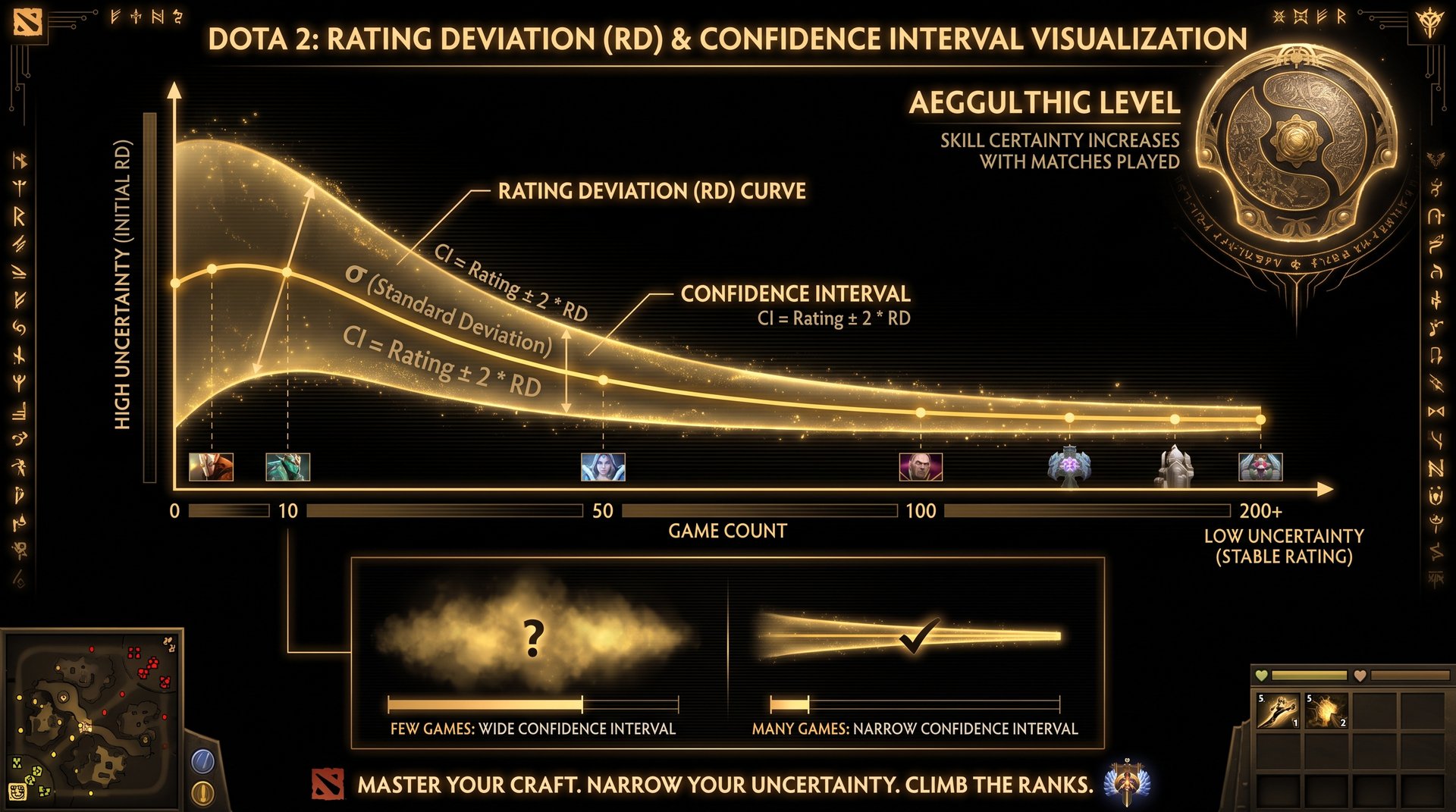
Rating Deviation is the most important concept to understand, and it is the one Elo does not have at all. RD represents how confident the algorithm is about its estimate of your true skill. A low RD means the system is quite certain your rating reflects your real ability. A high RD means the system is uncertain — your true skill could be significantly higher or lower than your displayed number.
RD behaves in two critical ways:
- RD decreases as you play games. Each game gives the system more information, so it becomes more confident. After enough games, your RD reaches a floor and stabilizes.
- RD increases when you stop playing. The system knows that real-world skill changes over time — a player who was 4,000 MMR six months ago might be anywhere from 3,200 to 4,800 now. So with every period of inactivity, the system widens its uncertainty estimate.
The crucial connection: a higher RD means larger MMR swings per game. When the system is uncertain about you, it needs more drastic rating adjustments to home in on your true skill quickly. When it is confident, small adjustments are enough to keep up with gradual skill changes.
Variable 3 — Volatility: How Consistent You Are
The third Glicko-2 variable is volatility — a measure of how consistent your performance has been over time. A player whose results are erratic (crushing one week, losing hard the next) has high volatility. A player who steadily performs at their level has low volatility.
High volatility causes the system to update your RD faster in response to unexpected results. If you suddenly go on a 15-game losing streak when you were previously stable, high volatility means the system will more aggressively revise its estimate of where you belong.
Dota 2 does not expose the volatility number to players, but its effects show up whenever your MMR moves unexpectedly after a performance that was out of character for your recent history.
Rating Deviation: The Hidden Variable Behind Every MMR Mystery
To make RD concrete, consider two hypothetical players, both sitting at exactly 4,000 MMR in Dota 2:
- Player A has played 2,000 games over three years. They have a low RD — maybe equivalent to a confidence interval of roughly plus or minus 80 MMR. The system is quite sure they belong somewhere between 3,920 and 4,080.
- Player B just finished their calibration games after returning from a year-long break. They have a high RD — say plus or minus 350 MMR. The system thinks they probably belong somewhere between 3,650 and 4,350, but it is not sure at all.
Now both players win the next game. Player A might gain 25 MMR. Player B might gain 80 MMR from the same result. Same displayed rating, same win — vastly different outcome because of hidden RD.
How Dota 2 Applies Glicko-2 — the Custom Parts
Valve confirmed in a 2013 developer blog post that Dota 2’s matchmaking draws on the Glicko-2 framework. However, the implementation is not a textbook Glicko-2 deployment. Valve has made custom modifications to fit a 5v5 team game, and some of those modifications explain behaviors that standard Glicko-2 would not predict on its own.
The key custom elements Valve has acknowledged or that are observable from the system’s behavior:
- Per-game updates, not rating periods. Standard Glicko-2 traditionally batches games into “rating periods” — periods of a week or a month — then updates all ratings at once. Dota 2 updates your MMR after every single game. This is a significant deviation that makes the system more responsive but also more noisy.
- Performance metrics beyond win/loss. Valve has stated publicly (in the 2013 blog and subsequent matchmaking blog posts) that in-game performance — particularly in lower-confidence brackets — influences how quickly your rating moves. This is Valve’s addition on top of the base Glicko-2 framework, which only uses match results.
- Separate core/support MMR. The split into role-specific ratings means each role has its own rating and its own RD. Your support rating may have a much higher RD than your core rating if you play one role significantly more.
- Behavior score interaction. Players with low behavior scores are matched into their own pools, which affects the quality of the opponent sample from which the system estimates your rating.
Why Calibration Games Swing So Hard — It Is the RD, Not Bad Luck
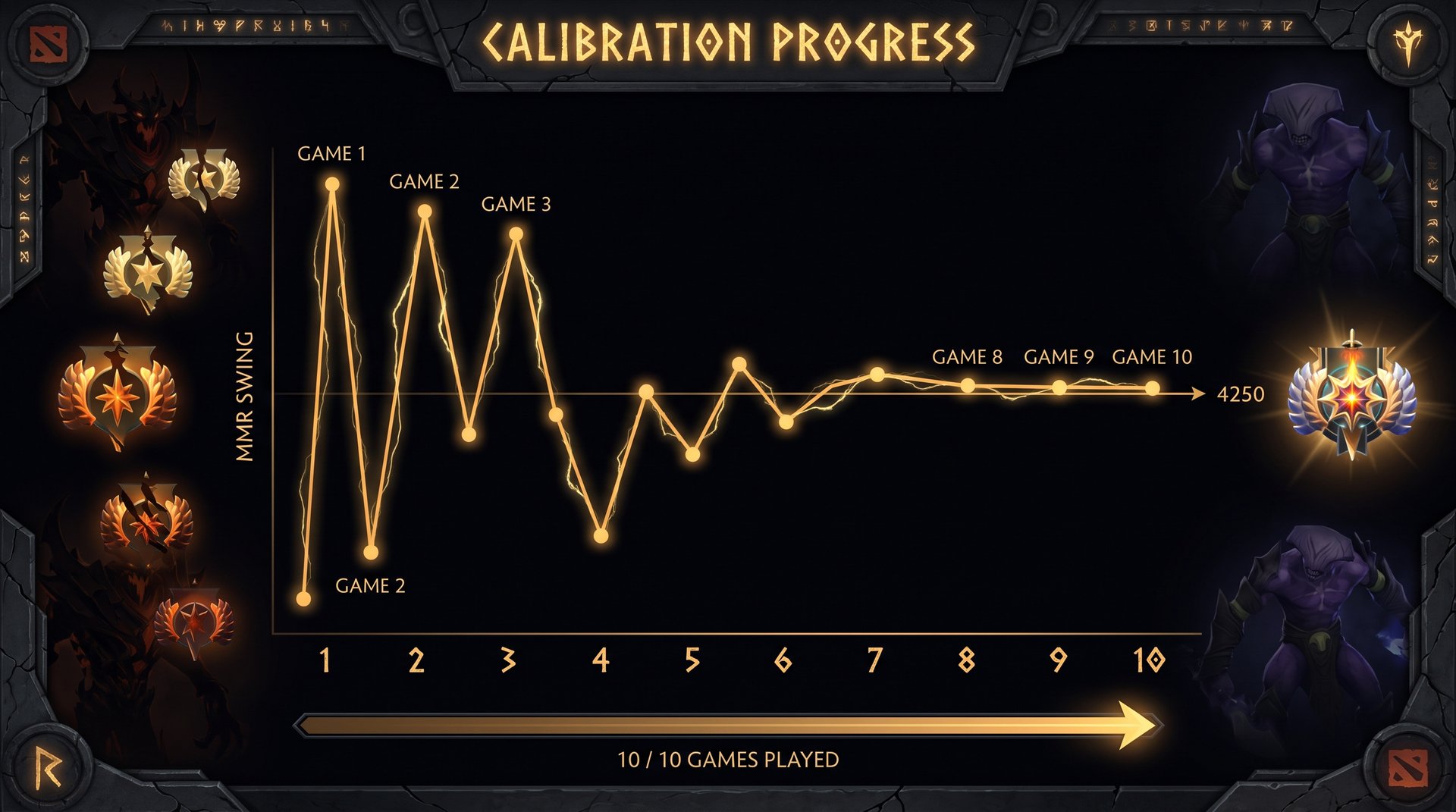
The most common source of player frustration with Dota 2’s rating system is calibration — the set of games at the start of a ranked season or on a new account where MMR seems to swing wildly. Win 7 of 10 calibration games and still land 300 MMR lower than expected. Lose 6 of 10 and land close to where you thought you should be. It feels random. It is not.
Calibration exists because the system starts with maximum RD. It has the least information about where you belong. Each game in calibration moves your rating dramatically because that is the mathematically correct response to high uncertainty — make large adjustments to gather information quickly.
The secondary factor is that calibration games also determine where on the rating curve your starting point anchors. If the system detects (through your pre-calibration unranked data, Stratz-observable performance patterns, or party compositions) that you likely belong higher, your calibration gains will be amplified. If it suspects you belong lower, your losses will be amplified. The swings are the system doing its job efficiently, not randomly.
If you want to understand everything that happens in those 10 calibration games specifically, we have a full breakdown in our guide on what happens if you win all 10 calibration games.
Why Win Streaks Feel Faster in Some Periods Than Others
Players often report that MMR felt “easier to gain” right after a season reset or after returning from a break, then the gains slowed down as they settled in. This is not a placebo — it is RD working exactly as designed.
A seasonal calibration reset raises everyone’s RD. That means larger gains per win and larger losses per loss for everyone temporarily. A player returning after a three-month break also has elevated RD because the system has been widening its uncertainty estimate during their absence.
In both cases, the system is saying: “I do not know exactly where this person belongs anymore, so I will use each game to recalibrate quickly.” That produces the subjective experience of “MMR flying up when I am on a streak” compared to the slower, grindier gains of a settled account.
The flip side: win streaks on a low-RD account (someone who has played steadily for months) produce smaller gains per game. This is correct behavior — the system already knows where you belong to a reasonable degree of confidence and is not going to make large adjustments based on a five-game streak that could easily be variance.
We explore this exact seasonal dynamic in our guide on why MMR is easiest to gain right after a major patch, where calibration resets and patch uncertainty interact.
Glicko-2 vs Elo: Direct Comparison
| Feature | Elo | Glicko-2 (Dota 2 Variant) |
|---|---|---|
| Variables tracked per player | 1 (rating only) | 3 (rating, RD, volatility) |
| Update frequency | After every game | After every game (custom; base Glicko-2 uses periods) |
| Rating change per game | Fixed max (K-factor) | Variable — scales with current RD |
| Handles inactivity | No — rating stays fixed | Yes — RD increases when not playing |
| New player calibration | Same formula as veterans | Elevated RD causes fast initial movement |
| Returning player treatment | Picks up exactly where you left off | Elevated RD, larger swings to recalibrate |
| Transparency | Single visible number | MMR visible; RD shown indirectly as “confidence” |
| Performance beyond result | Win/loss only | Valve adds in-game metrics (estimated) |
Why Your Gains and Losses Feel Uneven
One of the most common complaints in Dota 2 is the asymmetry of MMR gains and losses: “I gain 23 but lose 30, this system is rigged.” Once you understand RD, you can decode what is actually happening.
In standard Glicko-2, the points you gain in a win depend on your current RD compared to your opponents’ RD. If you are playing opponents whose rating the system is very confident about — established high-game-count accounts at your bracket — and your own RD is elevated, you will gain more for winning because each win is particularly informative about where you really belong.
The specific scenario where gains consistently feel smaller than losses — often called “negative variance” — can happen when:
- Your displayed MMR is above your current estimated true skill (the system is “pulling you down” by weighting losses more)
- You are on a partially calibrated account where the system’s uncertainty about you is directional — it suspects you belong lower but is not certain
- Your opponents in recent games have had significantly higher game counts than you, making their ratings more “reliable” as reference points
We have a dedicated breakdown of the mechanics behind uneven gains in our post on why you gain 20 MMR but lose 30. The short answer: asymmetric gains usually mean the system thinks your true skill is below your displayed number and it is trying to correct faster.
For a deep dive into how uncertainty specifically affects your matchmaking — including why you sometimes get matched against players who are clearly out of your bracket — see our explainer on why you get matched against higher ranks.
How In-Game Performance Metrics Factor In
Valve’s 2013 matchmaking blog post confirmed that Dota 2’s system considers in-game performance data beyond the binary win/loss result, particularly at lower confidence levels (high RD). Exactly which metrics are used and how they are weighted is not publicly documented. However, from observable behavior and Valve’s statements, the following are estimated to carry weight:
| Metric | Estimated Influence | Why It Matters to the System |
|---|---|---|
| Last hits and denies | Medium (especially in early calibration) | Strong lane-performance signal, less matchup-dependent than kills |
| KDA and kill participation | Medium | Fight contribution signal, though support roles affect this |
| GPM / XPM vs bracket average | Medium-high in early calibration | Efficient performance relative to expected bracket baseline |
| Camps stacked / wards placed | Low-medium (support-specific) | Soft signals for support role contribution |
| Win/loss result | Primary signal always | The core Glicko-2 data point; performance metrics are supplemental |
The critical qualifier: these performance metrics are most influential when your RD is high. As your RD falls and the system becomes confident in your rating, win/loss becomes nearly the only signal. This is why veteran accounts feel like they “cannot outperform their way out of a loss” — they are right. With low RD, losing is a loss and that is most of what the system registers.
This has a practical implication for players trying to climb: in the early stages of a new season or after returning from a break (both high-RD periods), your in-game performance genuinely matters more to your rating trajectory. Playing heroes where you can dominate your lane metrics will accelerate your calibration to a higher number. Later in the season, it is almost entirely about winning.
Practical Implications for MMR Climbing
Understanding Glicko-2 changes how you should think about your climb. Here is what the system’s design actually implies for strategy:
Calibrate Carefully, Not Casually
Because calibration games carry maximum RD and therefore maximum rating impact, losing calibration games costs more than losing later. This is not superstition — it is the math. Every loss during your high-RD calibration window moves you further from where you should be and requires more low-RD games later to correct. Take calibration seriously: play your best heroes, play sober, play with good internet. Check out our full MMR boosting guide for a complete framework on maximizing your climb efficiency from any starting point.
Come Back Strategically After a Break
If you return after a significant break, your RD is elevated and your first games back carry outsized weight in both directions. Do not jump straight into ranked after months away. Play unranked to rebuild mechanics and reduce RD before those games count. If your skill genuinely improved over the break (perhaps you studied the game, watched pros, or were playing a different game at high level), the elevated RD is your friend — your wins will be rewarded quickly. If you are rusty, the elevated RD will punish you equally fast.
Consistency Beats Peaks
The volatility component of Glicko-2 means the system tracks how consistent your performance is. Erratic results — crushing one session, throwing the next — increase your volatility score, which makes your rating more sensitive to swings. Long-term stable performance at your target bracket is what drives accurate placement and eventually pushes your rating up. Playing 2-3 focused games per session consistently outperforms marathon grinding sessions where fatigue causes erratic performance.
Role Specialization Has Hidden Benefits
Since Dota 2 tracks separate MMR for core and support roles, specializing means you are building RD-reduced confidence in a specific role faster. A player who alternates randomly between carry and support will have elevated RD in both and experience more variance. A player who locks in one role builds a confident, accurate rating in that lane faster — which means more stable, fair matchmaking.
Understand What You Can and Cannot Fix
Some players stuck at a bracket are there because the system is accurate — their MMR reflects their genuine current skill level. Others are stuck due to temporary elevated volatility from a rough patch, or because they are mid-calibration on a new season. If you are stuck at the same bracket for hundreds of games with a consistent winrate near 50%, the system is correct and the solution is improving your actual skill, not gaming the algorithm. If you are new to a season or returning from a break, elevated volatility is the likely cause and it resolves as you play more games.
If you want to accelerate the process of getting where you belong without waiting for the system to self-correct through hundreds of games, our Dota 2 MMR boost service places Immortal-ranked boosters on your account to get your displayed rating to your actual skill level in the shortest possible time. The math does not lie — getting your MMR where it belongs faster means you spend less time in mismatched games and more time playing at your actual bracket.
Get Your MMR to Match Your Real Skill Level
Our Immortal-ranked boosters understand the Glicko-2 system better than anyone. They play to win efficiently and help you escape the calibration volatility trap — fast.