How to Master Dragon Knight in Dota 2: The Ultimate Guide for Every Rank (2026)

Dragon Knight is the definition of a “brick wall” in Dota 2. While flashier heroes get all the highlight reels, DK quietly wins games by refusing to die, pushing towers relentlessly, and transforming into an Elder Dragon that turns team fights into nightmares for the enemy team. He has been a staple pick in professional Dota for over a decade — and for good reason.
In patch 7.40, Dragon Knight sits at a 52.3% winrate across all ranks according to Dotabuff, with an even higher 54.1% in Ancient and above brackets. His ability to dominate mid lane, tank enormous amounts of damage, and become a siege engine makes him one of the most reliable heroes for climbing MMR at every skill level.
This guide covers everything you need to master Dragon Knight — from hidden ability mechanics and rank-specific item builds to pro player strategies and the exact matchup knowledge that separates a 3K DK from an Immortal one. Whether you are picking him up for the first time or looking to refine your play, this is your complete roadmap.
Table of Contents
Why Dragon Knight Is the Most Reliable Mid in Dota 2
Dragon Knight fills a role that very few mid heroes can — he is a frontline tank who also deals significant damage and pushes towers faster than almost anyone. While most mid heroes are squishy spell casters or glass cannon carries, DK brings durability, stun, wave clear, and tower-melting siege power all in one package.
His current role in the meta is primarily as a position 2 mid laner, though he occasionally shows up as a safe lane carry in certain drafts. What makes DK unique is his simplicity combined with depth. The hero is easy to pick up — you press your buttons, you hit things, you push towers. But mastering his timing windows, understanding when to transform, and knowing which dragon form to prioritize in which situations separates good DK players from great ones.
According to Dotabuff, DK has maintained a consistent 8-10% pick rate in pub games, making him one of the most popular strength mid heroes. His winrate climbs significantly at higher MMR brackets because better players understand his timing-based playstyle — he is not a hero who farms for 40 minutes. He is a hero who hits his power spikes at 15-20 minutes and forces objectives before the enemy can respond.
Pros
- Extremely tanky with Dragon Blood passive
- Built-in stun on low cooldown
- Fastest tower pusher with Elder Dragon Form
- Simple to execute, hard to shut down
- Strong at every stage of the game
- Reliable initiation tool
Cons
- Low mana pool, mana-hungry early
- Weak without Elder Dragon Form active
- Limited farming speed compared to other mids
- Vulnerable to armor reduction and break
- No escape mechanism
- Relies heavily on BKB timing
Abilities Deep Dive
Dragon Knight’s kit is deceptively simple on the surface, but each ability has hidden mechanics and interactions that high-MMR players exploit constantly. Let us break down every ability in detail.
Breathe Fire (Q)
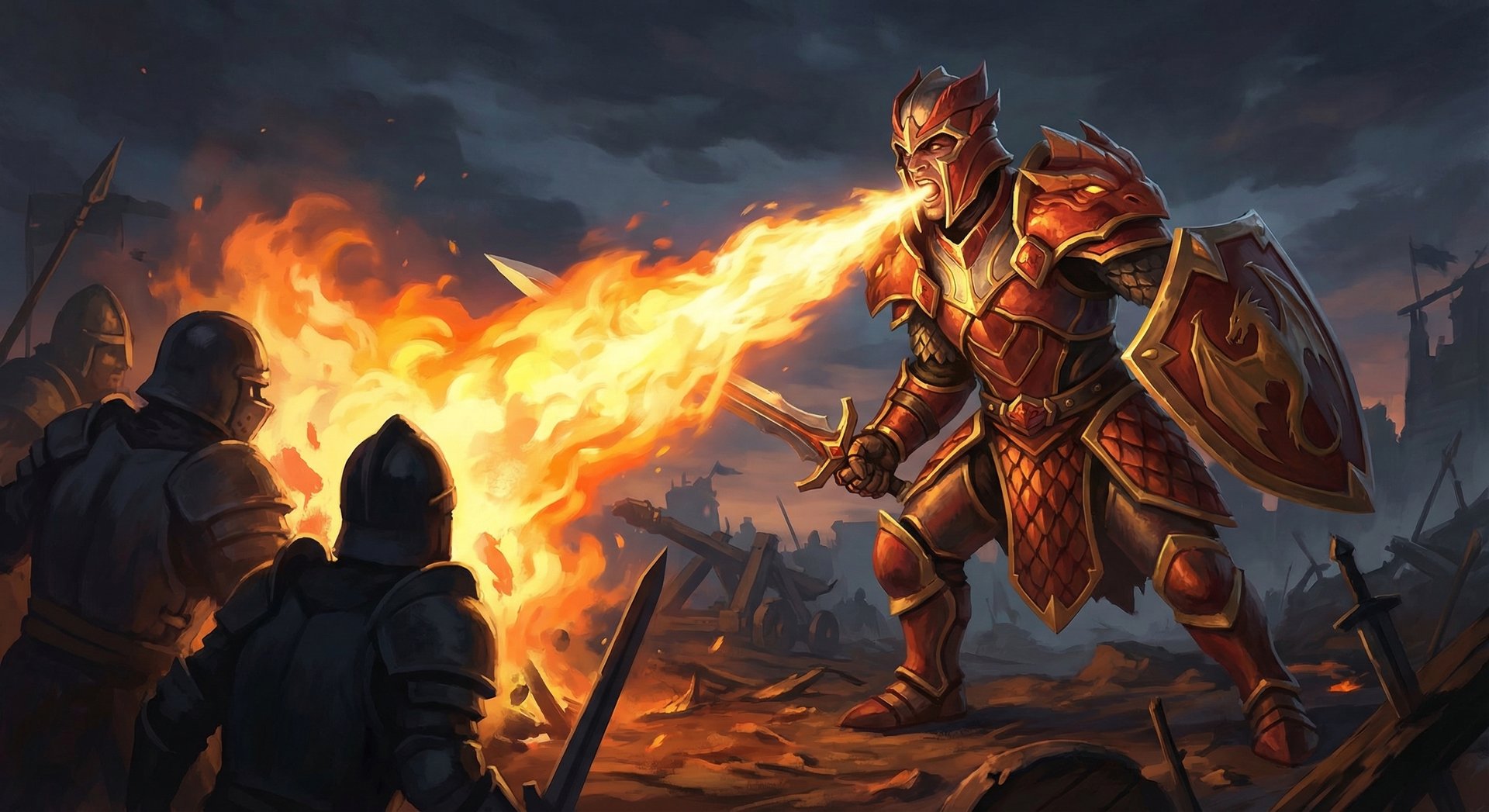
Damage: 90/170/240/300 | Attack Damage Reduction: 35% for 11 seconds | Mana Cost: 100/110/120/130 | Cooldown: 14/13/12/11s
Breathe Fire is your primary nuke and wave clear tool. The 300 damage at max level is solid, but the real value is the 35% base attack damage reduction it applies to all enemies hit. This is one of the most underrated aspects of Dragon Knight’s kit — hitting the enemy carry with Breathe Fire before a team fight effectively neuters their right-click damage for 11 seconds.
Hidden mechanics:
- The damage reduction only affects base damage and bonus damage from stats, not raw bonus damage from items like Daedalus or Crystalys procs
- Breathe Fire travels as a projectile in a cone — it has a cast point of 0.2 seconds, so you can animation cancel if you queue a move command
- In Elder Dragon Form, the visual changes but the mechanics stay identical
- The damage reduction debuff stacks with other sources of damage reduction (like Enfeeble)
Dragon Tail (W)
Stun Duration: 2.5/2.75/3/3.25 seconds | Damage: 50/75/100/125 | Mana Cost: 100 | Cooldown: 12/11/10/9s
Dragon Tail is one of the longest single-target stuns in Dota 2. At max level, 3.25 seconds is an eternity in a team fight. In human form, it is a melee-range stun. In Elder Dragon Form, it becomes a ranged projectile with 400 range — this is the key reason DK becomes so much more dangerous when transformed.
Hidden mechanics:
- The melee version has no projectile — it cannot be disjointed. The ranged version CAN be disjointed
- If you transform into Elder Dragon Form while Dragon Tail’s projectile is mid-air (from melee cast), it will still apply the melee-range properties
- Dragon Tail has a 0.5 second cast point in melee form but the stun is applied at the start of the animation in melee range, making it feel instant
- You can Blink Dagger into Dragon Tail for reliable initiation — this is DK’s bread and butter combo
Dragon Blood (E) — Passive
HP Regen: 4/7/10/14 | Armor: 4/7/10/14 | Always Active
Dragon Blood is what makes DK the unkillable brick wall in lane. At level 4, you get 14 bonus armor and 14 HP regen per second. To put that in perspective, that is like having a free Platemail and Ring of Health permanently. This passive is why DK can survive almost any mid lane matchup — even against heroes who should theoretically destroy him.
Hidden mechanics:
- Dragon Blood stacks with all other armor and regen sources multiplicatively
- The armor from Dragon Blood is affected by Break (Silver Edge, Viper’s Nethertoxin) — this is DK’s biggest vulnerability
- At level 7 with 2 points in Dragon Blood and a Soul Ring, you can sustain indefinitely in lane without ever going back to base
- The HP regen is constant, not percentage-based — meaning it is most effective in the early game when your HP pool is small
Elder Dragon Form (R) — Ultimate

Duration: 60 seconds | Cooldown: 115 seconds | Mana Cost: 50
Elder Dragon Form is what defines Dragon Knight. When activated, DK transforms into a dragon with ranged attacks (500 range), bonus movement speed, and progressively more powerful dragon forms at each ultimate level:
- Level 1 — Green Dragon: Corrosive Breath — attacks apply a poison DoT that deals 25 damage per second for 5 seconds. This also works on buildings, making DK a terrifying siege hero even at level 6
- Level 2 — Red Dragon: Splash Attack — 100% damage in a 150 radius, 75% in 225, 50% in 300. This turns DK into an AoE carry in team fights. Corrosive Breath still applies
- Level 3 — Blue Dragon: Frost Breath — attacks apply a 30% movement speed slow and 20 attack speed slow for 3 seconds. Splash and Corrosive Breath still apply. This is the full package
Hidden mechanics:
- The corrosive breath DoT on buildings does not draw aggro from towers — you can hit a tower once and walk away while the DoT ticks
- Splash damage from Red/Blue Dragon Form procs on-hit effects on all targets in the splash radius, including items like Skadi or Mjollnir
- The 60-second duration with 115-second cooldown means you have 55 seconds of downtime. Managing this window is the #1 skill expression on DK
- You can use Elder Dragon Form to remove certain debuffs on transformation — the model change cleanses some effects
- BKB duration continues ticking during Elder Dragon Form — always pop BKB after transforming, not before
Skill Build Order
| Level | 1 | 2 | 3 | 4 | 5 | 6 | 7 | 8 | 9 | 10 |
|---|---|---|---|---|---|---|---|---|---|---|
| Standard Mid | Q | E | Q | E | Q | R | Q | E | E | W |
| Hard Lane | E | Q | E | W | E | R | E | Q | Q | Q |
| Kill Lane | W | Q | Q | E | Q | R | Q | E | E | E |
The standard mid build maxes Breathe Fire first for wave clear and last-hitting, with two early points in Dragon Blood for lane sustain. You skip Dragon Tail until level 10 because in the laning phase, you rarely need the stun — you need survivability and farm. Take one point in Dragon Tail at 10 when team fights start happening.
The hard lane build prioritizes Dragon Blood for maximum survivability. If you are playing DK offlane (rare but viable in certain matchups), surviving the lane is more important than damage.
Item Builds by Rank Bracket

Dragon Knight’s item build varies significantly by rank bracket. Lower-ranked players need simpler, more forgiving builds, while higher-ranked players can optimize for specific game states. Here is what works at every level.
| Rank | Starting | Early Game | Core | Late Game |
|---|---|---|---|---|
| Herald – Crusader | Gauntlets x2, Branches, Tango | Soul Ring, Bracer, Power Treads | Blink Dagger, BKB, Assault Cuirass | Daedalus, Heart of Tarrasque |
| Archon – Legend | Gauntlets, Circlet, Branches x2, Tango | Soul Ring, Bracer, Power Treads | Blink Dagger, BKB, AC or Desolator | Silver Edge, Nullifier, Heart |
| Ancient – Divine | Quelling Blade, Gauntlets, Branches, Tango | Soul Ring, Bracer, Treads or Phase | Blink, BKB, Situational (AC/Deso/Halberd) | Overwhelming Blink, Nullifier, Satanic |
| Immortal | Quelling Blade, Gauntlets, Faerie Fire, Tango | Soul Ring, Bracer, Phase Boots | Blink, BKB, Game-dependent | Overwhelming Blink, Assault Cuirass, Situational |
Why Items Differ by Rank
Herald to Crusader: At this bracket, games go late and team fights are chaotic. You want items that are hard to mess up. Assault Cuirass is always good on DK, and Heart of Tarrasque makes you nearly unkillable. Daedalus gives you the damage to actually finish kills. Skip complicated active items — focus on stats.
Archon to Legend: Players here start understanding timing windows. Desolator becomes a strong option because it pairs with your corrosive breath for ridiculous tower damage — you can melt a tier 2 tower in a single dragon form duration. Silver Edge gives you break for those pesky Bristleback and Spectre matchups.
Ancient to Divine: Game sense improves significantly. You start buying Halberd against right-click carries because you understand when to disarm. Phase Boots become viable because you can manage tread-switching is less necessary when you have better mana management. Overwhelming Blink in the late game gives you a massive AoE slow on initiation that combos with your dragon form splash.
Immortal: At this level, item builds are almost entirely game-dependent. You might rush a Hand of Midas if the game is slow, go Shadow Blade into Silver Edge if you need break, or even build Aghanim’s Scepter for the Fireball ability in certain team fight-heavy games. Immortal DK players read the game and adapt every match.
Core Item Explanations
Soul Ring: Non-negotiable first item. DK has massive mana problems, and Soul Ring converts your abundant HP regen into mana. Dragon Blood heals back the HP sacrifice quickly. Buy this before anything else.
Blink Dagger: Your most important item. Without Blink, you have no way to initiate. Blink into Dragon Tail (in Elder Dragon Form for the 400-range ranged stun) is your primary engage tool. Every game, no exceptions.
Black King Bar: You are a frontline hero who needs to stay in fights. BKB lets you transform, stun, and fight without getting disabled. The timing of your first BKB is critical — ideally 18-22 minutes.
Laning Phase Masterclass

Dragon Knight’s laning phase is all about surviving and farming until level 6. You are not going to kill most mid heroes 1v1 before you have Elder Dragon Form — and that is okay. DK wins lanes through attrition, not aggression.
First Three Minutes
Start with two shared Tangoes and your starting items. Focus exclusively on last hitting. DK’s base damage is 52-58, which is average, so you need to practice timing. Use Breathe Fire to secure ranged creeps when the enemy contests them.
Key rule: Do not spam Breathe Fire to push the wave. Use it only when you can hit the enemy hero AND the creep wave at the same time, or when you need to secure a last hit you would otherwise miss. Mana is precious before Soul Ring.
Levels 3-5: The Sustain Game
By level 3, you should have 2 points in Breathe Fire and 1 in Dragon Blood (or 1-1-1 if the lane is very aggressive). This is where DK starts to become annoying for the enemy. Your HP regen means you can trade hits favorably against almost any mid hero. Take damage, regen it back, and keep farming.
Soul Ring timing: You should complete Soul Ring between minutes 3-4. Once you have Soul Ring, your laning pattern changes completely. Pop Soul Ring, use Breathe Fire to nuke the wave, take the last hits, and let Dragon Blood heal you back. Repeat every wave.
Level 6 Power Spike
Level 6 is when Dragon Knight comes online. The moment you hit 6, assess the map. If the enemy mid is at 60% HP or lower, you can often solo kill them with Elder Dragon Form, Dragon Tail, Breathe Fire, and right clicks. The corrosive breath DoT adds up fast.
If you cannot kill mid, immediately look to push the tower. Green Dragon’s corrosive breath on buildings is devastating — you can chunk a mid tower for 30-40% HP in a single Elder Dragon Form duration. Call your supports to help secure the tower. This is your first objective timing and it matters.
Matchup-Specific Laning Tips
- vs. Ranged mids (Lina, QoP, Puck): Accept you will take harass. Focus on getting every last hit with Breathe Fire. Dragon Blood heals you back. Do not try to trade — just farm and wait for 6
- vs. Melee mids (Ember, Void Spirit, Kez): You actually win these trades. Stand on the creep wave and force them to take Breathe Fire if they want last hits. Your armor advantage is massive
- vs. Heavy nukers (Zeus, Tinker): These lanes are tough. Buy extra regen and consider an early Magic Wand. Prioritize Dragon Blood over Breathe Fire if you are getting bursted
When to Rotate
DK is not a ganking mid. Do not leave your lane to gank side lanes before level 6 unless there is a guaranteed kill. Your job is to farm, hit your timings, and push the mid tower. After 6, if you cannot push mid, a TP rotation to save a side lane with Dragon Tail stun can swing a fight — but always have TP scrolls ready.
Mid and Late Game Transitions

Dragon Knight’s mid game is where the hero truly shines. Between minutes 15-30, DK with Blink and BKB is one of the strongest heroes in the game. Understanding your timing windows and how to press your advantage is the difference between winning and losing games.
The 15-20 Minute Window
Your ideal timing is Blink Dagger at 13-15 minutes, BKB at 18-22 minutes. When you have both items with Elder Dragon Form available, you should be looking to take objectives constantly. Group with your team, push a tower, take a fight, and repeat.
The key concept: DK is a tempo hero. You do not farm for 40 minutes. You use your power spike to take towers, secure Roshan, and choke the enemy’s map. Every minute you spend farming jungle instead of pushing is a minute wasted.
Roshan Timing
DK is one of the best Roshan heroes in the game. With Dragon Blood’s armor and regen, plus the splash damage from Red/Blue Dragon Form, you can solo Roshan as early as 20 minutes with Blink, BKB, and Assault Cuirass. In practice, you want your team to help, but even duo Roshan with your support is fast and efficient.
Aegis is game-changing on DK. With Aegis, you become impossibly hard to kill. Your playstyle with Aegis should be hyper-aggressive — push high ground, force fights, and make the enemy deal with you twice.
Team Fight Positioning
In team fights, DK plays as the initiator and frontliner. Your engagement pattern should be:
- Activate Elder Dragon Form before the fight (save it for fights, do not waste it farming)
- Blink into the priority target
- Dragon Tail (ranged stun in dragon form) to lock them down
- Pop BKB immediately after stunning
- Breathe Fire the cluster of enemies (35% damage reduction is huge)
- Right-click with splash damage — position so your splash hits multiple heroes
The splash damage from Red and Blue Dragon Form is often underestimated. If the enemy groups up, your right-click splash combined with items like Assault Cuirass can deal devastating AoE damage throughout the entire fight.
Late Game (35+ Minutes)
DK does not scale as well as hard carries like Anti-Mage or Spectre into the ultra-late game, but he remains relevant because of his incredible tower push and Roshan control. In late game, your role shifts from primary damage dealer to frontline tank, stun bot, and objective taker.
Key late game items like Overwhelming Blink (150% STR as AoE damage on blink), Assault Cuirass (armor aura for your team and minus armor for enemies), and Satanic (turn fights with the active) keep DK relevant even at 50+ minutes.
If the game goes ultra-late and you have buyback available, consider selling Blink for an Overwhelming Blink upgrade — the 150% strength damage in an AoE on arrival is essentially a free teamfight spell on top of your initiation.
Counters: Heroes That Destroy Dragon Knight

Even the most durable hero has weaknesses. Here are the top 5 heroes that give Dragon Knight the hardest time, and how to play around each one.
1. Viper
Viper is DK’s worst nightmare. Nethertoxin applies Break, disabling Dragon Blood entirely — which removes 14 armor and 14 HP regen. Without Dragon Blood, DK is just a slow melee hero with mediocre stats. Viper also wins the lane matchup hard with Poison Attack harass.
How to play around it: Avoid Nethertoxin pools. Buy extra regen in lane. Consider skipping mid entirely and going safe lane if Viper is mid. In team fights, Blink past Viper’s Nethertoxin zones. BKB does not dispel Break from Nethertoxin, so your best bet is to kill Viper first or avoid the zones.
2. Razor
Static Link steals your damage and there is nothing you can do about it. Razor runs at you, links you, and you either stand there losing damage or run away and lose the fight. In lane, Razor destroys DK because DK has no way to break the link without a BKB.
How to play around it: Never fight Razor without BKB. BKB breaks Static Link. In team fights, Dragon Tail Razor immediately when he links you — the 3.25-second stun gives you time to reposition. Late game, Razor falls off harder than DK, so outscale him.
3. Ancient Apparition
Ice Blast prevents all HP regeneration and healing. This completely negates Dragon Blood’s regen component and makes items like Heart of Tarrasque and Satanic useless. AA also kills you through Aegis if Ice Blast shatters you.
How to play around it: Buy BKB (blocks Ice Blast application). Stay above the shatter threshold. In team fights, try to bait out Ice Blast before committing. Late game, consider Linken’s Sphere as a secondary protection layer against the blast.
4. Lifestealer
Lifestealer’s Feast deals percentage-based damage — and DK builds a lot of HP. The more HP you have, the faster Lifestealer kills you. Rage also gives magic immunity, so Dragon Tail cannot stun him during it.
How to play around it: Do not manfight Lifestealer. Your job is to stun him after Rage ends and let your team burst him. Halberd is excellent against Lifestealer — the disarm prevents his lifesteal. Prioritize armor over HP items in this matchup.
5. Shadow Demon
Demonic Purge and Soul Catcher are devastating against DK. Shadow Demon can Disrupt you, set up his team, and amplify all damage against you with Soul Catcher. Multiple Demonic Purge charges also make it very hard for DK to chase or escape.
How to play around it: BKB blocks all of Shadow Demon’s abilities. Time your BKB usage to avoid being Disrupted at the start of fights. Focus Shadow Demon early in team fights since he is very squishy.
Heroes Dragon Knight Destroys
Dragon Knight’s tankiness, stun, and push power give him strong advantages against several popular heroes. Here are the top 5 matchups where DK excels.
1. Sniper
Sniper has no escape, low HP, and cannot deal with DK’s initiation. Blink, Dragon Tail, and a few right clicks kill Sniper instantly. DK’s armor makes Sniper’s physical damage negligible, and Breathe Fire’s damage reduction further reduces Sniper’s output.
2. Drow Ranger
Drow Ranger’s Marksmanship is disabled when DK is on top of her (melee range). Blink initiation completely shuts down Drow’s damage, and DK’s natural armor makes Frost Arrows tickle. This matchup is almost unwinnable for Drow in mid and late game team fights.
3. Huskar
Huskar relies on magical damage and attack speed — both of which DK counters. Dragon Blood’s armor reduces Burning Spear damage significantly, Breathe Fire’s attack damage reduction slows Huskar’s DPS, and Dragon Tail’s long stun gives your team time to burst him down.
4. Puck
Puck struggles against tanky heroes who do not die to burst combos. DK survives Puck’s combo easily and then chases with Elder Dragon Form’s movement speed. Dragon Tail in dragon form (ranged) can catch Puck after Phase Shift, and DK’s tower push forces Puck into unfavorable defensive positions.
5. Pugna
Pugna wants to deal magic damage from a distance, but DK’s natural magic resistance from high HP pool means Pugna’s nukes are not threatening enough. DK can walk through Nether Ward damage thanks to Dragon Blood and stun Pugna easily for a quick kill.
How Pros Play Dragon Knight in the Current Patch
Dragon Knight remains a consistent presence in professional Dota 2 in 2026. Here is how the best players in the world approach the hero.
Recent Pro Picks
At the DreamLeague Season 23 and recent ESL One qualifiers, DK has been picked primarily as a stable mid laner in drafts that prioritize early tower pressure. Teams like Team Spirit and Tundra Esports have used DK as a reliable pick when they want a frontline hero that does not need much space from supports.
Notable pro DK players to study include Collapse (who occasionally plays it offlane with devastating effect), Nisha (whose mid DK focuses on early Blink timing), and Quinn (who popularized the aggressive Phase Boots into Desolator build for maximum tower damage).
Pro Build Trends
- Phase Boots over Power Treads: Most pros now prefer Phase Boots for the movement speed and armor, which synergizes with Dragon Blood for maximum physical damage reduction
- Early Desolator: In games where tower push is the priority, pros rush Desolator after Blink for the minus armor on buildings. Combined with corrosive breath, this melts towers in seconds
- Aghanim’s Scepter pickup: In certain team fight-heavy games, pros pick up Aghanim’s for the Fireball ability, which provides additional AoE damage and zone control in dragon form
- Skipping BKB: In some games where the enemy has limited disables, pros skip BKB entirely and go straight for damage items. This is risky and only works when the draft allows it
Pro Tip: The “2 Tower” Timing
Rank-Specific Climbing Guide

Dragon Knight is one of the best heroes for climbing MMR because he is simple to execute, forgiving of mistakes, and forces a proactive playstyle. Here is how to climb at every rank bracket.
Herald to Guardian: Foundation Basics
At this bracket, focus on three things only:
- Last hitting: Aim for 40+ last hits by minute 10 in mid lane. Use Breathe Fire to secure ranged creeps
- Staying alive: Do not dive towers. Do not chase kills. Just farm, push, and survive
- Pressing R: Transform into Elder Dragon Form and hit towers. Towers win games. Every time your ult is ready, push a tower
Do not worry about complex combos or item timings. If you can farm decently, not die, and push towers, you will climb out of Herald with DK. The hero is practically designed for learning the game.
Crusader to Archon: Adding Game Sense
Now you need to add Blink Dagger initiation to your toolkit. Practice the Blink + Dragon Tail combo in demo mode until it is muscle memory. At this bracket, enemy heroes do not expect the instant stun from a DK blinking in, and kills are free.
Start paying attention to the minimap. When Elder Dragon Form is ready, check which lane has the easiest tower to push. Group with your team for that tower. Do not solo push without vision — this is the #1 mistake Crusader DK players make.
Item timing benchmarks: Soul Ring by 4 minutes, Blink by 14 minutes, BKB by 22 minutes. If you are hitting these timings consistently, you will climb.
Legend to Ancient: The Macro Leap
This is where DK players need to understand the concept of “playing around cooldowns.” Your entire game plan revolves around Elder Dragon Form’s 115-second cooldown. When it is up, you fight and push. When it is down, you farm safely and avoid fights.
Start tracking enemy BKB timers and key cooldowns. If the enemy carry’s BKB is on a 6-second duration, you can potentially stun them after it expires. If your BKB is longer than theirs, force fights — you will outlast them in a BKB trade.
At this bracket, start buying situational items instead of following a cookie-cutter build. If the enemy has heavy physical damage, Halberd is better than Assault Cuirass. If they have mobile heroes, you might need a coaching session to learn when to prioritize Aghanim’s for the zone control.
Divine to Immortal: What Separates the Top 1%
At Divine and above, Dragon Knight mastery is about understanding power windows. The top DK players know exactly when they are the strongest hero in the game (usually 18-30 minutes with Blink + BKB + one damage item) and press that advantage relentlessly.
Key concepts at this level:
- Smoke timing: Use smokes when Elder Dragon Form is about to come off cooldown (check the timer). Smoke as a team, fight, and immediately push a tower afterward
- Roshan control: Always carry a TP scroll to the Roshan pit side of the map. DK with Aegis is the strongest tempo play in the mid game
- Buyback discipline: Always keep buyback gold after 25 minutes. DK with buyback can defend high ground even when behind
- Item flexibility: At Immortal, you might build completely different items every game. Study the enemy draft in the loading screen and have a plan before the game starts
If you are struggling to break into Immortal, consider boosting your account to experience how Immortal-level DK players control the tempo, or invest in professional coaching to identify specific mistakes in your gameplay.
Tips and Tricks

These are the advanced mechanics and hidden interactions that only experienced DK players know about.
Animation Cancels
- Breathe Fire animation cancel: Queue a move command immediately after casting Q. This shaves about 0.15 seconds off the animation, which adds up over an entire game
- Dragon Tail shift-queue: After blinking in, shift-queue Dragon Tail for the fastest possible stun. This removes human reaction time from the combo
- Transform cancel: You can use items during the Elder Dragon Form transformation animation. Pop BKB or use Blink during the transformation to save time
Hidden Interactions
- Corrosive Breath + Desolator stack: The armor reduction from Desolator applies before the corrosive breath DoT damage, making each tick hit harder on buildings
- Splash + Skadi interaction: In dragon form, the splash damage applies Eye of Skadi’s slow to all enemies hit, not just the primary target. This creates an AoE slow field in team fights
- Dragon Tail through BKB: If you cast Dragon Tail and the enemy pops BKB after the projectile is mid-air (ranged version), the stun is blocked but the damage still applies. However, in melee form, the instant stun goes through if cast before BKB
- Soul Ring timing: Pop Soul Ring BEFORE transforming. The HP sacrifice is reduced by Dragon Blood’s regen, and you get the mana for your combo. If you transform first, you waste dragon form uptime
Common Mistakes to Avoid
- Using Elder Dragon Form to farm: Never use your ultimate to farm jungle camps unless you have nothing else to do AND no objectives are available. Dragon Form’s primary purpose is fighting and pushing
- Fighting without dragon form: DK without Elder Dragon Form is 50% of the hero. Avoid team fights when your ult is on cooldown unless absolutely necessary for defense
- Skipping Soul Ring: Some players try to rush Blink without Soul Ring. This is wrong. Soul Ring solves your entire mana problem for 800 gold. Always buy it first
- Not pushing towers: The single biggest mistake DK players make at every rank is not pushing enough. If your ult is ready and a tower is pushable, you should be pushing it. Period
- Late BKB timing: BKB after 25 minutes is too late. The item’s effectiveness decreases as it loses duration charges. Get it by 22 minutes at the latest
Frequently Asked Questions
Yes, DK is one of the best heroes for new players. His kit is straightforward, Dragon Blood makes him very forgiving of positioning mistakes, and his gameplan (push towers, take objectives) teaches fundamental Dota concepts. He is also one of the heroes recommended in the Dota 2 tutorial for a reason.
Mid is the primary role for DK in 99% of games. He needs levels more than farm, and mid gives him the fastest route to level 6 and his tower-pushing power spike. Safe lane DK is viable but suboptimal because he does not scale as well as traditional carries and wastes the safe lane’s farm priority.
Pick DK when your team needs a tanky frontliner who can push towers and initiate fights. He fits best in drafts that want to group up and take objectives between 15-30 minutes. Avoid picking DK into heavy Break lineups (Viper, Silver Edge carriers) or when the enemy has strong late-game carries that will outscale you.
Talent choices depend on the game, but generally: take the damage talent at level 10 for faster farming, the Dragon Blood bonus at level 15 for survivability, the Breathe Fire cooldown reduction at level 20 for more frequent damage reduction in fights, and the Elder Dragon Form bonus at level 25 for maximum late-game impact.
The best counters to DK are heroes with Break (Viper, Silver Edge carriers), percentage-based damage (Lifestealer), and heroes that prevent regeneration (Ancient Apparition). Focus on fighting when his Elder Dragon Form is on cooldown — he is significantly weaker in human form. Also, avoid grouping up against Blue Dragon Form’s splash damage.
Aghanim’s Scepter gives DK the Fireball ability in Elder Dragon Form, which provides additional AoE damage and zone control. It is situationally strong in team fight-heavy games but should not be a core item every game. Buy it after your core items (Blink, BKB, one damage item) if the game calls for it.
Yes, DK can solo Roshan as early as 20-22 minutes with Blink, BKB, and Assault Cuirass. Pop Elder Dragon Form, use Dragon Blood’s regen and armor to sustain, and the splash damage from Red/Blue Dragon Form speeds up the kill. Bring a Smoke of Deceit to avoid being spotted on the minimap.
Ready to Dominate as Dragon Knight
Our Immortal-rank coaches have mastered every DK timing window and matchup. Get personalized coaching to take your Dragon Knight play to the next level — or let us boost your MMR while you watch the pros work.