

Dota Plus for Climbing: Worth It in 2026?

Dota Plus costs a few dollars per month. For that price, Valve promises hero guides, progression rewards, weekly quests, and a suite of tools the base game does not include. The question every serious climber asks is blunt: does any of it actually translate into wins?
The honest answer is yes — but only from three specific features. The rest is cosmetic economy and social infrastructure. This guide strips the marketing away and looks at Dota Plus through one lens: does it help you gain MMR?
We cover the full feature list, compare Plus against the best free alternatives, rank the value by bracket, and give you a plain verdict at the end. If you are already using a structured MMR improvement strategy, knowing where Dota Plus fits — and where it does not — is worth the five minutes this takes to read.
Contents
What Is Dota Plus?
Dota Plus is Valve’s official monthly subscription for Dota 2, introduced in 2018 as a replacement for the annual Battle Pass. It is a recurring subscription — not a one-time purchase — and runs on a monthly, three-month, or six-month billing cycle.
The subscription bundles three distinct categories of content:
- Functional features — tools that affect your in-game decision-making: Plus Assistant hero suggestions, match-adapted item builds, ability leveling guidance, and Battle Reports
- Social features — Guilds, exclusive chat emotes, and hero-level animations tied to the progression system
- Cosmetic economy — Plus Shards earned through quests, redeemable in the Shard Shop for item sets and effects unavailable elsewhere
From a climbing perspective, only the first category matters directly. The following table maps every feature against climbing utility so you know exactly what you are getting.
| Feature | Climbing Value | Notes |
|---|---|---|
| Plus Assistant (draft phase) | High | Suggests heroes ranked by current team comp and meta |
| Plus Assistant (in-game builds) | High | Item builds adapted to the live match, not static population guides |
| Plus Assistant (ability leveling) | Medium | Skill order and talent suggestions, valuable for off-role games |
| Battle Reports | Medium | Post-game stat summaries that highlight patterns over time |
| Hero Progression Data | Low-Medium | Tracks hero-specific stats, useful for identifying personal weak spots |
| Weekly and Seasonal Quests | None (direct) | Awards shards, no gameplay impact |
| Plus Shards and Shard Shop | None | Cosmetic access only |
| Guild Features | Indirect | Coordination benefit if your guild is active; irrelevant for solo queues |
The pattern is clear: climbing value concentrates in the Plus Assistant. Everything below that line is either supplementary or decorative. Keep that hierarchy in mind throughout this analysis.
The Climbing Features That Actually Matter
Ignore the feature list breadth and focus on mechanics. Dota Plus delivers three tools with a real, measurable effect on your per-game decision quality. All three live inside the Plus Assistant.
1. Hero Suggestions During the Draft
The Plus Assistant reads the draft in real time. It processes the heroes already selected by both sides, your assigned role, and current patch performance data to generate a sorted list of recommended picks. It does not present every viable option — it narrows the field to a short, ranked list that fits the situation you are currently in.
This matters most in solo queue, where you have roughly 20 seconds to make a pick decision while your team is handling five things at once. The Plus Assistant reduces the decision from “which of 124 heroes is correct here” to “here are 6 that work in this draft.” For Herald through Ancient players, that reduction in cognitive load directly improves draft quality in a game where draft frequently decides outcomes before creeps spawn.
One important caveat: the suggestions are data-driven, not tailored to your personal hero mastery. If you have 300 games on a hero that the Plus list omits, that hero may still be your best pick. The system provides a useful anchor, not an instruction.
2. In-Game Item Builds That Adapt to the Match
Standard Dota 2 offers community item builds — popular loadouts that represent average choices across millions of games. Dota Plus offers builds tuned to the specific enemy lineup in your game right now. If the enemy team has four physical damage heroes, the Plus build prioritizes armor. If three heroes have 5-second stun chains, it flags BKB earlier than a standard build would.
Free tools like Dotabuff and Stratz provide excellent population-level stats — what most players build on a hero across all matchups. The Plus Assistant provides game-specific context. That distinction is meaningful at every bracket because the optimal item order in any given game often diverges significantly from the population average when the enemy lineup is unusual.
The adaptation is not dramatic on standard games — common matchups produce builds close to community guides. But on complex or unusual drafts, where the enemy lineup does not fit typical patterns, the Plus build can highlight deviations that a static guide would miss entirely.
3. Ability Leveling and Talent Guidance
Talent trees and skill orders are among the most frequently misplayed mechanics at lower brackets. Many players pick talents by feel, without understanding how the option interacts with their item build or the specific match state at that point in the game. Dota Plus suggests skill level orders from game start and highlights which talent options are statistically performing best for the hero in the current patch, in the kind of game you are currently in.
For players who have internalized skill orders on their main heroes, this feature adds less. For off-role games, or when you are deliberately expanding your hero pool to 10-15 viable picks, it eliminates an entire class of avoidable errors that compound across games.
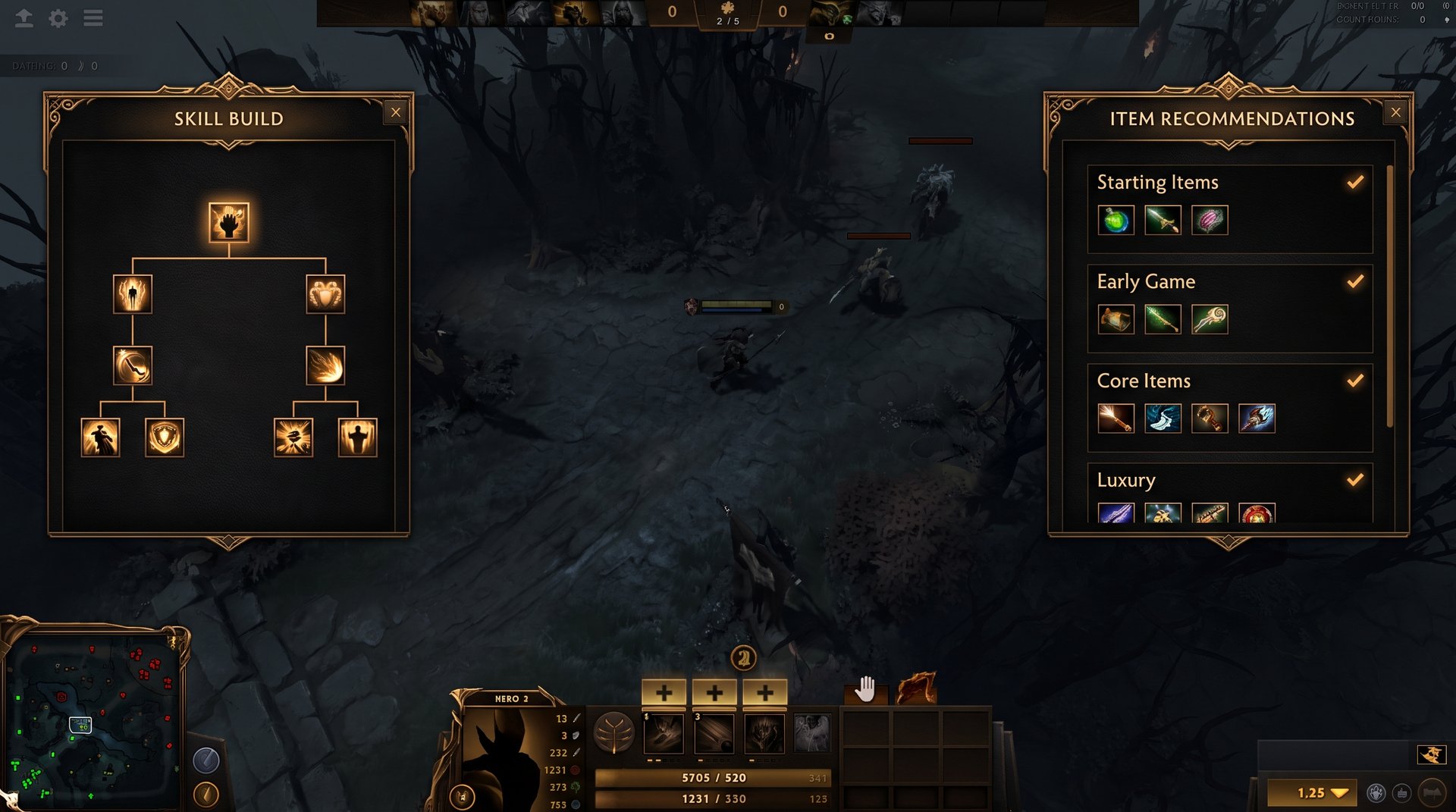
Plus Assistant: Pick Phase to Late Game
The Plus Assistant is active from the moment you enter hero selection until the victory screen. Here is how it delivers value across each game phase.
Pre-Game: Hero Selection
Before you lock in, the Plus Assistant evaluates the current draft state and generates a ranked list of recommended picks. The recommendations account for team needs (you need a reliable initiator, you need range against a melee-heavy enemy, you need late-game scaling), counter-pick value against specific enemy heroes already locked in, and hero performance across the current patch and your bracket.
The list updates in real time as the enemy team picks. If your original target gets banned or taken, the Plus Assistant adjusts its recommendations without you having to manually recalculate the draft.
During the Game: Adaptive Build Panel
Once the game starts, the Plus Assistant populates an in-game panel with a contextual item build. The panel is integrated into the client — no third-party software required, no alt-tab necessary. The build updates as match conditions change: if the enemy draft shifts emphasis mid-game through ability use patterns or itemization, the Plus suggestions may adjust priorities accordingly.
You can follow the build closely or use it as a reference layer. Either approach is faster and more accurate than trying to recall the right item order from memory when you are 30 minutes into an intense game. For players actively working on maximizing climb efficiency, the passive reduction in decision overhead across every game adds up.
Late Game: Talent and Item Pivots
As you reach talent tiers at levels 10, 15, 20, and 25, the Plus Assistant highlights the recommended choice and provides brief reasoning. In the late game, it also surfaces timing reminders for critical events — when a specific item window becomes available, when Aegis expiration is approaching, and similar macro cues.
For most players, the talent suggestions are the most underutilized part of the Plus Assistant. The item build panel gets the attention, but incorrect talent choices produce equivalent or greater MMR losses than incorrect item orders on many heroes. Getting the talent right, consistently, across all heroes, is a meaningful edge.
Dota Plus vs Free Alternatives
A fair assessment requires checking what free tools cover before recommending a paid subscription. Dotabuff, Stratz, and DotaCoach each provide meaningful data at no cost. Here is where the comparison actually lands.
| Tool | Cost | Draft Suggestions | Match-Adapted Builds | Ability Order | Post-Game Analysis |
|---|---|---|---|---|---|
| Dota Plus | ~$3.99/mo | Yes, in-client | Yes, live-adapted | Yes, in-game | Battle Reports |
| Dotabuff | Free / Pro | No | No (population builds only) | No | Deep stats, replays |
| Stratz | Free | No | No | No | Advanced metrics, AI analysis |
| DotaCoach | Free | Limited | Static builds | Yes (static) | No |
| OpenDota | Free | No | No | No | Basic stats, API access |
The conclusion from this comparison is direct: if your only goal is post-game analysis, stat tracking, and identifying patterns in your own history, free tools cover it well. Dotabuff Pro is roughly comparable to Dota Plus in price and provides superior historical analysis. Stratz offers more advanced metrics than either at zero cost.
The gap Dota Plus fills that no free tool currently closes: in-game, real-time, match-adapted guidance within the client. DotaCoach provides an overlay with static builds, but it does not adapt to the enemy lineup the way Plus does. Dotabuff and Stratz require alt-tabbing outside the game, which introduces a friction cost during matches.
The combination most effective players end up using is Dota Plus for in-game guidance and either Dotabuff or Stratz for post-game review. They complement rather than compete. If budget is a constraint, prioritize Dota Plus for lower brackets where in-game guidance produces larger marginal gains, and shift emphasis toward free post-game tools at higher brackets where your game knowledge increasingly handles what Plus provides in-game.
Who Gets the Most Value (by Bracket)
Dota Plus does not deliver equal value across all skill levels. As player knowledge increases, the overlap between what Plus provides and what the player already knows grows — reducing the marginal benefit. Here is a frank bracket-by-bracket breakdown.
Herald and Guardian (0 — 2,300 MMR)
This is where Dota Plus provides the highest relative value. Players at this level are actively building their foundational understanding of hero strengths, item options, and skill priorities. The Plus Assistant substitutes for knowledge gaps on every hero, every game. The draft suggestion feature alone will meaningfully improve pick quality in games that are frequently decided by hero selection before creeps spawn.
The in-game build panel is equally valuable here. Herald and Guardian players often default to builds they memorized weeks or months ago without updating for the current patch. Plus keeps the builds current automatically.
If you are in this range and serious about climbing, the subscription is an easy decision. The value-to-cost ratio at Herald and Guardian is the highest it gets anywhere on the ladder.
Crusader and Archon (2,300 — 3,500 MMR)
The mid-bracket is where Dota Plus pays for itself consistently but less dramatically. Players here understand core heroes and have established item patterns on their main roles. The value concentrates in three scenarios: off-role games, hero pool expansion, and catching meta shifts faster than manual research would allow.
The match-adaptive build feature is particularly useful at Archon because games at this level have enough strategic diversity that the enemy draft does materially change optimal item order in ways that static population guides miss. A flexible build recommendation layer catches those deviations without requiring the player to calculate them from first principles mid-game.
For players in the Crusader-Archon range following a structured MMR improvement plan, Dota Plus functions well as a support tool alongside deliberate practice.
Legend and Ancient (3,500 — 5,000 MMR)
At this level, the draft suggestion value decreases. Legend and Ancient players typically know what they want to play, understand the matchup landscape on their main heroes, and draft without needing outside input in standard situations. The Plus Assistant’s role shifts from driver to confirmation layer.
Where it still earns its keep: deep hero pool games where you are genuinely unfamiliar with the hero, unusual draft compositions that fall outside your experience, and as a quality check on talent choices during complex team fights.
The cosmetic economy also becomes proportionally more valuable at this range, as players who have been active on Plus for several months accumulate meaningful shard balances that provide ongoing cosmetic access. The math shifts from “paying for climbing tools” to “paying for a subscription whose climbing tools still provide occasional value.”
Divine and Immortal (5,000+ MMR)
At the top of the public ladder, Dota Plus provides minimal climbing value. Players in this range have internalized or outgrown what the Plus Assistant teaches. The item builds are not wrong, but a Divine or Immortal player already knows why each item is in the build, when to deviate, and how to adapt to unusual enemy compositions — skills the algorithm is approximating, not exceeding.
The subscription is defensible at this level for cosmetic economy or if the player values the guild infrastructure. As a pure climbing tool, the ROI is low for Divine+ players.
Non-Climbing Features: Honest Assessment
For completeness, here is an honest look at the features that do not directly affect your win rate but do affect the overall value proposition.
Hero Progression System
Every hero in Dota 2 has a progression track accessible through Dota Plus. As you play them, you earn hero relics — passive stat counters that track hero-specific achievements over your entire career. You also earn progression levels that unlock exclusive voicelines, animated emoticons, and special ability effects not available through normal cosmetic purchases.
None of this affects gameplay. It is a mastery visibility system for players who find that kind of tracking motivating. The indirect climbing benefit is real but soft: players who feel invested in specific heroes tend to practice them more deliberately, which does improve performance over time. But the causal arrow runs through personal motivation, not any mechanical advantage.
Plus Shards and the Shard Shop
You earn Plus Shards by completing weekly and seasonal quests and by finishing games with an active Plus subscription. These shards are redeemable in the Shard Shop for cosmetic content that is otherwise unavailable outside of limited events.
The shard economy is genuinely competitive. Players who accumulate shards over several months can access item sets and effects that would require purchasing event passes or waiting for specific limited windows. For players who care about cosmetics, this is meaningful value that effectively reduces the “real” cost of the subscription when you account for what you would otherwise spend on cosmetic content.
Guilds
Dota Plus includes access to Guilds — organized groups of players that earn seasonal points through coordinated play and shared objectives. If you have a consistent group of people to stack with, the guild infrastructure adds a layer of accountability and coordination that can improve communication and decision-making in team scenarios.
For players operating primarily as solo queue, guilds provide no measurable benefit. The feature exists and is polished, but its value is entirely contingent on your playstyle.
Is the Price Right?
Dota Plus is priced at approximately $3.99 per month. Valve offers discounted rates for longer subscription commitments, reducing the effective monthly cost for players who plan to maintain the subscription.
| Subscription Length | Approx. Monthly Cost | Best For |
|---|---|---|
| 1 Month | ~$3.99 | Testing the value before committing |
| 3 Months | ~$3.00 | Active season with consistent play schedule |
| 6 Months | ~$2.50 | Committed ladder grind over multiple months |
The per-game cost calculation is the most honest way to evaluate this. A player who queues 15 games per week is spending roughly 25 to 27 cents per game on Dota Plus at the monthly rate. At that frequency, the subscription delivers more per game than most other single purchases you make in Dota 2.
A player who queues 3 games per week is spending over a dollar per game. At low play frequency, the math is less favorable unless the cosmetic economy compensates.
Frequency of play matters more than any other variable in the value calculation. Active players who use the Plus Assistant in every game get the best return. Casual players who primarily want shard income and cosmetic access are paying a reasonable but not exceptional price for that specific use case.
For players considering tools that accelerate progress more aggressively than Dota Plus, professional boosting services operate at a different price point and produce direct MMR results. Dota Plus is the budget tier of the improvement tool spectrum; coaching and boosting occupy the premium tier. They are not interchangeable, but they exist on the same axis of “tools that help you climb.”
The Verdict: Worth It in 2026?
Yes — for most active Dota 2 players in Herald through Ancient, Dota Plus is worth the subscription in 2026. The climbing value is real but concentrated. The Plus Assistant is the reason to subscribe. If you are going to use the Plus Assistant in every game, the subscription earns its cost. If you are subscribing for the shards and cosmetics while ignoring the Plus Assistant, you are running a cosmetic subscription and should evaluate it on cosmetic terms instead.
Subscribe if you match any of these:
- You are in Herald through Ancient and want in-game build and draft guidance without alt-tabbing
- You are actively expanding your hero pool and want ability order suggestions on unfamiliar heroes
- You play 10+ games per week and want to reduce per-game decision overhead across all of them
- You care about Dota 2 cosmetics and find the shard economy genuinely valuable
Skip it if you match any of these:
- You are Divine or Immortal and have already internalized what the Plus Assistant teaches
- You play only a small set of heroes and have their builds completely locked in from memory
- You queue fewer than 5 games per week — the per-game cost math does not work at low frequency
- Your primary goal is fast rank gains rather than skill development — MMR boost services produce faster results for that specific goal
Dota Plus is not a skill substitute. It does not fix your decision-making at the fundamental level the way coaching does, and it does not produce wins the way a boosted account does. What it does is reduce the friction cost of correct decision-making in every game you play, at a price point that makes it one of the highest-value subscriptions available in the Dota 2 ecosystem. For the right player, that is worth $3.99 per month without much debate.
Frequently Asked Questions
Ready to Climb Faster Than Organic Play Allows?
Dota Plus is the budget-tier tool for MMR improvement. If you want results on a faster timeline — without waiting for slow skill development — TeamSmurf’s professional boosting and coaching services are built specifically for Dota 2. We only work on Dota 2, which means every booster and coach on our roster is a specialist, not a generalist.



