


Dota 2 MMR Thresholds by Year: 2022-2026 Medal Table

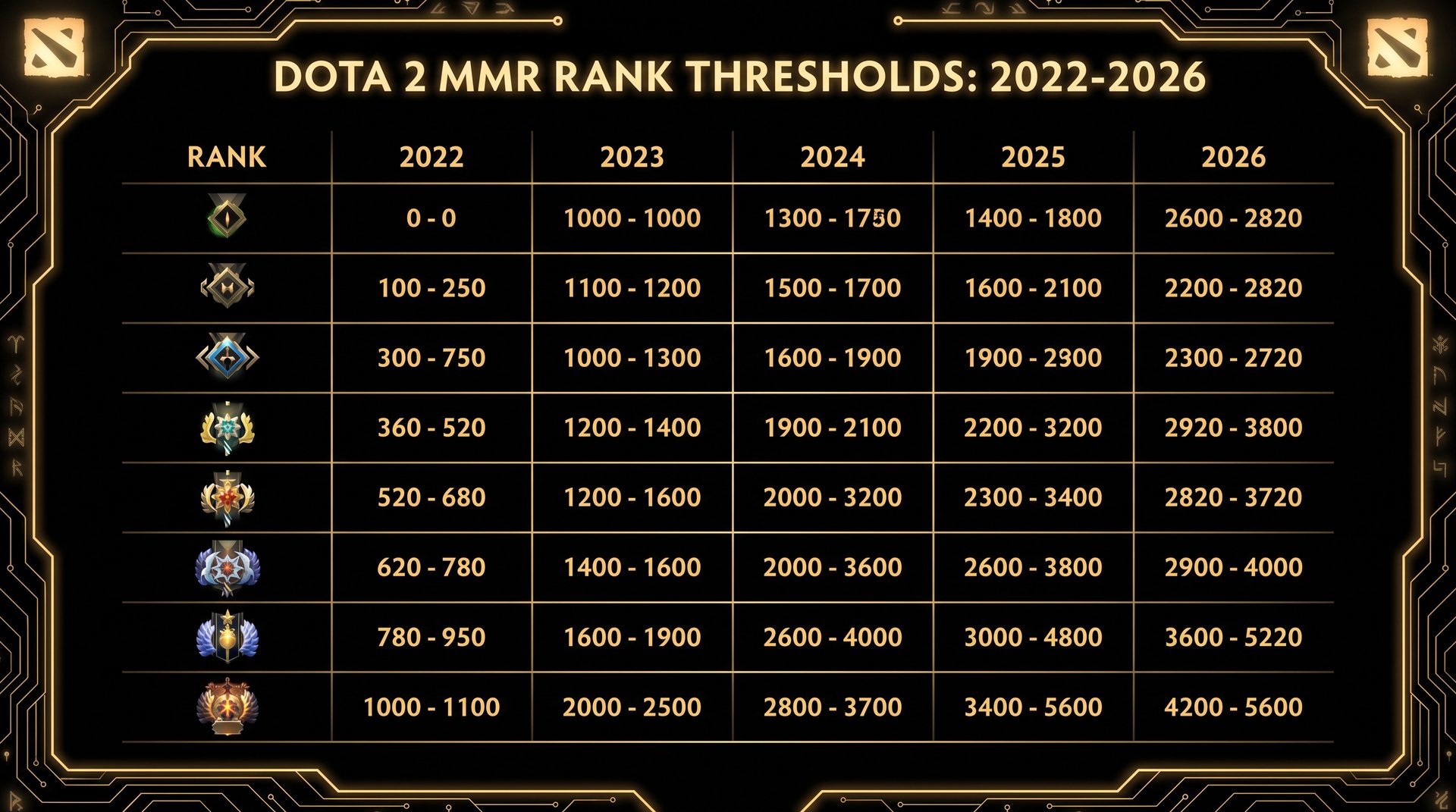
The MMR floor for every Dota 2 medal from Herald 1 through Immortal is shown in the table below. The direct answer to the title: the threshold numbers have not moved between 2022 and 2026. Herald still starts at 0. Immortal still requires 5,420 MMR. Every bracket between them uses the same floors it used four years ago. The story is in the player distribution — how many people now occupy those fixed brackets — not in any change to the numbers themselves.
| Medal | MMR Floor (star 1) | MMR Ceiling | 2022 same? | 2023 same? | 2024 same? | 2025 same? | 2026 same? |
|---|---|---|---|---|---|---|---|
| Herald | 0 | 769 | Yes | Yes | Yes | Yes | Yes |
| Guardian | 770 | 1,539 | Yes | Yes | Yes | Yes | Yes |
| Crusader | 1,540 | 2,309 | Yes | Yes | Yes | Yes | Yes |
| Archon | 2,310 | 3,079 | Yes | Yes | Yes | Yes | Yes |
| Legend | 3,080 | 3,849 | Yes | Yes | Yes | Yes | Yes |
| Ancient | 3,850 | 4,619 | Yes | Yes | Yes | Yes | Yes |
| Divine | 4,620 | 5,419 | Yes | Yes | Yes | Yes | Yes |
| Immortal | 5,420+ | no cap | Yes | Yes | Yes | Yes | Yes |
All figures are community-verified estimates. Valve has never published official MMR bracket boundaries. Sources: Dota 2 wiki (Wayback Machine archive, August 2022), TeamSmurf MMR table 2026, TeamSmurf mmr-inflation analysis.
Table of Contents
- Complete Star-by-Star MMR Breakdown
- Year-by-Year Threshold History 2022-2026
- What Patch 7.33 Actually Changed in April 2023
- What Did Change: Player Distribution 2023-2026
- The Immortal Bracket: Why It Grew Without a Threshold Change
- Immortal Leaderboard Cutoffs by Region (2026)
- Using the Table to Plan Your Next Medal
- Frequently Asked Questions
Complete Star-by-Star MMR Breakdown
The table below shows the floor MMR for every medal and every individual star level in Dota 2 as of 2026. For Herald through Ancient, each star covers 154 MMR. For Divine, each star covers 160 MMR. Immortal has no star structure — your position is expressed as a leaderboard rank within your server region.
These thresholds are sourced from community tracking tools, the Dota 2 wiki (confirmed via Wayback Machine, August 2022 snapshot), and TeamSmurf’s own Dota 2 MMR table 2026. Valve does not publish official bracket boundaries. The “~” notation used in older wiki versions reflected that the community was estimating from behavior rather than reading from public data; the 2023 Glicko system confirmed the same values without publishing new official figures.
| Medal | Star 1 (floor) | Star 2 | Star 3 | Star 4 | Star 5 | MMR per star |
|---|---|---|---|---|---|---|
| Herald | 0 | 154 | 308 | 462 | 616 | 154 |
| Guardian | 770 | 924 | 1,078 | 1,232 | 1,386 | 154 |
| Crusader | 1,540 | 1,694 | 1,848 | 2,002 | 2,156 | 154 |
| Archon | 2,310 | 2,464 | 2,618 | 2,772 | 2,926 | 154 |
| Legend | 3,080 | 3,234 | 3,388 | 3,542 | 3,696 | 154 |
| Ancient | 3,850 | 4,004 | 4,158 | 4,312 | 4,466 | 154 |
| Divine | 4,620 | 4,780 | 4,940 | 5,100 | 5,260 | 160 |
| Immortal | 5,420+ | — | — | — | — | leaderboard rank |
The math: each of the six medals from Herald through Ancient spans exactly 770 MMR. Divide 770 by 5 stars and you get 154 MMR per star. To find your exact star within a medal, subtract the medal floor from your MMR and divide by 154, rounding up. So a player at 2,550 MMR (Archon floor is 2,310) has an offset of 240. Divide 240 by 154 = 1.56, round up = Archon 2. The next star, Archon 3, starts at 2,618 — 68 MMR away.
Divine is the exception. It spans 800 MMR instead of 770, making each star 160 MMR wide. This makes the Divine math slightly different but the principle is the same. A player at 5,050 MMR (Divine floor 4,620) has an offset of 430. Divide by 160 = 2.69, round up = Divine 3.
Year-by-Year Threshold History: 2022, 2023, 2024, 2025, 2026
If you expected to see the brackets creeping upward year by year — Archon 1 starting at 2,200 in 2022, then 2,310 in 2023, then 2,400 in 2024 — that is not what happened. The thresholds in every column of this section are the same.
| Year / Period | System in use | Thresholds changed? | Key event |
|---|---|---|---|
| 2022 (full year) | Seasonal ranked (recalibration windows) | No | Season 10 (May 2022) — transition season, no threshold change |
| Jan-Mar 2023 | Seasonal ranked (final period) | No | Same bracket floors as 2022 |
| Apr 2023 (7.33) | Continuous Glicko ranking introduced | Formally confirmed, not changed | 7.33 locked community-known numbers into new system, abolished seasonal resets |
| 2024 | Continuous Glicko | No | No threshold revision; Immortal population continued to grow |
| 2025 | Continuous Glicko | No | No threshold revision; leaderboard cutoffs shifted by region |
| 2026 | Continuous Glicko | No | Herald 0, Immortal 5,420+ — same as 2022 |
The reason the thresholds have not moved is structural: each medal boundary is a clean multiple of 154, creating a predictable ladder that is easy for both players and matchmaking to reason about. Changing these numbers would require a system-wide recalibration that Valve has never indicated any intention to do. The transition to Glicko in 2023 was a change to how quickly MMR moves per game and how uncertainty is modeled — not to where the bracket lines are drawn.
Season 10 (May 2022): The Last Seasonal Reset
Season 10, which launched in approximately May 2022, was the final season under the traditional recalibration window model. Players who participated would have gone through 10 calibration games that adjusted their displayed medal relative to their MMR history. The bracket thresholds themselves were the same as in Season 9 and Season 8 before it. Calibration could move your displayed rank by a few hundred MMR, but the bracket a given number of MMR corresponded to did not change.
This is a source of genuine confusion for some 2022 players: they remember their calibration putting them at a different medal than expected, and interpret that as the brackets having moved. In reality, calibration adjusts your MMR, and your medal follows from that MMR using the fixed thresholds. The thresholds were not the variable.
What Patch 7.33 Actually Changed in April 2023
Patch 7.33 (April 2023) is the most significant update to Dota 2 ranked matchmaking in the 2022-2026 window. It deserves careful attention because it is widely referenced when discussing MMR changes but is often mischaracterized as moving the bracket thresholds.
What 7.33 Changed
- Rating algorithm — Glicko system: Valve moved from a simpler points-based model to a Glicko-inspired system. Glicko tracks not just your MMR but your MMR uncertainty — how confident the system is that your current number reflects your true skill. New or returning players have high uncertainty and therefore larger per-game adjustments. Established players with stable performance have low uncertainty and see smaller swings.
- End of seasonal resets: The recalibration window system was abolished. Before 7.33, players could opt in to reset their MMR at the start of each season (roughly every six months) and play 10 calibration games to get a new starting point. After 7.33, MMR adjusts continuously throughout the year. There is no seasonal reset to game or fear.
- Per-game MMR variance: Under the old system, MMR gain and loss per match were relatively predictable at around 25-30 points. Under Glicko, the per-game value varies based on your uncertainty score. Players with recent inactivity may see larger swings when they return. Players with stable long records see smaller swings.
What 7.33 Did Not Change
- The MMR required to enter any specific medal
- The 154-MMR-per-star structure for Herald through Ancient
- The 160-MMR-per-star structure for Divine
- The 5,420 MMR threshold for Immortal
The practical consequence: if you played a game in March 2023 as Legend 3 and then played again in May 2023 after 7.33, your Legend 3 meant the same MMR range (3,388-3,541) in both cases. What changed was how much each game moved you within that range, and whether you had the option to reset your calibration. For players who want to understand the full history of ranked seasons, our Dota 2 ranked season history covers every major reset and rule change since 2017.
What Did Change: Player Distribution 2023-2026
While the bracket thresholds were fixed, the percentage of players at each bracket has shifted over the same period. This is the actual phenomenon behind “rank inflation” questions — it is not that the entry fee for Archon has gone up, but that a slightly different share of the playerbase now occupies it.
The following comparison uses TeamSmurf’s internal ranked data analysis. The late 2023 figures represent the first full post-Glicko season. The mid-2026 figures reflect June-July 2026 data from our ongoing tracking. As always: these are community estimates. Valve does not release official distribution data.
| Medal | MMR Range | % of Players (late 2023) | % of Players (mid-2026) | Change |
|---|---|---|---|---|
| Herald | 0-769 | ~5.1% | ~4.5% | -0.6 pts |
| Guardian | 770-1,539 | ~9.8% | ~9.2% | -0.6 pts |
| Crusader | 1,540-2,309 | ~17.2% | ~16.8% | -0.4 pts |
| Archon | 2,310-3,079 | ~22.1% | ~22.4% | +0.3 pts |
| Legend | 3,080-3,849 | ~19.7% | ~20.1% | +0.4 pts |
| Ancient | 3,850-4,619 | ~14.3% | ~14.8% | +0.5 pts |
| Divine | 4,620-5,419 | ~7.7% | ~8.2% | +0.5 pts |
| Immortal | 5,420+ | ~3.1% | ~4.0% | +0.9 pts |
Source: TeamSmurf internal distribution tracking, community-aggregated. All figures are estimates. Valve does not publish official distribution data. Late 2023 baseline reflects first full post-7.33 season. Mid-2026 data from June-July 2026.
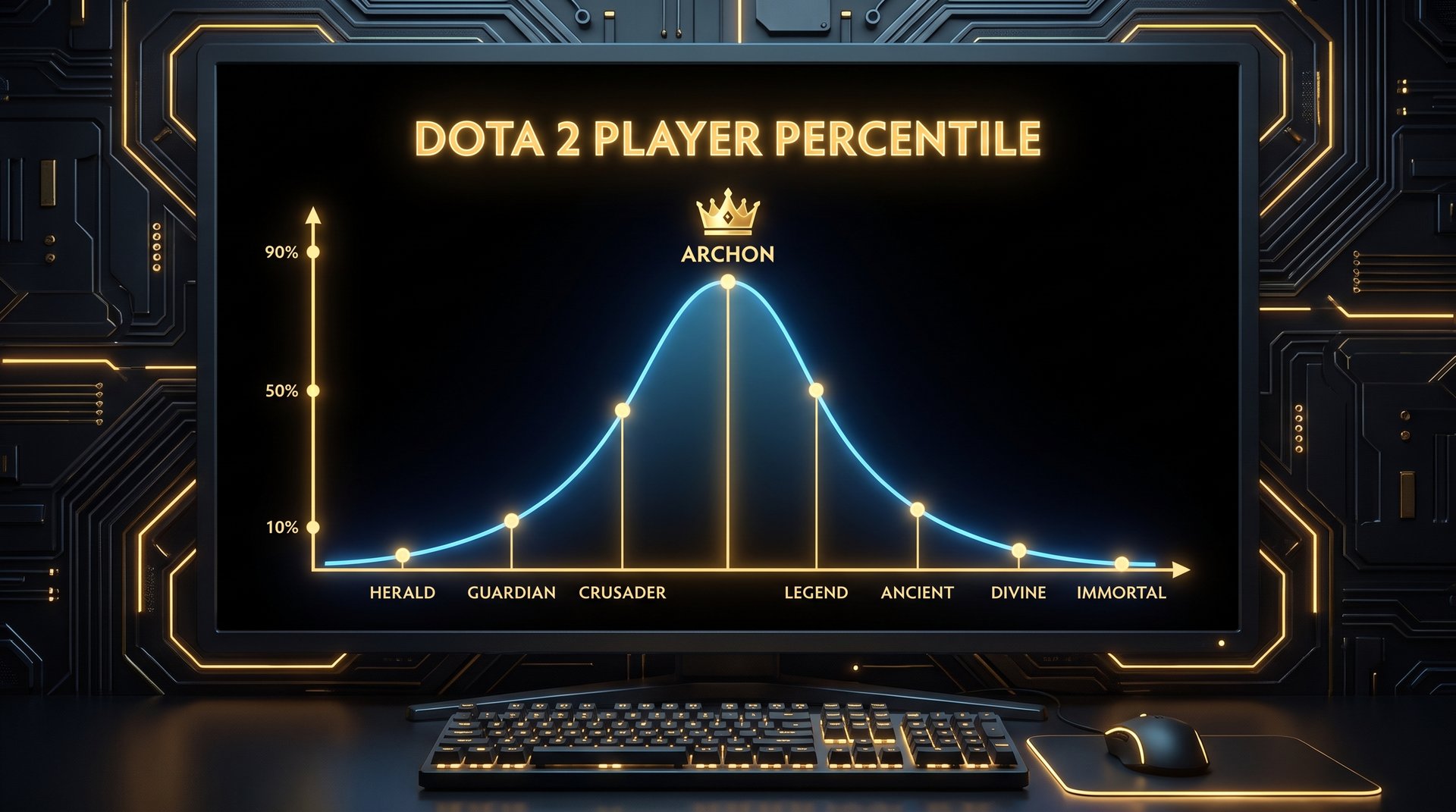
The story the table tells is subtle. The lower brackets (Herald, Guardian, Crusader) are slightly smaller in 2026 than in 2023. The upper brackets (Ancient, Divine, Immortal) are slightly larger. The middle brackets (Archon, Legend) are essentially stable. This is consistent with the gradual upward drift of a maturing player base: players who have been in the game for 10+ years are better than they were, and as they improve, more of them end up in the upper-middle and high brackets.
The Immortal Bracket: Why It Grew Without a Threshold Change
Immortal growing from approximately 3.1% to 4.0% of the ranked playerbase over three years is the most significant distributional shift in the data. Understanding the mechanisms behind this growth matters because it is regularly misread as evidence that the threshold dropped — which it did not.
Mechanism 1 — No more seasonal compression. Under the old seasonal system, some high-MMR players were periodically pushed below the Immortal threshold during a recalibration window and never fully recovered before the next season. The continuous Glicko system removed this pattern. Players who consistently play at Immortal level now stay there, accumulating in the bracket rather than cycling in and out.
Mechanism 2 — Long-term skill elevation. A player who started Dota 2 in 2018 and has been actively playing and learning for eight years is better than they were in their third year. The gradual skill elevation of the long-term active playerbase slowly pushes more people past fixed thresholds. This process is slow — it produces roughly a quarter to a third of a percentage point of growth per year at the top bracket — but it compounds over a four-year window.
Mechanism 3 — Smurf account correction. Anti-smurf improvements since 2023 have reduced the number of high-skill players artificially suppressed in lower brackets. As enforcement got stronger, some genuinely Immortal-caliber players who were playing on secondary accounts were either identified and corrected, or chose to move to their main account. This produced a net transfer of high-skill games (and their outcomes) into higher brackets where they belong.
The result: more players at the Immortal level, same entry threshold, stronger competition inside the bracket at all tiers. A 5,420 MMR player in 2026 faces more competition for leaderboard positions than they would have in 2022, because the bracket has a larger population above them.
Immortal Leaderboard Cutoffs by Region (2026)
While the Immortal badge requires 5,420 MMR everywhere, the numbered leaderboard rank shown next to your Immortal badge requires being in the top 5,000 players on your regional server. As more players enter the Immortal bracket, these leaderboard cutoffs rise. The following are community estimates for mid-2026 and should not be treated as official or precise figures — they vary by season and server activity.
| Server Region | Est. Top-5,000 Cutoff (2026) | Est. Top-5,000 Cutoff (2022) |
|---|---|---|
| Southeast Asia (SEA) | ~6,400-6,600 MMR | ~5,900-6,100 MMR |
| Europe (EEU + EU) | ~6,200-6,400 MMR | ~5,700-5,900 MMR |
| China | ~6,500-6,800 MMR | ~6,000-6,200 MMR |
| North America | ~5,800-6,000 MMR | ~5,500-5,700 MMR |
| South America | ~5,700-5,900 MMR | ~5,400-5,600 MMR |
| Australia | ~5,600-5,800 MMR | ~5,400-5,600 MMR |
Source: Community tracking estimates. These are approximate ranges — actual cutoffs vary by time of season and active player count. Not official Valve data.
The key distinction: reaching 5,420 MMR will always give you an Immortal badge regardless of region. Getting a numbered leaderboard rank requires being inside the regional top 5,000, and the MMR floor for that slot has risen by approximately 200-400 MMR across most regions over four years — driven by the same growth in the high-bracket population described above.
Using the Table to Plan Your Next Medal
The threshold table is most useful as a precision target-setting tool. Once you know where each bracket starts, you can calculate exactly how many MMR you need and how many net wins that translates to at typical Glicko per-game values.
A rough per-game guideline for mid-2026: at standard Glicko values for established accounts with low uncertainty, gains and losses fall between 22 and 32 MMR per game, with the average closer to 26-28. Higher uncertainty (returning after a break, new account, recent win-loss variance) produces larger swings in both directions.
| Current medal / star | Target | MMR needed | Est. net wins (at 26 MMR avg) |
|---|---|---|---|
| Archon 4 (2,772) | Legend 1 (3,080) | 308 | ~12 |
| Archon 5 (2,926) | Legend 1 (3,080) | 154 | ~6 |
| Legend 5 (3,696) | Ancient 1 (3,850) | 154 | ~6 |
| Ancient 5 (4,466) | Divine 1 (4,620) | 154 | ~6 |
| Divine 5 (5,260) | Immortal (5,420) | 160 | ~6-7 |
| Ancient 3 (4,158) | Divine 1 (4,620) | 462 | ~18 |
| Legend 3 (3,388) | Ancient 1 (3,850) | 462 | ~18 |
These net-win figures are minimums under ideal variance. Real games include swings of 30+ MMR in wins and losses at uncertain skill levels, which means a 6-win target might take 15 games if variance is high. The planning value is not predicting an exact timeline — it is knowing the exact distance and not inflating the target with anxiety.
If you are reading this before a calibration match sequence or a ranked season push, our MMR boosting guide covers the mechanics of both the Glicko system and professional rank assistance — including what typical gain rates look like and what differentiates services that help you improve versus those that just move a number.
The Immortal Number Is a Floor, Not a Ceiling
One of the most useful reframes this table offers is treating Immortal as a floor with a lot of headroom, not a ceiling. The badge triggers at 5,420 MMR. The leaderboard number requires significantly more. Pro players commonly play at 8,000-12,000+ MMR. The bracket is wider than any other in the game — there is no cap.
For most players the practical implication is this: if your goal is the Immortal badge, 5,420 is your number and it has not moved. If your goal is a specific leaderboard rank, you need to track your region’s current cutoff, which is a moving target independent of the entry threshold. If safety is a concern as you plan any rank improvement strategy, our guide on whether Dota 2 boosting is safe addresses current Valve policy directly.
Frequently Asked Questions
Know Your Number — Now Close the Gap
The thresholds have not moved in four years. Your target MMR is fixed. What remains is closing the distance — whether through grinding net wins, targeted coaching, or professional rank assistance from TeamSmurf’s Immortal-rank team.
MMR Boost Service Coaching Sessions



