

Dota 2 Hero Attributes Explained: What Every Point of STR, AGI, INT and Universal Gives (2026)

Every time you level up in Dota 2, your hero gains stat points — but do you know exactly what each point does? Whether you are trying to decide between a Strength item or an Agility item, or wondering why Universal heroes like Dawnbreaker or Ember Spirit care about all three attributes equally, this guide gives you the precise numbers for every attribute in Dota 2.
This page covers patch 7.41f (current as of September 2026). We break down what every single point of STR, AGI, INT, and Universal gives, explain the damage formula for each attribute type, and show you how to use this knowledge when choosing items and building your hero.
Contents
- The Four Attribute Types
- Strength: HP and Regen
- Agility: Armor and Attack Speed
- Intelligence: Mana and Regen
- How Primary Attribute Damage Works
- Universal Heroes: A Different Damage Formula
- Full Per-Point Reference Table
- How Attributes Scale During a Game
- Practical Impact on Item Choices
- Frequently Asked Questions
The Four Attribute Types in Dota 2
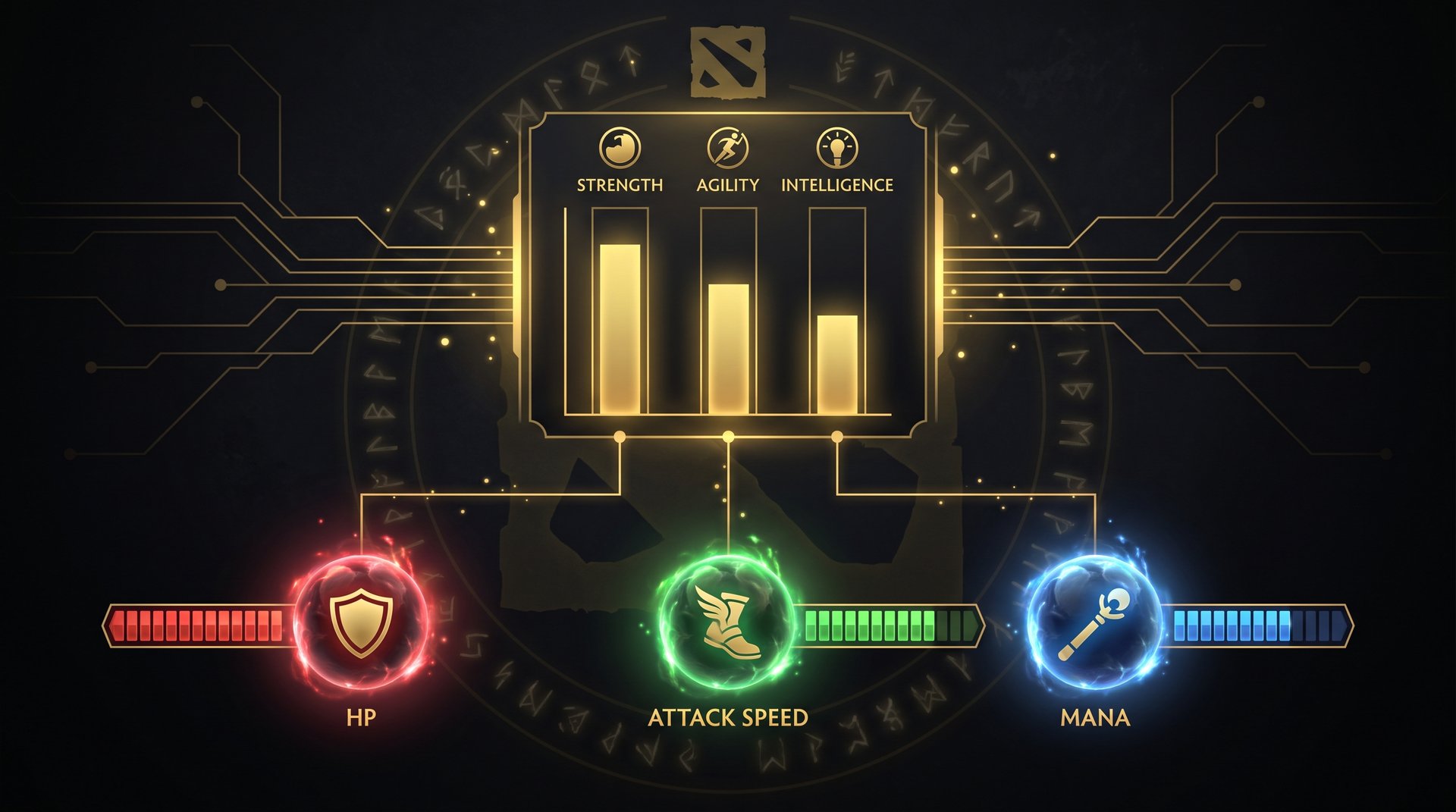
Dota 2 heroes are split into four attribute categories: Strength, Agility, Intelligence, and Universal. Every hero has all three core stats (STR, AGI, INT), but one of them is designated as their primary attribute — or, in the case of Universal heroes, none is primary and all three contribute equally to attack damage.
Understanding this split is the foundation of itemization. A Strength carry like Wraith King wants STR items because each STR point gives HP AND attack damage. An Agility carry like Phantom Assassin wants AGI items because each AGI point gives attack speed, armor, AND damage. An Intelligence support like Crystal Maiden wants INT because it gives mana AND damage on her spells. And a Universal hero like Ember Spirit benefits from stacking ANY attribute, making hybrid stat items stronger on them than on primary-attribute heroes.
The numbers in this guide have been verified against the patch 7.41f game client. The base per-point values have been stable since the Universal attribute type was introduced in patch 7.33, and no changes to these core formulas were made in the 7.41 patch series.
What Every Point of Strength Gives
Strength is the durability attribute. Every hero benefits from STR because it directly increases your HP — making you harder to kill. For STR-primary heroes (like Dragon Knight, Axe, or Centaur), each point also adds one point of attack damage on top of the survivability bonus.
| Stat | Value per STR Point | Notes |
|---|---|---|
| Max HP | +20 | Applies to all heroes regardless of primary attribute |
| HP Regeneration | +0.1 HP/s | Applies to all heroes; stacks with items and fountain regen |
| Attack Damage | +1 | Only for STR-primary heroes; 0 for AGI/INT/Universal primaries |
The Math Behind Strength Items
A 100-point STR total gives you 2,000 max HP and 10 HP regen per second from attributes alone. This is why late-game STR heroes like Tidehunter or Undying can reach 5,000 plus HP — their base STR plus item STR bonuses stack directly into the HP pool.
The 0.1 HP regen per point sounds small, but it adds up. At 80 STR (a common mid-game total for a STR hero), you are getting 8 HP regen per second from the stat alone — equivalent to a free Ring of Health. This passive regeneration is one reason STR heroes are harder to chip down with repeated small damage.
For STR-primary heroes, every point of STR is doing triple work: tanking HP, providing regen, and dealing damage. This is why items like Heart of Tarrasque (40 STR) or Sange (18 STR) are so cost-efficient on Strength carries — every STR point returns value across three separate stats. If you are boosting your STR hero to climb faster, our Dota 2 boosting guide covers which heroes get the most value from STR-stacking strategies.
STR and HP Scaling Explained
The 20 HP per STR formula is linear, not exponential. A hero with 30 base STR gains 600 HP from base alone before any growth. A hero with 3.5 STR growth per level reaches 30 additional STR points by level 9, adding another 600 HP mid-game. By the time you add item STR, understanding the 20 HP multiplier helps you instantly gauge how much HP any STR item gives.
What Every Point of Agility Gives
Agility is the attack efficiency attribute. It grants two things to all heroes: physical protection through armor, and speed of attack through attack speed. For AGI-primary heroes (like Juggernaut, Drow Ranger, or Bloodseeker), it also adds attack damage.
| Stat | Value per AGI Point | Notes |
|---|---|---|
| Armor | +0.16 | Applies to all heroes; full formula: Armor = AGI / 6.25 |
| Attack Speed | +1 | Applies to all heroes; base is 100, hard cap is 700 |
| Attack Damage | +1 | Only for AGI-primary heroes |
The 0.16 Armor Formula Explained
The exact formula for armor from AGI is: Armor = AGI / 6.25. This rounds to 0.16 armor per AGI point. So a hero with 80 AGI gains 12.8 armor from the AGI stat alone — before any item or aura bonuses.
Armor converts to damage reduction through the Effective HP formula. If you want to understand the full math of how armor translates into physical damage reduction, our sister guide on Armor and Magic Resistance math breaks down the complete formula. In short: higher armor means each HP is worth more effective HP against physical attacks.
For AGI-primary heroes, this means agility is the best all-round stat in the game. Each AGI point gives attack damage (for the hero’s right-click), physical armor (which reduces incoming physical damage), AND attack speed (which increases damage output over time). This is why AGI carries scale so hard in the late game — every point of AGI stacks across three separate combat values.
Attack Speed and the 700 Cap
The base attack speed for all heroes is 100. AGI adds 1 attack speed per point, and items add their listed attack speed on top of that. The hard cap is 700 attack speed. At maximum attack speed, most melee heroes attack roughly 4 times per second. In practice, late-game AGI carries with full builds rarely hit the absolute cap, but understanding the cap helps when comparing attack speed items against raw damage items.
For a detailed breakdown of attack speed breakpoints — when adding more attack speed outperforms adding raw damage — see our attack speed breakpoints guide.
What Every Point of Intelligence Gives
Intelligence is the resource management attribute. It controls how long you can cast spells through its mana pool and mana regen bonuses. For INT-primary heroes (like Crystal Maiden, Invoker, or Skywrath Mage), it also adds attack damage.
| Stat | Value per INT Point | Notes |
|---|---|---|
| Max Mana | +12 | Applies to all heroes regardless of primary attribute |
| Mana Regeneration | +0.05 mana/s | Applies to all heroes; stacks with items and Clarity potions |
| Attack Damage | +1 | Only for INT-primary heroes |
Why INT Matters on Non-INT Heroes
Even if you play a STR or AGI hero, your mana pool comes from INT. A Strength hero with 50 INT has 600 mana — enough for several casts in a fight. A Strength hero who neglects INT finds themselves mana-gated: they can survive long enough to cast their spells, but they run out of mana before they can finish a fight.
This is why items like Bloodstone (20 INT) or Aghanim’s Scepter (INT components) matter to non-INT heroes. The 12 mana per INT point and the 0.05 mana regen per INT point are the two levers every hero in the game has for controlling their resource bar.
Mana Regen in Practice
The 0.05 mana regen per INT is passive and constant. At 100 INT (a common total for a dedicated INT support late-game), you regenerate 5 mana per second from attributes alone. Combined with mana regen items (Arcane Boots, Guardian Greaves, Bloodstone), INT supports can sustain constant spell output in teamfights without relying on Clarity potions past the laning phase.
For heroes who want to cast many spells quickly, the mana regen from INT is more valuable than the raw mana pool from INT. A hero with high mana regen can stay in the fight through multiple ability uses; a hero with a large mana pool but low regen has to manage their resources carefully across longer fights.
How Primary Attribute Damage Works
Attack damage in Dota 2 comes from two sources: the hero’s base damage (shown as a range in the HUD), and bonus damage from attributes. The attribute damage rule is simple: you only gain attack damage from your primary attribute, and the multiplier is exactly 1 damage per 1 point.
| Hero Type | Attribute That Gives Damage | Damage per Point |
|---|---|---|
| Strength Primary (Axe, Dragon Knight, Lifestealer…) | Strength only | +1 per STR |
| Agility Primary (Phantom Assassin, Drow Ranger, Spectre…) | Agility only | +1 per AGI |
| Intelligence Primary (Invoker, Zeus, Lina…) | Intelligence only | +1 per INT |
| Universal (Ember Spirit, Marci, Dawnbreaker…) | All three (STR plus AGI plus INT) | +0.7 per point of each |
For primary-attribute heroes, secondary attributes give zero attack damage. A Phantom Assassin with 100 AGI, 70 STR, and 60 INT gets exactly 100 damage from attributes (all from her AGI). The 70 STR and 60 INT contribute their HP, regen, mana, and armor bonuses — but not a single point of attack damage.
This means that for a primary-attribute hero, the only way to increase raw attack damage from stats is to increase their specific primary stat. Items that give +30 STR on an AGI hero give HP and regen — but no damage. This is not a flaw; it is the design intent. AGI carries need AGI items to scale attack damage, which forces them into a specific item tree instead of going straight damage.
Why This Makes Some Items Hero-Specific
Take Daedalus (+88 damage, no attributes). It gives the same flat damage to every hero. But a +25 STR item gives a STR hero both 500 HP and +25 damage — the same item gives an AGI hero 500 HP and exactly zero extra damage from the STR. This is why STR heroes often prefer STR items for their cost efficiency, while AGI carries sometimes prefer pure damage items for raw output in the late game when their HP pool is already adequate.
If you are struggling to apply this in ranked games, our MMR boosting guide has a section on how to evaluate items based on your hero’s attribute type.
Universal Heroes: A Different Damage Formula
Universal heroes get +0.7 attack damage per point of each attribute — not just one. This sounds weaker than the +1.0 per primary point, but it applies to all three stats simultaneously. A Universal hero gains damage from STR items, AGI items, AND INT items.

The Universal Damage Calculation
The damage formula for Universal heroes is straightforward:
Attack Damage from Attributes = (Total STR + Total AGI + Total INT) x 0.7
Example: A Universal hero with 90 STR, 80 AGI, and 70 INT has 240 total attribute points. Their attack damage bonus from attributes is 240 x 0.7 = 168 damage. Compare that to a pure STR hero with the same stats: they would only get 90 damage from their STR (the AGI and INT give 0 damage for a STR-primary hero).
| Game Stage | STR | AGI | INT | Primary-Attr Damage | Universal Damage |
|---|---|---|---|---|---|
| Early game (lv 10) | 50 | 40 | 35 | 50 / 40 / or 35 (by type) | 87.5 |
| Mid game (lv 20) | 80 | 65 | 60 | 80 / 65 / or 60 | 143.5 |
| Late game (lv 30 + items) | 130 | 110 | 90 | 130 / 110 / or 90 | 231 |
This table shows the key insight: Universal heroes start somewhat weaker on raw damage in the early game (when their total stats are low relative to high-primary-stat heroes), but they scale dramatically with item stats because every point of every stat contributes to damage. A +25 AGI item gives a Universal hero 25 armor/attack speed bonus AND 17.5 extra attack damage. The same item gives a STR hero zero extra damage from the AGI.
Universal Heroes and Flexible Itemization
Because Universal heroes benefit from all three attributes, they can itemize more flexibly than primary-attribute heroes. An Ember Spirit can go Bloodstone (INT item) for survivability and mana, and the INT bonus still contributes to his damage output. A Marci can pick up an Aghanim’s Scepter (INT stats inside) for its ability while the INT points contribute to her attack damage.
This flexibility is by design. Universal heroes were introduced (patch 7.33) to represent heroes whose power comes equally from all aspects of combat rather than specializing in one area. They tend to be slightly harder to itemize correctly because any attribute has a damage return, which means there are more viable build paths.
For a full tier list and build guide covering the best Universal heroes in the current patch, see our Universal Heroes 2026 guide.
Full Per-Point Attribute Reference Table (Patch 7.41f)
Here is the complete reference table for every per-point bonus in Dota 2. All values verified against patch 7.41f (September 2026).
| Attribute | Max HP | HP Regen/s | Armor | Attack Speed | Max Mana | Mana Regen/s | Damage (Primary) | Damage (Universal) |
|---|---|---|---|---|---|---|---|---|
| Strength | +20 | +0.1 | 0 | 0 | 0 | 0 | +1 (STR heroes) | +0.7 |
| Agility | 0 | 0 | +0.16 | +1 | 0 | 0 | +1 (AGI heroes) | +0.7 |
| Intelligence | 0 | 0 | 0 | 0 | +12 | +0.05 | +1 (INT heroes) | +0.7 |
This table is the single most useful reference for comparing item value. When you see an item with “+15 all attributes”, multiply by the bonuses above to understand the full stat package: +300 HP, +1.5 HP regen, +2.4 armor, +15 attack speed, +180 mana, +0.75 mana regen — plus the appropriate damage bonus for your hero type.
How Attributes Scale During a Game
Hero attributes come from three sources: the base starting stats, the per-level attribute gain (shown as “X gain per level” in the hero info panel), and items. Understanding all three is important for planning your item path.
Base Stats and Growth
Every hero starts with base values of all three attributes. For example, Axe starts with 25 STR, 20 AGI, 15 INT. Each level, Axe gains approximately 3.7 STR, 1.7 AGI, and 1.7 INT. By level 25 (the max in most games), his STR has grown from 25 to approximately 25 plus (24 x 3.7) = roughly 114 STR. That is 2,280 HP from STR growth alone, without any items.
The attribute gain varies dramatically by hero. Support heroes often have high INT growth (around 0.8 to 1.2 INT per level), which helps them sustain mana without items. Agility carries tend to have high AGI growth (2.5 to 3.5 per level), which scales their physical damage and armor naturally without requiring as many pure AGI items.
Items and Late-Game Stats
A full six-item build on a carry hero can add 100 or more points to their primary attribute. At +20 HP per STR point, a STR hero with 60 item STR has an extra 1,200 HP from items alone. This linear scaling is why Dota 2 late-game heroes become so dominant — the numbers multiply directly from attribute totals.
Items that add to all attributes (like Manta Style, Drum of Endurance, or Aghanim’s Shard) scale differently based on hero type. A Universal hero gets damage from all attribute additions. A primary-attribute hero only gets damage from the component matching their primary stat, with the other stat bonuses going toward survivability and utility instead.
Want to fast-track your way through the MMR brackets while you master the itemization theory? Our Dota 2 boosting service is run by players who understand this stat system deeply. Our boosters use attribute knowledge to itemize optimally on every hero they play.
Practical Impact on Item Choices
The per-point attribute values directly determine which items are efficient on which heroes. Here are the key decision rules that come from the math.
When to Buy Stat Items vs Flat Damage Items
A Bracer costs around 500 gold and gives +6 STR, +3 AGI, +3 INT. For a STR hero, this gives +120 HP, +0.6 HP regen, +0.48 armor, +3 attack speed, +36 mana, +0.15 mana regen, and +6 attack damage. The total value package is a strong early-game tanking item that also includes damage. For the same 500 gold on a pure INT support, the dominant value shifts to the mana and INT damage bonus — the STR HP is a secondary benefit.
Compare that to a 500-gold pure damage item. It gives no stats, only flat attack damage. Depending on the hero and the game stage, the stat item often outperforms the pure damage item in the early game because it does more things at once.
All-Stat Items Are Stronger on Universal Heroes
This is the single most important implication of the Universal damage formula. Items like Manta Style, Power Treads (on any stat setting), or components with mixed stats give a Universal hero more damage output than they give a primary-attribute hero. A Universal hero gets 0.7 x (total attributes added) as damage. A primary-attribute hero gets 1.0 x (primary attribute added) as damage — and gets 0 damage from the other stats.
Example: An item that adds +10 STR, +10 AGI, +10 INT gives a Universal hero +21 attack damage (30 x 0.7). The same item gives an AGI carry exactly +10 attack damage (only AGI counts). All-stat items are roughly twice as damage-efficient on Universal heroes compared to single-attribute heroes, assuming equal total attribute points.
Armor and AGI: Not Just for Carries
The 0.16 armor per AGI point applies to every hero, including INT supports. A Crystal Maiden with 60 AGI (a typical late-game total without AGI items) has 9.6 armor from AGI alone. This matters because some support heroes build Eul’s Scepter or Cyclone (which contain AGI components) and get meaningful armor bonuses as a secondary benefit.
For a deep dive into how armor reduces damage and how to itemize around physical versus magical damage threats, our Armor and Magic Resistance math guide has the complete breakdown. Understanding that guide alongside this one gives you the full picture of Dota 2’s defensive stat system.
INT Items and Non-INT Heroes
Many STR and AGI heroes buy INT-heavy items for their active abilities (Blink Dagger has no stats, but items like Aeon Disk or Glimmer Cape have INT). For these heroes, the 12 mana per INT is a genuine upgrade to their spell rotation, and the 0.05 mana regen per INT helps sustain it. The lack of HP or damage from INT on these heroes is acceptable when the item’s active ability is worth the cost. Always evaluate an item for its ability first, then its stat efficiency second.
Frequently Asked Questions
Climb Faster With Expert Coaching
Understanding attribute math is the foundation — but applying it in live games under pressure takes practice. TeamSmurf’s Dota 2 coaches are high-MMR players who teach item selection, stat efficiency, and hero-specific builds from the first session.
Whether you need an MMR boost to reach a bracket that matches your skill, or a coaching session that targets your specific itemization habits, we have you covered.



