Dota 2 Dark Carnival Act 2: Midnight Run Guide

Dota 2 Dark Carnival Act 2 is the biggest non-esports story in the game right now, and it matters for one simple reason: Valve finally moved Midnight Run from “cool event with a long grind” into “actually worth planning around.” Chapter 2 unlocked this week, ticket gifting is live, and the older July 1 system changes are still doing heavy lifting in the background with Scrap income, Hero ticket conversion, and cleaner event progression.
If you opened the client, saw new nodes, saw people talking about Blimp Jump, and still had no clue what the smart route was, you are not alone. The event looks casual on the surface, but the best way to play it is not casual at all. There is a difference between wandering around for cosmetics and converting your limited games into the maximum number of useful unlocks.
This guide breaks down what changed, why Chapter 2 is a bigger deal than it first looks, how ticket gifting shifts account value, and how an Immortal player should approach the grind without burning ranked time for no reason. If you only want one shortcut: treat Dark Carnival like efficiency Dota. The same mindset that wins pubs — route planning, role discipline, and knowing when to skip bait — is exactly what makes this event feel good instead of exhausting.
Table of Contents
What Actually Changed In Act 2
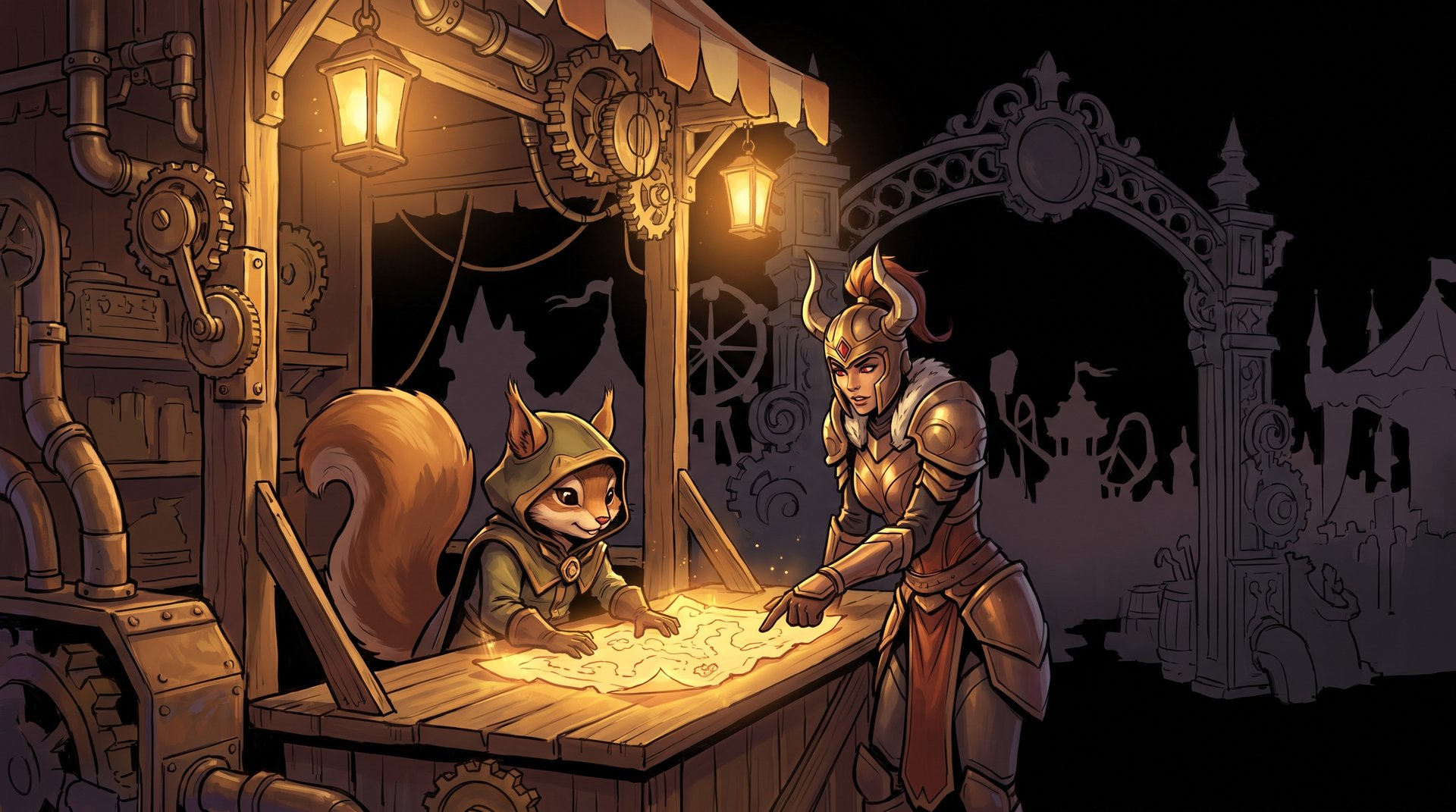
The official baseline starts with Valve’s June 25 launch of The Dark Carnival, where Midnight Run opened as a free event chapter focused on Legion Commander and Hoodwink, backed by a fully voiced map, five new Automaton Personas, and 20 new hero sets. That mattered because it established the event as more than a tiny side quest. Valve clearly built this to sit in the client for weeks, not for one weekend.
The first major quality-of-life pass landed on July 1. That update is easy to ignore now that Chapter 2 is here, but it changed the economy of the event in a huge way:
- Regular games now give 2 Scrap tickets.
- Turbo games now give 1 Scrap ticket.
- 6 Scrap can be traded for a Hero ticket of your choice.
- Seeing Stones became earnable in Co-op Bot matches on Hard and Unfair.
- Ability Draft and co-op bot ticket bugs were fixed.
- The Ticket Trader and reward requirement tooltips were cleaned up.
- Pick the Lock stopped changing behavior with FPS, which matters more than it sounds.
Then the current story hit: community coverage on July 9 and July 10 confirmed that Midnight Run Chapter 2 unlocked and that ticket gifting was added to the event. That is the real headline. New story content is nice, but gifting is what turns progression from account-locked friction into a tradable, group-optimized system.
There is also a smaller community angle worth noting: players were so hungry for Chapter 2 that workaround chatter appeared almost immediately before full rollout, including reports of people forcing early access by changing local time on PC. That tells you two things. First, the event actually has momentum. Second, players already see the new chapter as something worth optimizing, not just exploring once.
| Update Window | Specific Change | Why Players Should Care |
|---|---|---|
| June 25 launch | Midnight Run opens with 5 Automaton Personas and 20 hero sets | Established Dark Carnival as a full event, not a tiny promo |
| July 1 hotfix | Regular games give 2 Scrap, Turbo gives 1, 6 Scrap converts into 1 Hero ticket | Made normal queue time translate into event progress reliably |
| July 1 hotfix | Co-op bots on Hard and Unfair grant Seeing Stones | Opened a low-stress farming path for casual or time-limited players |
| July 9-10 coverage | Chapter 2 unlocks and ticket gifting arrives | Creates better account routing, better friend-group efficiency, and more reward control |
How Far Are You From Your Goal MMR?
See exactly how many games stand between you and your target rank — then decide how you want to get there.
MMR Goal Calculator
How far are you from the rank you want? Real math, no sugarcoating.
Enter a goal MMR higher than your current MMR (0-12000).
Why Ticket Gifting Matters More Than People Think
Most players will read “ticket gifting added” and think it is just a friendly feature. It is not. It changes the efficiency model of the whole event. In Dota terms, this is the difference between every hero farming isolated jungle camps and a team actually stacking, refilling, and passing resources where they matter most.
Before gifting, every account had to brute-force its own reward path. That created three problems:
- Players ended up with tickets they did not value as much as other players would.
- Friend groups could not specialize their grind.
- Alt accounts and casual accounts had dead-end value because their progress stayed trapped.
With gifting, all three of those problems soften. Not disappear, but soften enough to matter. If one player in your stack is event-focused and the other two mostly care about ranked, you can now centralize reward value instead of diluting it. That makes Chapter 2 more important for grinders than the new story nodes alone.
High-MMR players should especially understand this because we already think in resource conversion. Every pub has hidden economies:
- Who gets the dangerous lane…
- Who holds smoke…
- Who gets the stacked triangle…
- Who farms the one part of the map the enemy cannot contest…
Dark Carnival gifting is the same conversation with less MMR at stake. If your stack ignores it and everyone mindlessly spends everything on themselves, you are playing event Dota like a 3K team that refuses to move wisdom runes to the right support.
There is another layer too: ticket gifting reduces the opportunity cost of playing ranked-first accounts. If you are trying to climb and you do not want to turn your main into a full event-farming account, your group can still move value intelligently. That matters for the exact TeamSmurf audience that reads this site. A lot of players care about cosmetics, but they care about MMR more. The best system is the one that lets you protect both.
The July 1 Update Still Defines The Grind
This is the part too many people skip. Chapter 2 is the headline, but the July 1 update is still the reason the event feels playable. Without that change set, Act 2 would just add more terrain to a weaker system. With it, your normal matches feed the event in a clean, understandable way.
Scrap tickets are the real backbone
The most important number in the whole event economy is still 6 Scrap = 1 Hero ticket. That conversion is what makes the event predictable. Before, progression could feel too dependent on specific nodes or event-only pacing. Now every normal session does something tangible.
Here is the simple math players should keep in mind:
| Queue Type | Scrap Per Game | Games Needed For 1 Hero Ticket |
|---|---|---|
| Regular | 2 Scrap | 3 games |
| Turbo | 1 Scrap | 6 games |
That is not complicated, but it changes behavior. Regular is the premium efficiency route if you were already going to queue serious Dota. Turbo is the fallback route if you only want event progress with lower mental load. Neither is wrong. What is wrong is queueing without a plan and then complaining that the event is random.
Co-op bots are better than prideful pub players think
The Seeing Stone change for Hard and Unfair co-op bot matches is another underrated shift. No, bots are not the best use of time if you are fully focused on improving ranked mechanics. But for players who only have 30 to 40 minutes, or for lower-energy sessions where you do not want to risk a long pub, this can be the difference between zero progress and some progress.
Immortal perspective here: players massively overrate the value of forcing low-quality ranked sessions. If you are tilted, tired, or just do not have the focus for a real game, a controlled event-farm route is better than feeding a pub and pretending it was “grind.” Dark Carnival’s revised structure finally supports that choice.
The FPS fix on Pick the Lock is not just a tiny patch note
Valve also fixed Pick the Lock gameplay changing with FPS. Casual readers might skip that. You should not. Any event minigame tied to frame behavior instantly creates fake difficulty and fake competition. Once that is fixed, event optimization gets more honest. If you lose time now, it is more likely a route problem or an execution problem, not your hardware trolling you.
That matters because one of the early Chapter 2 conversation points was already minigame efficiency, especially around reward chasing like Blimp Jump’s reported 30,000-point reward threshold. If the core minigames are cleaner, routing decisions become more skill-based and less scuffed.
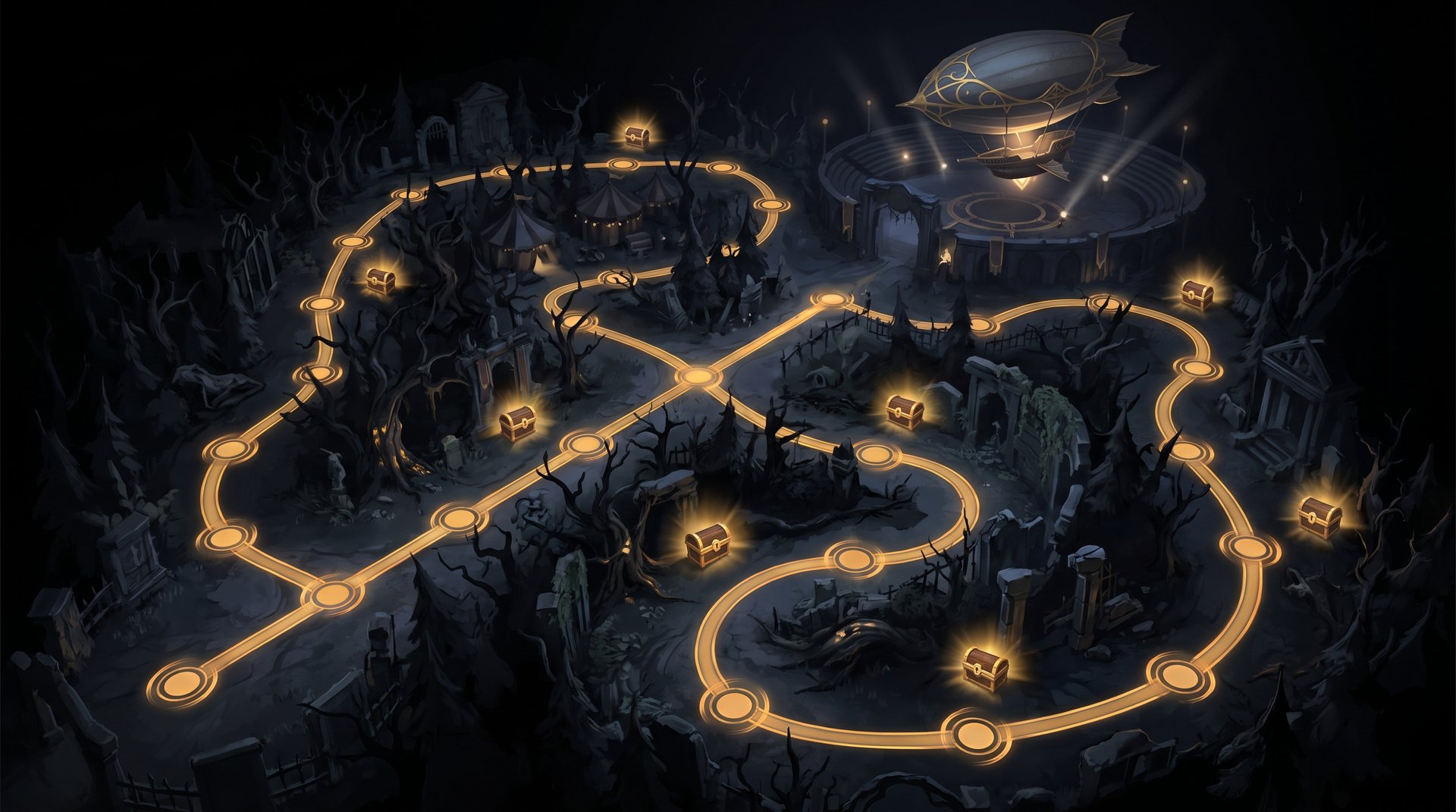
The Efficient Midnight Run Route
If your goal is to get meaningful Dark Carnival rewards without letting the event eat your entire week, use this order of operations.
1. Decide whether your account is ranked-first or event-first
This sounds obvious, but most players never decide. They just drift. That is why they feel behind in both places.
- Ranked-first account: prioritize regular queue progress, use Scrap conversion, take event nodes that do not force weird time sinks, and use gifting intelligently if you have friends.
- Event-first account: maximize node clearing, minigame repetition, and reward funneling. This is the account that should absorb more of the grind.
If you are serious about climbing, your main should almost always be ranked-first. If the event is eating your best concentration hours, that is the exact kind of leak that sends people to Dota 2 MMR boost or coaching later because they wasted a month doing everything halfway.
2. Bank value through regular games whenever possible
Because regular matches give 2 Scrap, the cleanest path for good players is still to treat Dark Carnival as a side economy attached to normal queueing. If you are playing three quality ranked or unranked games anyway, that is a Hero ticket without any event-only panic.
That is the best psychological route too. It keeps the event from hijacking your schedule. Dota players are at their best when the plan is simple:
- Play real games.
- Take the free event currency.
- Convert only when you know what reward path you want.
3. Use Turbo only when your mental energy is the bottleneck
Turbo at 1 Scrap per game is less efficient on paper, but it can still be correct if your real alternative was not playing at all. This is the same logic as low-commitment replay review or last-hitting drills. Inferior to a perfect session, better than no session.
Just do not fool yourself: if you are fully alert and your only goal is reward efficiency, regular queue wins. Turbo is a convenience lane, not the optimal lane.
4. Spend tickets where route density is best, not where hype is loudest
When Chapter 2 drops, everyone rushes whatever feels new. That is a classic pub mistake. The smarter move is to ask three questions first:
- Does this path unlock multiple useful nodes close together…
- Does it gate a reward I actually want, or just event curiosity…
- Can I support this route later with Scrap conversion and gifting…
If the answer is no, do not overcommit just because social media is posting screenshots. That is event FOMO, not event optimization.
5. If you have a stack, appoint one event brain
One of the dumbest things a friend group can do is have four people sort of understanding the system and nobody actually planning it. If gifting is active, let one player handle the macro. Everyone else just reports what they need, what they value, and how much time they are willing to spend.
That one decision alone will make your Chapter 2 experience cleaner than most public chatter around the event.
Five Mistakes Players Are Making Already
1. They are overvaluing novelty and undervaluing route economy
New chapter does not automatically mean best chapter. Sometimes the most efficient move is still to clean up a high-value earlier route before you force the fresh content. Event maps are built to trigger curiosity. Your job is to beat that instinct when it is bad for efficiency.
2. They convert Scrap too early
Scrap is safer than random emotional spending. If you spend the second you hit six, you lose flexibility. If Chapter 2 changes your priorities, or gifting opens a better target, you want optionality. The best players in any economy hold resources until the information edge is clear.
3. They are treating co-op bots like “fake progress”
No. Bad ranked sessions are fake progress. If Hard or Unfair co-op bots help you finish a route or collect Seeing Stones on a low-energy day, that is real value. The only mistake is pretending you are above controlled farming while wasting two hours tilt-queueing.
4. They are not separating event time from climb time
This is the big one for TeamSmurf readers. If your priority is MMR, be honest. Dark Carnival can coexist with improvement, but only if it is scheduled correctly. If you need help regaining structure afterward, that is exactly where coaching, boosting, or even a fast calibration service can save a month of sloppy ladder play.
5. They still have not learned the value of support systems
The smartest Dark Carnival players are not necessarily the ones with the most games. They are the ones with the cleanest systems: friend gifting, route planning, queue discipline, and reward prioritization. Dota has always rewarded structure over noise. This event is no different.
Is Dark Carnival Act 2 Actually Worth Your Time…
Yes, with conditions. If you like cosmetics, enjoy Dota lore, or want a side progression loop that does not require winning every game, Act 2 is worth touching. If you already play regular Dota most days, the July 1 Scrap system means the event now piggybacks on your normal schedule instead of fighting it.
But if you are asking whether Act 2 is worth throwing away your ranked rhythm for, the answer is usually no. Here is the clean breakdown:
| Player Type | Act 2 Verdict | Best Approach |
|---|---|---|
| Ranked grinder | Worth doing on the side | Use regular games for Scrap, route efficiently, do not let event pacing own your week |
| Casual event enjoyer | Absolutely worth it | Mix Turbo, co-op bots, and story clearing at your own pace |
| Friend-group optimizer | Best target audience | Exploit gifting and shared planning for maximum value |
| MMR emergency player | Be careful | Protect climb time first, event second |
That last category matters more than people admit. A lot of players read event guides while quietly losing rank because they stopped controlling their sessions. If that is you, fix the ladder first. Read our breakdowns on EWC group-stage adaptation, early 7.41d draft trends, and current group-stage meta lessons if you want real patch context instead of just event progression.
And if you are buried in low priority because you chased event games with a bad mindset, that is another classic self-own. Fix it fast with low priority removal and get back to playing proper Dota.
The real Immortal take
The best part of Dark Carnival Act 2 is not the story node itself. It is that Valve finally gave the event enough infrastructure to reward disciplined players. Ticket gifting, Scrap conversion, and cleaner minigame behavior all point in the same direction: the player who plans better will feel better.
That is why this update lands. Not because every reward is perfect. Not because every route is balanced. It lands because the event finally respects the same kind of optimization instinct that keeps good Dota players queueing for years.
Want The Rewards Without Falling Behind In Ranked…
Grind the event if you enjoy it, but do not let Dark Carnival wreck your MMR progress. TeamSmurf can help with fast climbing, recalibration, coaching, or cleaning up low priority so your main account keeps moving while the event is live.
Get MMR Boost Book Coaching