

Can You Transfer MMR Between Accounts? Valve’s Rules

Short answer: no. There is no official feature in Dota 2 or Steam that lets you move MMR from one account to another. MMR is permanently tied to the Steam account it was earned on, and Valve has no transfer mechanism — it was never built.
What most players actually mean when they ask this question is one of three things: they want to start fresh on a new account but reach their current rank quickly, they have moved to a new region and wonder if progress carries over, or they want to consolidate multiple accounts into one. This guide covers all three scenarios, what Valve’s rules say about each, and what actually works without risking a ban.
In This Guide
What MMR Transfer Actually Means
The phrase “transfer MMR” does not appear anywhere in Valve’s documentation because no such feature exists. The confusion comes from players using one phrase to describe several different situations.
Situation 1 — New Account, Same Target Rank
This is the most common scenario. A player who is 5,000 MMR on their main account wants to reach the same rank on a second account. They are not transferring numbers — they are trying to reach a rank faster than the calibration process allows. This is a question about time, not data migration.
Situation 2 — Region Change
MMR in Dota 2 has always been region-separated. A player moving from EU to SEA will find their MMR in each region is tracked independently. There is no mechanism to equalize them, and Valve has made no indication one is coming. Your EU number and your SEA number coexist on the same account; they simply reflect different player pools. You cannot move the higher one to the lower one.
Situation 3 — Multiple Accounts to One
Some players have built up MMR on more than one Steam account and want to consolidate. This is not possible. Each Steam account is a separate legal entity under the Steam Subscriber Agreement, and there is no merge or transfer feature for game progression data, including Dota 2 MMR.
What the Question Is Really Asking
In nearly all cases, what a player actually wants is to reach a specific MMR number on a specific account in the shortest time possible. The word “transfer” is shorthand for that goal, and the real question is what the fastest and safest route to that goal looks like. We cover that in detail in the sections below.
Valve’s Official Account Rules
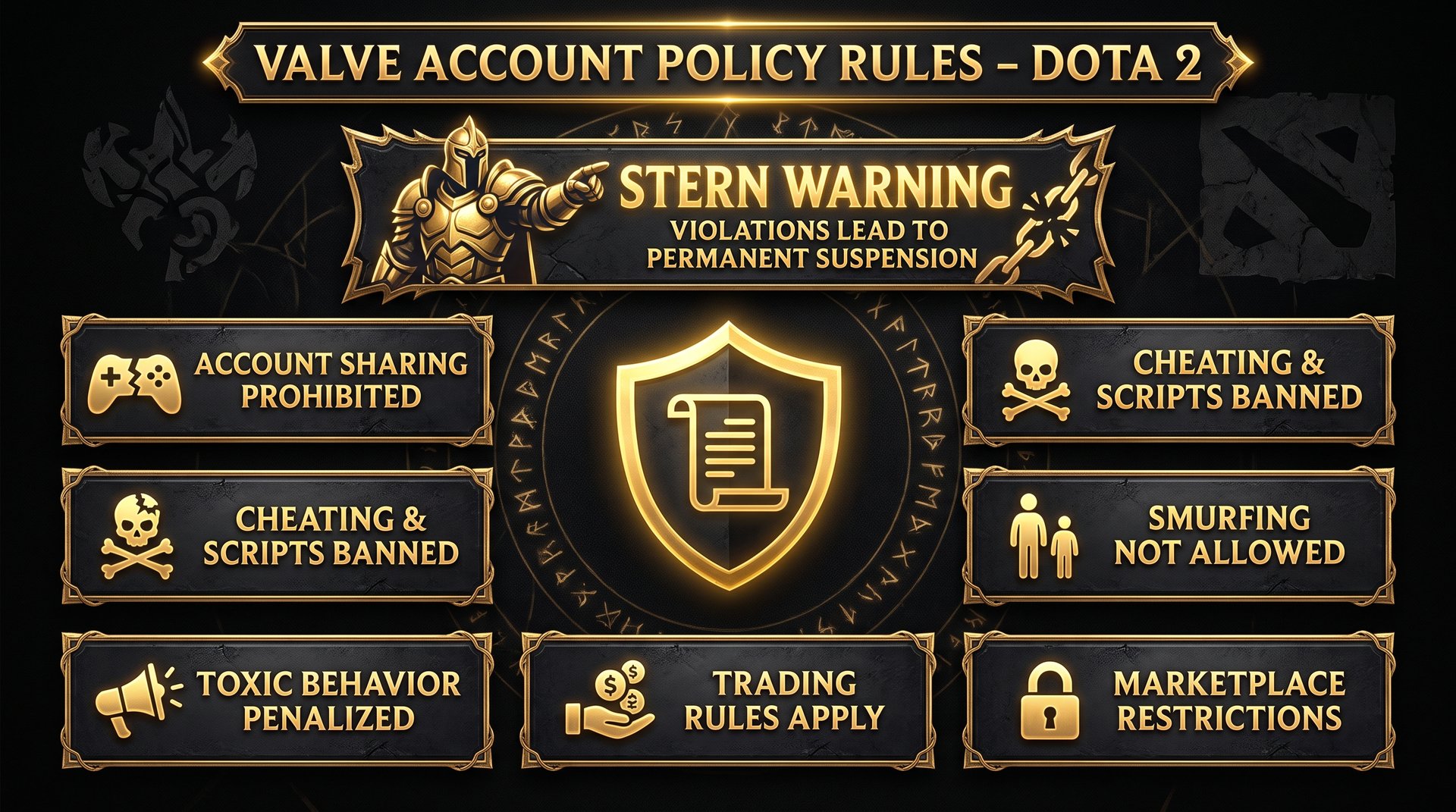
Valve’s rules on account behavior live in two places: the Steam Subscriber Agreement and the Dota 2 Code of Conduct. Both apply to every Dota 2 account. Here is what each document says about the behaviors players associate with MMR transfer.
The Steam Subscriber Agreement
The Subscriber Agreement is the legal contract you accept when you create a Steam account. Section 3 covers account usage and is the most relevant part for Dota 2 ranked play. The key restriction: your Steam account is personal and non-transferable. You may not sell, buy, trade, or give your account to another person. Valve can terminate accounts that change hands without authorization.
This directly covers the “buy a boosted account” scenario that some players consider when they want to skip the calibration process. The account you purchase may already be at the MMR you want, but you are accepting full legal risk that Valve can reclaim or terminate it at any time.
The Dota 2 Code of Conduct
Dota 2 has its own behavioral framework that sits on top of the Steam Agreement. It covers ranked play specifically and includes a prohibition on “MMR manipulation.” Valve defines MMR manipulation broadly enough to include boosting (having a higher-skilled player control your account to win games), win trading (coordinating with opponents to guarantee wins), and account sharing for ranked play.
The consequence for MMR manipulation under the Code of Conduct ranges from MMR resets to permanent bans, depending on severity and whether it is a repeat offense.
What Valve Has Not Ruled Out
Valve has never stated that having a friend play with you in party queue is a violation. Coaching is not prohibited. Watching high-level play as a spectator has no mention in the rules. The rules target actions that artificially inflate the number without the player developing underlying skill — not assistance in general.
What Gets Accounts Banned
Understanding exactly which actions carry ban risk is more useful than a vague warning. Here is a breakdown of behaviors relevant to MMR transfer attempts, ranked by how aggressively Valve acts on them.
| Behavior | Risk Level | Typical Consequence | Detectable By |
|---|---|---|---|
| Win trading (coordinating with opponents) | Critical | Immediate permanent ban | Pattern analysis + reports |
| Buying a pre-boosted account | High | Account termination, no appeal | Account sale markets, login anomalies |
| Account sharing for ranked boosting | Medium-High | MMR reset or seasonal ban | IP/device changes + behavior shift |
| Using automation scripts or bots | High | Permanent ban | VAC + behavior detection |
| Coaching with account access | Low-Medium | Varies by frequency and outcome | Behavior shift, mass reports |
| Party queuing with smurfs | Low | Rarely actioned directly | Conduct score system |
The pattern across all high-risk behaviors is the same: any action that artificially inflates an account’s MMR without the primary account holder developing the skill to hold that rank is what Valve targets. The mechanism matters less than the outcome — if your account suddenly behaves like a different player at a higher skill level, the detection system notices.
High-Risk: Buying Pre-Boosted Accounts
Buying an account already at your target MMR is the highest-risk shortcut available. The original Steam account owner can reclaim it at any time by contacting Steam Support. The account may be permanently banned if Valve detects it was sold. You lose the purchase price and any items on the account with no recourse. This is not a gray area — it is a clear violation of the Steam Subscriber Agreement.
Why There Is No MMR Transfer Feature
Valve has never offered an MMR transfer, and the design of the ranked system explains why one would be difficult to implement even if Valve wanted to.
MMR Is an Account-Level Rating, Not a Player Score
Dota 2’s MMR is a property of the Steam account, not of an abstract player identity. The system is built around the assumption that one person controls one account. A transfer feature would require Valve to verify that the same human being owns both accounts, which creates an authentication and identity verification problem that Steam has never solved at scale.
Region Separation Is Intentional
Regional MMR pools exist because the player populations in each region are genuinely different skill distributions. SEA Immortal and EU Immortal are not the same rank in terms of average performance data, and allowing players to move MMR between regions would distort both pools. Valve separated them deliberately and keeps them separate for the same reason.
The Fraud Problem
Any transfer system would immediately become the highest-value attack surface in the game. A mechanism that moves MMR between accounts would be exploited within days of launch for account selling, win trading, and boosting at a scale that would make the current situation look minor. Valve’s security team is well aware of this, which is one reason the feature has never existed despite years of player requests.
Your Real Options for a Fresh Start
If you want to reach a specific MMR on a new account, you have four realistic paths. Each has a different risk profile, time cost, and dollar cost.
Option 1 — Play Your Way Up from Calibration
Create a new Steam account, complete the placement games required before ranked access, calibrate, and climb naturally. This is free, carries zero ban risk, and teaches you the game as you go. It is also the slowest option by a wide margin. At the community-reported average gain of 25 to 30 MMR per win and roughly 50% win rate in an unfamiliar bracket, reaching 5,000 MMR from a calibrated 1,500 can take 200 or more games. At two to three games per session, that is months of grinding.
Option 2 — Boost the New Account with a Professional Service
A professional Dota 2 boosting service assigns an Immortal-level player to your account and plays until the target MMR is reached. The service player uses VPN and offline mode to minimize detection risk. This is the fastest option — most services complete a 2,000 to 5,000 MMR order within 7 to 14 days. The risk is managed by how the service operates: Valve’s detection focuses on behavioral patterns and account trading markets, not on individual sessions per se. A well-run service keeps risk low.
If you are considering this route, read our complete MMR boosting guide for what to look for in a service and how to evaluate safety claims before handing over login credentials.
Option 3 — Coaching to Accelerate Your Own Climb
A Dota 2 coach reviews your gameplay, identifies the specific mistakes holding you back, and helps you fix them before ranked games happen. This is the most ban-safe form of assistance available. The downside is time — coaching improves your performance gradually, and the timeline depends on the player’s starting point and how consistently they apply the feedback. If you are stuck in a specific bracket and want to understand why, coaching is the best long-term investment. TeamSmurf’s coaching service pairs you with an Immortal coach who specializes in your bracket’s specific patterns.
Option 4 — Use a Smurf Account With Its Own Risks
Some players create accounts specifically to play below their main rank, either to practice heroes, play with lower-ranked friends, or escape a perceived toxic bracket. Valve has become progressively harder on smurf accounts since 2023, adding detection mechanisms and behavior score penalties for accounts that consistently outperform their bracket. Using a smurf is not the same as transferring MMR, but it is worth knowing that Valve does not look favorably on accounts created specifically to play outside their natural skill range.
The Fastest Path to Target MMR on a New Account
If the goal is speed — reaching a target MMR on a new account as fast as possible — a professional boost service is the most efficient option by a large margin. Here is how it actually works at a reputable service, and what separates a safe order from a risky one.
How a Boost Order Works Step by Step
- You select the target MMR. Most services price by MMR increment (e.g., per 100 MMR gained). You set the starting point and the destination. TeamSmurf’s Dota 2 MMR boost page shows live pricing per increment with an estimated delivery window.
- You share login credentials securely. The service logs into your account using a dedicated VPN server close to your region to keep the login IP consistent. Good services use offline mode in Steam to prevent detection from friends list activity.
- An Immortal booster is assigned to your account. The booster plays ranked games in your role using strong hero picks for the current patch. The goal is a high win rate per game played, not simply volume.
- You receive progress updates. Reputable services send MMR tracking updates after each session. You can follow the climb in real time.
- Order completes at target MMR. You receive credentials back, change your password, and the account is yours with the new rank intact.
What Makes TeamSmurf Different
TeamSmurf focuses exclusively on Dota 2. That means every booster on the roster is vetted specifically for Dota 2 at the Immortal level — not a general gaming service that happens to offer Dota 2 alongside other games. The calibration-bracket knowledge is deeper, the hero pool awareness is current-patch specific, and the completion rate on orders is higher than services that spread boosters across multiple games. Read more about how safe Dota 2 boosting actually is and what the real risk factors look like before making a decision.
How Long Does It Take
Delivery times depend heavily on the MMR gap being closed and the starting bracket. Herald and Guardian brackets complete quickly because games are shorter and an Immortal-level player wins at a very high rate. Crusader and Archon brackets take moderately longer as opponents are more unpredictable. Ancient and Divine brackets take the most time because games are longer, team coordination matters more, and the opponent pool plays more consistently. Most services, including TeamSmurf, publish estimated delivery windows on the product page and are accurate within one to three days for typical orders.
Protecting Yourself During and After a Boost
A few precautions make a meaningful difference in keeping a boosted account clean after delivery. First, change your password immediately when the order is complete so the booster’s access is cut off cleanly. Second, avoid stacking multiple boost orders back to back without playing the account yourself between them — the sudden activity plateau followed by a new ramp-up is a detectable pattern. Third, do not announce the boost in public channels, Discord servers, or Reddit threads tied to your username. The risk from other players reporting suspicion to Valve is real if the account’s history is publicly visible.
Comparing Every Method Side by Side
| Method | Cost | Time to Target | Ban Risk | Skill Gained |
|---|---|---|---|---|
| Climb naturally from calibration | Free | Weeks to months | None | High |
| Professional MMR boost service | Paid (per 100 MMR) | 3 to 14 days | Low (managed) | None directly |
| Coaching plus self-climb | Paid per session | Weeks (faster than pure grind) | None | High |
| Buy pre-boosted account | High upfront | Instant | Very High | None |
| Smurf account natural play | Free (new account) | Weeks (but below your skill level) | Low-Medium | Low |
The right choice depends on what you are optimizing for. If time is the constraint, a professional boost service is the clear answer. If skill improvement is the goal, coaching is more valuable. If you want both in a single order, a coaching-plus-boost bundle gives you a coached climb where a coach watches sessions and gives feedback between games — you reach the target rank faster than self-climbing and come away with concrete improvements. See our guide on MMR boosting in Dota 2 at /mmr-boosting-guide/ for a full breakdown of how to combine services effectively.
How Valve Detects Account Manipulation
Understanding what Valve’s detection actually looks at helps you make an informed decision about any method you choose. Valve has not published its detection methods, but community analysis of ban waves and developer comments over the years point to several consistent patterns.
Behavior Shift Detection
The most consistent factor in account bans for boosting is a sudden and dramatic change in in-game performance. An account playing at a 45% win rate with 30-minute average game times that suddenly shifts to a 70% win rate with a completely different hero pool and behavior pattern is a strong signal. The detection system is calibrated around what normal MMR progression looks like, and statistical outliers get flagged for review.
Login Pattern Anomalies
Valve and Steam log login activity including IP addresses and device fingerprints. An account that suddenly logs in from a different country, uses a VPN associated with known boosting services, or shows unusual login patterns from different locations raises flags. Professional boost services mitigate this by using region-local VPNs and offline mode, which is one of the key quality markers separating reputable services from fly-by-night operations.
Community Reports
Mass-reporting a suspected booster can trigger manual review in some cases. If a player consistently dominates at a bracket far below their evident skill level, opponents will report them. Reports alone do not trigger a ban, but they can accelerate a manual review that might confirm other signals. This is why the Herald and Guardian brackets are actually lower-risk for boost orders — the opponents there are less likely to recognize and report an unusually dominant performance as suspicious.
Account Sale Market Detection
Valve actively monitors third-party markets where boosted accounts are sold. Accounts that appear on these markets are cross-referenced with Steam account data and are at highest risk of termination. This is the core reason why buying a pre-boosted account is so dangerous — you may be purchasing an account that Valve has already flagged and is monitoring.
What Valve Does Not Monitor in Real Time
Valve does not have the resources to manually review every game played. The detection system is largely automated and pattern-based. A single boosted session that resembles normal performance variance is unlikely to trigger action. Sustained, obvious manipulation over many games — especially combined with login anomalies or marketplace activity — is what triggers the automated flag queue.
Frequently Asked Questions
Reach Your Target MMR — Without the Wait
MMR cannot transfer between accounts, but it can be built quickly on any account with the right help. TeamSmurf connects you with Immortal-ranked Dota 2 specialists who know your bracket and can get you to your target MMR in days, not months.


